Ballistic Coefficient Explained
Ballistic coefficient is a comparison number for how well a bullet overcomes air resistance and retains velocity. It helps predict drop and wind deflection, but it depends on the drag model, velocity range, test method and bullet shape.
By RaiS. Reviewed by RaiS. Published . 7 min read.
Research and drafting were assisted by AI. RaiS checked the facts against the sources below and approved this page.
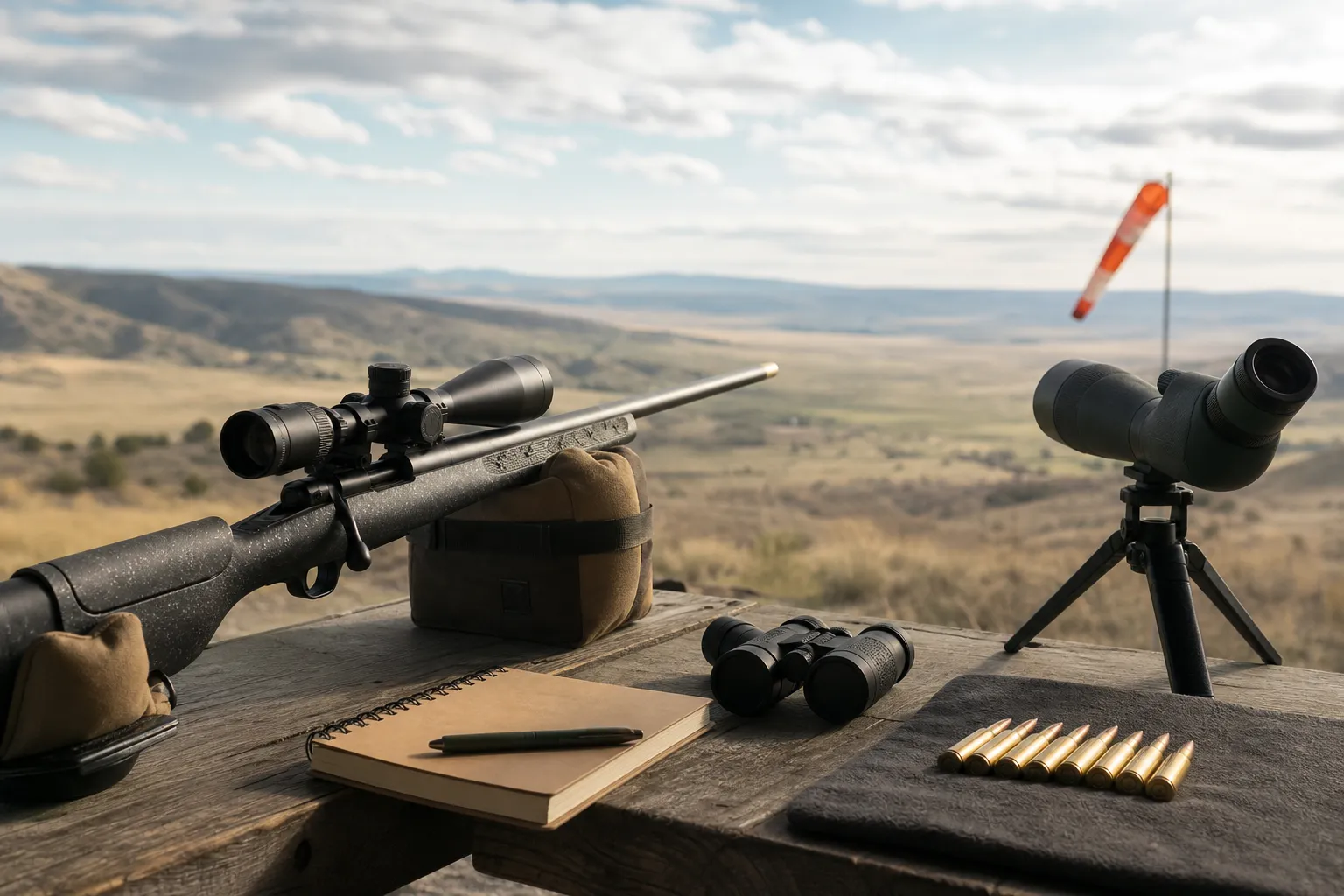
Ballistic coefficient, often shortened to BC, is an index of how a projectile slows down in flight and how well it overcomes air resistance. SAAMI defines it as an index of how a projectile “decelerates in free flight” and represents its ability to overcome air resistance. In plain terms, a higher BC usually means a bullet holds velocity better, drops less and is pushed less by wind when muzzle velocity, environment and other inputs are the same, as Berger explains in its BC guide.
What ballistic coefficient means
BC is not a simple score for bullet quality. It is a comparison number used in exterior ballistics, which is the study of a bullet after it leaves the muzzle. Hornady describes BC as a bullet’s “relative ability to overcome air resistance” and says it compares a bullet’s drag, meaning velocity loss from air resistance, with a standard projectile.
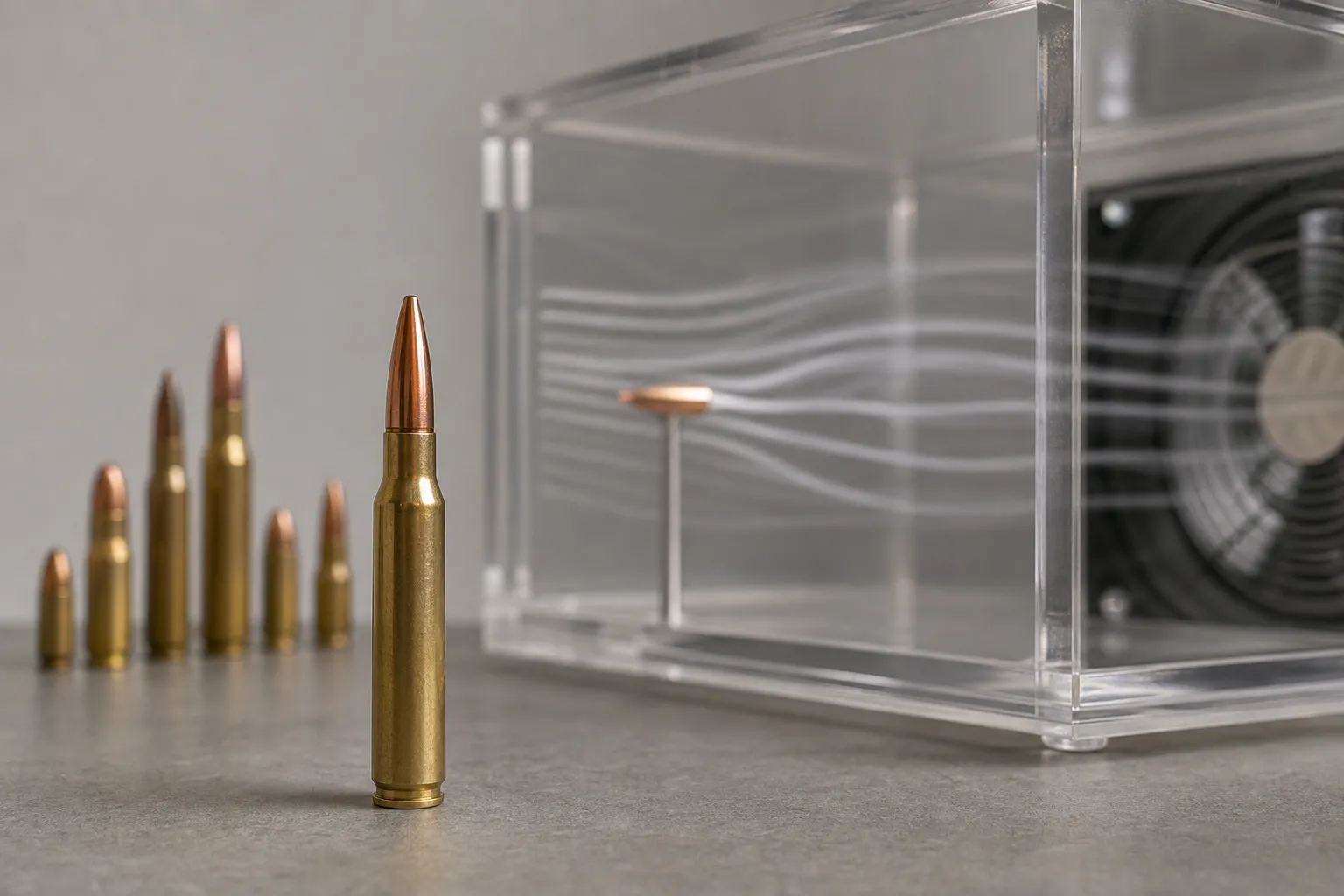
SAAMI gives the formula as c = w/id², where the variables are projectile mass, form factor and bullet diameter. Berger describes the same basic pieces as weight, diameter and form factor. Hornady also says BC calculations combine bullet shape and sectional density.
For a beginner, the practical idea is this: BC helps describe how quickly a bullet gives up speed to air resistance. Berger defines BC as how well a bullet retains velocity downrange compared with a standard. Berger also states that, for a given muzzle velocity and environment, a higher BC produces less drop and wind deflection.
That last part matters, but only in context. BC is one input in a trajectory calculation. Berger says a modern ballistics solver uses BC along with user inputs such as muzzle velocity, atmospheric conditions and zero range. Hornady also cautions that there is “no such thing as an absolute” BC that applies unchanged in every situation.
What makes BC higher or lower
The three basic BC components are weight, diameter and form factor, according to Berger. SAAMI’s formula also includes mass, form factor and bullet diameter. Form factor is the shape related part: Berger explains it as a number that relates a bullet’s drag to a standard such as G1 or G7.
Bullet shape is the easiest part to picture. Berger says a long pointed nose and boat tail reduce drag compared with a blunt flat-base bullet. Hornady gives a similar example: with equal caliber, weight, sectional density and muzzle velocity, a spire point bullet has a higher BC and less 500-yard drop than a round-nose bullet. In that example, Hornady notes that “shape is the only variable.”
That is why sleek, pointed bullets often have higher BCs than round-nose or blunt bullets of otherwise similar setup. The key reason is not magic. It is drag. Hornady says BC compares the drag of a bullet with a standard projectile, and Berger says form factor relates a bullet’s drag to a standard.
Still, a higher BC does not automatically make a bullet the right choice for every job. The ledger sources support BC as a drag and velocity retention comparison number, not as a complete measure of terminal performance, accuracy, suitability for a rifle or suitability for a hunt.
G1 versus G7 BC
Most shooters encounter BC as either G1 or G7. Berger lists G1 and G7 as the two most common BC standards. Berger describes G1 as suited to older flat-base, blunt-nose bullets and G7 as suited to modern spitzer boat-tail bullets. Hornady describes G1 as a flat-base, stumpy-ogive standard and G7 as a boat-tail, sleek-ogive standard.
The important point is that G1 and G7 are different reference shapes. A G1 BC and a G7 BC are not the same kind of number, so do not compare a G1 number for one bullet directly to a G7 number for another bullet. Berger says G7 is closer to modern long-range bullets than G1, and Applied Ballistics says G7 is typically better for boat-tail bullets.
Applied Ballistics gives a useful selection rule: the appropriate BC is the one with the least variation over the velocity range being used. Berger’s velocity-variation example also points in this direction. For a 6 mm 105-grain Hybrid bullet, Berger says G7 produced a much smaller 1000-yard prediction window than G1.
Hornady adds another limitation. A BC-based calculator knows only the selected G1 or G7 standard, not the bullet’s actual drag curve. That is why the drag model matters, especially when a bullet’s real shape is not a close match to the chosen standard.
How BC affects drop and wind drift
BC affects trajectory because it is tied to velocity retention. Berger states that a higher BC produces less drop and wind deflection for a given muzzle velocity and environment. Sierra also says BC becomes especially important in competitive match shooting because bullet efficiency helps reduce wind’s effect on impact.
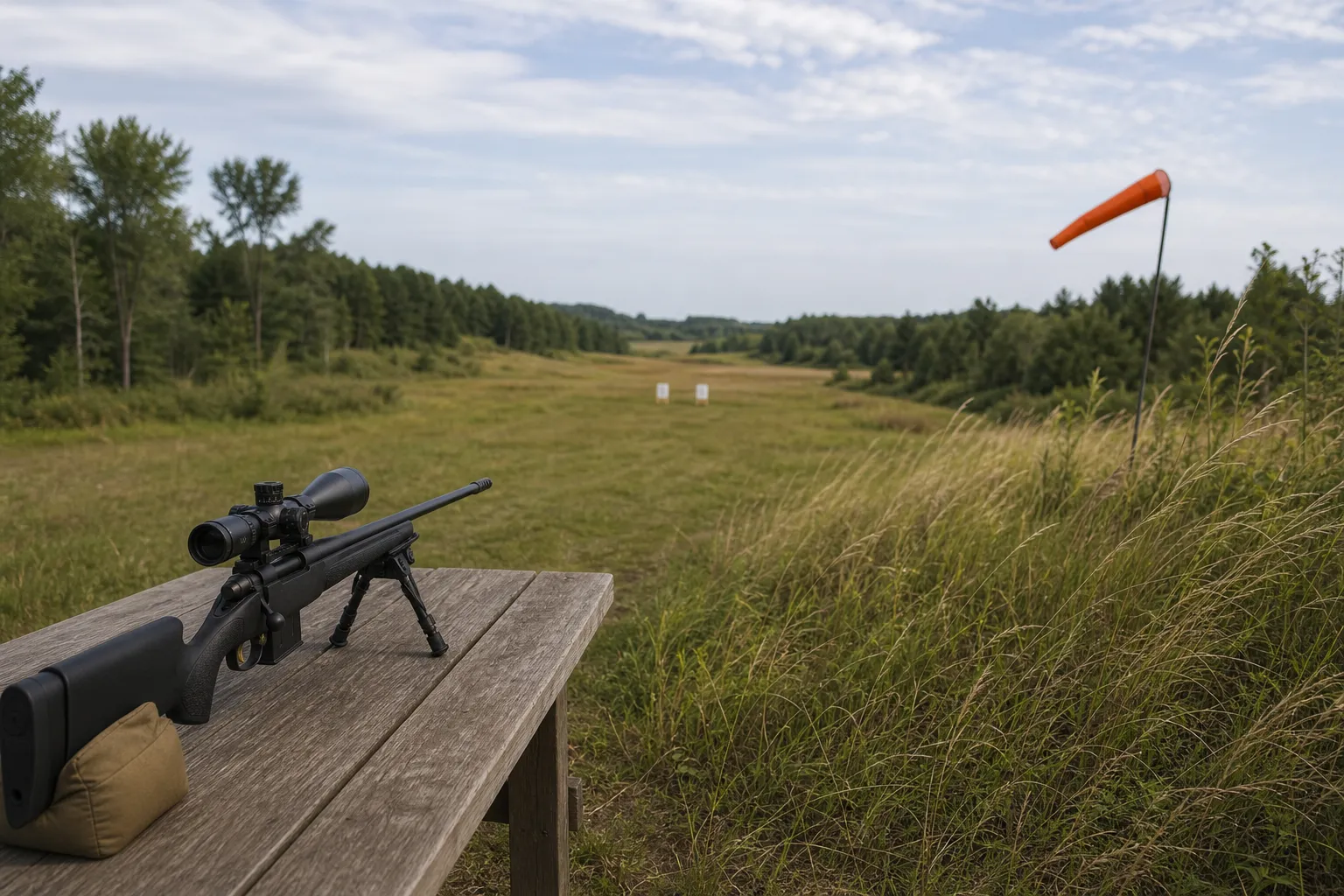
For hunting, BC may matter little at short distances but more as distance grows. Sierra’s deer-hunting example says BC has little impact under 200 yards. In the same example, Sierra compared a .30 caliber 180-grain round nose with BC .240 and a 180-grain spitzer boat tail with BC .501. Sierra found only .58 inch difference at 200 yards, but 14.27 inches at 500 yards.
That example is useful because it keeps bullet weight and caliber in the same general comparison and shows how distance magnifies the effect. It does not mean every rifle, load or hunting situation will match those numbers. It does show the general pattern supported by Berger and Sierra: as distance increases, BC becomes more important for predicting drop and wind deflection.
For target shooting, BC is valued because wind is a major source of uncertainty at midrange and long range. Sierra specifically connects bullet efficiency with reducing the amount wind affects impact. Berger connects higher BC with less wind deflection for the same muzzle velocity and environment.
How shooters use BC in ballistics solvers
A ballistics solver uses BC as one part of a calculation. Berger says modern solvers use BC along with muzzle velocity, atmospheric conditions and zero range. That means a BC number alone is not enough to produce a reliable trajectory prediction.
At minimum, the solver must know which drag model the BC uses. A G1 BC should be entered as G1, and a G7 BC should be entered as G7. Hornady warns that a BC-based calculator only knows the selected G1 or G7 standard, not the actual drag curve of the bullet.
Some systems use more detailed drag information instead of a single BC. Hornady’s 4DOF instructions state that its calculator uses drag coefficient rather than requiring the user to enter a BC. Applied Ballistics describes custom drag models as using the actual measured drag of a specific bullet rather than referencing G1 or G7.
This is why two trajectory tools can disagree if the user enters different BC types, different BC values or different input conditions. The ledger sources identify muzzle velocity, atmospheric conditions, zero range, velocity range, drag model and actual drag curve as important parts of the calculation.
Why published BCs vary
Published BCs vary because BC is not fixed for all speeds and conditions. Hornady says BC values can and usually do change with velocity. Berger says velocity dependence comes from form factor, because bullet weight and diameter do not change with velocity.
Manufacturers may also publish values based on different velocity ranges, drag models, test methods or standards. Hornady now publishes 200-yard Mach 2.25 G1 and G7 BC numbers for A-Tip, ELD-X and ELD Match bullets, and Hornady says Mach 1.75 BC values should be used for trajectory calculations beyond 600 yards. Berger says it measures BC with live-fire Doppler radar and publishes an average from 3000 fps to 1500 fps.
Measurement method matters too. Berger warns that observed bullet drop is the least accurate way to measure BC because it includes many additional variables. Berger’s stated method is live-fire Doppler radar. Hornady and Applied Ballistics also point readers toward drag-curve based approaches: Hornady says its 4DOF calculator uses drag coefficient rather than requiring BC, and Applied Ballistics describes custom drag models based on actual measured drag.
The takeaway is simple: do not assume every published BC is directly interchangeable. Check whether the number is G1 or G7, what velocity range it represents and whether the calculator or app expects a single BC, a velocity banded BC or a custom drag model.
A simple way to think about BC
For most new shooters and hunters, the best mental model is this:
| Question | Practical answer | |, -|, -| | What does BC measure? | A projectile’s drag and velocity retention compared with a standard, as described by SAAMI, Hornady and Berger. | | What does a higher BC usually do? | It usually means less velocity loss, less drop and less wind deflection when other inputs are the same, according to Berger. | | What shapes tend to raise BC? | Long pointed noses and boat tails reduce drag compared with blunt flat-base shapes, according to Berger. | | Which BC type should I use? | Use the drag model listed by the bullet maker or solver. Berger and Hornady describe G1 and G7 as different standards. | | Why do BC numbers differ? | Hornady and Berger state that BC changes with velocity, and makers may use different models, ranges and methods. |
Bottom line
Ballistic coefficient is a useful comparison number for how a bullet deals with air resistance. It is most helpful when you use the correct G1 or G7 model, the current manufacturer data and accurate solver inputs.
Before relying on a trajectory table, check the bullet maker’s current BC listing, the drag model required by your calculator, the stated velocity range for the BC and the solver’s instructions. For hunting, also confirm all season, method and ammunition rules with the wildlife agency for the place and date of the hunt.
Frequently asked questions
What is ballistic coefficient?
SAAMI defines ballistic coefficient as an index of how a projectile decelerates in free flight and how well it overcomes air resistance. Hornady describes it as a bullet’s relative ability to overcome air resistance.
Does a higher ballistic coefficient mean less drop?
Berger says a higher BC produces less drop and wind deflection for a given muzzle velocity and environment. It is still only one input, since solvers also use muzzle velocity, atmospheric conditions and zero range.
What is the difference between G1 and G7 BC?
Berger lists G1 and G7 as the two most common BC standards. Berger describes G1 as for older flat-base blunt-nose bullets and G7 as closer to modern spitzer boat-tail bullets. Hornady also describes G1 as a flat-base, stumpy-ogive standard and G7 as a boat-tail, sleek-ogive standard.
Why do published BC numbers vary?
Hornady says BC values can and usually do change with velocity. Published numbers can also reflect different drag models, velocity ranges, test methods and standards. Berger says it measures BC with live-fire Doppler radar and publishes an average from 3000 fps to 1500 fps.
Does BC matter for hunting?
Sierra’s deer-hunting example says BC has little impact under 200 yards, but the difference grew in its example as distance increased. Sierra compared two .30 caliber 180-grain bullets and found .58 inch difference at 200 yards but 14.27 inches at 500 yards.
Should I use G1 or G7 in a ballistic calculator?
Use the model that matches the bullet maker’s BC data and the calculator input. Applied Ballistics says the appropriate BC is the one with the least variation over the velocity range, and says G7 is typically better for boat-tail bullets.
Sources
- Ballistic Coefficient, Sporting Arms and Ammunition Manufacturers' InstituteOfficial source. Accessed October 20, 2026.
- External Ballistics, Hornady ManufacturingOfficial source. Accessed October 20, 2026.
- Ballistic Coefficient, Hornady ManufacturingOfficial source. Accessed October 20, 2026.
- Understanding drag holds key to better solutions, Hornady ManufacturingOfficial source. Accessed October 20, 2026.
- 4DOF Instructions, Hornady ManufacturingOfficial source. Accessed October 20, 2026.
- What is a bullet BC?, Berger BulletsOfficial source. Accessed October 20, 2026.
- Form Factor, Berger BulletsOfficial source. Accessed October 20, 2026.
- Variation in BC with Velocity, Berger BulletsOfficial source. Accessed October 20, 2026.
- Using BC To Calculate Trajectory, Berger BulletsOfficial source. Accessed October 20, 2026.
- Measuring BCs, Berger BulletsOfficial source. Accessed October 20, 2026.
- Education, Applied Ballistics. Accessed October 20, 2026.
- How Much Difference Does Ballistic Coefficient Make?, Sierra BulletsOfficial source. Accessed October 20, 2026.
- More on Ballistic Coefficient (BC), Sierra BulletsOfficial source. Accessed October 20, 2026.
- Bullet Selection, Sierra BulletsOfficial source. Accessed October 20, 2026.