.300 Blackout vs 5.56 NATO: Specs and Safety
.300 AAC Blackout is the larger bullet option, while the 5.56 side is the smaller bullet, higher velocity option. For safety, ammunition must match the firearm’s chamber marking and owner’s manual.
By RaiS. Reviewed by RaiS. Published . 4 min read.
Research and drafting were assisted by AI. RaiS checked the facts against the sources below and approved this page.
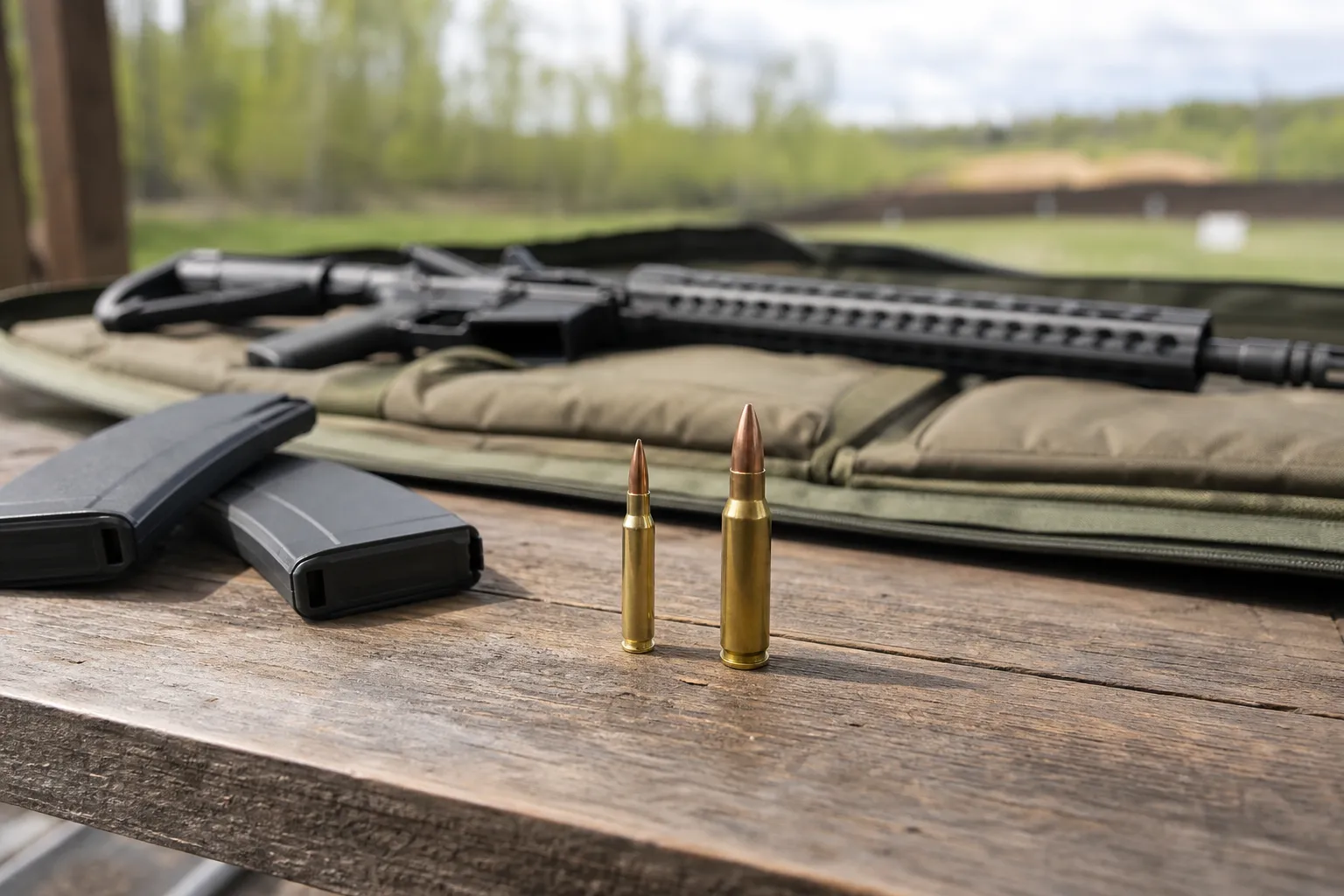
.300 AAC Blackout and 5.56 NATO are often compared because both are discussed around the AR 15 platform, but they are very different cartridges. .300 AAC Blackout uses a much larger .30 caliber bullet. The 5.56 side of the comparison uses a smaller .22 caliber bullet and, in SAAMI’s 5.56 Commercial data, much higher listed velocity. The most important safety point is simple: use only ammunition that matches the firearm’s chamber marking and owner’s manual.
Standards note: 5.56 NATO, 5.56 Commercial, and .223 Remington
.300 AAC Blackout is listed by both SAAMI and C.I.P. SAAMI lists the abbreviation as 300 BLK, and C.I.P. lists alternative names including 300 Whisper, 300 BLK, and 7.62 x 35.
The 5.56 side needs more care. SAAMI’s public 5.56 data is for 5.56 Commercial. SAAMI says conformance to its 5.56 Commercial specification does not imply or ensure conformance with any military or NATO specification. SAAMI also says the absence of publicly available standards for 5.56 x 45 variants, including 5.56 NATO, makes blanket compatibility statements impossible.
For C.I.P., the public dimensional reference used here is .223 Remington, not 5.56 NATO. The Defense Logistics Agency ASSIST record identifies AOP 4172 as a NATO document for interchangeability of 5.56 mm x 45 ammunition, with active status and a promulgation date of April 9, 2020, but viewing that document requires login.
Side-by-side specifications
SAAMI says its centerfire rifle standard provides pressure, velocity, and dimensional characteristics for centerfire rifle sporting ammunition in the interest of safety and interchangeability. The table below keeps the standards labels separate.
| Specification | .300 AAC Blackout | 5.56 side of comparison |
|---|---|---|
| Public standards used here | SAAMI .300 AAC Blackout, C.I.P. .300 AAC Blackout | SAAMI 5.56 Commercial, C.I.P. .223 Remington |
| General bullet class | .30 caliber class | .22 caliber class for 5.56 Commercial |
| SAAMI bore and groove diameter | .300 inch bore.308 inch groove | .219 inch bore.224 inch groove for 5.56 Commercial |
| C.I.P. barrel dimensions | F 7.62 mm, Z 7.82 mm | F 5.56 mm, Z 5.69 mm for .223 Remington |
| SAAMI pressure | 55,000 psi MAP | 62,000 psi MAP for 5.56 Commercial |
| SAAMI velocity examples | .300 AAC Blackout table lists bullet weights from 90 to 220 grains, with 150 grains at 1,900 fps and 220 grains at 1,020 fps | 5.56 Commercial public introduction lists a 55 grain bullet at 3,400 fps |
The dimensional contrast is the heart of the comparison. .300 AAC Blackout is the larger .30 caliber side, while 5.56 Commercial is the smaller .22 caliber side. This is why the cartridges must be kept separate.
Published load examples
Manufacturer catalog data can differ by product and catalog year, so these are examples rather than a complete performance ranking. All values below are published muzzle figures from the named manufacturers.
| Cartridge label in catalog | Manufacturer and load | Bullet | Muzzle velocity | Muzzle energy |
|---|---|---|---|---|
| 5.56mm | Winchester WM193CP, 2022 new products sheet | 55 grain FMJ | 3,180 fps | 1,235 ft lbs |
| 5.56mm | Winchester WM855CP, 2022 new products sheet | 62 grain FMJ | 3,060 fps | 1,289 ft lbs |
The pattern is clear from these examples. The listed 5.56 examples use lighter 55 and 62 grain bullets at higher listed velocities. The .300 AAC Blackout standard also includes heavier bullet weights in the range shown above.
Different design goals
AAC’s 2012 catalog describes the .300 AAC Blackout design goal as launching .30 caliber projectiles from the AR 15 platform without a reduction in magazine capacity. That explains the emphasis on .30 caliber bullets in an AR 15 size platform.
The 5.56 side of the comparison is the small bore, high velocity side. SAAMI’s 5.56 Commercial public introduction lists a 55 grain bullet at 3,400 fps, while Winchester’s 2022 5.56mm examples list 55 grains at 3,180 fps and 62 grains at 3,060 fps.
That makes the choice mostly about what kind of published cartridge characteristics you want to compare. .300 AAC Blackout is the larger diameter, heavier bullet path. The 5.56 family is the smaller diameter, lighter bullet, higher velocity path in the published examples here.
Mis-chambering danger
Do not treat these cartridges as interchangeable. SAAMI warns that using ammunition in a chamber that is not marked for that specific ammunition may result in serious injury or death to the user or bystanders, as well as damage to the firearm.
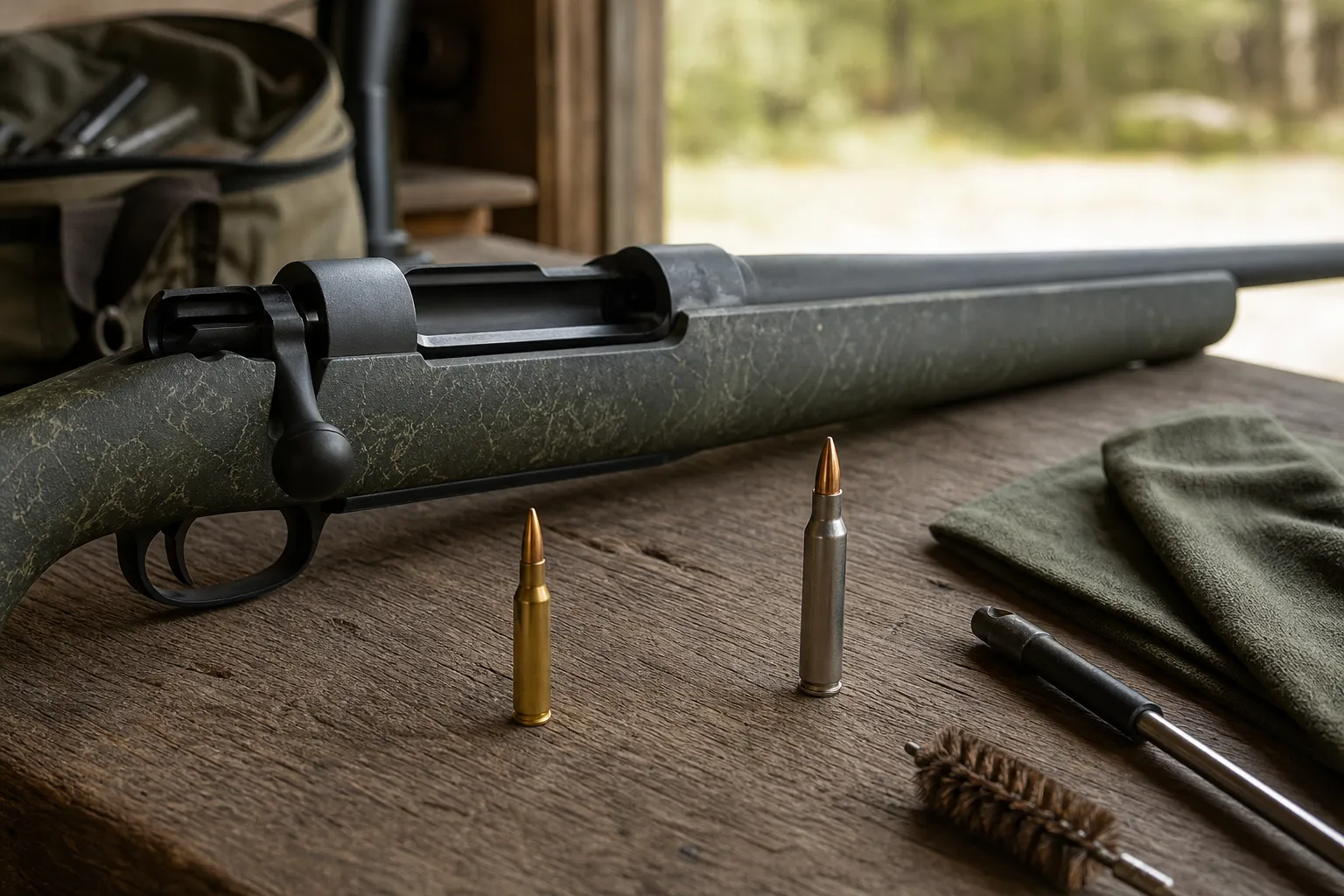
The size difference is large. .300 AAC Blackout is a .30 caliber cartridge, while SAAMI 5.56 Commercial uses .22 caliber bore and groove dimensions. That is why the chamber marking, barrel marking, ammunition box, and owner’s manual matter.
SAAMI advises users to verify the owner’s manual or ask the firearm manufacturer about safe cartridge compatibility. For a newcomer, that is the rule to remember: the cartridge name on the ammunition must match what the firearm maker says the firearm is chambered to use.
Which one is “better”?
The published specifications do not make one universally better. They show different priorities.
Choose the .300 AAC Blackout column if you are comparing a standardized .30 caliber cartridge with heavier bullet weights in the specifications shown. Choose the 5.56 column if you are comparing the small bore, high velocity side, while keeping in mind that SAAMI 5.56 Commercial is not the same thing as a NATO specification.
Before buying or using ammunition, verify the exact chamber marking on the firearm, the owner’s manual, and the firearm manufacturer’s compatibility guidance. For standards questions, use the current SAAMI or C.I.P. document, and remember that the public SAAMI 5.56 Commercial specification does not establish NATO conformance.
Frequently asked questions
Is .300 Blackout the same as 5.56 NATO?
No. .300 Blackout is a .30 caliber cartridge, while 5.56 is a .22 caliber cartridge. They are different cartridges and must not be treated as interchangeable.
Why is 5.56 NATO labeled carefully in this comparison?
SAAMI’s public data is for 5.56 Commercial, and SAAMI says that conformance to that specification does not imply or ensure conformance with military or NATO specifications. The C.I.P. dimensional data used here is .223 Remington, not 5.56 NATO.
Which has higher listed velocity in the examples?
The 5.56 side is the higher velocity side in the examples shown here. SAAMI’s 5.56 Commercial public introduction lists a 55 grain bullet at 3,400 fps, and Winchester’s 2022 5.56mm examples list velocities above 3,000 fps.
What is the main safety warning?
Use only ammunition that matches the firearm’s chamber marking and the owner’s manual. SAAMI warns that using ammunition in a chamber not marked for that specific ammunition may result in serious injury or death and firearm damage.
Sources
- SAAMI Z299.4-2025, Voluntary Industry Performance Standards for Pressure and Velocity of Centerfire Rifle Ammunition, Sporting Arms and Ammunition Manufacturers’ InstituteOfficial source. Accessed October 22, 2026.
- New Cartridge & Chamber, 5.56 Commercial (5.56 COMM), Sporting Arms and Ammunition Manufacturers’ InstituteOfficial source. Accessed October 22, 2026.
- C.I.P. TDCC, 300 AAC Blackout, Commission internationale permanente pour l’épreuve des armes à feu portativesOfficial source. Accessed October 22, 2026.
- C.I.P. TDCC, 223 Rem., Commission internationale permanente pour l’épreuve des armes à feu portativesOfficial source. Accessed October 22, 2026.
- C.I.P. TDCC Public Tables, Commission internationale permanente pour l’épreuve des armes à feu portativesOfficial source. Accessed October 22, 2026.
- Generally Accepted Firearms and Ammunition Interchangeability, Sporting Arms and Ammunition Manufacturers’ InstituteOfficial source. Accessed October 22, 2026.
- AOP-4172 Document Details, Defense Logistics Agency ASSIST QuickSearchOfficial source. Accessed October 22, 2026.
- Federal 2026 Catalog, Rifle Ballistics, Federal Premium AmmunitionOfficial source. Accessed October 22, 2026.
- Federal Premium 2019 Catalog, Federal Premium AmmunitionOfficial source. Accessed October 22, 2026.
- Winchester 2022 New Products, Winchester AmmunitionOfficial source. Accessed October 22, 2026.
- AAC 2012 Catalog, Advanced Armament Corp.Official source. Accessed October 22, 2026.