.223 Remington vs 5.56 NATO: Chamber Safety, Pressure, and .223 Wylde
.223 Remington and 5.56 NATO are closely related, but they are not automatically interchangeable in both directions. SAAMI says .223 Remington ammunition is safe in a 5.56 military specification chamber, while 5.56, 5.56 NATO, or 5.56x45mm ammunition is not safe in a barrel marked only .223 Remington.
By RaiS. Reviewed by RaiS. Published . 6 min read.
Research and drafting were assisted by AI. RaiS checked the facts against the sources below and approved this page.
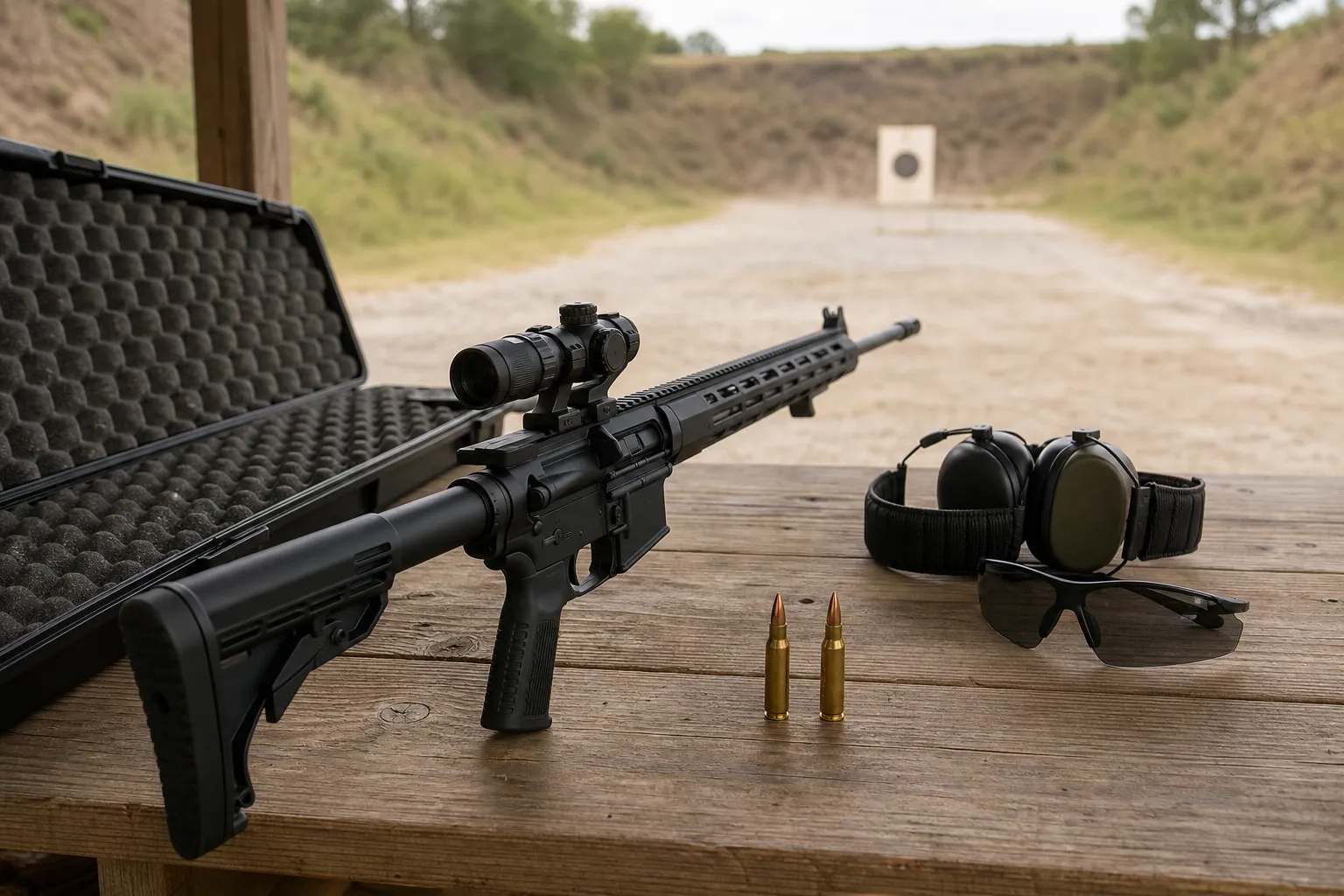
If you remember only one thing from the .223 Remington vs 5.56 NATO comparison, make it this: SAAMI says .223 Remington ammunition is safe in a 5.56 military specification chamber, but 5.56, 5.56 NATO, or 5.56x45mm ammunition is not safe in a barrel marked only .223 Remington. Put the other way, for “5.56 vs 223,” do not fire 5.56 in a .223 only barrel. For “223 vs 5.56,” SAAMI says .223 Remington is safe in a 5.56 military specification chamber, with the firearm maker able to verify the chamber.
For AR 15 and bolt action owners, that means the practical check is the barrel marking, the owner’s manual, and the firearm manufacturer’s guidance. SAAMI also tells readers to consult the owner’s manual or firearm manufacturer because non military and wildcat 5.56 chamber geometries exist.
Quick comparison
| Question | Short answer |
|---|---|
| Can I fire .223 Remington in a 5.56 chamber? | SAAMI says .223 Remington ammunition is safe in a 5.56 military specification chamber, with the firearm maker able to verify the chamber. |
| Can I fire 5.56 NATO in a .223 Remington chamber? | SAAMI says 5.56, 5.56 NATO, or 5.56x45mm ammunition is not safe in a barrel marked as chambered in .223 Remington. |
| Why is the warning one way? | SAAMI identifies the shorter .223 Remington throat as the main reason 5.56 ammunition in a .223 marked barrel can raise pressure. |
| Are the pressure numbers directly comparable? | Not cleanly. SAAMI, C.I.P., and NATO pressure figures use their own methods and measurement systems. |
| What about .223 Wylde? | It is a chamber approach, not a SAAMI, C.I.P., or NATO cartridge standard. Follow the barrel or firearm maker’s guidance. |
Cartridge dimensions: where .223 Remington is clearly standardized
The .223 Remington cartridge is clearly standardized. That is one reason the names can look deceptively interchangeable to new owners. The more important safety difference is not simply the outside shape of the cartridge. It is the relationship among ammunition pressure, pressure measurement method, and chamber throat geometry.
For 5.56x45mm NATO, the U.S. DLA ASSIST record lists AOP 4172 as active and titled “Technical Performance Specification Providing for the Interchangeability of 5.56 mm x 45 Ammunition.” A public 1993 STANAG 4172 document says the aim was to standardize essential characteristics of 5.56 mm ammunition for NATO armed forces and battlefield interchangeability.
Pressure: why the numbers are not apples to apples
C.I.P.’s .223 Rem. TDCC sheet lists Pmax as 4300 bar under the transducer method.
The public 1993 STANAG 4172 document gives a different kind of number for 5.56 mm ammunition. It states that, at 21 degrees C, average chamber pressure must not exceed 380 MPa and average plus three standard deviations must not exceed 420 MPa. The same document says those pressure values apply only with NATO defined electronic apparatus for 5.56 mm ammunition.
That last point matters. A SAAMI psi value, a C.I.P. bar value, and a NATO MPa value are not clean apples to apples comparisons when they come from different procedures and equipment. It is safer to treat each figure inside its own standard rather than rank them as if they were measured the same way.
Hornady Law Enforcement gives a manufacturer level explanation that is useful, as long as it is kept in that context. Hornady says 5.56 NATO runs at approximately 58,000 psi and .223 Remington at approximately 55,000 psi. Hornady also says firing 5.56 NATO in a .223 Remington chambered rifle is not safe and may harm the operator, rifle, or both.
SAAMI’s later 5.56 Commercial notice adds another important caution. SAAMI announced 5.56 Commercial on October 12, 2026, as a SAAMI commercial standard with a MAP of 62,000 psi, but it says that does not imply conformance with military or NATO specifications. The same SAAMI notice says the absence of publicly available standards for 5.56 x 45, including 5.56 NATO, makes blanket compatibility statements impossible. SAAMI also says its existing guidance remains unchanged: only .223 Remington ammunition should be used in firearms chambered and roll marked only .223 Remington.
Chamber throat, leade, and the real reason for the warning
The key safety issue is the chamber throat, also called the leade area. SAAMI identifies the shorter .223 Remington throat as the main reason firing 5.56 ammunition in a .223 marked barrel can raise pressure.
C.I.P.’s .223 Rem. chamber data also describes the start of rifling. It lists commencement of rifling values including G1 5.69 mm and G 2.18 mm.
Hornady Law Enforcement describes the chamber difference in practical terms, saying a 5.56 NATO chamber has a .125 inch longer throat than .223 Remington. Hornady also says .223 Remington in a 5.56 NATO chamber may not work optimally because of the throat difference and pressure drop.
That does not change SAAMI’s safety message. SAAMI says .223 Remington ammunition is safe in a 5.56 military specification chamber. But it helps explain why owners may see separate discussions of safety and performance. A combination can be acceptable from a safety standpoint and still not be the most optimal pairing according to a manufacturer.
.223 Remington in a 5.56 chamber
For “223 vs 5.56,” the common question is whether .223 Remington can be fired in a 5.56 chamber. SAAMI says .223 Remington ammunition is safe in a 5.56 military specification chamber, with the firearm maker able to verify the chamber.
That last phrase is important. SAAMI tells readers to consult the owner’s manual or firearm manufacturer because non military and wildcat 5.56 chamber geometries exist. In other words, do not assume every barrel marked with some form of 5.56 has the same geometry as a NATO military specification chamber.
5.56 NATO in a .223 Remington chamber
For “5.56 vs 223,” the risk goes the other direction. SAAMI says 5.56, 5.56 NATO, or 5.56x45mm ammunition is not safe in a barrel marked as chambered in .223 Remington.
SAAMI gives the reason: the .223 Remington marked barrel has a shorter throat than a 5.56 barrel, which may increase pressure with 5.56 ammunition. Faxon gives similar manufacturer guidance, saying a .223 Remington chamber is not capable of safely firing 5.56 NATO spec ammunition.
This is why the barrel marking matters more than casual shorthand. Many shooters say “.223” and “5.56” loosely, but the actual chamber marking and firearm maker’s instructions are what matter for a specific rifle.
Where .223 Wylde fits
.223 Wylde is best understood as a chamber approach, not as a separate cartridge standard from SAAMI, C.I.P., or NATO. It is intended to sit between the common .223 Remington and 5.56 NATO chamber discussions, but the exact guidance still comes from the barrel or firearm maker.
Faxon says a .223 Wylde chamber uses the same body dimensions as a 5.56 NATO chamber and can accept both .223 Remington and 5.56 NATO spec ammunition. Faxon also says .223 Wylde carries over the freebore diameter and length from .223 Remington for accuracy potential while remaining functional with both ammunition types.
That is manufacturer guidance for that chamber description. If your rifle is marked .223 Wylde, follow the barrel or firearm maker’s instructions for the ammunition it accepts.
Practical checklist before you load the rifle
Use this checklist before assuming compatibility:
- Read the barrel marking.
- Read the owner’s manual.
- Check the firearm or barrel manufacturer’s ammunition guidance.
- If the barrel is marked only .223 Remington, follow SAAMI’s guidance and use only .223 Remington ammunition.
- If the rifle is marked 5.56, confirm with the firearm maker whether it is a 5.56 military specification chamber or another 5.56 chamber geometry.
- If the rifle is marked .223 Wylde, follow the maker’s specific guidance for that chamber.
The safest summary is simple: .223 Remington in a verified 5.56 military specification chamber is the accepted direction under SAAMI guidance. 5.56, 5.56 NATO, or 5.56x45mm in a barrel marked only .223 Remington is the direction SAAMI warns against.
Before firing any rifle, check the barrel marking, owner’s manual, and firearm manufacturer’s current guidance. For standards questions, check current SAAMI, C.I.P., and NATO related documents where available, because SAAMI’s 5.56 Commercial notice specifically cautions against blanket compatibility statements for 5.56 x 45 and 5.56 NATO.
Frequently asked questions
Can I shoot .223 Remington in a 5.56 NATO chamber?
SAAMI says .223 Remington ammunition is safe in a 5.56 military specification chamber, with the firearm maker able to verify the chamber. Check the barrel marking, owner’s manual, and manufacturer guidance for your rifle.
Can I shoot 5.56 NATO in a .223 Remington chamber?
SAAMI says 5.56, 5.56 NATO, or 5.56x45mm ammunition is not safe in a barrel marked as chambered in .223 Remington. SAAMI identifies the shorter .223 Remington throat as the main reason pressure can increase.
Are .223 Remington and 5.56 NATO pressure numbers directly comparable?
Not cleanly. SAAMI, C.I.P., and NATO pressure figures use their own methods and measurement systems.
What is .223 Wylde?
.223 Wylde is a chamber approach, not a SAAMI, C.I.P., or NATO cartridge standard. Faxon says a .223 Wylde chamber uses 5.56 NATO body dimensions and can accept both .223 Remington and 5.56 NATO spec ammunition.
Does SAAMI’s 5.56 Commercial standard change the .223 only warning?
No. SAAMI’s October 12, 2026 5.56 Commercial notice says existing guidance remains unchanged: only .223 Remington ammunition should be used in firearms chambered and roll marked only .223 Remington.
Sources
- SAAMI FAQ, 223 Remington and 5.56 interchangeability, Sporting Arms and Ammunition Manufacturers’ InstituteOfficial source. Accessed October 23, 2026.
- SAAMI Z299.4-2025, Centerfire Rifle, 223 Remington drawing and pressure data, Sporting Arms and Ammunition Manufacturers’ InstituteOfficial source. Accessed October 23, 2026.
- SAAMI 223 Remington Velocity and Pressure Data, Sporting Arms and Ammunition Manufacturers’ InstituteOfficial source. Accessed October 23, 2026.
- C.I.P. TDCC, 223 Rem., Commission Internationale Permanente pour l’Epreuve des Armes à Feu PortativesOfficial source. Accessed October 23, 2026.
- ASSIST document details, STANAG-4172, Defense Logistics Agency ASSIST Quick SearchOfficial source. Accessed October 23, 2026.
- STANAG 4172 Edition 2, 5.56 mm Ammunition, 1993 public copy, North Atlantic Treaty Organization, hosted copy. Accessed October 23, 2026.
- What is the difference between 5.56 NATO and 223 Rem ammunition?, Hornady Law EnforcementOfficial source. Accessed October 23, 2026.
- FAQ: 5.56 NATO vs .223 Wylde, What’s The Difference?, Faxon FirearmsOfficial source. Accessed October 23, 2026.
- SAAMI Announces Acceptance of a New Cartridge, 5.56 Commercial, Sporting Arms and Ammunition Manufacturers’ InstituteOfficial source. Accessed October 23, 2026.