Loaded Chamber Indicators Explained: What They Show and What They Do Not
Loaded chamber indicators are chamber status aids. They may show or let you feel that a cartridge is chambered, but they do not replace opening the action and checking the chamber.
By RaiS. Reviewed by RaiS. Published . 8 min read.
Research and drafting were assisted by AI. RaiS checked the facts against the sources below and approved this page.

Loaded chamber indicators are warning aids, not proof that a firearm is safe or unloaded. AFTE defines a loaded chamber indicator as a mechanism that reveals a chambered cartridge when the firearm is in battery, while manufacturer manuals repeatedly tell owners to remove the ammunition source, open the action, and visually and physically check the chamber.
What a loaded chamber indicator is
SAAMI defines the chamber as the rearmost part of a rifle, shotgun, or pistol barrel formed to accept a specific cartridge or shell. SAAMI defines the action as the combination of the receiver or frame and other parts of the mechanism by which a firearm is loaded, fired, and unloaded.
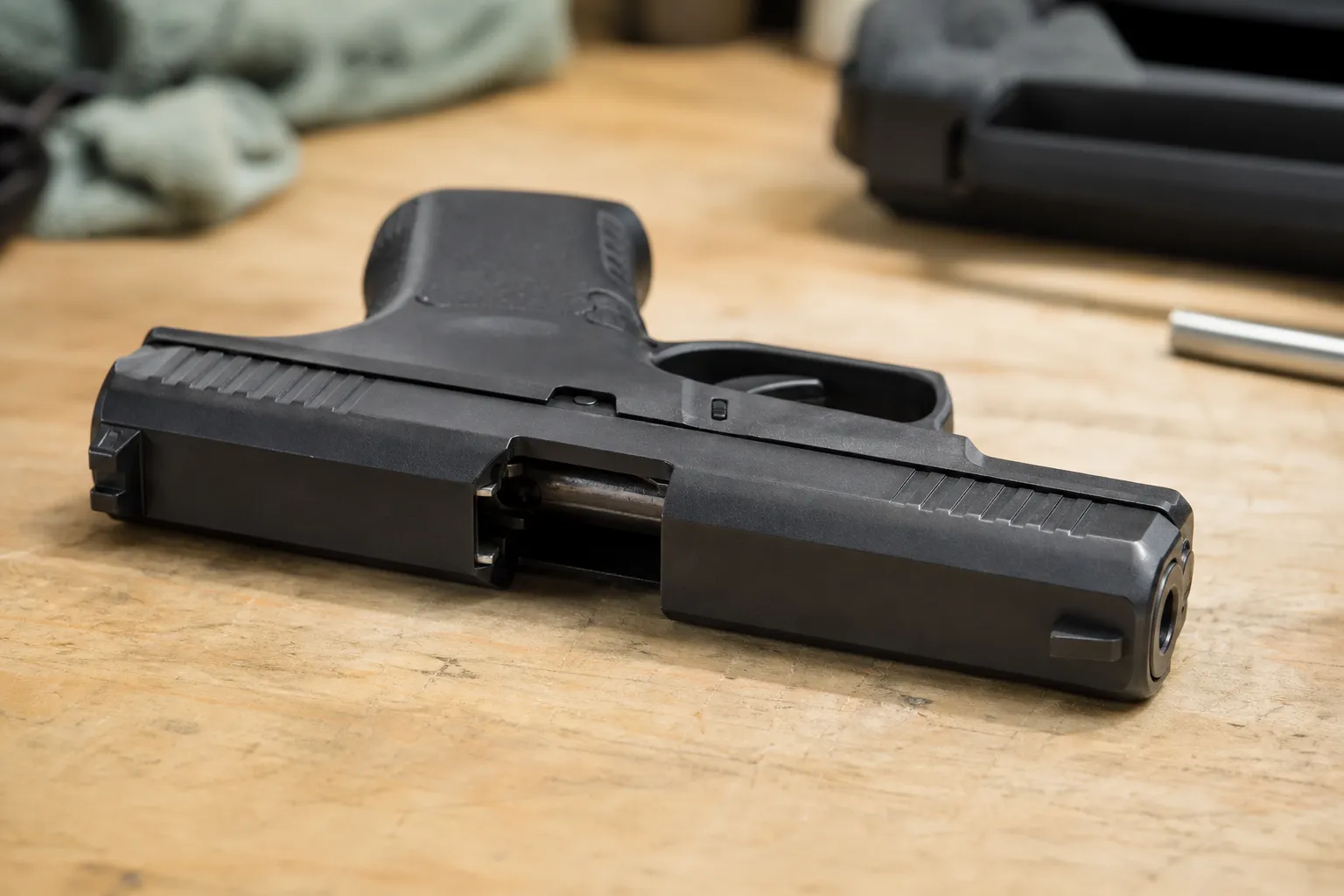
That matters because a loaded chamber indicator, often shortened to LCI, is about the chamber. It is not about whether a magazine is inserted. It is not a substitute for knowing how the firearm’s action works. It is simply a chamber status aid on some firearms.
AFTE defines a loaded chamber indicator as a mechanism on a firearm that reveals when a cartridge is chambered if the firearm is in battery. AFTE says it may take the form of a small rod, a raised extractor, or another mechanism that protrudes or raises.
For the broader safety rules behind this topic, see The Basic Rules of Firearm Safety.
Related terms: witness holes, viewports, and chamber flags
A witness hole is a visual opening, not necessarily a moving mechanical indicator.
Some manuals use similar wording for openings or ports. Smith & Wesson’s M&P M2.0 manual describes one type of indicator as an opening at the rear of the barrel hood.
A chamber flag is different. It is normally used with an open action to show that the chamber is empty. The Civilian Marksmanship Program says rifles or firearms should have the action open with a CBI, ECI, or OBI inserted when handled. SIG Sauer’s M400 manual says its chamber safety flag prevents chambering a round when installed and provides a visible indication that the firearm’s chamber is empty.
For more on that range safety device, see Chamber Flag.
Common designs you may see in manuals
Loaded chamber features vary by firearm and by model. Smith & Wesson’s M&P M2.0 manual tells buyers they must determine which features are present on their specific pistol and how those features operate. That is the safest way to read any loaded chamber indicator description: model first, manual first.
| Design described in manuals | What it may show | Limits to remember |
|---|---|---|
| Raised tab or protruding indicator | Ruger’s LC9 manual says the indicator appears on top of the slide, is flush when the chamber is empty, and protrudes with a visible red bar when loaded. Smith & Wesson describes a tactile type that protrudes above the slide when the chamber is loaded. | Ruger warns never to rely on memory or any loaded chamber indicator to know whether a firearm is loaded. |
| Witness hole, barrel hood opening, or viewport | Smith & Wesson’s M&P M2.0 manual describes a top opening near the barrel hood. | Smith & Wesson warns that light, cleanliness, ammunition color, and other factors may limit effectiveness. |
| Optional tactile LCI | SIG Sauer’s P365 manual says the optional LCI provides a tactile indication that there is a live round in the chamber. | The same manual says to visually verify the chamber and barrel are clear, then check twice, both visually and physically. |
| Chamber flag or empty chamber indicator | The Civilian Marksmanship Program refers to CBI, ECI, and OBI devices used with an open action. SIG Sauer’s M400 manual says a chamber safety flag gives a visible indication that the chamber is empty. | This is an open chamber or range handling signal, not the same thing as a handgun LCI showing a chambered cartridge. |
The key point is that these features are not one universal system. One pistol may use an extractor. Another may use a raised tab. Another may use only a visual opening. A rifle on a range may use a flag inserted into the open action or chamber.
What a loaded chamber indicator can show
A loaded chamber indicator can give useful information when it is working as designed. AFTE’s definition is narrow: it reveals when a cartridge is chambered if the firearm is in battery. Manufacturer manuals use similar but model specific language.
On the Ruger LC9, the manual says the indicator appears on top of the slide. The manual says it should be flush when the chamber is empty. When the chamber is loaded, Ruger says the forward portion should protrude from the top of the slide and a red bar is visible.
On Smith & Wesson M&P M2.0 pistols, the manual describes two types. One is an opening at the rear of the barrel hood. The other is a tactile indicator whose front protrudes from the top of the slide when the chamber is loaded.
On the SIG Sauer P365, the manual says the optional LCI provides a tactile indication that there is a live round in the chamber.
On the Springfield Armory Hellcat, the manual says the indicator allows the user to observe whether a cartridge is in the chamber.
These examples show why the owner’s manual matters. Even when two manuals use the same phrase, the feature may not look or feel the same.
What it does not show
A loaded chamber indicator does not prove that a firearm is safe to handle carelessly. NSSF says that when handling or handing over a firearm, you should open the action immediately and visually check the chamber, receiver, and magazine.
A loaded chamber indicator also does not replace an open action. NSSF says the only time you can be absolutely certain that a gun cannot fire is when the action is open and it is completely empty.
It does not replace physically checking the chamber. SIG Sauer’s P365 manual says to visually verify the chamber and barrel are clear, then check twice, both visually and physically.
It does not overcome the limits of a visual opening. Smith & Wesson warns that the amount of light, cleanliness of the pistol, color of the ammunition, and other factors may limit the effectiveness of an LCI.
It does not make a magazine irrelevant. Springfield Armory’s Hellcat manual says the firearm is not completely unloaded until the magazine is removed and the chamber is empty.
It does not replace other safety habits. NSSF describes a firearm safety as a mechanical device that supplements safe handling but does not replace it. The same principle applies to a loaded chamber indicator: it can supplement safe handling, but it cannot stand in for it.
A safe chamber check, in plain English
Use your specific firearm manual, but the same basic sequence appears across official safety guidance and manufacturer manuals.
- Treat the firearm as loaded.
- Remove the ammunition source.
- Open the action or breech. NSSF says to open the action immediately when handling or handing over a firearm.
- Lock the action open where the firearm design and manual call for it.
- Visually check the chamber. NSSF says to visually check the chamber, receiver, and magazine.
- Physically check the chamber. SIG Sauer’s P365 manual says to check the firearm twice, both visually and physically.
- Do not rely on memory, an LCI, a safety, a red mark, or the absence of a magazine alone. Ruger warns never to rely on memory or any loaded chamber indicator to know if a firearm is loaded.
If you are handing a firearm to another person, SIG Sauer’s M400 manual says to physically and visually check the chamber so both people can ensure the firearm is unloaded.
Handguns, rifles, and range procedures
Most loaded chamber indicator examples in the manuals listed here are handguns. That does not mean chamber status is only a handgun issue. SAAMI’s chamber definition covers rifles, shotguns, and pistols. The basic safety practice, remove the ammunition source, open the action, and check the chamber, applies across firearm types.

Rifles and range rules often use empty chamber indicators instead of the handgun style LCI. The Civilian Marksmanship Program says rifles or firearms should have the action open with a CBI, ECI, or OBI inserted when handled. SIG Sauer’s M400 manual describes a chamber safety flag that prevents chambering a round when installed and gives a visible indication that the chamber is empty.
If you are learning how different actions expose or enclose the chamber during handling, ProjectGuns has separate guides on bolt-action rifles and pistol magazines. For cleaning related handling, see How to Clean a Gun Safely.
Model specific caution
Do not assume that two firearms use the same indicator just because both manuals use the phrase “loaded chamber indicator.” Smith & Wesson’s M&P M2.0 manual is explicit that buyers must determine which features are present on their specific pistol and how those features operate.
Do not assume that a witness hole gives the same information as a protruding tactile indicator. A witness hole is a visual opening, while a protruding tactile indicator is designed to be felt.
Do not assume that a red bar, raised extractor, or visible brass is enough. Ruger warns not to rely on memory or any loaded chamber indicator. Smith & Wesson warns that light, cleanliness, ammunition color, and other factors may limit effectiveness.
Bottom line
A loaded chamber indicator can be a helpful reminder that a cartridge may be in the chamber. It can be visual, tactile, mechanical, or simply an opening that lets you look for a chambered round, depending on the firearm.
But the safe answer is always the same: treat the firearm as loaded, remove the ammunition source, open the action, and visually and physically check the chamber. Confirm the exact indicator, unloading procedure, range flag rule, and storage procedure in your firearm’s manual and with the relevant range, agency, or instructor.
Frequently asked questions
What is a loaded chamber indicator?
AFTE defines a loaded chamber indicator as a mechanism on a firearm that reveals when a cartridge is chambered if the firearm is in battery.
Is a witness hole the same as a loaded chamber indicator?
Not always. A witness hole is a visual opening, not necessarily a moving mechanical indicator.
Can I rely on a loaded chamber indicator to know a gun is unloaded?
No. Ruger warns never to rely on memory or any loaded chamber indicator to know whether a firearm is loaded.
What is the correct way to check the chamber?
NSSF says to open the action and visually check the chamber, receiver, and magazine when handling or handing over a firearm.
Does removing the magazine unload the firearm?
Not by itself. Springfield Armory’s Hellcat manual says the firearm is not completely unloaded until the magazine is removed and the chamber is empty.
What is a chamber flag or empty chamber indicator?
The Civilian Marksmanship Program refers to CBI, ECI, and OBI devices used with an open action. SIG Sauer’s M400 manual says its chamber safety flag prevents chambering a round when installed and provides a visible indication that the firearm’s chamber is empty.
Sources
- CHAMBER, Sporting Arms and Ammunition Manufacturers' InstituteOfficial source. Accessed November 4, 2026.
- SAAMI Glossary, Sporting Arms and Ammunition Manufacturers' InstituteOfficial source. Accessed November 4, 2026.
- Loaded Chamber Indicator, Association of Firearm and Tool Mark Examiners. Accessed November 4, 2026.
- Loaded Chamber Indicator (LCI), SIG SauerOfficial source. Accessed November 4, 2026.
- Witness Holes, SIG SauerOfficial source. Accessed November 4, 2026.
- Learn About Firearms Safety and Security, Bureau of Alcohol, Tobacco, Firearms and ExplosivesOfficial source. Accessed November 4, 2026.
- Firearm Safety, 10 Rules of Safe Gun Handling, National Shooting Sports Foundation. Accessed November 4, 2026.
- GLOCK Instructions for Use, Gen5 X Model, GLOCKOfficial source. Accessed November 4, 2026.
- GLOCK G44 Instructions for Use, GLOCKOfficial source. Accessed November 4, 2026.
- Ruger LC9 and LC380 Instruction Manual, Sturm, Ruger & Co.Official source. Accessed November 4, 2026.
- M&P M2.0 Pistols Safety & Instruction Manual, Smith & WessonOfficial source. Accessed November 4, 2026.
- SIG Sauer P365 Operator's Manual, SIG SauerOfficial source. Accessed November 4, 2026.
- Hellcat Operation and Safety Manual, Springfield ArmoryOfficial source. Accessed November 4, 2026.
- Safety, Civilian Marksmanship ProgramOfficial source. Accessed November 4, 2026.
- SIG M400 Operator's Manual, SIG SauerOfficial source. Accessed November 4, 2026.
- 3.4 LOADED CHAMBER INDICATOR (LCI), EQUIPPED PISTOLS. Accessed November 4, 2026.
- 6.0 Unloading/Clearing the Pistol. Accessed November 4, 2026.