Pump-Action vs Semi-Automatic Shotguns: How They Differ
Pump-action shotguns cycle when the shooter moves the fore-end by hand. Semi-automatic shotguns use energy from the fired shotshell to eject and reload, while still requiring a separate trigger pull for each shot.
By RaiS. Reviewed by RaiS. Published . 6 min read.
Research and drafting were assisted by AI. RaiS checked the facts against the sources below and approved this page.
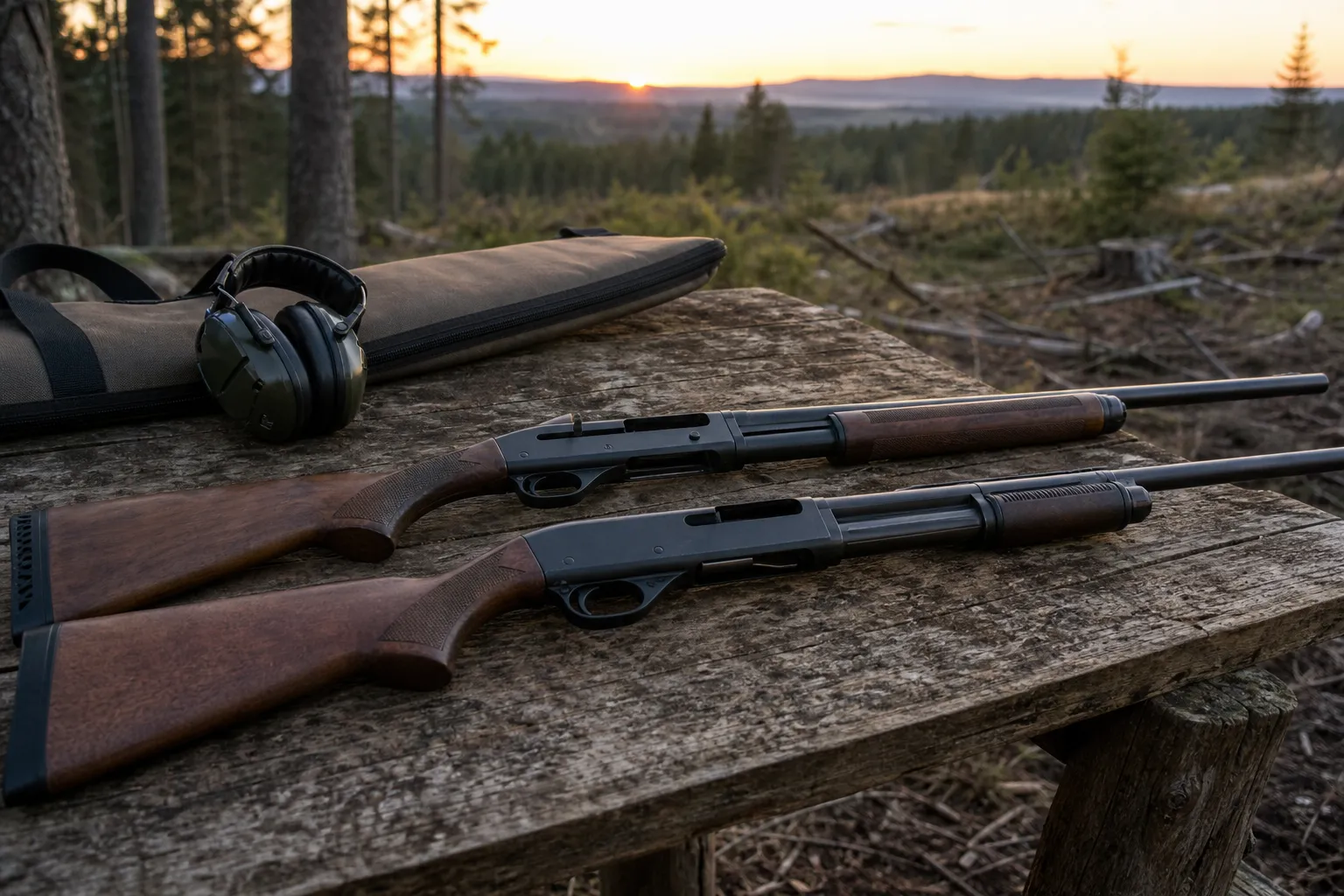
Pump-action and semi-automatic shotguns differ mainly in how the action cycles after a shot. In a pump-action shotgun, the shooter moves the fore-end rearward and forward to eject the spent shell and chamber the next one. In a semi-automatic shotgun, the gun uses energy from the fired shotshell to cycle the action, but the shooter still fires one shot per trigger pull.
What the shotgun action does
SAAMI defines a firearm action as the receiver or frame plus the mechanism parts by which a firearm is loaded, fired and unloaded. For a new shotgun shooter, that means the action is the part of the gun that handles the shell before, during and after firing.
Pump-action and semi-automatic shotguns are both repeating shotgun actions. They can both feed another shotshell from the magazine system into the chamber, but they do it in different ways.
In a pump-action shotgun, the movable fore-end is operated by hand in line with the barrel. That movement helps run the loading and unloading cycle.
A semi-automatic shotgun feeds the next shell after firing, while requiring a separate trigger pull for each shot.
How a pump-action shotgun cycles
In a pump-action shotgun, the shooter supplies the cycling motion. The fore-end is moved rearward and then forward. The Oklahoma Department of Wildlife Conservation hunter education manual says that sliding the front grip back and then forward ejects the spent shell, loads another shell and cocks the hammer.
The Mossberg 500 family pump manual describes the same basic sequence. It states that pulling the forearm completely rearward ejects the spent case or unfired shotshell through the ejection port. It also states that pushing the forearm fully forward chambers a live shotshell from the magazine.
The Winchester SXP manual describes the SXP as a pump-action shotgun that lets the user load a shell by cycling the action to eject the empty shell and move an unfired shell from the magazine tube to the chamber.
For the shooter, the key point is simple: the gun does not cycle itself after the shot. The shooter operates the fore-end to extract, eject and chamber.
How a semi-automatic shotgun cycles
In a semi-automatic shotgun, the action uses energy from the fired shotshell to cycle. The Oklahoma Department of Wildlife Conservation hunter education manual says a semi-automatic fires, ejects the spent cartridge and chambers a fresh cartridge each time the trigger is pulled.
The Mossberg 940 autoloading shotgun manual says the firearm automatically feeds the next live shotshell from the magazine tube into the chamber each time the firearm is fired. The same manual warns that no mechanical force from the user is needed in this feeding process.
That does not mean the gun fires continuously. In practical terms, a semi-automatic shotgun cycles itself between shots, but the shooter still fires one shot per trigger pull.
Pump-action vs semi-automatic at a glance
| Topic | Pump-action shotgun | Semi-automatic shotgun |
|---|---|---|
| What cycles the action | The shooter manually moves the fore-end | The action uses energy from the fired shotshell, as described by manufacturer manuals |
| What happens after firing | The shooter moves the fore-end to eject and chamber | The gun ejects and chambers as part of the firing cycle |
| Trigger use | One trigger pull fires one shot | One trigger pull fires one shot |
| Recoil perception | Texas Parks and Wildlife says apparent felt recoil is greater than in a semi-automatic | Texas Parks and Wildlife says semi-automatic shotguns reduce the recoil the shooter experiences because the action uses recoil and gas from the fired shotshell |
| Maintenance focus | Follow the owner’s manual and clean after use | Follow the owner’s manual, with extra attention to the operating system described in the manual |
Gas-operated semi-automatic shotguns
In a gas-operated autoloading shotgun, propellant gas is routed into the operating system to help cycle the action.
The Browning Maxus manual describes a gas-operated autoloading shotgun in more detail. It states that high-pressure gases from behind the shot charge pass through two ports in the barrel, through the gas bracket and into the gas system, forcing it rearward. Browning says that as the gas system moves rearward, it forces the bolt to the rear and operates the action.
The Remington Model 1100 and 11-87 manual states that gas operation provides significant recoil reduction by bleeding gases off the barrel to pressurize a piston, which unlocks and functions the action.
Those same gases affect maintenance. The Remington manual states that the gases carry combustion residues that can foul the magazine tube and piston or piston seal assembly. The Beretta 2026 semiauto shotgun manual lists gas-system parts including the gas piston, gas cylinder and valve assembly.
Inertia and recoil operated semi-automatic shotguns
Some semi-automatic shotguns use inertia or recoil-based operating systems rather than the gas-operated system described above.
Benelli states that spring pressure delays the opening of the action until after the shot has left the barrel.
This is a different operating system from a gas-operated semi-automatic. The important comparison for a new shooter is not a ranking. Gas-operated systems route propellant gas into a gas system. Other semi-automatic operating systems use a different mechanism, so the owner’s manual for the exact shotgun matters.
Recoil perception
Felt recoil is the shooter’s perception of rearward movement after firing.
Texas Parks and Wildlife hunter education material says semi-automatic shotguns reduce the recoil the shooter experiences because the action uses recoil and gas from the fired shotshell to work the action. The same Texas material says apparent felt recoil is greater in a pump-action shotgun than in a semi-automatic shotgun.
The Remington Model 1100 and 11-87 manual gives a gas-system example, stating that gas operation provides significant recoil reduction by bleeding gases off the barrel to pressurize a piston that unlocks and functions the action.
These statements explain why many basic shotgun comparisons discuss action type when discussing recoil. They should not be read as a universal percentage for every shotgun, since the cited material does not give one.
Maintenance and cleaning differences
The Oklahoma hunter education manual recommends cleaning a firearm after every use for safe and efficient functioning. That general advice applies whether the shotgun is pump-action or semi-automatic.
The difference is that a semi-automatic’s operating system may add cleaning areas that the owner’s manual specifically names. In gas-operated examples, Remington states that combustion residues can foul the magazine tube and piston or piston seal assembly. Beretta’s 2026 semiauto shotgun manual lists gas-system parts such as the gas piston, gas cylinder and valve assembly.
A pump-action shotgun still needs cleaning and inspection according to its manual. Its cycling force comes from the shooter’s movement of the fore-end, rather than from gas or recoil energy used by some semi-automatic actions.
Do not go beyond the disassembly instructions in the firearm’s manual. The Winchester SXP manual cautions that if further disassembly for service or cleaning is required, the firearm should be taken to a qualified gunsmith or Winchester service facility.
Which action is easier to understand?
For learning how the actions differ, the pump-action cycle is more direct: the shooter moves the fore-end, and that movement ejects and chambers. The semi-automatic cycle is more internal: the gun uses energy from the fired shotshell to run the action and feed the next shell.
Neither explanation is a product ranking. Manufacturer manuals show that both are established shotgun action types, and the right way to learn a specific shotgun is to read the manual for that exact model.
Before using any shotgun, check the current owner’s manual for loading, unloading, cleaning, ammunition and disassembly instructions. For hunting, also confirm current rules with the wildlife agency for the state, province or territory where you plan to hunt.
Frequently asked questions
Is a semi-automatic shotgun fully automatic?
No. A semi-automatic shotgun cycles after a shot, but the shooter still fires one shot per trigger pull.
What does the pump do on a pump-action shotgun?
The Oklahoma Department of Wildlife Conservation hunter education manual says sliding the front grip back and forward ejects the spent shell, loads another shell and cocks the hammer. Mossberg’s pump manual also states that rearward movement ejects and forward movement chambers a live shotshell from the magazine.
How does a gas-operated semi-automatic shotgun work?
Browning describes high-pressure gases passing through barrel ports into the gas system, moving it rearward and driving the bolt to operate the action. Remington describes gas operation as bleeding gases off the barrel to pressurize a piston, which unlocks and functions the action.
Do semi-automatic shotguns reduce felt recoil?
Texas Parks and Wildlife says semi-automatic shotguns reduce the recoil the shooter experiences because the action uses recoil and gas from the fired shotshell. Remington also states that gas operation provides significant recoil reduction in its Model 1100 and 11-87 manual.
Do semi-automatic shotguns need different cleaning attention than pumps?
Both types should be cleaned after use, according to the Oklahoma hunter education manual. Gas-operated semi-automatics can have gas-system parts and residue concerns, as described in Remington manuals, and Beretta manuals identify gas-system parts.
Sources
- SAAMI Glossary, Sporting Arms and Ammunition Manufacturers' InstituteOfficial source. Accessed October 23, 2026.
- Semiautomatic Action, Sporting Arms and Ammunition Manufacturers' InstituteOfficial source. Accessed October 23, 2026.
- 2024 Hunter Education Manual, Oklahoma Department of Wildlife ConservationOfficial source. Accessed October 23, 2026.
- Shotguns, Texas Parks and Wildlife DepartmentOfficial source. Accessed October 23, 2026.
- Owner's Manual for 500, 505, 510, 535, 590 and 835 Pump Action Shotguns, O.F. Mossberg & SonsOfficial source. Accessed October 23, 2026.
- 940 Autoloading Shotgun Owner's Manual, O.F. Mossberg & SonsOfficial source. Accessed October 23, 2026.
- SXP Owner's Manual, Winchester Repeating ArmsOfficial source. Accessed October 23, 2026.
- Maxus Shotgun Owner's Manual, BrowningOfficial source. Accessed October 23, 2026.
- Model 11-87 and Model 1100 Autoloading Shotgun Owner's Manual, Remington ArmsOfficial source. Accessed October 23, 2026.
- Semiauto Shotgun User Manual, February 2026, BerettaOfficial source. Accessed October 23, 2026.
- Montefeltro Silver Shotgun Product Manual, Benelli USAOfficial source. Accessed October 23, 2026.