The Mossberg 500: A Guide to the Pump Shotgun Family
The Mossberg 500 is a long-running American pump-action shotgun family. Mossberg’s own history dates its introduction to 1962 and describes the 500 platform as the basis for related 590 and 590A1 models.
By RaiS. Reviewed by RaiS. Published . 6 min read.
Research and drafting were assisted by AI. RaiS checked the facts against the sources below and approved this page.
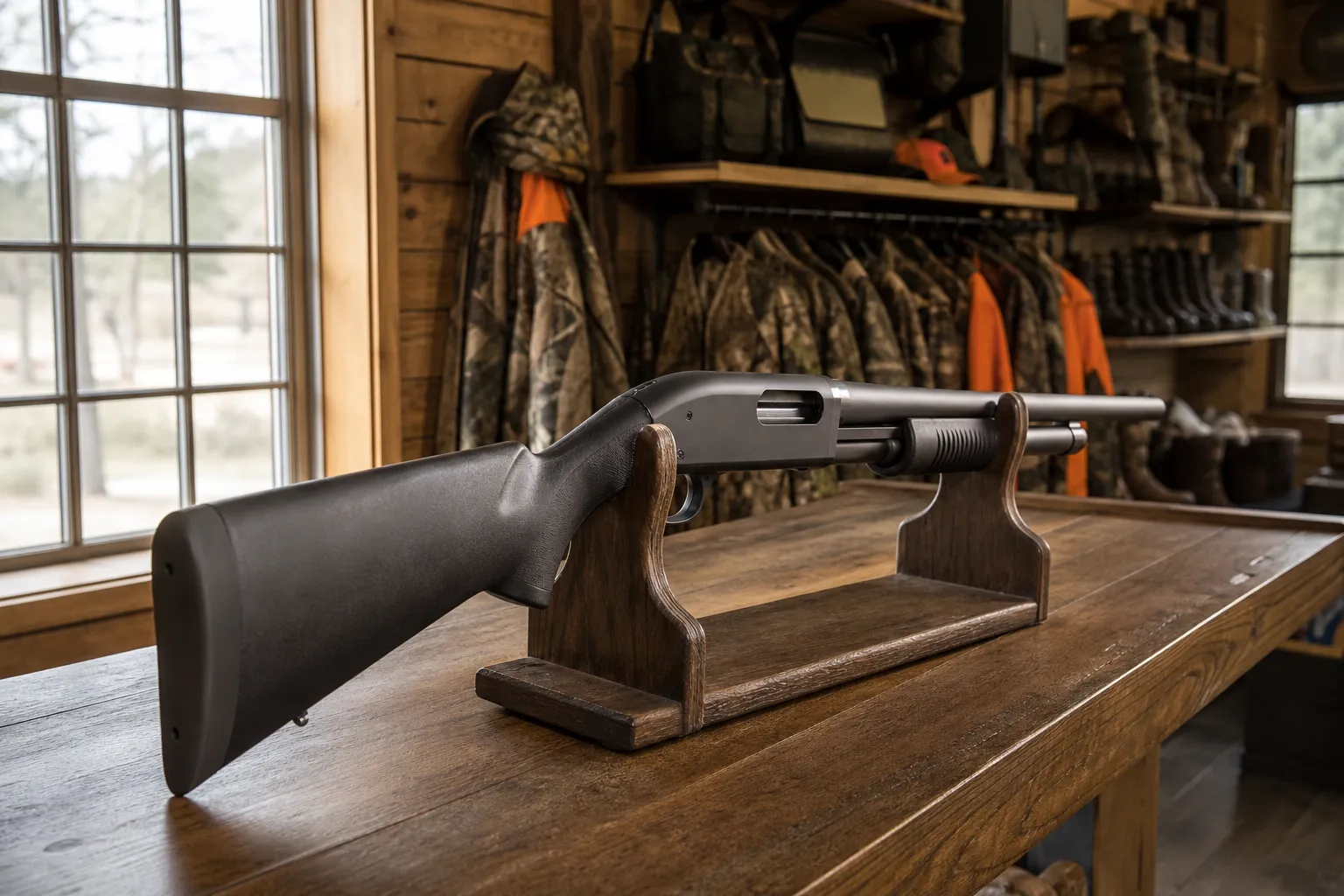
The Mossberg 500 is a pump-action shotgun family introduced in 1962, according to O.F. Mossberg & Sons’ official history. It is best understood as a broad platform rather than one single configuration: Mossberg’s manuals and press materials connect the 500 with related 505, 510, 590, and 590A1 pump-action models, while the Maverick 88 is a related line with some shared features.
A short history of the Mossberg 500
Mossberg’s official company history says 1962 was a benchmark year because the 500 pump shotgun was introduced. That same history describes the 500 as the company’s most successful firearm and says the line reached 10 million units after more than 50 years.
The 500 became the foundation for a larger pump-action family. Mossberg’s 2015 L-Series announcement describes the 500, 590, and 590A1 L-Series as based on the 500 pump-action platform. That wording is useful because it separates the platform idea from any one model number, barrel length, gauge, or stock style.
The 590 and 590A1 are especially important branches of that family. Mossberg’s official history says U.S. Navy engineers requested changes to the 590 in the early 1990s, leading to the 590A1. Mossberg says those requested changes included a clean-out tube, heavy-walled barrel, and aluminum trigger group and safety.
How the 500 pump action works
Mossberg’s pump-action owner’s manual gives the basic cycle in simple terms: pulling the forearm fully rearward ejects a spent case or unfired shotshell, and pushing the forearm fully forward chambers the next shotshell. That is the core pump-action sequence for the models covered by that manual.
The same owner’s manual covers the 500, 505, 510, 535, 590, and 835 pump-action shotguns. It also identifies two common control locations. The safety button is on the top rear portion of the receiver. The action lock lever is on the left side of the trigger housing, just behind the trigger guard.
Mossberg’s press materials list several key 500-platform design features:
| Feature | How Mossberg describes it |
|---|---|
| Twin action bars | Non-binding twin action bars |
| Lock-up | Positive steel-to-steel lock-up |
| Elevator | Anti-jam elevator |
| Extraction | Dual extractors |
| Receiver | Anodized aluminum receiver |
| Safety | Ambidextrous top-mounted safety |
A 1996 U.S. Government Accountability Office decision also describes Mossberg shotguns as using a top-of-the-receiver sliding safety located under the operator’s thumb in firing position. The same GAO decision records Mossberg’s position that its anodized aluminum receivers did not need refinishing to maintain a nonreflective surface.
For owners, the important point is not just the list of parts. It is that the 500’s layout is recognizable across much of the family: pump operation, a receiver-top safety on traditional 500-platform guns, dual extractors, twin action bars, and a lock-up system Mossberg describes as steel-to-steel.
Gauges, chambers, barrels, and chokes
Mossberg’s pump-action manual says 500, 505, and 510 models are designed for factory-loaded 12 gauge, 20 gauge, or .410 shotshells, depending on item number. The same manual says 590 models are designed for factory-loaded 12 gauge 2.75 inch and 3 inch shotshells.
The owner’s manual gives an important compatibility warning about barrels. It says accessory barrels are interchangeable only within specific model, gauge, and magazine capacity. That is a narrow statement, and it should not be stretched into a general claim that any barrel in the family fits any receiver.
For choke tubes, Mossberg’s manual says Accu-Choke tubes are designed for lead or steel shot and are marked for pattern guidance. The manual also urges pattern testing. In practical terms, choke markings are a starting point, while patterning shows what a specific gun, choke, and load actually do on paper.
The Model 500 within the larger family
The Model 500 is the central member of the family. Mossberg’s own history names it as the 1962 introduction and the company’s most successful firearm.
The pump-action owner’s manual places the 500 alongside the 505, 510, 535, 590, and 835 because they share enough manual coverage to be addressed together for safety and operation. That does not mean every part, barrel, chambering, or feature is shared across all models.
Mossberg’s manual warning is direct: modification, alteration, or improper fitting of parts may result in a dangerous malfunction and can cause serious injury or death. For that reason, a reference guide should treat factory specifications and official manuals as the boundaries, not as starting points for improvised changes.
The 590 and 590A1
Mossberg describes the 590 as part of the 500 pump-action platform. In its 2015 L-Series press release, Mossberg says the 590 L-Series 9-Shot uses an open-ended, flush magazine tube design and that the magazine tube design offers easy-access cleanout.
The 590A1 is the heavier-duty military-spec branch of the family in Mossberg’s materials. Mossberg’s 2025 590A1 Professional Series announcement calls the 590A1 its flagship 12 gauge, 3 inch shotgun and its most durable pump action. The same release says standard 590A1 upgrades include a clean-out magazine tube, heavy-walled barrels, and metal trigger guard and safety.
Mossberg’s 2015 L-Series announcement similarly describes the 590A1 L-Series 9-Shot as having a heavy-walled barrel, metal trigger guard and safety button, extended magazine capacity, and easy-cleanout magazine tube.
Those descriptions show the relationship clearly. The 590 is a 500-platform tactical line with an easy-cleanout magazine tube feature in the cited Mossberg material. The 590A1 adds durability-oriented features that Mossberg ties to military requirements.
Related lines: 590S, 590R, 590RM, and Maverick 88
Mossberg also uses the 590 name on newer related lines, but they should not be treated as identical to a standard 500.
Mossberg says the 590S Series is a 12 gauge pump-action line capable of cycling 1.75 inch, 2.75 inch, and 3 inch shotshells interchangeably, in any combination, without an adapter. That is a specific 590S claim from Mossberg’s 2021 release.
Mossberg’s 2025 590R and 590RM announcement identifies those models as 12 gauge shotguns with a rotary safety selector and AR-style ergonomics. That makes them related Mossberg pump shotgun lines, but their controls and ergonomics are described differently from the traditional top-mounted safety layout listed for the 500 platform.
The Maverick 88 is another related line. Mossberg’s Maverick 88 overview says Maverick models use dual extractors, twin action bars, steel-to-steel lockup, and an anti-jam elevator. Mossberg also says Maverick 88 pump-action models are fully interchangeable with Mossberg 500 barrels within gauge and capacity.
That barrel statement is specific and limited: within gauge and capacity. It does not erase Mossberg’s broader manual warning that accessory barrels are interchangeable only within specific model, gauge, and magazine capacity.
Military use and government records
Mossberg’s official history says its military 500, 590, and 590A1 models have passed U.S. Military Mil-Spec 3443 requirements since 1979. Mossberg describes the heart of that requirement as full interchangeability of parts in the field and a 3,000-round endurance test using buckshot loads.
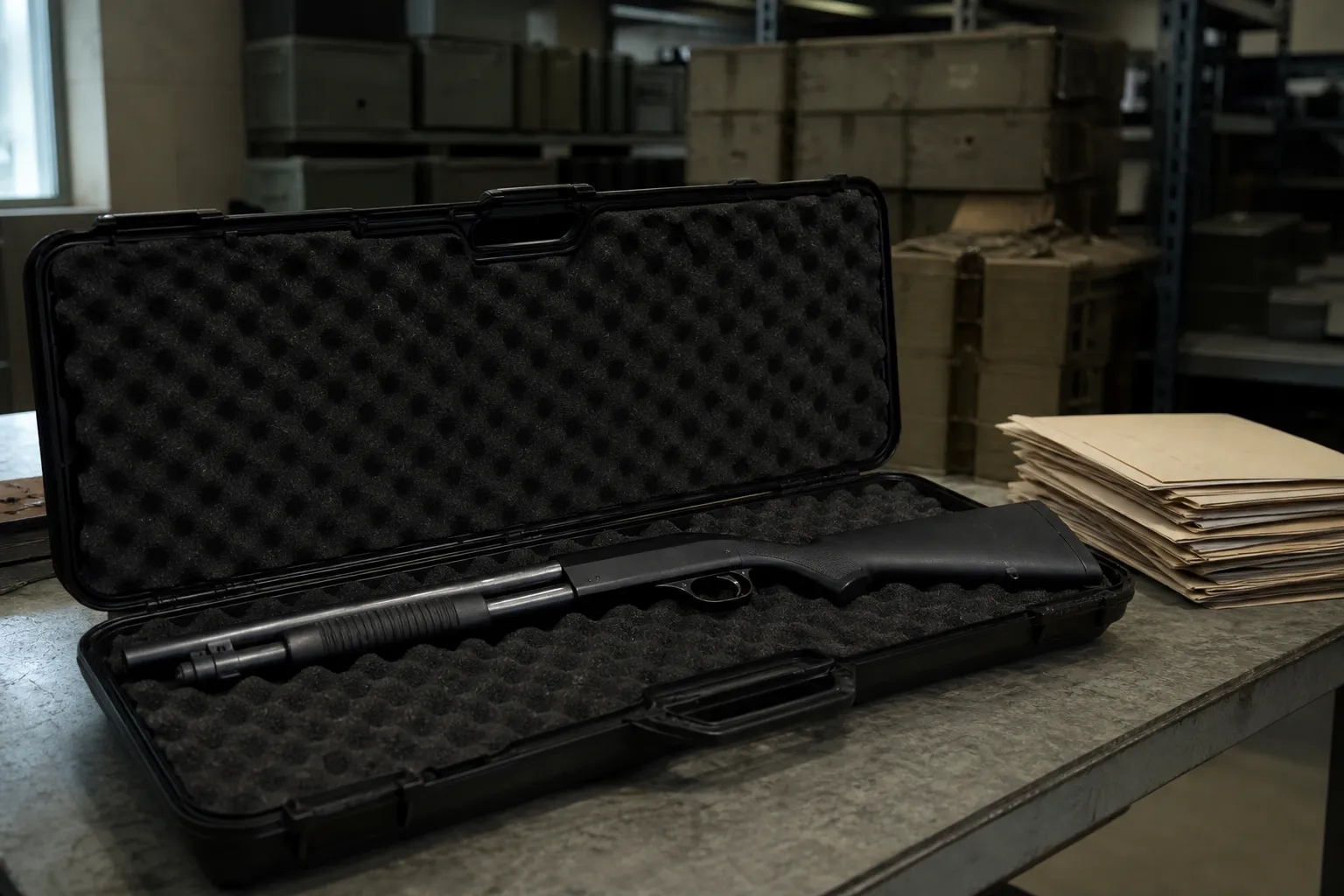
Mossberg also says the 590A1 has been carried by members of every branch of the U.S. Armed Services and by military and law enforcement agencies in more than 70 countries worldwide. That is Mossberg’s claim in its 2025 590A1 Professional Series announcement.
What defines the Mossberg 500 family
The Mossberg 500 family is defined less by one fixed configuration and more by a shared pump-action design language. Mossberg’s materials repeatedly point to twin action bars, dual extractors, an anti-jam elevator, steel-to-steel lock-up, an anodized aluminum receiver, and a top-mounted safety on the traditional 500 platform.
The family also spans sporting, defensive, law enforcement, and military-oriented versions. The 500 is the foundation. The 590 is a 500-platform branch with an easy-cleanout magazine tube design in Mossberg’s cited materials. The 590A1 is the reinforced military-spec branch, described by Mossberg with heavy-walled barrels and metal trigger guard and safety parts.
Owners should check the exact model marking, gauge, chamber marking, magazine capacity, barrel marking, and the current Mossberg manual for their individual shotgun. For military history claims, check Mossberg’s official history and the relevant U.S. government records. For any parts, barrel, or choke question, follow the current Mossberg manual rather than assuming compatibility across the family.
Frequently asked questions
When was the Mossberg 500 introduced?
Mossberg’s official history says the Model 500 pump shotgun was introduced in 1962.
What are the main Mossberg 500 platform features?
Mossberg lists non-binding twin action bars, positive steel-to-steel lock-up, an anti-jam elevator, dual extractors, an anodized aluminum receiver, and an ambidextrous top-mounted safety.
What gauges are listed for Mossberg 500 models?
Mossberg’s pump-action manual says 500, 505, and 510 models are designed for factory-loaded 12 gauge, 20 gauge, or .410 shotshells, depending on item number.
How is the 590A1 different from the 590 in Mossberg’s materials?
Mossberg describes the 590A1 as adding a clean-out magazine tube, heavy-walled barrels, and metal trigger guard and safety parts. Mossberg links the 590A1 to military requirements.
Is the Maverick 88 the same as a Mossberg 500?
Mossberg treats the Maverick 88 as a related line, not simply the same gun. Mossberg says Maverick 88 pump-action models share features such as dual extractors and twin action bars, and that Maverick 88 barrels are interchangeable with Mossberg 500 barrels within gauge and capacity.
Sources
- Since 1919...A Look at the Storied History of Mossberg, O.F. Mossberg & SonsOfficial source. Accessed October 23, 2026.
- Owners Manual for 500, 505, 510, 535, 590 and 835 Pump Action Shotguns, O.F. Mossberg & SonsOfficial source. Accessed October 23, 2026.
- Mossberg Introduces 500/590/590A1 L Series Shotguns, O.F. Mossberg & SonsOfficial source. Accessed October 23, 2026.
- Mossberg Introduces 590A1 Professional Series Pump-Action Shotguns, O.F. Mossberg & SonsOfficial source. Accessed October 23, 2026.
- Mossberg Announces 590S Pump-Action Line, O.F. Mossberg & SonsOfficial source. Accessed October 23, 2026.
- Mossberg Introduces 590R and 590RM Shotguns with Rotary Safety Selector, O.F. Mossberg & SonsOfficial source. Accessed October 23, 2026.
- Series Overview, Maverick 88, O.F. Mossberg & SonsOfficial source. Accessed October 23, 2026.
- 500 Shotguns, O.F. Mossberg & SonsOfficial source. Accessed October 23, 2026.
- 590 Shotguns, O.F. Mossberg & SonsOfficial source. Accessed October 23, 2026.
- Maverick 88 Shotguns, O.F. Mossberg & SonsOfficial source. Accessed October 23, 2026.
- Matter of: Mossberg Corporation, File B-274059, U.S. Government Accountability OfficeOfficial source. Accessed October 23, 2026.
- Mossberg M500 and the M590/M90A1 Weapon Systems and Mossberg 500/590 Spare Parts Kits, SAM.gov, U.S. General Services AdministrationOfficial source. Accessed October 23, 2026.
- U.S. Army Technical Manuals Record Referencing TM 9-1005-338-13&P, SAM.gov, U.S. General Services AdministrationOfficial source. Accessed October 23, 2026.
- USAIS 350-6, Expert Infantryman Badge Task Document, U.S. Army Infantry SchoolOfficial source. Accessed October 23, 2026.