Types of Shotguns: Pump, Semi-Auto, Break-Action and More
Shotgun actions describe how a shotgun opens, loads, fires, extracts, ejects, and chambers the next shell. This guide covers break-action, pump-action, semi-automatic, bolt-action, and lever-action shotguns.
By RaiS. Reviewed by RaiS. Published . 7 min read.
Research and drafting were assisted by AI. RaiS checked the facts against the sources below and approved this page.
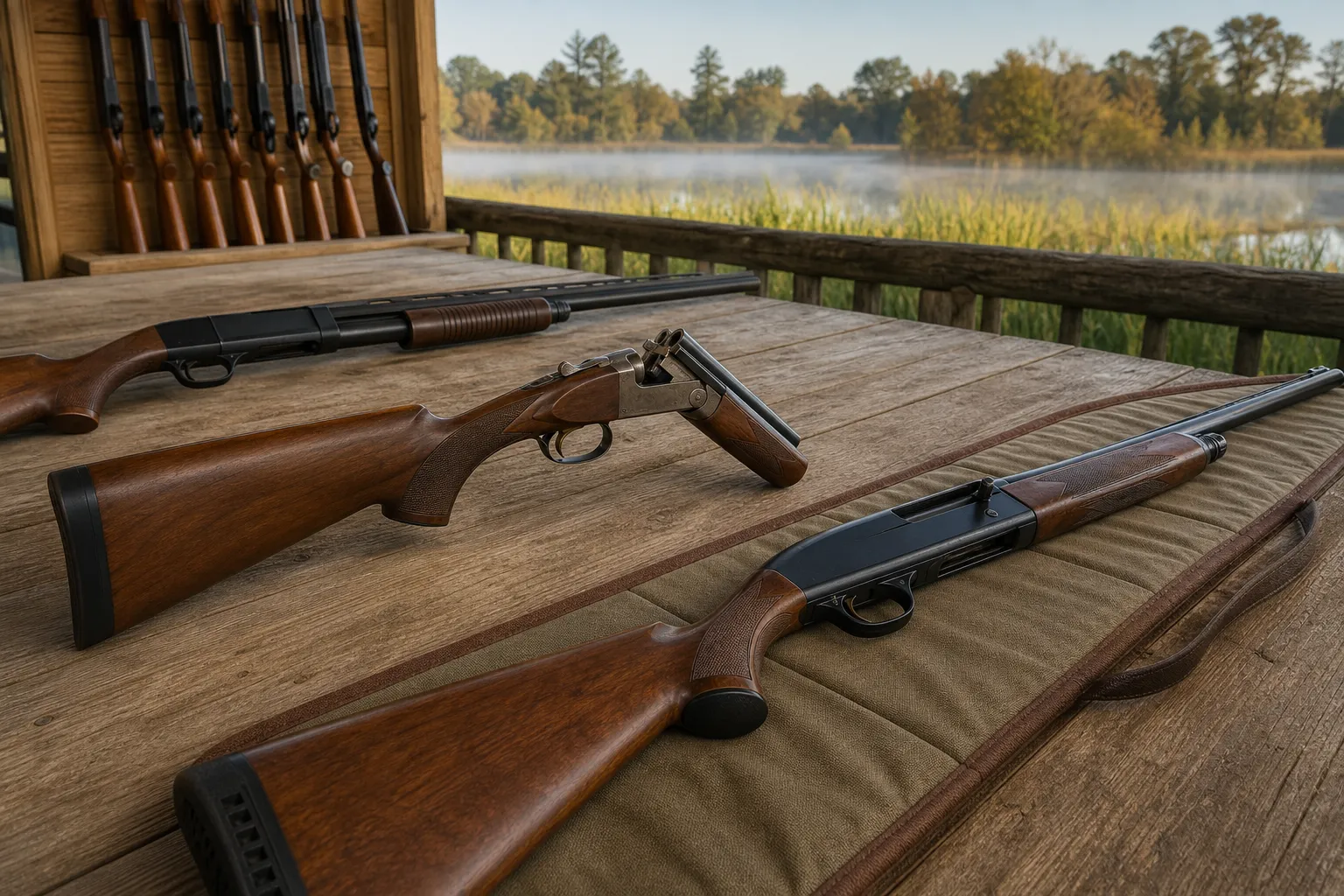
A shotgun’s action is the system that loads, fires, extracts, ejects, and, in repeating designs, chambers the next shell. This guide covers break-action, pump-action, semi-automatic, bolt-action, and lever-action shotguns.
Start with the shared shotgun vocabulary
SAAMI defines a shotgun as a smooth-bore shoulder firearm that usually fires either multiple pellets or a single slug. Before comparing action types, it helps to separate the action from three other terms new shooters often hear: gauge, choke, and load.
SAAMI says gauge is the naming system used for most shotgun bores. The .410 bore is the major exception because it is named by bore diameter rather than by gauge.
SAAMI defines choke as an internal constriction near the muzzle that helps control shot dispersion. In plain English, choke affects how wide or tight the shot pattern is after it leaves the barrel.
Those terms are separate from the action. A pump, semi-automatic, or break-action shotgun can be discussed by gauge and choke, but the action is about how the gun opens, loads, and cycles.
The main shotgun action families
Shotgun actions can be grouped by how they open and cycle. This guide discusses break-action, pump-action, semi-automatic, bolt-action, and lever-action shotguns.
| Action type | How it cycles | Common context from official and shooting-sports references |
|---|---|---|
| Break-action | The barrel or barrels hinge open from the receiver and stock. Shells are loaded directly into the chamber or chambers. | North Dakota Game and Fish describes break or hinge shotguns as commonly used for upland hunting and target shooting. NSCA/NSSA says over-under designs are more popular in skeet, trap, and sporting clays. |
| Pump-action | The shooter manually moves the fore-end. Rearward motion extracts and ejects, and forward motion chambers the next shell. | North Dakota Game and Fish describes pump shotguns as commonly used for turkey, upland, or waterfowl hunting. |
| Semi-automatic | One shell fires with each trigger pull, and the action cycles automatically after firing. | North Dakota Game and Fish describes semi-automatic shotguns as commonly used for waterfowl, upland, and turkey hunting. |
| Bolt-action | The shooter manually turns and slides the bolt to move shells in and out of the chamber. | The 4-H shotgun study resource says slow cycling makes bolt-action shotguns a poor choice for most clay target games. |
| Lever-action | A lever cycles the action. | Another repeating action type discussed below. |
If you are deciding specifically between a pump and a semi-auto, see the separate Pump-Action vs Semi-Automatic Shotguns comparison. For model-specific background, see the Remington 870 and Mossberg 500 pages.
Break-action shotguns
The NSCA and NSSA describe a break-action shotgun as a design in which the barrel or barrels hinge open from the receiver and stock. That simple opening motion is the defining feature.
A break-action shotgun usually has one or two barrels, according to NSCA/NSSA. The common layouts are:
- Single-shot: one barrel and one chamber.
- Side-by-side: two barrels arranged next to each other.
- Over-under: two barrels stacked vertically.
With a break-action, the shooter opens the action and loads shells directly into the chamber or chambers. After firing, opening the action gives access to the fired shell or shells. Some break-actions use extractors, which lift the shell enough to remove by hand. Some use ejectors, which throw the fired shell clear when the gun is opened.
Break-actions are strongly tied to clay sports. The NSCA/NSSA equipment page says over-under designs are more popular in clay sports such as skeet, trap, and sporting clays. North Dakota Game and Fish also describes break or hinge shotguns as commonly used for upland hunting and target shooting.
For skeet in particular, the 2026 NSSA rule book says standard competitions include 12-gauge, 20-gauge, 28-gauge, and .410 bore events. The same rule book says skeet guns must be capable of two shots because a regulation 25-shot round includes four sets of doubles. That is one reason two-barrel break-actions fit many clay-sports settings well.
Pump-action shotguns
A pump-action shotgun is a manually operated repeater. The shooter fires one shell, then moves the fore-end to cycle the action before the next shot.
The Browning BPS manual describes the BPS as a manually operated, slide-action, repeating shotgun. Browning explains that the slide motion unlocks the breech block, extracts and ejects the fired hull, transfers a shell from the magazine to the chamber, and locks the breech block.
Mossberg’s manual for the 500, 505, 510, 535, 590, and 835 pump shotguns describes the same basic user motion in simple terms. Pulling the forearm fully rearward ejects the shotshell case. Pushing the forearm fully forward chambers a live shotshell from the magazine.
That gives the pump its basic cycle:
- Fire one shell.
- Pull the fore-end rearward to unlock, extract, and eject.
- Push the fore-end forward to chamber the next shell.
- The action is ready for the next shot.
North Dakota Game and Fish describes pump shotguns as commonly used for turkey, upland, or waterfowl hunting. Pumps can also be used in clay sports, although the shooter must cycle the fore-end between shots. In games with fast pairs, a two-shot break-action or a semi-automatic may be more convenient because the shooter does not have to manually run a slide between the first and second shot.
Semi-automatic shotguns
A semi-automatic shotgun fires one shell per trigger pull, then cycles the action automatically after firing. In the sources used here, the two operating systems to understand are gas operation and inertia operation.
That “one shell per trigger pull” point matters. Semi-automatic, in this context, does not mean that the gun keeps firing while the trigger is held. It means the action reloads itself after a shot, and the shooter must press the trigger again for the next shot.
North Dakota Game and Fish describes semi-automatic shotguns as commonly used for waterfowl, upland, and turkey hunting.
Gas-operated semi-automatics
Browning describes the Maxus as a gas-operated autoloading shotgun. In Browning’s description, after a shell is fired, the gas system operates the bolt, ejects the fired shell, picks up a shell from the magazine, and chambers it automatically.
A simple gas-operated cycle looks like this:
- The shooter fires one shell.
- The gas system operates the bolt.
- The fired shell is ejected.
- A shell is picked up from the magazine.
- The next shell is chambered automatically.
Inertia-operated semi-automatics
Benelli’s UltraLight manual says Benelli semi-automatic shotguns use inertial operation with a fixed barrel and the kinetic energy of recoil to cycle the action. The same manual says this system requires no gas outlet for operation.
Benelli also states that the inertial system needs a minimum level of kinetic energy to cycle normally. For a beginner, the important distinction is that an inertia-operated shotgun uses recoil energy as part of the cycling system, while a gas-operated shotgun uses a gas system to operate the bolt.
A simple inertia-operated cycle looks like this:
- The shooter fires one shell.
- Recoil energy operates the action.
- The fired shell is extracted and ejected.
- The action chambers the next shell.
- The shooter must press the trigger again for another shot.
Bolt-action shotguns
Bolt-action shotguns use a manual bolt system. The 4-H shotgun study resource says a bolt-action shotgun ejects by lifting and drawing back the bolt, then loads by pushing the bolt forward and rotating the handle down.
The 4-H shotgun study resource says bolt-action shotguns are suitable for many types of hunting, but slow cycling makes them a poor choice for most clay target games.
For a new shooter, the takeaway is that bolt-action shotguns are deliberate, manual actions. They are not the usual first picture that comes to mind for skeet, trap, or sporting clays.
Lever-action shotguns
Lever-action shotguns use a lever to cycle the action.
A lever-action shotgun uses a lever to cycle the action.
This category is worth recognizing as another shotgun action type. Most beginner comparisons focus first on break-action, pump-action, and semi-automatic designs because those action types appear throughout the hunting and clay-sports examples above.
Typical uses in hunting and clay sports
For hunting, North Dakota Game and Fish gives a useful beginner-level snapshot. It describes pump shotguns as commonly used for turkey, upland, or waterfowl hunting. It describes semi-automatic shotguns as commonly used for waterfowl, upland, and turkey hunting. It describes break or hinge shotguns as commonly used for upland hunting and target shooting.
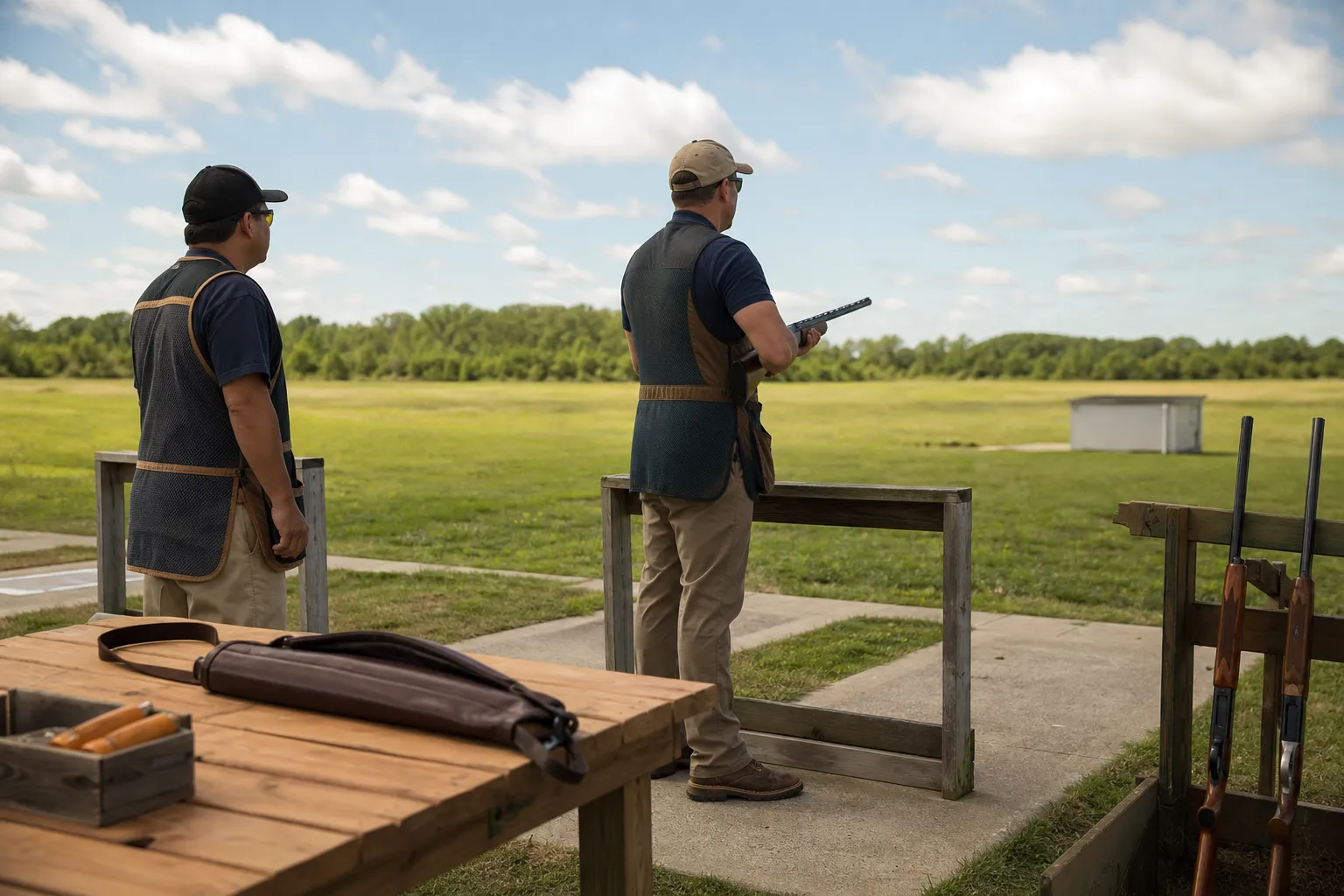
For clay sports, NSCA/NSSA says over-under designs are more popular in skeet, trap, and sporting clays.
Skeet adds one important equipment point. The 2026 NSSA rule book says a regulation 25-shot round includes four sets of doubles, so skeet guns must be capable of firing two shots. That requirement can be met by more than one action type, but it explains why single-shot shotguns are not the standard tool for a regulation skeet round.
Which action should a beginner study first?
Start with break-action, pump-action, and semi-automatic shotguns because they cover most of the hunting and clay-sports examples described above.
A simple way to remember them is:
- Break-action: open the gun at the hinge and load directly into the chamber or chambers.
- Pump-action: move the fore-end rearward and forward to eject and reload.
- Semi-automatic: fire one shell per trigger pull, while the action cycles itself after each shot.
- Bolt-action: lift, pull, push, and turn the bolt to eject and load.
- Lever-action: operate a lever to cycle the action.
Before using any shotgun for hunting or competition, confirm the current rules with the wildlife agency, range, club, or sanctioning body for the place and event. Gauge, shell, shot, magazine, choke, and action requirements can depend on the specific season, location, and game or clay-sports rule book.
Frequently asked questions
What are the main types of shotgun actions?
This guide covers break-action, pump-action, semi-automatic, bolt-action, and lever-action shotguns.
How does a pump-action shotgun cycle?
The shooter cycles it manually with the fore-end. Mossberg describes pulling the forearm fully rearward to eject the shotshell case and pushing it fully forward to chamber a live shell from the magazine.
What is the difference between gas and inertia semi-automatic shotguns?
In Browning’s gas-operated description, the gas system operates the bolt, ejects the fired shell, and chambers the next shell. Benelli describes inertia operation as using a fixed barrel and recoil energy to cycle the action, with no gas outlet required.
Why are over-under shotguns common in clay sports?
NSCA/NSSA says over-under designs are more popular in skeet, trap, and sporting clays. The 2026 NSSA rule book also says skeet guns must be capable of two shots because a regulation round includes four sets of doubles.
Are bolt-action shotguns common for clay target games?
The 4-H shotgun study resource says bolt-action shotguns can be suitable for many types of hunting, but their slow cycling makes them a poor choice for most clay target games.
Is .410 a gauge?
SAAMI says gauge identifies most shotgun bores, while .410 bore is an exception to that naming system.
Sources
- SHOTGUN, Sporting Arms and Ammunition Manufacturers' InstituteOfficial source. Accessed October 26, 2026.
- GAUGE, Sporting Arms and Ammunition Manufacturers' InstituteOfficial source. Accessed October 26, 2026.
- CHOKE, Sporting Arms and Ammunition Manufacturers' InstituteOfficial source. Accessed October 26, 2026.
- Equipment, National Skeet Shooting Association / National Sporting Clays AssociationOfficial source. Accessed October 26, 2026.
- Owner’s Manual for 500, 505, 510, 535, 590 and 835 Pump Action Shotguns, O.F. Mossberg & Sons, Inc.Official source. Accessed October 26, 2026.
- Browning BPS Pump Shotgun Owner's Manual, BrowningOfficial source. Accessed October 26, 2026.
- Maxus Owner's Manual, BrowningOfficial source. Accessed October 26, 2026.
- Benelli UltraLight Manual, Benelli USAOfficial source. Accessed October 26, 2026.
- B-LINK, BerettaOfficial source. Accessed October 26, 2026.
- Firearms, General Information, North Dakota Game and Fish DepartmentOfficial source. Accessed October 26, 2026.
- 2026 NSSA Rule Book, National Skeet Shooting AssociationOfficial source. Accessed October 26, 2026.
- National 4-H Shooting Sports Quiz Bowl Shotgun Study Resources, University of Alaska Fairbanks Cooperative Extension Service / 4-H. Accessed October 26, 2026.
- A Break Down of Different Firearm Action Types, Savage ArmsOfficial source. Accessed October 26, 2026.
- Henry .410 Lever Action Series User Manual, Henry Repeating ArmsOfficial source. Accessed October 26, 2026.