Gas vs Inertia Semi-Automatic Shotguns: How the Systems Differ
Gas and inertia semi-automatic shotguns both use energy from a fired shell to cycle the action, but they use it in different places. Gas systems tap propellant gas to move operating parts, while inertia systems use recoil energy stored in a spring within the bolt assembly.
By RaiS. Reviewed by RaiS. Published . 7 min read.
Research and drafting were assisted by AI. RaiS checked the facts against the sources below and approved this page.
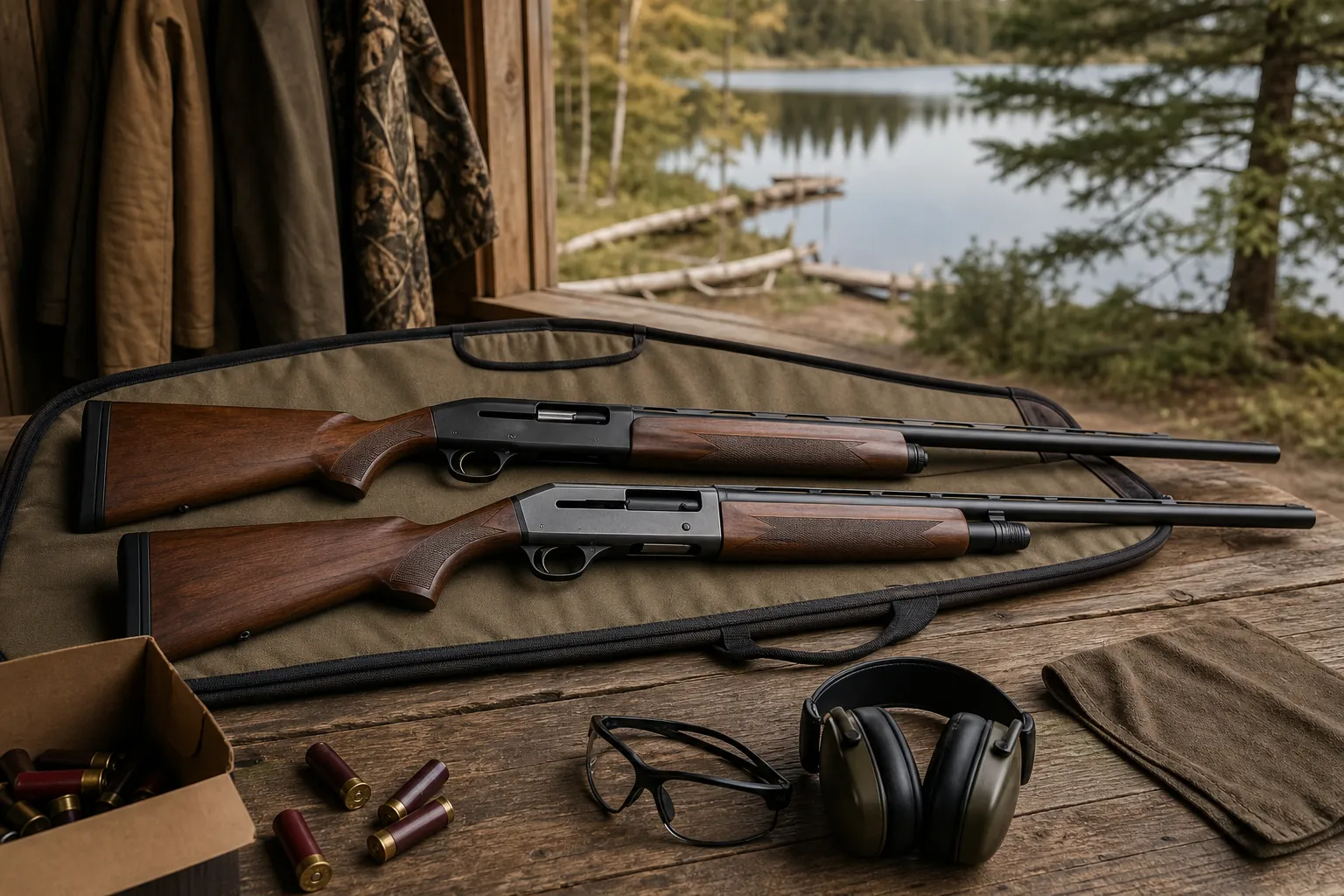
Gas and inertia semi-automatic shotguns differ in how they take energy from a fired shell to cycle the action. A gas-operated shotgun taps expanding gas through barrel ports to move a piston or related operating parts. An inertia-operated shotgun uses recoil energy, with a bolt assembly and spring delaying opening, then driving the cycle. Neither system is automatically “best.” The useful comparison is how each works, what parts are involved, and what each manufacturer says about load range, cleanliness and manual-based care.
For the bigger action-category picture, see Types of Shotguns: Pump, Semi-Auto, Break-Action and More and Pump-Action vs Semi-Automatic Shotguns: How They Differ.
Quick comparison
| Topic | Gas-operated semi-auto shotgun | Inertia-operated semi-auto shotgun |
|---|---|---|
| Energy source | The National Institute of Justice describes gas operation as using expanding gas from a fired cartridge to drive a piston. | Benelli manuals describe inertial operation as using the kinetic energy of gun recoil. |
| How energy enters the action | NIJ states that many gas-operated firearms use ported barrels to bleed off gas. Browning’s Silver manual describes gas passing through two barrel ports into the gas piston. | The Benelli inertia patent record describes a bolt assembly operating in inertial mode using recoil energy. |
| Typical operating parts named by manufacturers | Beretta’s semiauto manual lists gas-system parts such as a gas piston, gas cylinder and valve assembly. Browning’s Silver manual names a sleeve bar push rod that forces the bolt rearward. | The Benelli inertia patent record names a floating bolt element, rotatable locking bolt head and return spring. |
| Manufacturer-stated load behavior | Browning says its Active Valve system diverts more gas to run light loads and uses less gas with magnum loads. | Benelli’s Super Black Eagle 3 manual says the inertial system requires a minimum level of kinetic energy and tells users to choose ammunition powerful enough to fully cycle the action. |
| Care cautions | Beretta’s semiauto manual cautions users not to strip the valve spring or retaining nut. | Benelli manuals emphasize ammunition that provides enough energy for normal cycling. |
How a gas-operated semi-auto shotgun cycles
A gas-operated shotgun uses propellant gas after the shell fires. NIJ describes the general principle as expanding gas from the cartridge driving a piston, and notes that many gas-operated firearms use barrel ports to bleed off gas. NIJ also explains that a gas piston may use either a short or long stroke.
Browning’s Silver owner’s manual gives a shotgun-specific example. Browning identifies the Silver as a gas-operated autoloading shotgun. In that design, gases pass through two ports in the barrel into the gas piston. The manual says the sleeve bar push rod forces the bolt to the rear. Browning states that this rearward bolt travel cocks the hammer and ejects the fired shell.
Beretta’s semiauto manual for A400 models lists gas-system parts including the gas piston, gas cylinder and valve assembly.
The important point is that “gas operated” is not one exact mechanical layout. The common idea is the use of gas pressure from the fired shell to move operating parts. The named parts, valve layout and service instructions are model specific.
Gas-system tradeoffs manufacturers describe
Manufacturers often discuss gas systems in terms of load handling, but their wording is system specific. Browning says its Active Valve system uses gas from fired shells to operate the action instead of recoil. Browning also says Active Valve diverts most of the gases when shooting light loads, while using less gas with magnum loads.
That manufacturer description separates the cycling system from the shooter’s shoulder movement. This does not mean every gas shotgun will behave the same with every shell. It means Browning describes this system as using gas operation rather than requiring recoil energy for the reload cycle.
Gas systems also include parts that manage combustion gas. Beretta’s A400 manual lists the gas piston, gas cylinder and valve assembly. Browning says its Active Valve system vents excess gas out the top of the forearm and away from the action. Beretta describes its valve device as self-cleaning and requiring no maintenance, while also cautioning users not to strip the valve spring or retaining nut.
For a reader comparing models, that means the owner’s manual matters. Normal care should follow the manual for that exact shotgun. Do not assume that one manufacturer’s valve, piston or gas cylinder instructions apply to another model.
How an inertia-operated semi-auto shotgun cycles
An inertia-operated shotgun uses recoil energy rather than tapped barrel gas. Benelli manuals describe inertial operation as using the kinetic energy of gun recoil.
Benelli describes key bolt parts in simple terms. The Benelli M2 manual describes a spring positioned between the locking head and bolt. The Benelli inertia patent record describes a bolt assembly operating in inertial mode using recoil energy and identifies a floating bolt element, rotatable locking bolt head and return spring.
The M2 manual also gives a useful detail about timing. It says the inert breech bolt moves about 4 mm forward during firing. Benelli says spring pressure delays opening and compensates for cartridge-pressure differences without adjustment.
Browning describes a similar recoil-energy concept in its A5 Kinematic Drive materials. Browning says the A5’s Kinematic Drive stores recoil energy in an internal spring. Browning also says that the spring rebounds and sends the bolt slide rearward to unlock and cycle the action. Browning’s A5 owner’s manual describes the A5 as a recoil-operated autoloading shotgun.
The terms are not always identical across brands. Benelli uses “Inertia Driven,” while Browning uses “Kinematic Drive” for the A5. Both manufacturer descriptions center on recoil energy and a spring-powered bolt cycle rather than gas ports in the barrel.
Inertia-system tradeoffs manufacturers describe
The main caution in Benelli’s manuals is energy. The Super Black Eagle 3 manual states that the inertial system requires a minimum level of kinetic energy for normal cycling. It also tells users to choose ammunition powerful enough to fully cycle the action.
That is the key comparison point with gas operation. Gas systems described by Browning use gas pressure to drive the action. Inertia systems described by Benelli and Browning use recoil energy stored and released through the bolt assembly. If the shotgun, ammunition and conditions do not provide the minimum energy required by the design, Benelli’s manual warns that normal cycling depends on ammunition powerful enough for the action.
Load choice, shell length and model fit
Load range is one of the first practical questions readers ask about semi-auto shotguns. Browning says Active Valve sends more gas to operate light loads and uses less gas with magnum loads. Benelli’s Super Black Eagle 3 manual says inertia operation requires a minimum level of kinetic energy and ammunition powerful enough to fully cycle the action.
Those statements should not be stretched into a universal rule for all gas or all inertia shotguns. They are manufacturer statements about particular systems. Gauge, chambering and shell length also matter when choosing ammunition for a shotgun. For background on those separate topics, see Shotgun Gauges Explained and Shotgun Shell Length Explained.
Maintenance and normal care
The safest maintenance comparison is narrow: follow the manual for the exact model. Gas shotguns have gas-system parts named in manuals, and Beretta lists parts such as a gas piston, gas cylinder and valve assembly. Beretta also cautions users not to strip the valve spring or retaining nut, while describing the valve device as self-cleaning and requiring no maintenance.
Inertia shotguns are still mechanical systems with model-specific manual requirements. Benelli manuals emphasize having enough kinetic energy for normal cycling.
For general safety practices around firearm cleaning, see How to Clean a Gun Safely. For the operating system itself, use the maker’s manual and do not apply maintenance steps from one design to another.
A short history note
Gas and inertia semi-auto shotguns both have long-running production examples. Browning’s A5 owner’s manual describes the modern A5 as a recoil-operated autoloading shotgun, and Browning’s Kinematic Drive description explains its recoil-energy spring cycle.

Benelli’s inertia patent record describes a bolt assembly operating in inertial mode using kinetic recoil energy. That record identifies the main elements as a floating bolt element, a rotatable locking bolt head and a return spring.
Which system should you choose?
Choose by model, ammunition requirements and the manufacturer’s manual, not by a blanket ranking. A gas system may appeal to readers who want the manufacturer-stated benefits of gas operation and load-adaptive gas management. An inertia system may appeal to readers who want a design centered on recoil energy stored and released through the bolt assembly.
Before buying or using any semi-auto shotgun, check the current owner’s manual for the exact model. Confirm the required ammunition, shell length, cleaning instructions, gas-system warnings if applicable, and any break-in or function guidance the manufacturer publishes for that shotgun.
Frequently asked questions
What is the basic difference between gas and inertia semi-auto shotguns?
Gas-operated shotguns use expanding gas from the fired shell to move operating parts. Inertia-operated shotguns use recoil energy stored and released through a bolt assembly and spring.
Do gas-operated shotguns need recoil to reload?
Browning describes Active Valve as using gas from fired shells to operate the action instead of recoil.
What parts are involved in an inertia system?
The Benelli inertia patent record identifies a floating bolt element, rotatable locking bolt head and return spring.
Can an inertia shotgun cycle any load?
Benelli’s Super Black Eagle 3 manual says the inertial system requires a minimum level of kinetic energy for normal cycling and tells users to choose ammunition powerful enough to fully cycle the action.
Should I disassemble a gas valve for cleaning?
Follow the manual for the exact shotgun. Beretta’s semiauto manual cautions users not to strip the valve spring or retaining nut and describes the valve device as self-cleaning and requiring no maintenance.
Sources
- A5 Shotgun Owner’s Manual, BrowningOfficial source. Accessed November 2, 2026.
- Firearms Examiner Training, Semiautomatic and Automatic, National Institute of JusticeOfficial source. Accessed November 2, 2026.
- Silver Shotgun Owner’s Manual, BrowningOfficial source. Accessed November 2, 2026.
- Active Valve, Semi-Auto Gas System, BrowningOfficial source. Accessed November 2, 2026.
- B-LINK, BerettaOfficial source. Accessed November 2, 2026.
- Semiauto Shotgun User Manual, MANO088/002, BerettaOfficial source. Accessed November 2, 2026.
- M2 Field Product Manual, Benelli USAOfficial source. Accessed November 2, 2026.
- 2022 Dealer Workbook, Benelli USAOfficial source. Accessed November 2, 2026.
- Super Black Eagle 3 Product Manual, Benelli USAOfficial source. Accessed November 2, 2026.
- Kinematic Drive, A5 Shotguns, BrowningOfficial source. Accessed November 2, 2026.
- US4604942A, Bolt assembly with a rotating locking bolt head and a floating bolt element for automatic firearms, Google Patents, United States patent record. Accessed November 2, 2026.
- Model 1100 History, RemArmsOfficial source. Accessed November 2, 2026.