How to Clean a Gun Safely
To clean a gun safely, unload it first, verify the chamber, keep all ammunition away from the cleaning area, and follow the owner’s manual for that exact firearm. Use a clear, well ventilated workspace, correct size cleaning tools, eye protection, firearm solvent, light gun oil, and secure storage afterward.
By RaiS. Reviewed by RaiS. Published . 7 min read.
Research and drafting were assisted by AI. RaiS checked the facts against the sources below and approved this page.
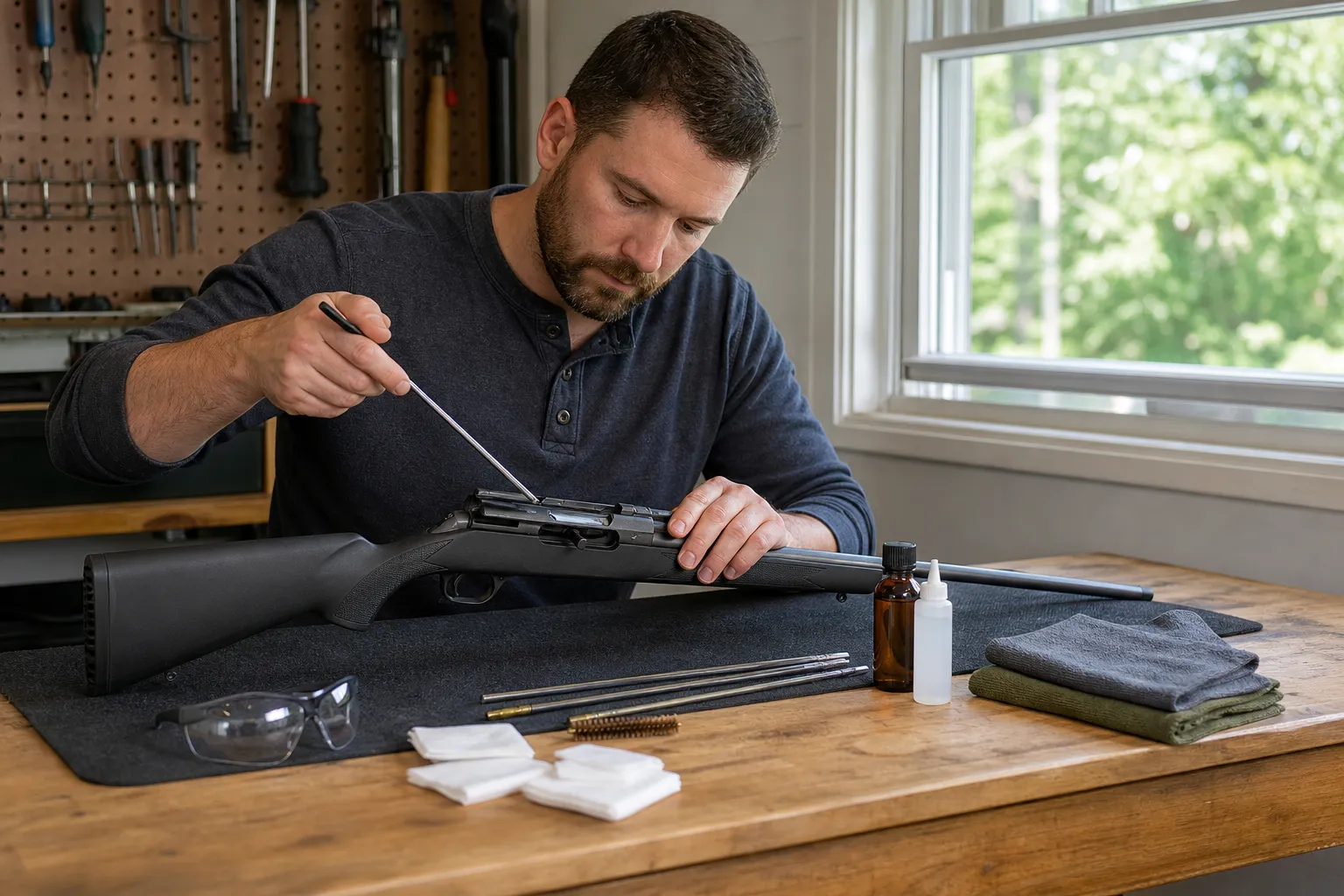
To clean a gun safely, start by unloading it and verifying it is unloaded before any cleaning begins. Keep the muzzle pointed in a safe direction, keep your finger off the trigger, open the action or breech, and check the chamber. Keep all ammunition away from the cleaning area, then follow the owner’s manual for disassembly, cleaning, lubrication, and reassembly for that specific firearm.
Safety first, before any cleaning
The first cleaning step is not solvent or a brush. It is making the firearm safe to handle.
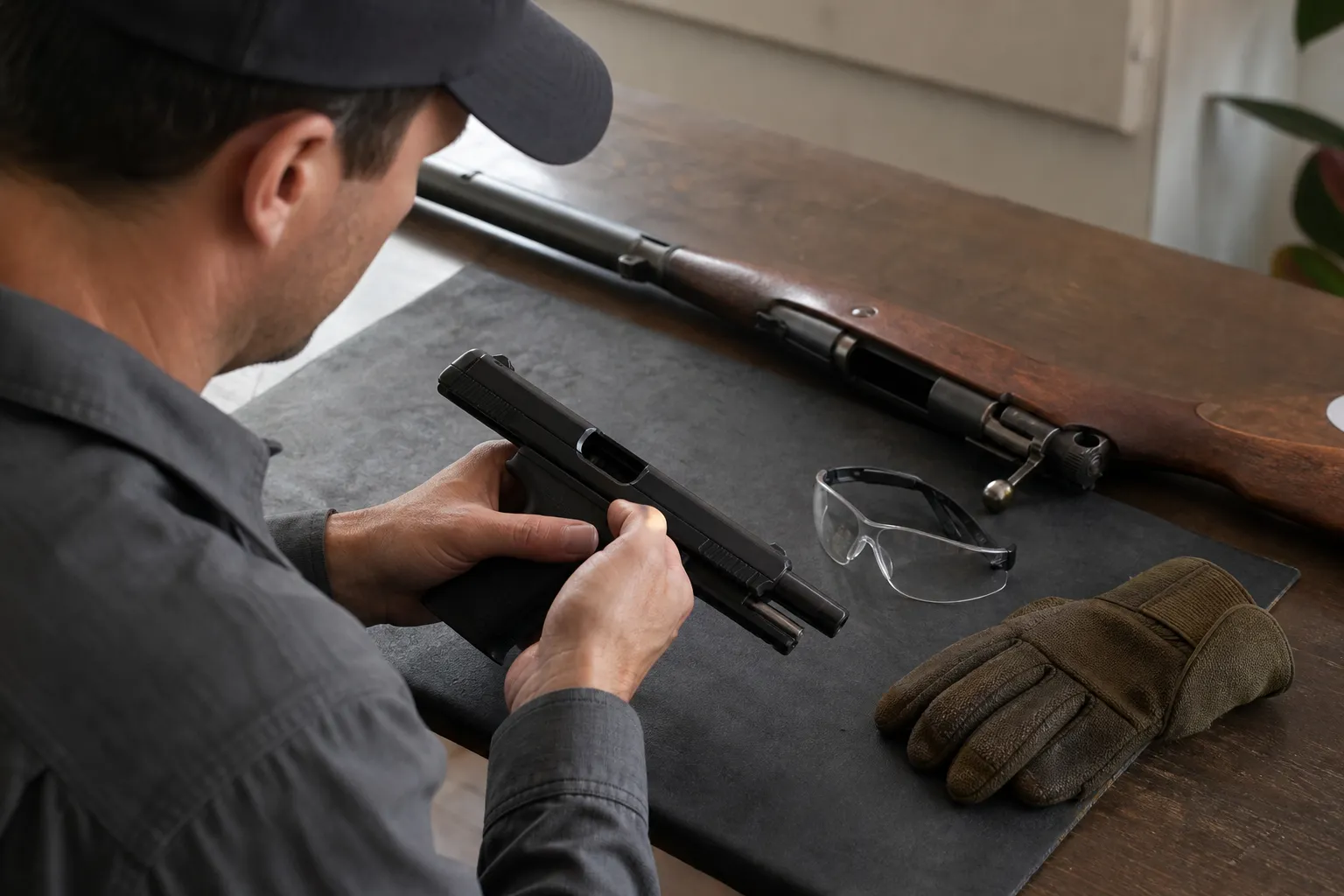
NSSF gives a similar handling rule in another form: whenever you handle a firearm or hand it to someone, open the action immediately and visually check the chamber, receiver, and magazine. NSSF
A safe cleaning routine starts like this:
- Point the muzzle in a safe direction.
- Keep your finger off the trigger and outside the trigger guard.
- Follow the owner’s manual to unload the firearm.
- Open the action or breech when the manual allows.
- Visually check the chamber, receiver, and magazine.
- Keep treating the firearm as if it were loaded, even after checking.
Texas Parks and Wildlife states the same starting point for cleaning: before cleaning any firearm, point the muzzle in a safe direction and check to be sure it is unloaded. Texas Parks and Wildlife
Keep ammunition out of the cleaning area
The cleaning area should contain the firearm, cleaning tools, solvent, lubricant, and protective equipment. It should not contain ammunition. Texas Parks and Wildlife says, “There should be no ammunition in the cleaning area.” Winchester’s Model 94 manual also says to keep ammunition away from the cleaning location and never test the mechanical function of any firearm with live ammunition. Texas Parks and Wildlife, Winchester Model 94 manual
This rule matters because cleaning involves handling the action, chamber, barrel, and other parts of the firearm. Removing ammunition from the area helps keep the cleaning job separate from loading, function checking with live ammunition, or range use.
Set up a clear, well ventilated workspace
Use a work area where you can stay focused. Texas Parks and Wildlife recommends working undistracted in a well ventilated area. NSSF states that cleaning firearms or handling ammunition may result in exposure to lead and other substances, and recommends ventilation and hand washing after exposure. Texas Parks and Wildlife, NSSF Firearm Safety Depends on You
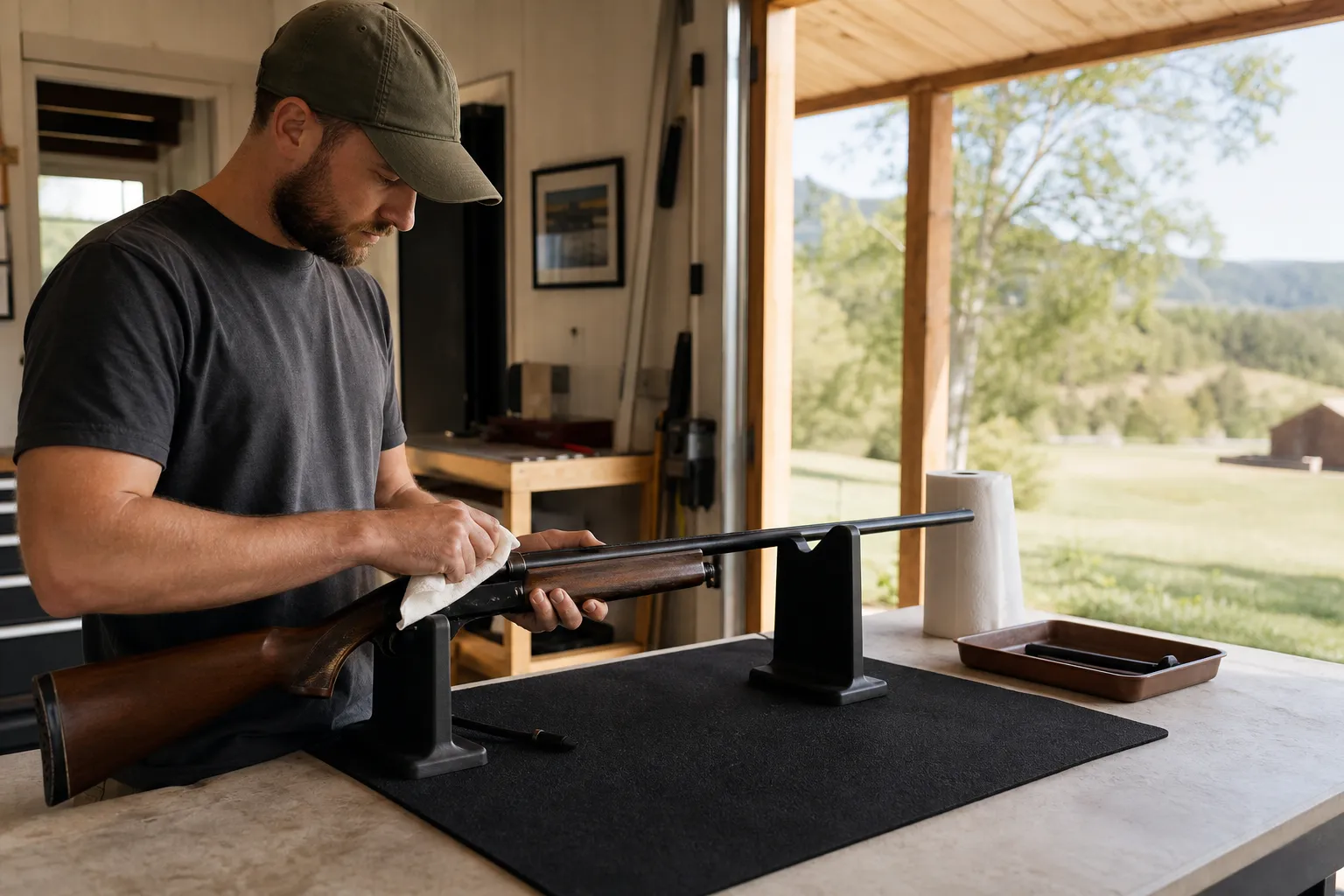
Follow the label and safety data sheet for the solvent or cleaner you use.
NSSF also recommends eye protection when disassembling and cleaning any gun because springs, spring tension parts, solvents, or other agents can contact your eyes. NSSF Firearm Safety Depends on You
Basic cleaning supplies
Use cleaning tools that match the firearm. Texas Parks and Wildlife says to buy a cleaning kit and accessories that are the correct size for the firearm, and warns that equipment made for a different caliber or gauge can damage the firearm. Texas Parks and Wildlife
A basic cleaning setup commonly includes:
| Supply | Purpose in a general routine | |, -|, -| | Cleaning rod | Holds a brush, patch holder, or jag for bore cleaning | | Bore brush | Used when fouling is heavy | | Patch holder or jag | Holds cleaning patches | | Clean patches | Used with solvent, then dry, then lightly oiled | | Firearm solvent | Used to help clean the bore and other areas the manual allows | | Light gun oil | Used for light oiling and lubrication points specified by the manual |
Texas Parks and Wildlife recommends using commercial solvents and gun oils specifically manufactured for firearms. Texas Parks and Wildlife
Follow the owner’s manual before disassembly
Do not guess how your firearm comes apart. NSSF says you should always read and refer to the instruction manual you received with your gun, and contact the manufacturer for a replacement copy if needed. NSSF Firearm Safety Depends on You
Manufacturer instructions vary by model. GLOCK says each time you clean a GLOCK pistol, it should be field stripped, and also tells owners to check the manual for their model for where to apply lubricant and how much to apply. Winchester’s Model 94 manual warns owners not to take the rifle apart further than the manual explains. GLOCK, Winchester Model 94 manual
For a beginner, the safest rule is simple: clean only as far as the manual describes for routine cleaning. If the manual does not tell you to remove a part, do not remove it as part of basic cleaning.
General bore cleaning routine
Texas Parks and Wildlife recommends cleaning the bore from the breech end when possible, using a bore guide. It describes using solvent moistened patches, a brush if the firearm is very dirty, clean patches, and then a lightly oiled patch. It also says to alternate passes of solvent moistened and clean patches through the barrel until a clean patch emerges. Texas Parks and Wildlife
A general, manual guided routine looks like this:
- Confirm the firearm is unloaded and ammunition is not in the cleaning area.
- Follow the owner’s manual for any routine disassembly or field stripping.
- When possible, clean the bore from the breech end using a bore guide.
- Run solvent moistened patches through the bore.
- Use a correctly sized bore brush if fouling is heavy.
- Alternate solvent moistened and clean patches until a clean patch emerges.
- Finish the bore with a lightly oiled patch.
- Inspect the bore and chamber afterward.
Winchester’s XPR manual specifically says to inspect the barrel and chamber after cleaning to make sure no patches have inadvertently been left in them. Winchester XPR manual
Lubrication: light oil, in the places the manual specifies
Lubrication is not a place to improvise. GLOCK says proper cleaning and lubrication helps prevent corrosion and removes accumulated dirt and debris that can affect a pistol’s operation. GLOCK also warns that too much lubrication can affect pistol performance, and tells owners to check the manual for the correct lubrication points and amount. GLOCK
Texas Parks and Wildlife describes cleaned firearms as being stored after a light oiling. That matches the general principle: use light lubrication, use products made for firearms, and follow the owner’s manual for where and how much lubricant to apply. Texas Parks and Wildlife
How often should you clean a gun?
Texas Parks and Wildlife says firearms should be cleaned after each use. Project ChildSafe says to always unload, clean, and place firearms in secure storage immediately after returning from a hunting trip or a day at the range. Texas Parks and Wildlife, Project ChildSafe
Manufacturer guidance may be more specific for a particular model. Winchester’s XPR manual says to clean the firearm after every day of shooting, and more often if it becomes excessively dirty. Texas Parks and Wildlife also says that after hunting in wet and muddy conditions, a thorough cleaning is necessary, and that this may require partial disassembly according to the owner’s manual. Winchester XPR manual, Texas Parks and Wildlife
Use those sources together: clean after use, clean after a range day or hunt, clean more thoroughly when the firearm becomes excessively dirty, and follow the schedule and procedure in the manual for your exact model.
What not to do while cleaning
Routine cleaning is not gunsmithing. NSSF warns not to alter the trigger, safety, or other mechanism of any firearm, and not to allow unqualified repairs or modifications. Winchester’s Model 94 manual says not to disassemble the rifle beyond what the manual explains, and to use an authorized repair center or competent gunsmith when further work is required. NSSF Firearm Safety Depends on You, Winchester Model 94 manual
Avoid these mistakes:
- Do not clean with ammunition in the work area.
- Do not skip the unloading check.
- Do not use the wrong caliber or gauge cleaning tools.
- Do not over lubricate.
- Do not disassemble beyond the owner’s manual.
- Do not modify triggers, safeties, or other mechanisms.
- Do not test mechanical function with live ammunition.
Store the firearm securely after cleaning
After cleaning and light oiling, Texas Parks and Wildlife says to store firearms in a secure place under locked conditions, with ammunition stored separately from firearms. Project ChildSafe also says to unload, clean, and place firearms in their secure storage location immediately after a hunting trip or a day at the range. Texas Parks and Wildlife, Project ChildSafe
Before putting the firearm away, confirm that no patch or obstruction remains in the barrel or chamber, as Winchester’s XPR manual instructs. Then secure the firearm and store ammunition separately according to the safety guidance above. Winchester XPR manual
Final checks with official sources
For any firearm you clean, check the owner’s manual for the exact unloading check, field stripping steps, cleaning points, lubrication points, lubricant quantity, and reassembly procedure. If the manual is missing, NSSF says to contact the manufacturer for a replacement copy. For solvents and oils, check the product label and safety data sheet for ventilation, eye protection, and other protective equipment guidance.
Frequently asked questions
What is the first step in cleaning a gun?
Unload and verify first. Point the muzzle in a safe direction, keep your finger off the trigger, follow the owner’s manual to unload the firearm, open the action when the manual allows, and visually check the chamber, receiver, and magazine.
Should ammunition be in the room while I clean a gun?
No. Texas Parks and Wildlife says there should be no ammunition in the cleaning area. Winchester’s Model 94 manual also says to keep ammunition away from the cleaning location and never test mechanical function with live ammunition.
What basic tools do I need to clean a gun?
A general cleaning setup includes a correct size cleaning rod, bore brush, patch holder or jag, clean patches, firearm solvent, and light gun oil. Texas Parks and Wildlife says to use cleaning kits and accessories that are the correct size for the firearm and to use commercial solvents and gun oils made for firearms.
Which direction should I clean the barrel?
Texas Parks and Wildlife recommends cleaning the bore from the breech end when possible, using a bore guide.
How often should I clean my gun?
Texas Parks and Wildlife says firearms should be cleaned after each use. Project ChildSafe says to unload, clean, and securely store firearms after a hunting trip or range day. Always check the manual for the schedule for your specific firearm.
Can cleaning include modifications or extra disassembly?
No. NSSF warns not to alter triggers, safeties, or other mechanisms. Winchester’s Model 94 manual says not to disassemble beyond what the manual explains and to use an authorized repair center or competent gunsmith when further work is required.
Sources
- Firearm Safety, 10 Rules of Safe Gun Handling, National Shooting Sports FoundationOfficial source. Accessed October 20, 2026.
- Learn About Firearms Safety and Security, Bureau of Alcohol, Tobacco, Firearms and ExplosivesOfficial source. Accessed October 20, 2026.
- Firearm Safety Depends on You, National Shooting Sports FoundationOfficial source. Accessed October 20, 2026.
- In Your Home, Project ChildSafeOfficial source. Accessed October 20, 2026.
- Firearms Cleaning and Maintenance, Texas Parks and Wildlife DepartmentOfficial source. Accessed October 20, 2026.
- Cleanliness: A Guide to Firearm Maintenance, Mississippi State University Extension Service. Accessed October 20, 2026.
- Caring for Your GLOCK, GLOCKOfficial source. Accessed October 20, 2026.
- Model 94 Cross Bolt Safety Rifle Owner's Manual, Winchester Repeating ArmsOfficial source. Accessed October 20, 2026.
- XPR Owner's Manual, Winchester Repeating ArmsOfficial source. Accessed October 20, 2026.
- Canadian Firearms Safety Course 2008, Royal Canadian Mounted Police, Canadian Firearms ProgramOfficial source. Accessed October 20, 2026.
- Hoppe's No 9 Plus Safety Data Sheet, Hoppe's. Accessed October 20, 2026.