Gun Safe Humidity Explained: Rust Prevention, Desiccants and Dehumidifiers
Gun safe humidity matters because moisture supports metal corrosion, while very dry or unstable storage can harm wood and other organic materials. A practical target for many mixed firearm collections is about 40 to 55 percent relative humidity, managed with safe placement, desiccants, heated rods, and regular inspections.
By RaiS. Reviewed by RaiS. Published . 7 min read.
Research and drafting were assisted by AI. RaiS checked the facts against the sources below and approved this page.
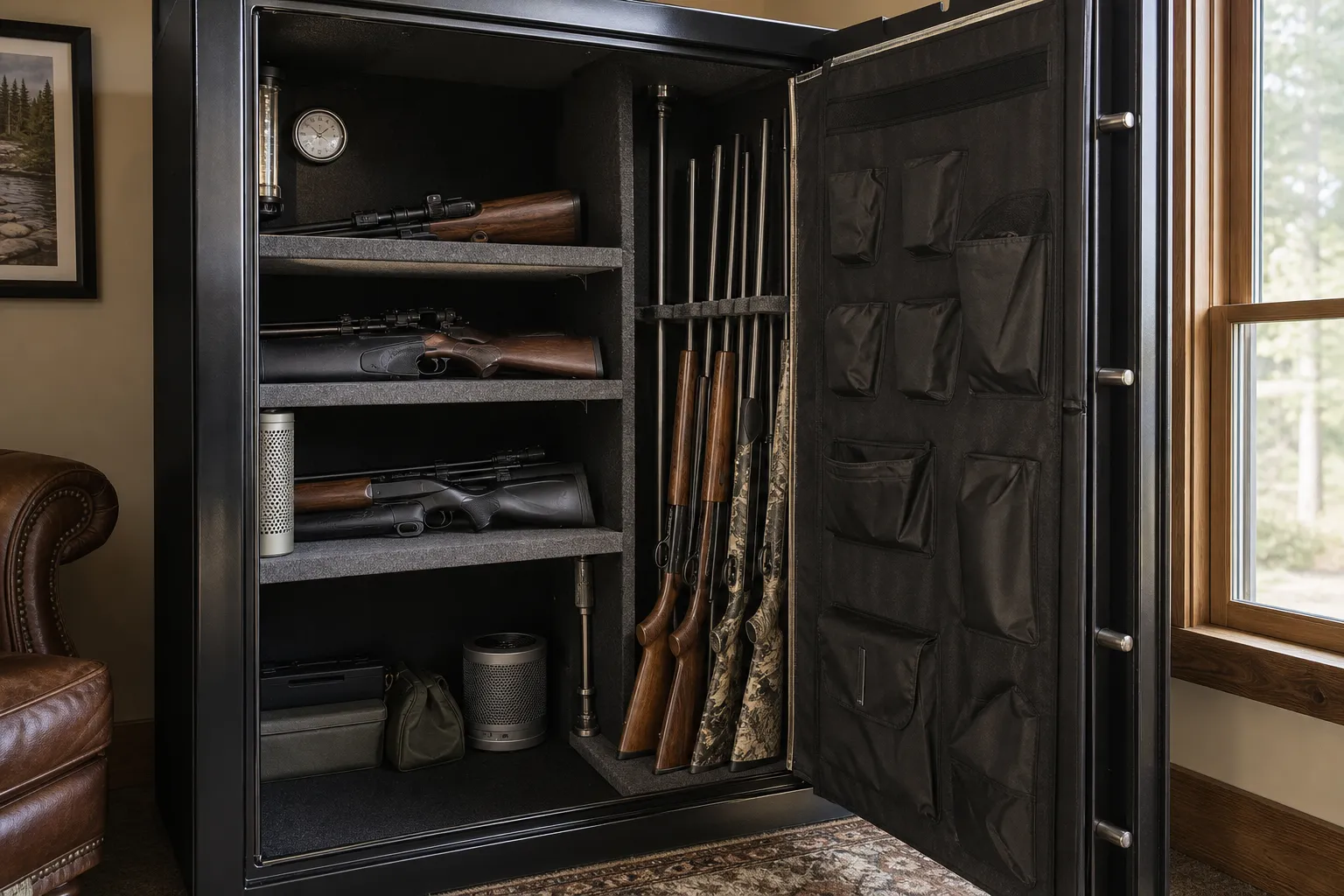
Gun safe humidity matters because moisture is part of the corrosion process on metals, and firearms often combine metal, wood, finishes, ammunition, and optics in one storage space. For many mixed firearm collections, a practical goal is roughly 40 to 55 percent relative humidity, based on conservation guidance for mixed metal and organic materials. That is a preservation target, not a promise that a safe is fireproof, waterproof, or more secure.
What relative humidity means
Relative humidity, often shortened to RH, is a percentage. The National Weather Service describes it as a ratio, expressed in percent, of the amount of atmospheric moisture present. It is also affected by temperature, not only by how much water is in the air.
That matters in a gun safe because the same safe can show different RH readings as temperature changes. A basement, garage, closet, or safe room may feel dry at one time and become a moisture problem later, especially if temperature and humidity swing.
In a gun safe or storage cabinet, tracking conditions over time is better than relying on feel.
Why humidity matters for steel, wood, and optics
The Canadian Conservation Institute explains that the corrosion process on metals requires water, meaning moisture is central to rust risk. Firearms include steel and other metals, so humid storage increases the need for careful protection, inspection, and drying.
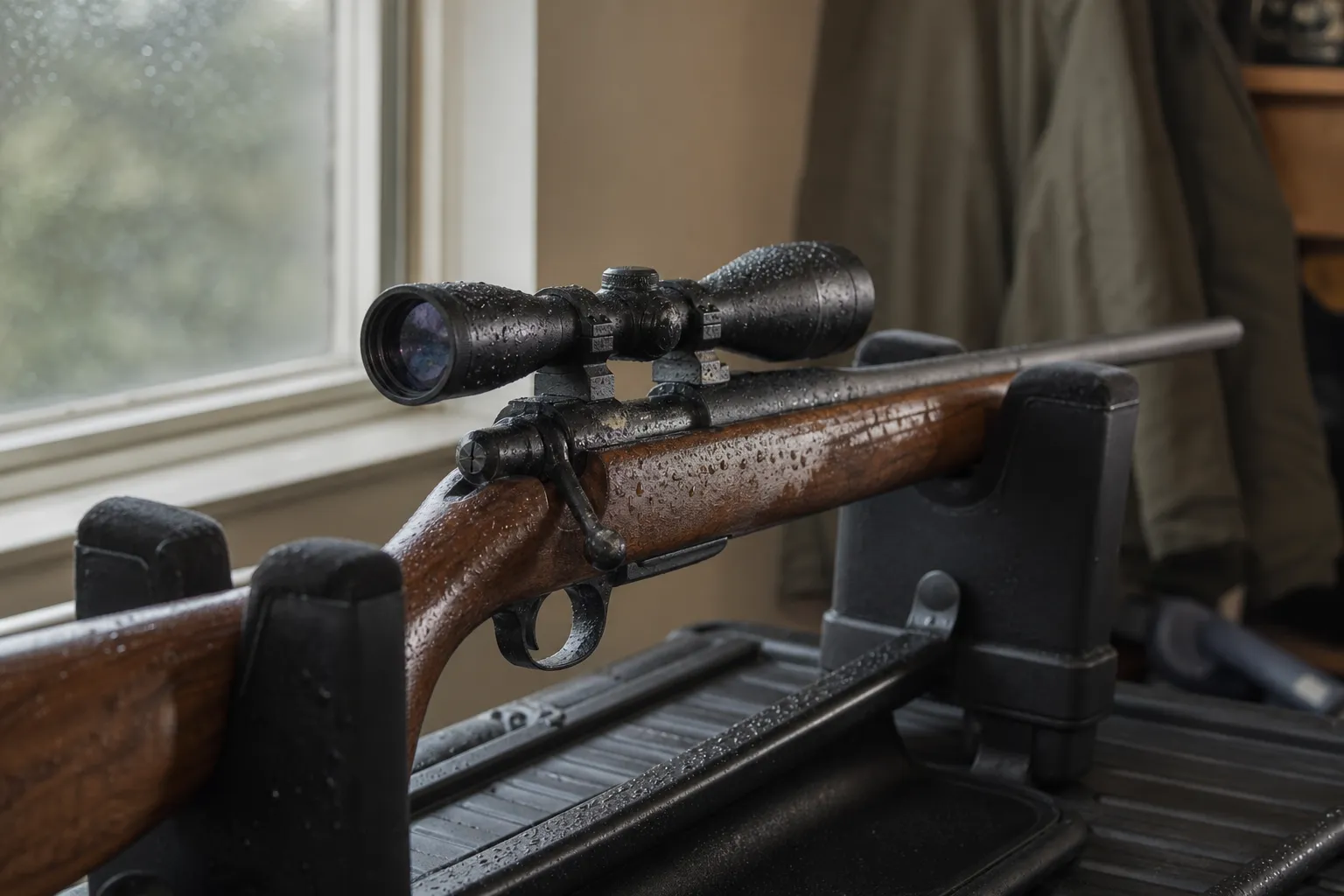
Humidity is not only a metal problem. Department of the Interior museum guidance warns that low RH below 35 percent can cause shrinkage, warping, and cracking in wood and ivory. Firearms with wood stocks are mixed material objects, so the goal is not simply to make the safe as dry as possible.
High or unstable humidity can also create problems for organic materials. Conservation guidance for collections treats RH control as a balance between reducing corrosion risk and avoiding damage to moisture sensitive materials.
Optics deserve attention too. Nikon advises avoiding storage of binoculars in high humidity, high temperature, or dusty areas. A dark, closed safe may be useful for security, but it still needs humidity monitoring if optics are stored inside.
Reasonable humidity targets for a gun safe
A good general target for many mixed firearm collections is about 40 to 55 percent RH. The Canadian Conservation Institute says a moderate 40 to 55 percent RH range is adequate to keep corrosion risks low for most metals in mixed collections.
These are conservation targets, not firearm warranty rules. They are useful because many gun safes hold mixed materials: blued or stainless metal, wood stocks, synthetic stocks, scopes, binoculars, slings, documents, and sometimes ammunition.
Avoid extended high humidity. EPA indoor mold guidance says indoor RH should be kept below 60 percent, ideally between 30 and 50 percent where possible.
Also avoid pushing a mixed safe extremely dry for long periods. Department of the Interior guidance warns that low RH below 35 percent can damage wood and ivory through shrinkage, warping, and cracking. If your safe contains wood stocked firearms or other organic materials, the safer approach is controlled moderate humidity rather than maximum dryness.
A simple way to think about it:
Below 35 percent: May be too dry for wood and other organic materials over time, according to Department of the Interior museum guidance
About 40 to 55 percent: Practical preservation range supported by Canadian Conservation Institute collection guidance
Above 60 percent: EPA says indoor RH should be kept below this level where possible
Hygrometers: the one tool you should not skip
Regular RH readings help you see whether your safe is staying in a reasonable range.
Place a hygrometer inside the safe or cabinet and watch trends. A single reading is less useful than a pattern. If the number rises after rainy weather, after placing damp gear inside, or during seasonal changes, the safe may need better room conditions, desiccant maintenance, or a different storage location.
Indicating silica gel can help, but it is only one cue. Color indicators are useful reminders, while recorded RH readings help show the broader storage pattern.
Desiccant packs and canisters
Desiccants are moisture absorbing materials. The Canadian Conservation Institute describes desiccants such as silica gel as materials that absorb moisture from surrounding air.
Desiccants work best in a closed storage space that is reasonably well sealed. The Canadian Conservation Institute says they work best within a sufficiently well sealed enclosure. In a leaky cabinet or a safe opened often in a damp room, the desiccant may saturate faster.
Common gun safe desiccants include small packets, larger canisters, and rechargeable units. Some use color indicators. Hornady says its desiccant canister uses color changing crystals to show when the unit needs recharging, and that the canister is recharged by oven drying until the granules turn blue.
Always follow the instructions for the exact product. Recharge methods vary, and heat, power, and placement instructions are product specific.
Heated rods and “GoldenRod style” dehumidifiers
Heated rods are different from desiccants. Lockdown says dehumidifier rods work by slightly increasing and maintaining the air temperature inside a gun safe or enclosure. Lockdown also says the warm air circulation from a rod is continuous inside the safe.
These rods do not work like a room dehumidifier that removes water into a tank. They warm the air in the enclosure and promote circulation. That can help reduce conditions that allow moisture to settle, but you still need a hygrometer to know what the safe is doing.
Use heated rods only according to the manufacturer’s instructions. Placement, electrical routing, and clearance matter because the device is powered and runs inside a storage enclosure.
Room dehumidifiers and safe location
Sometimes the room is the problem. Liberty Safe says its safes should be installed in an enclosed, climate controlled environment and should not be exposed to weather or excessive humidity. Browning ProSteel warns that rain, moisture, or high humidity can damage a safe and cause rust.
A safe accessory may struggle if the safe sits in a damp garage, wet basement, or non climate controlled area. In that case, controlling the room environment may matter as much as anything inside the safe. EPA’s indoor mold guidance supports keeping indoor RH below 60 percent, ideally between 30 and 50 percent where possible.
Safe placement also affects long term care. When possible, follow the safe maker’s manual and choose an enclosed, climate controlled, non damp location.
For a deeper look at what safe ratings do and do not mean, see our guide to gun safe ratings.
Storage habits that reduce moisture problems
Good humidity control starts before the gun goes back into storage. Browning tells owners to make certain a firearm is unloaded before storage. That safety check comes first.
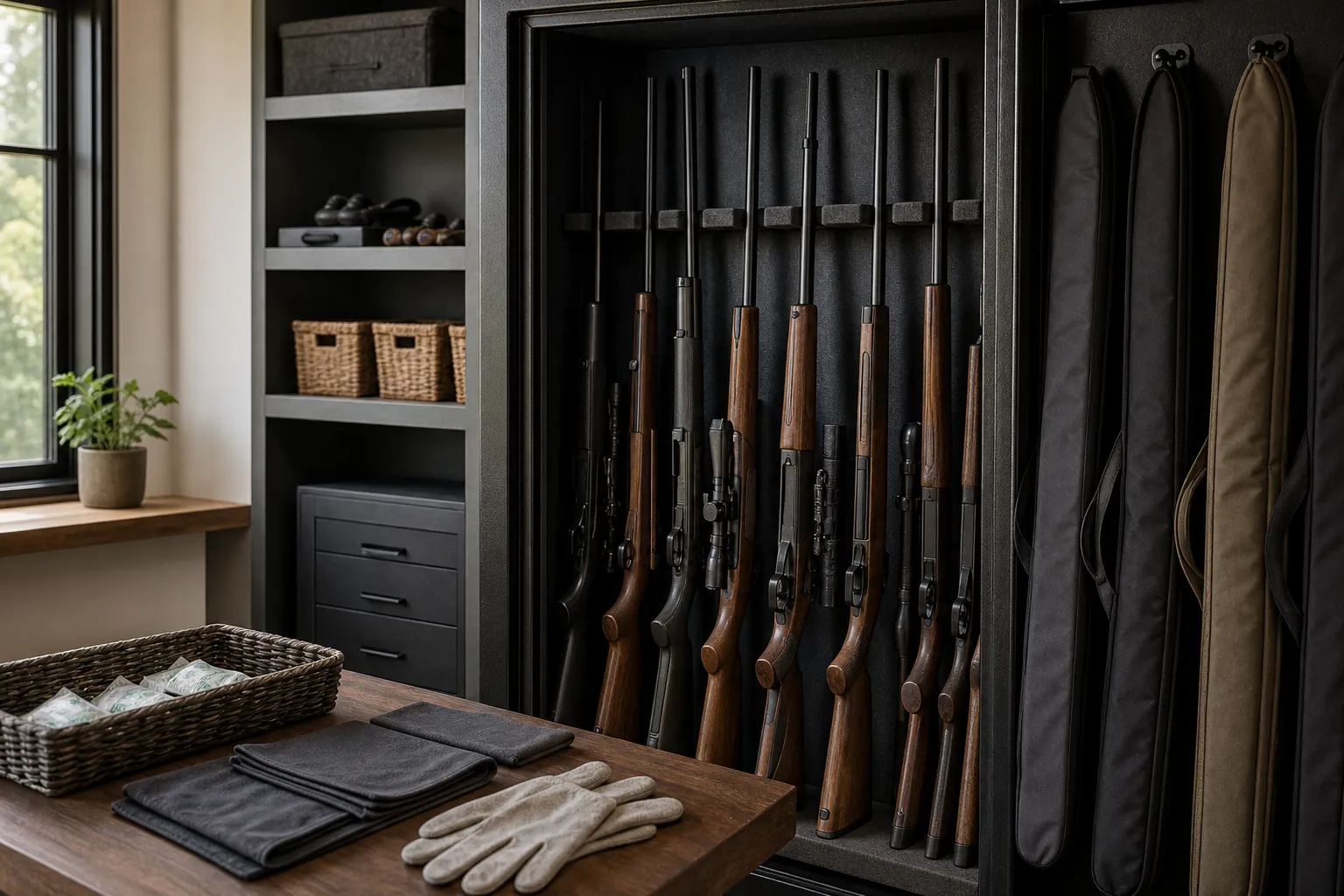
After range use or hunting, remove firearms from cases, confirm they are unloaded, clean and dry them, and inspect for rust. Browning recommends periodic firearm inspections that include rust checks.
Avoid long term storage in tightly sealed cases. Browning warns never to store a firearm in a tightly sealed case because condensation can cause rust.
If a firearm needs cleaning before storage, see our beginner guide to cleaning a gun safely. If rust is already present, see how to remove rust from a gun and prevent it.
Ammunition and humidity
Ammunition should be stored safely and kept away from poor environmental conditions. SAAMI recommends ammunition be stored in a cool, dry location away from solvents and other chemicals, heat sources, or open flames.
Storage safety still applies. Browning says ammunition should be stored away from all firearms. RCMP guidance for individuals says ammunition should be stored separately or locked up.
For more on ammunition storage and shelf life, see Does Ammo Expire?.
Humidity control is not a substitute for safe storage
Humidity control helps preserve firearms and accessories, but it does not replace safe handling or secure storage. Browning tells owners to confirm a firearm is unloaded before storage. RCMP firearm storage guidance for individuals says to unload and lock firearms.
If children, guests, or unauthorized people may be present, locks and secure storage are part of the safety system. Our guide to gun locks explains common lock types, and our basic firearm safety rules covers the core habits every owner should know.
Humidity accessories also do not change a safe’s tested performance. Browning ProSteel warns that its safes are fire resistant, not fireproof. A dehumidifier, desiccant pack, or heated rod does not make a safe fireproof, waterproof, or more secure than its rating.
A practical inspection routine
Use a simple routine and adjust it to your climate, safe, and manufacturer instructions:
- Confirm every firearm is unloaded before storage.
- Remove firearms and optics from damp field cases or range bags.
- Clean and dry firearms before long term storage.
- Check the hygrometer inside the safe.
- Keep the safe near a moderate RH range, roughly 40 to 55 percent for many mixed collections.
- Recharge or replace desiccant when indicators or readings show it is no longer controlling humidity.
- Inspect firearms periodically for rust.
- Store ammunition separately or locked up, following RCMP, SAAMI, and manufacturer guidance.
What to check before you rely on any setup
Check the owner’s manual for each firearm, the safe manual, and the instructions for every humidity control accessory. If you are in the United States or Canada, also confirm current storage requirements with the appropriate authority for your location. Humidity control protects condition, but safe, lawful storage still depends on unloading, locking, secure ammunition storage, and following official rules.
Frequently asked questions
What humidity should a gun safe be kept at?
For many mixed firearm collections, about 40 to 55 percent RH is a practical target. The Canadian Conservation Institute gives 40 to 55 percent RH for most metals in mixed collections.
Is very low humidity better for preventing rust?
Not always. Moisture supports metal corrosion, but Department of the Interior museum guidance warns that RH below 35 percent can cause shrinkage, warping, and cracking in wood and ivory. Mixed firearm storage should avoid both high humidity and extreme dryness.
Are heated rods the same as dehumidifiers with water tanks?
No. Lockdown describes dehumidifier rods as devices that slightly increase and maintain air temperature inside a safe and circulate warm air. They are not the same as a room dehumidifier that removes water into a tank.
Should firearms be stored in cases inside a safe?
Browning warns against long term storage in tightly sealed cases because condensation can cause rust.
Does humidity control make a safe fireproof or waterproof?
No. Browning ProSteel warns that its safes are fire resistant, not fireproof. Humidity control accessories do not change a safe’s tested fire, water, or security performance.
Sources
- NOAA National Weather Service Glossary: RH, NOAA National Weather ServiceOfficial source. Accessed November 3, 2026.
- Air: Atmospheric Climate Variables, NOAA Climate.govOfficial source. Accessed November 3, 2026.
- Caring for metal objects, Preventive conservation guidelines for collections, Canadian Conservation Institute, Government of CanadaOfficial source. Accessed November 3, 2026.
- Museum Handbook, Part I: Museum Collections, National Park ServiceOfficial source. Accessed November 3, 2026.
- Museum Property Handbook, Chapter 5: Environmental Agents of Deterioration, U.S. Department of the InteriorOfficial source. Accessed November 3, 2026.
- Mold Course Chapter 2, U.S. Environmental Protection AgencyOfficial source. Accessed November 3, 2026.
- Fungus on lens, Nikon SupportOfficial source. Accessed November 3, 2026.
- Precautions, How to Use Binoculars, Nikon Consumer Sport OpticsOfficial source. Accessed November 3, 2026.
- How should I store my firearm?, BrowningOfficial source. Accessed November 3, 2026.
- Learn About Firearms Safety and Security, Bureau of Alcohol, Tobacco, Firearms and ExplosivesOfficial source. Accessed November 3, 2026.
- Recommendations for Safe Ammunition Storage and Handling, SAAMI. Accessed November 3, 2026.
- Conserve O Gram 2/15, National Park ServiceOfficial source. Accessed November 3, 2026.
- Canister Dehumidifier, HornadyOfficial source. Accessed November 3, 2026.
- Dehumidifier Rod, LockdownOfficial source. Accessed November 3, 2026.
- Gun Safe Use and Care, Liberty SafeOfficial source. Accessed November 3, 2026.
- Browning ProSteel Safe Owner’s Manual, BrowningOfficial source. Accessed November 3, 2026.
- Storing, transporting and displaying firearms, Royal Canadian Mounted PoliceOfficial source. Accessed November 3, 2026.