Gun Safe Ratings Explained: Weight, Fire Ratings and Security Ratings
Gun safe specifications are easier to compare when you separate weight, fire ratings, burglary ratings, steel thickness, locks and installation needs. The label matters, but so do the safe’s location, anchoring, humidity control and the exact test behind each claim.
By RaiS. Reviewed by RaiS. Published . 6 min read.
Research and drafting were assisted by AI. RaiS checked the facts against the sources below and approved this page.
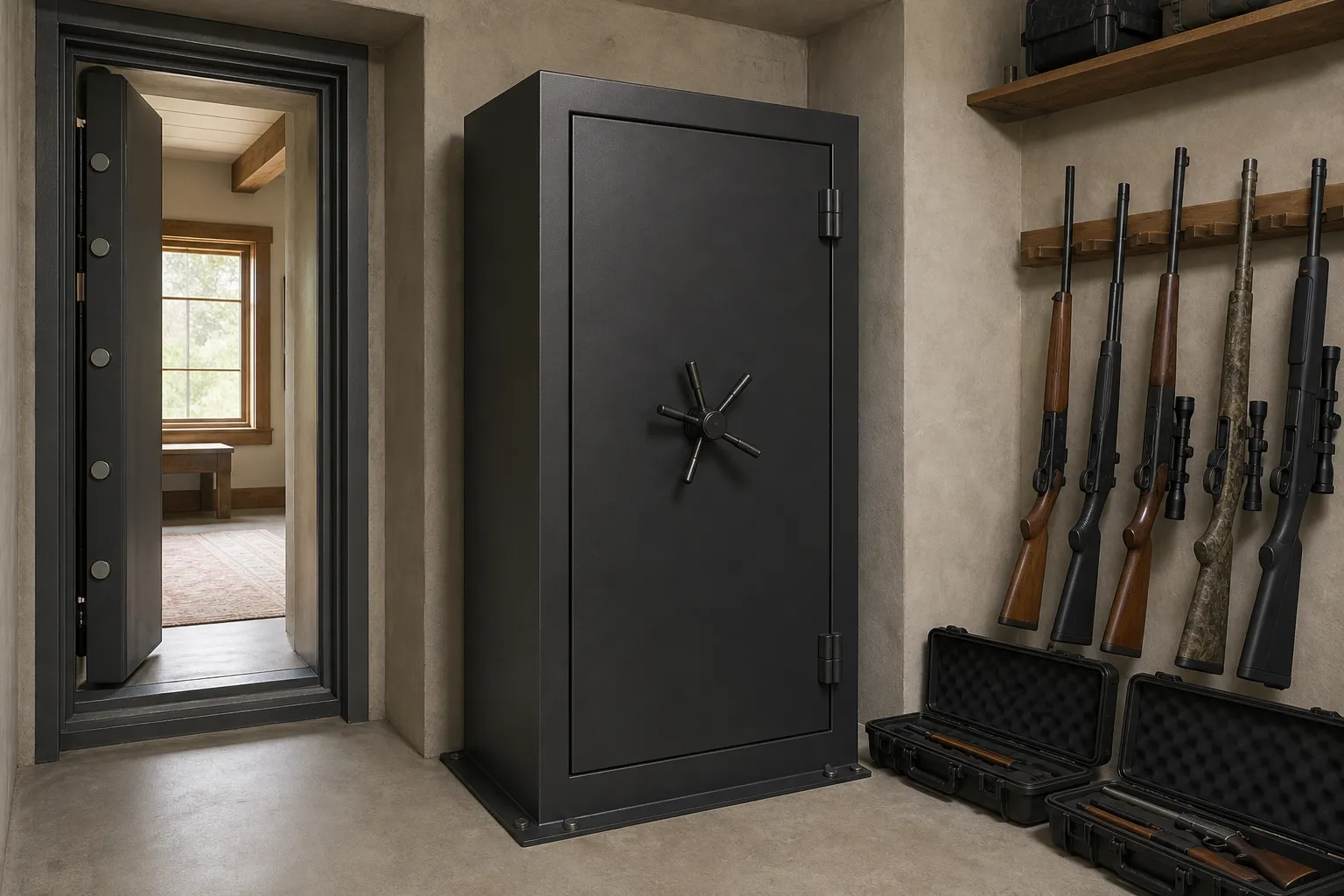
Gun safe specifications are not one single rating. Weight tells you something about moving, floor loading and tip risk. Fire ratings describe a time, temperature and test method. Security ratings such as UL 1037 Residential Security Container and UL 687 burglary-safe labels describe specific attack tests, not an impenetrable box. The best way to read a safe spec sheet is to separate fire protection, burglary resistance, lock rating, steel thickness and installation requirements.
Project ChildSafe recommends that unloaded firearms be stored when not in use in a locked cabinet, safe, gun vault or storage case, and that ammunition be locked separately. A gun safe can be part of that storage plan, but its rating label should be read carefully.
What a gun safe rating can and cannot tell you
A gun safe listing may include several different kinds of information. Do not treat them as interchangeable.
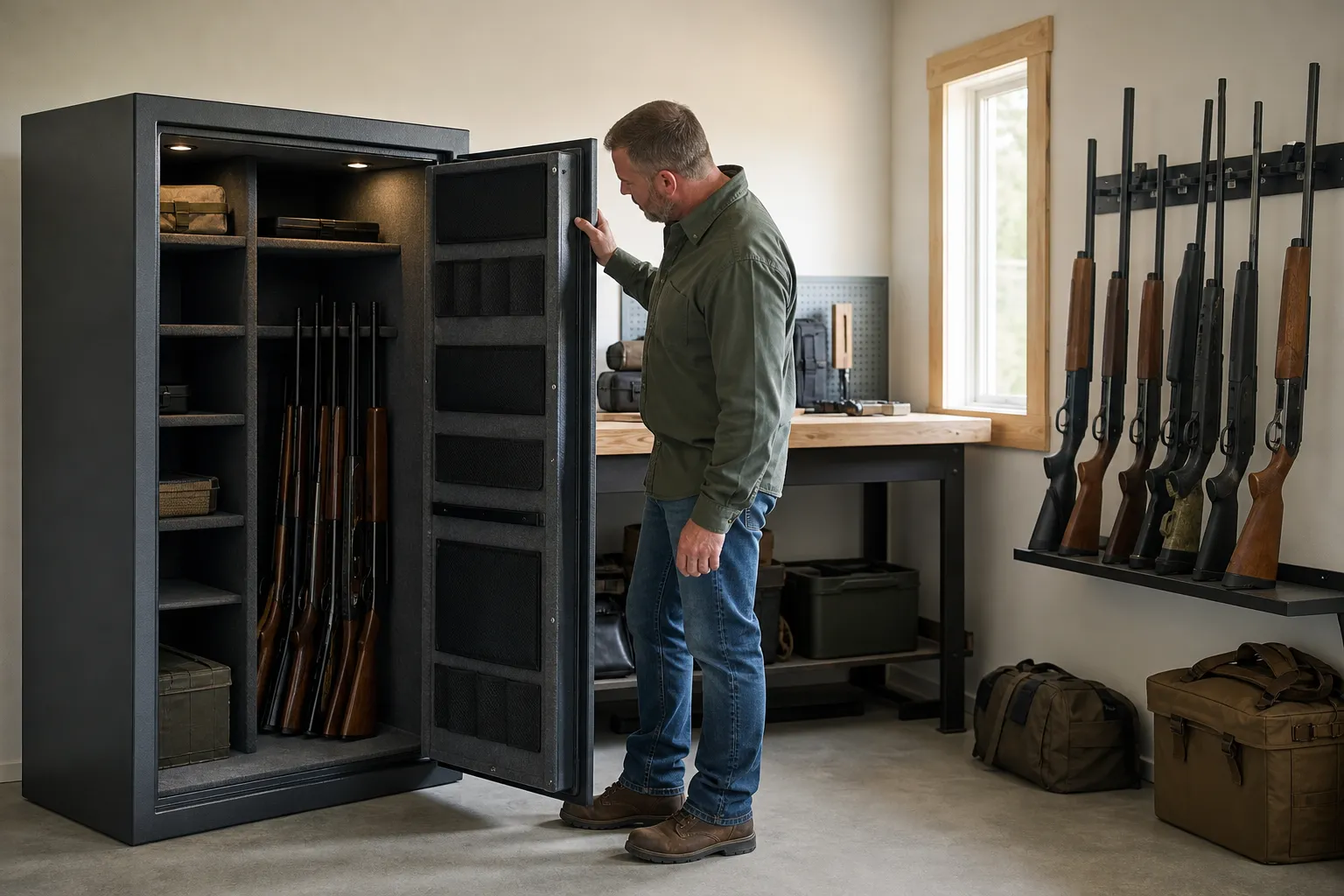
Common specification categories include:
| Spec | What it tells you | What it does not tell you |
|---|---|---|
| Weight | How heavy the safe is for delivery, placement and anchoring decisions | Whether the floor is suitable for that exact installation |
| Fire rating | A stated exposure time, temperature and interior temperature limit | That the safe is fireproof or usable after any fire |
| UL 1037 RSC rating | Resistance to a defined residential security container attack test | That the safe is a TL-rated burglary safe |
| UL 687 TL rating | A higher burglary-safe classification under UL’s burglary-resistant safe standard | That the safe also has a fire rating |
| Steel gauge | Approximate steel thickness, with lower gauge numbers meaning thicker steel | The full burglary rating by itself |
| Lock listing | The type of lock tested or listed | The full strength of the safe body or door |
UL 687 is a UL standard for burglary-resistant safes.
That separation matters. A fire label is not a burglary label. A burglary label is not a humidity-control plan. A heavy safe is not automatically a highly rated safe.
How much does a gun safe weigh?
Gun safe weight varies widely by size and construction. Manufacturer specifications show residential gun safes in the hundreds of pounds.
Examples from manufacturer specification pages and catalogs include:
| Example specification | Listed weight |
|---|---|
| Liberty Centurion models shown | 245 to 411 lb |
| Liberty USA models shown | 565 to 930 lb |
Those numbers matter before the safe arrives. A 245-pound safe and a 930-pound safe are very different moving jobs. Stairs, turns, thresholds, second-floor placement and door clearances can all affect whether a safe can be delivered safely.
Weight also matters after installation. Browning ProSteel’s manual warns that the weight of an open heavy safe door can cause a safe to tip forward on uneven or unstable flooring. Browning describes a safe as a deterrent and delaying device, and says location and anchoring can make it more effective.
Floor loading and anchoring
Floor loading should be treated as an installation question, not a simple spec-sheet comparison. The 2000 International Residential Code interpretation table lists 40 pounds per square foot for rooms other than sleeping rooms and 30 pounds per square foot for sleeping rooms. Those figures are a baseline reference, not an approval for a particular safe in a particular house.
A safe is a concentrated load. Its weight sits on a limited footprint, and the door can shift the load when opened. For a heavy safe, a second-floor installation, or an older home, the safer approach is to ask a qualified installer or structural professional before placement.
Liberty’s use and care guidance recommends installing large safes of 1,000 pounds or more near a load-bearing wall, especially in older homes. Liberty also says safe anchoring is an important security add-on and recommends anchoring through pre-drilled holes for optimum security.
This guide does not give installation steps. Follow the safe manufacturer’s manual and use qualified help when the safe’s weight, floor type or anchoring method is uncertain.
Gun safe fire ratings
A useful fire rating should tell you four things: the exposure time, the outside test temperature, the interior temperature limit and who performed the test. Without those details, the phrase “fire rated” is hard to compare.
Gun safe manufacturers may also list tests by time and furnace temperature. Liberty’s Centurion specifications list 30 minutes at 1200°F for models 12 and 18, and 40 minutes at 1200°F for models 24 and 32. Browning ProSteel’s manual says its fire-resistant safes are evaluated in a controlled test environment and should not be assumed to withstand every fire.
The key point is simple: fire-resistant does not mean fireproof. Look for the exact test, the time, the temperature and the interior limit.
UL 1037 Residential Security Container ratings
UL Solutions says the UL 1037 Residential Security Container framework has three tiers that reflect increasing resistance to physical attack.
In beginner terms:
| UL 1037 RSC tier | UL Solutions description |
|---|---|
| Attack Level One | Five-minute attack using common hand tools by one technician |
| Attack Level Two | Ten-minute attack by two technicians using more aggressive tools, including carbide drills and pressure devices, with a six-square-inch opening attempt |
| Attack Level Three | Ten-minute attack using the most advanced toolsets, with a two-square-inch maximum breach |
UL Solutions also says RSC products under 750 pounds may be subject to a drop test that simulates forced entry by impact, unless secure mounting provisions and clear installation instructions make the drop test inapplicable.
An RSC label is meaningful because it points to a defined test. It does not mean the safe cannot be opened by any method, with any tools, given unlimited time.
UL 687 TL-rated burglary safes
UL 687 is the UL standard for burglary-resistant safes. It covers combination-locked burglary-resistant safes including TL-15, TL-30, TRTL-30 and X6 classifications. UL 687 distinguishes attack against the door and front face from attack against the door and body.
The jump from RSC to TL-rated safes is important. RSC ratings are common on gun safes. TL labels belong to UL’s burglary-resistant safe standard and describe different test categories.
Steel thickness and gauge numbers
Steel gauge can be confusing because the number runs opposite of what many beginners expect. Liberty says the smaller the gauge number, the thicker the steel.
Liberty’s steel gauge guide lists these common safe-gauge thicknesses:
| Steel gauge | Listed thickness |
|---|---|
| 14-gauge | 5/64 inch |
| 12-gauge | 7/64 inch |
| 10-gauge | 9/64 inch |
| 7-gauge | 3/16 inch |
Steel thickness is only one part of a safe’s construction. The complete rating also depends on the tested design, door, lock, attack method and other construction details.
Lock types and lock listings
A lock specification should be read separately from the safe body rating.
When comparing safes, read the lock listing, the burglary rating and the fire rating as separate lines. A listed lock does not automatically make the whole safe a higher burglary class.
Humidity, rust and storage location
A gun safe also needs the right storage environment. Liberty recommends keeping a safe in an enclosed, climate-controlled environment and not exposing it to weather or excessive humidity. Liberty also recommends a moisture barrier between the safe and floor to protect the bottom of the safe against rust.
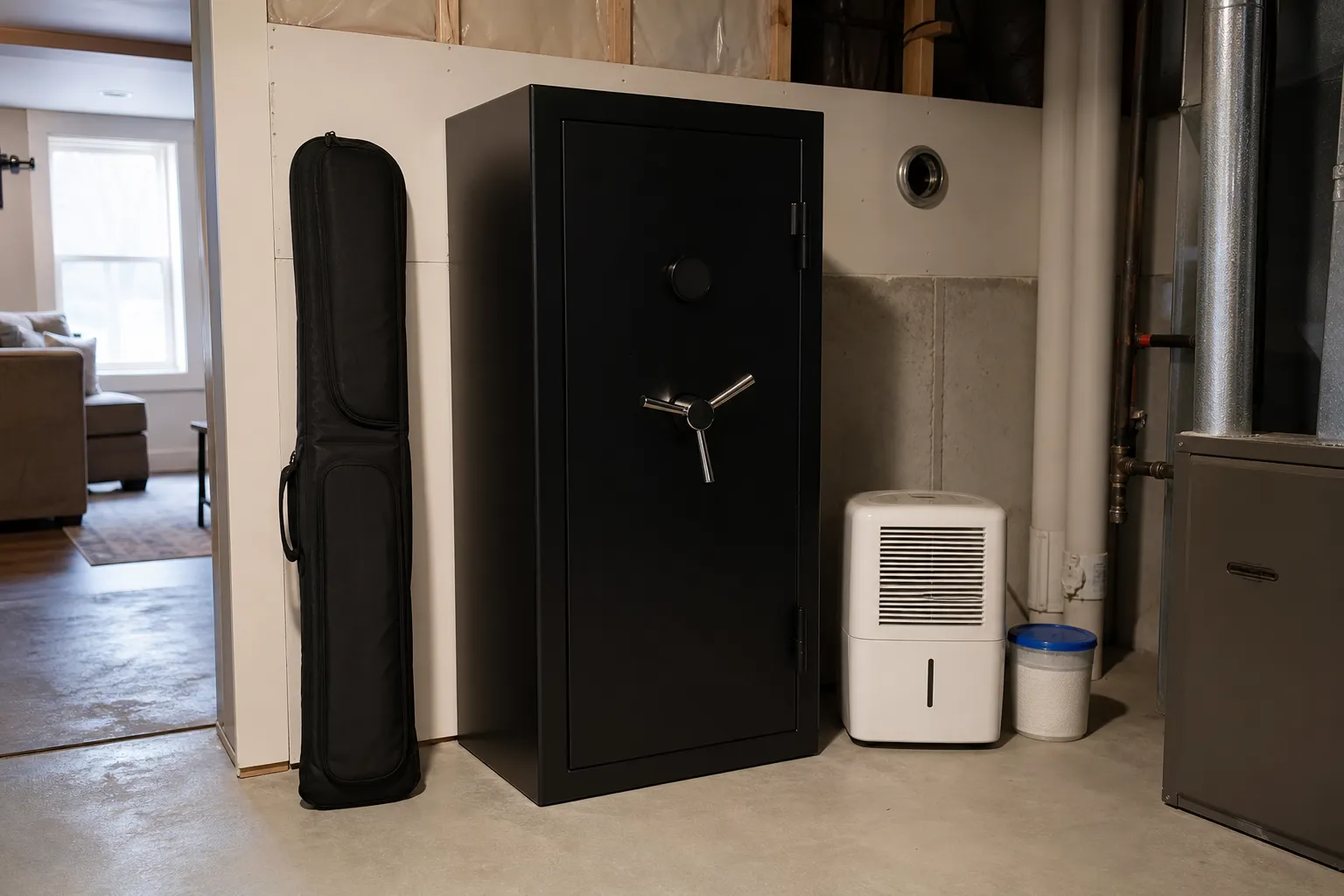
For humidity control, desiccants, dehumidifiers and routine corrosion checks, see our rust prevention guide. Those details are part of long-term firearm care, but they are separate from burglary and fire ratings.
What to check before you buy or install
Before relying on a gun safe specification, check these items in the manufacturer’s current manual or specification sheet:
- The safe’s exact weight and outside dimensions.
- Whether the fire rating lists time, outside temperature, interior temperature limit and the testing organization.
- Whether the security label is UL 1037 RSC, UL 687 TL-rated, or another claim.
- The steel gauge and whether the spec describes body walls, door steel or both.
- The lock type and any lock listing.
- The manufacturer’s anchoring, floor placement and humidity guidance.
- Whether a qualified installer or structural professional should review the planned location.
Confirm current labels and manuals with the manufacturer, UL, ETL or the appropriate testing organization. For very heavy safes, older homes or upper-floor installations, confirm placement with qualified local help before delivery.
Frequently asked questions
What is a UL 1037 RSC rating on a gun safe?
The RSC framework has three attack levels, with Level One described as a five-minute attack using common hand tools by one technician, Level Two as a ten-minute attack with more aggressive tools, and Level Three as a ten-minute attack with the most advanced toolsets and a smaller maximum breach.
Is a fire-rated gun safe fireproof?
No. Browning ProSteel’s manual says a fire-resistant safe should not be assumed to withstand every fire. A useful fire rating should identify the exposure time, test temperature, interior temperature limit and whether the test was independent or factory testing.
How much does a gun safe weigh?
Manufacturer specifications show a wide range. Liberty’s Centurion models shown list 245 to 411 pounds, and Liberty’s USA models shown list 565 to 930 pounds.
What does TL-30 mean compared with RSC?
UL 687 is the UL standard for burglary-resistant safes. TL labels belong to that standard, while RSC ratings are residential security container ratings under UL 1037.
Does lower gauge steel mean thicker steel?
Yes. Liberty says the smaller the steel gauge number, the thicker the steel. Liberty lists 14-gauge at 5/64 inch, 12-gauge at 7/64 inch, 10-gauge at 9/64 inch and 7-gauge at 3/16 inch.
Should a gun safe be anchored?
Liberty says anchoring is an important security add-on and recommends anchoring through pre-drilled holes for optimum security. Browning ProSteel’s manual says location and anchoring can make a safe more effective, and warns that an open heavy safe door can tip a safe forward on uneven or unstable flooring.
Sources
- Firearms Questions and Answers, Bureau of Alcohol, Tobacco, Firearms and ExplosivesOfficial source. Accessed October 29, 2026.
- Project ChildSafe Law Enforcement Brochure, Project ChildSafe, NSSF. Accessed October 29, 2026.
- Anti-theft Device Testing and Certification, UL SolutionsOfficial source. Accessed October 29, 2026.
- Residential Security Container Standard Revised, UL SolutionsOfficial source. Accessed October 29, 2026.
- UL 687, Standard for Burglary-Resistant Safes, UL Standards and EngagementOfficial source. Accessed October 29, 2026.
- ANSI/CAN/UL 72:2026, Tests for Fire Resistance of Record Protection Equipment, ANSI WebstoreOfficial source. Accessed October 29, 2026.
- Burglary Safe Ratings Explained, American Security. Accessed October 29, 2026.
- Fire Ratings Explained, American Security. Accessed October 29, 2026.
- BFS2815 UL & ETL Certified Burglary & Fire Safe, American Security. Accessed October 29, 2026.
- 2025 Gun Safe Catalog, American Security. Accessed October 29, 2026.
- Browning ProSteel Safe Owner’s Manual, Browning. Accessed October 29, 2026.
- Centurion Series Gun Safes, Liberty Safe. Accessed October 29, 2026.
- USA Series Gun Safes, Liberty Safe. Accessed October 29, 2026.
- Gun and Home Safe Use and Care, Liberty Safe. Accessed October 29, 2026.
- What Does Steel Gauge Mean?, Liberty Safe. Accessed October 29, 2026.
- IRC Interpretation No. 11-04, Table R301.4 Live Load, International Code CouncilOfficial source. Accessed October 29, 2026.