6.5 Creedmoor vs .308 Winchester
6.5 Creedmoor usually stands out for high BC 6.5 mm bullets, mild recoil examples and modern long range target or hunting loads. 308 Winchester stands out for its long history, larger .30 caliber bullets and higher energy in some comparable factory hunting loads.
By RaiS. Reviewed by RaiS. Published . 6 min read.
Research and drafting were assisted by AI. RaiS checked the facts against the sources below and approved this page.
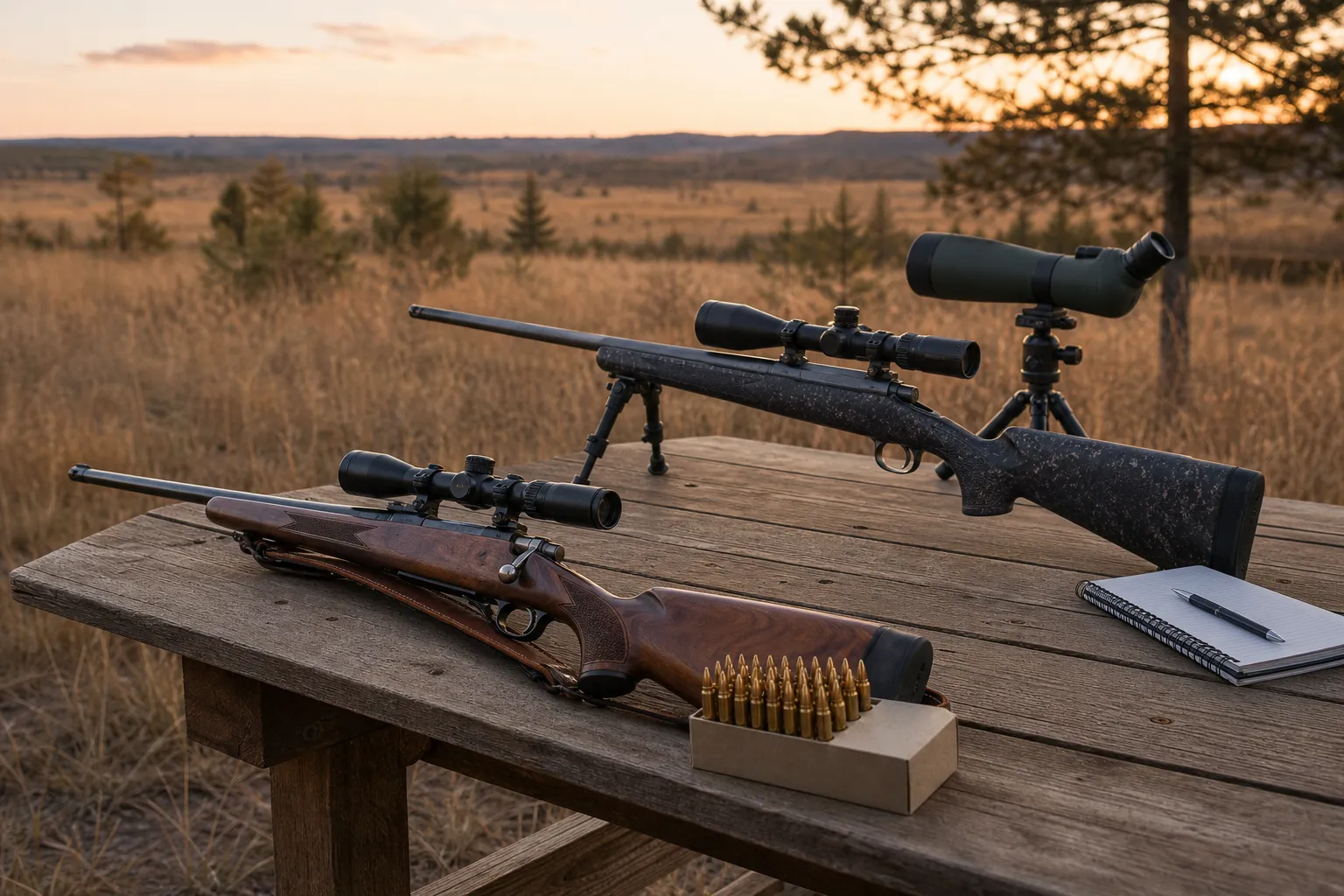
6.5 Creedmoor vs 308 is not a question with one universal winner. Based on the cited Hornady and Winchester sources, 6.5 Creedmoor is the more modern cartridge built around 6.5 mm bullets and long range match use, while 308 Winchester is the older .30 caliber hunting and target cartridge. In similar factory hunting examples from Hornady, the 6.5 Creedmoor load has the higher listed ELD-X ballistic coefficient, while the 308 Win load launches a heavier bullet and has higher listed muzzle energy.
A naming note before we start: SAAMI says the recognized abbreviated format is 308 Win, with no leading decimal point, because “a decimal point is never included preceding the numerical caliber component of any cartridge name” (SAAMI FAQ). This page uses “.308 Winchester” where readers commonly search for it, but uses 308 Win or 308 Winchester when referring to SAAMI style.
Quick comparison table
| Category | 6.5 Creedmoor | 308 Winchester | |, -|, -:|, -:| | Origin | Introduced by Hornady in 2007, developed by Dave Emary and Dennis DeMille (Hornady) | Winchester introduced the 308 Winchester cartridge in 1952 (Winchester) | | Hornady Precision Hunter example | 143 gr ELD-X, 24 in test barrel, 2,700 fps, 2,315 ft-lb (Hornady) | 178 gr ELD-X, 24 in test barrel, 2,600 fps, 2,671 ft-lb (Hornady) | | Hornady ELD-X BC, Mach 2.25 | 143 gr ELD-X: 0.623 G1, 0.314 G7 (Hornady BC) | 178 gr ELD-X: 0.552 G1, 0.278 G7 (Hornady BC) | | Hornady ELD Match BC, Mach 2.25 | 140 gr ELD Match: 0.646 G1, 0.326 G7 | 168 gr ELD Match: 0.523 G1, 0.263 G7 | | Recoil example | Outdoor Life published about 11.6 ft-lb from an 8 lb rifle with a 140 gr bullet | Outdoor Life published about 15 ft-lb from an equal 8 lb rifle with a 150 gr bullet |
History and design intent
Hornady says the 6.5 Creedmoor was introduced in 2007 and developed by Hornady Senior Ballistics Scientist Dave Emary and Dennis DeMille. Hornady’s origin article says one goal was an “off-the-shelf cartridge” that was accurate enough to win, with less recoil than 308 and comparable barrel life to 308 (Hornady).
Winchester’s historical timeline says Winchester introduced the 308 Winchester cartridge in 1952 (Winchester). The fact ledger does not include a design-goal source for 308 Winchester beyond that introduction date, so this page does not add one.
SAAMI dimensions and pressure
SAAMI’s 2025 centerfire rifle standard, SAAMI Z299.4-2025, is the main standards source here. SAAMI describes that standard as “Voluntary Industry Performance Standards for Pressure and Velocity of Centerfire Rifle Ammunition for the Use of Commercial Manufacturers,” and says cartridge and chamber dimensions plus performance characteristics are contained in its American National Standards (SAAMI standards page).
Factory hunting loads and bullet weights
When comparing cartridges, compare the same type of load when possible. A hunting bullet comparison is more useful than comparing one cartridge’s match bullet to the other cartridge’s hunting bullet.
Hornady’s current Precision Hunter examples in the ledger are close in product family:
- 6.5 Creedmoor: Hornady Precision Hunter item 81499, 143 gr ELD-X, 20 per box. Hornady lists a 24 inch test barrel, 2,700 fps muzzle velocity and 2,315 ft-lb muzzle energy.
- 308 Win: Hornady Precision Hunter item 80994, 178 gr ELD-X, 20 per box. Hornady lists a 24 inch test barrel, 2,600 fps muzzle velocity and 2,671 ft-lb muzzle energy.
For those ELD-X bullets, Hornady’s BC page says it publishes “200 yard” Mach 2.25 G1 and G7 BC numbers for ELD-X and ELD Match bullets for comparison. Hornady lists the 6.5 mm 143 gr ELD-X at 0.623 G1 and 0.314 G7. It lists the 30 Cal 178 gr ELD-X at 0.552 G1 and 0.278 G7.
Recoil: useful, but not fixed
Recoil is not a fixed number for a cartridge name. SAAMI publishes a gun recoil formulae data sheet for informational purposes, and its FAQ says recoil velocity and recoil energy can be calculated. SAAMI also says recoil energy, usually expressed in foot-pounds, is a conventional way of recording and comparing recoil (SAAMI recoil formulae, SAAMI FAQ).
The missing pieces are important. A recoil calculation needs assumptions such as rifle weight, bullet weight, muzzle velocity and powder charge. The fact ledger does not include a full powder-charge dataset for the loads above, so this page does not calculate new recoil figures.
It does include one published equal-rifle example. Outdoor Life published a comparison using equal eight-pound rifles: a 6.5 Creedmoor with a 140 gr bullet at about 11.6 ft-lb, and a 308 rifle of equal weight with a 150 gr bullet at about 15 ft-lb (Outdoor Life). Treat that as one load-and-rifle comparison, not a universal rule for every rifle.
Target shooting comparison
The strongest target-shooting facts in the ledger are the cartridge history and the published match bullet BCs.
Hornady says 6.5 Creedmoor was developed with match use in mind, including an off-the-shelf cartridge that was accurate enough to win and recoiled less than 308 in the context described by Hornady. Hornady also labels its 6.5 Creedmoor content for target and match contexts.
For match bullets, Hornady lists the 6.5 mm 140 gr ELD Match at Mach 2.25 as 0.646 G1 and 0.326 G7. Hornady lists the 30 Cal 168 gr ELD Match at 0.523 G1 and 0.263 G7. Those are bullet BC comparisons only. They do not prove how accurate a specific rifle will be with a specific lot of ammunition.
Hunting comparison: deer and elk questions
For hunting, the cartridge name is only part of the answer. The bullet design and the manufacturer’s intended use matter.

Hornady describes the ELD-X as a “match accurate, ALL-RANGE hunting bullet” with high ballistic coefficients and consistent, controlled expansion. Hornady’s ELD-X page says that at high-velocity 0 to 400 yard impact, the bullet expands throughout its penetration path and lists 50 to 60 percent weight retention. The same page says that at low-velocity 400 plus yard impact, the bullet initiates expansion and lists 85 to 90 percent retained weight (Hornady ELD-X).
Hornady labels Precision Hunter and 6.5 Creedmoor content for medium game from 50 to 300 lb, large game from 300 to 1500 lb and target or match contexts. That manufacturer application statement is relevant to deer-sized and elk-sized hunting discussions, but it is not a substitute for local hunting regulations, impact-velocity limits for a specific bullet, or judgment in the field.
The cited Hornady Precision Hunter 308 Win load has higher listed muzzle energy than the cited 6.5 Creedmoor load, 2,671 ft-lb compared with 2,315 ft-lb. The cited 6.5 Creedmoor ELD-X bullet has the higher Hornady-listed BC, 0.623 G1 compared with 0.552 G1. Those two facts can both be true at the same time.
Rifle and ammunition availability
The ledger supports examples of current support, not a complete market count.
On the ammunition side, Hornady lists examples for both cartridges in the cited materials. That supports saying both have Hornady factory ammunition examples in the cited materials. It does not support a complete claim about every store shelf, every Canadian retailer, every U.S. retailer, exact inventory or current prices.
What is not known from the cited sources
The fact ledger does not establish:
- Exact current ammunition inventory in the United States or Canada.
- Exact current rifle inventory by manufacturer, model and region.
- Current street prices.
- Actual velocity from a reader’s rifle barrel.
- Free recoil for every load and rifle, because that varies with load data and rifle weight.
- Terminal performance in every hunting situation.
- A single accuracy result that applies to every rifle.
Bottom line
Choose 6.5 Creedmoor if your comparison centers on the cited high-BC 6.5 mm bullets, the cartridge’s match-focused origin and published mild-recoil examples. Choose 308 Winchester if your comparison centers on a longer cartridge history, heavier .30 caliber factory hunting examples and the higher muzzle energy shown in the cited Hornady Precision Hunter comparison.
Before buying ammunition or hunting with either cartridge, check the ammunition maker’s current product data, your rifle maker’s chambering and manual, and the current hunting regulations from the state, province, territory or federal agency that governs your hunt.
Frequently asked questions
Is 6.5 Creedmoor more powerful than 308 Winchester?
Not in the cited Hornady Precision Hunter example. Hornady lists the 6.5 Creedmoor 143 gr ELD-X at 2,315 ft-lb of muzzle energy, while the 308 Win 178 gr ELD-X is listed at 2,671 ft-lb. That comparison applies to those loads, not every possible load.
Which has the higher ballistic coefficient in the cited hunting loads?
In Hornady’s ELD-X data, the 6.5 mm 143 gr ELD-X is listed at 0.623 G1 and 0.314 G7 at Mach 2.25. The 30 Cal 178 gr ELD-X is listed at 0.552 G1 and 0.278 G7.
Does 6.5 Creedmoor recoil less than 308 Winchester?
It depends on the rifle and load. SAAMI treats recoil energy as a calculated comparison, and Outdoor Life published one equal eight-pound rifle example with about 11.6 ft-lb for a 6.5 Creedmoor 140 gr load and about 15 ft-lb for a 308 150 gr load.
Sources
- SAAMI Standards, SAAMIOfficial source. Accessed October 20, 2026.
- FAQs, SAAMIOfficial source. Accessed October 20, 2026.
- SAAMI Z299.4-2025, Centerfire Rifle, SAAMIOfficial source. Accessed October 20, 2026.
- SAAMI Z299.4-2025, Centerfire Rifle, SAAMIOfficial source. Accessed October 20, 2026.
- Gun Recoil Formulae, SAAMIOfficial source. Accessed October 20, 2026.
- The 6.5 Creedmoor, An interview with Hornady’s senior ballistician, Dave Emary, Hornady ManufacturingOfficial source. Accessed October 20, 2026.
- Historical Timeline 1950-1999, Winchester Repeating ArmsOfficial source. Accessed October 20, 2026.
- 6.5 Creedmoor 143 gr ELD-X Precision Hunter, Hornady ManufacturingOfficial source. Accessed October 20, 2026.
- 308 Win 178 gr ELD-X Precision Hunter, Hornady ManufacturingOfficial source. Accessed October 20, 2026.
- Ballistic Coefficient, Hornady ManufacturingOfficial source. Accessed October 20, 2026.
- 6.5mm .264 143 gr ELD-X, Hornady ManufacturingOfficial source. Accessed October 20, 2026.
- 2026 Hornady Product Catalog, English Metric Version, Hornady ManufacturingOfficial source. Accessed October 20, 2026.
- 2026 Federal Catalog, Federal PremiumOfficial source. Accessed October 20, 2026.
- Federal Catalog 2022, Federal PremiumOfficial source. Accessed October 20, 2026.
- Ruger Firearms Catalog, RugerOfficial source. Accessed October 20, 2026.
- Ruger International Catalog, RugerOfficial source. Accessed October 20, 2026.
- 6.5 Creedmoor vs 308 Winchester, Outdoor Life. Accessed October 20, 2026.