Thermal vs Night Vision Optics: How Each Works
Thermal optics detect differences in heat, while analog and digital night vision depend on visible or near-infrared light. The best choice depends on whether the priority is detecting heat in darkness, preserving visual detail, or working with available light and IR illumination.
By RaiS. Reviewed by RaiS. Published . 7 min read.
Research and drafting were assisted by AI. RaiS checked the facts against the sources below and approved this page.
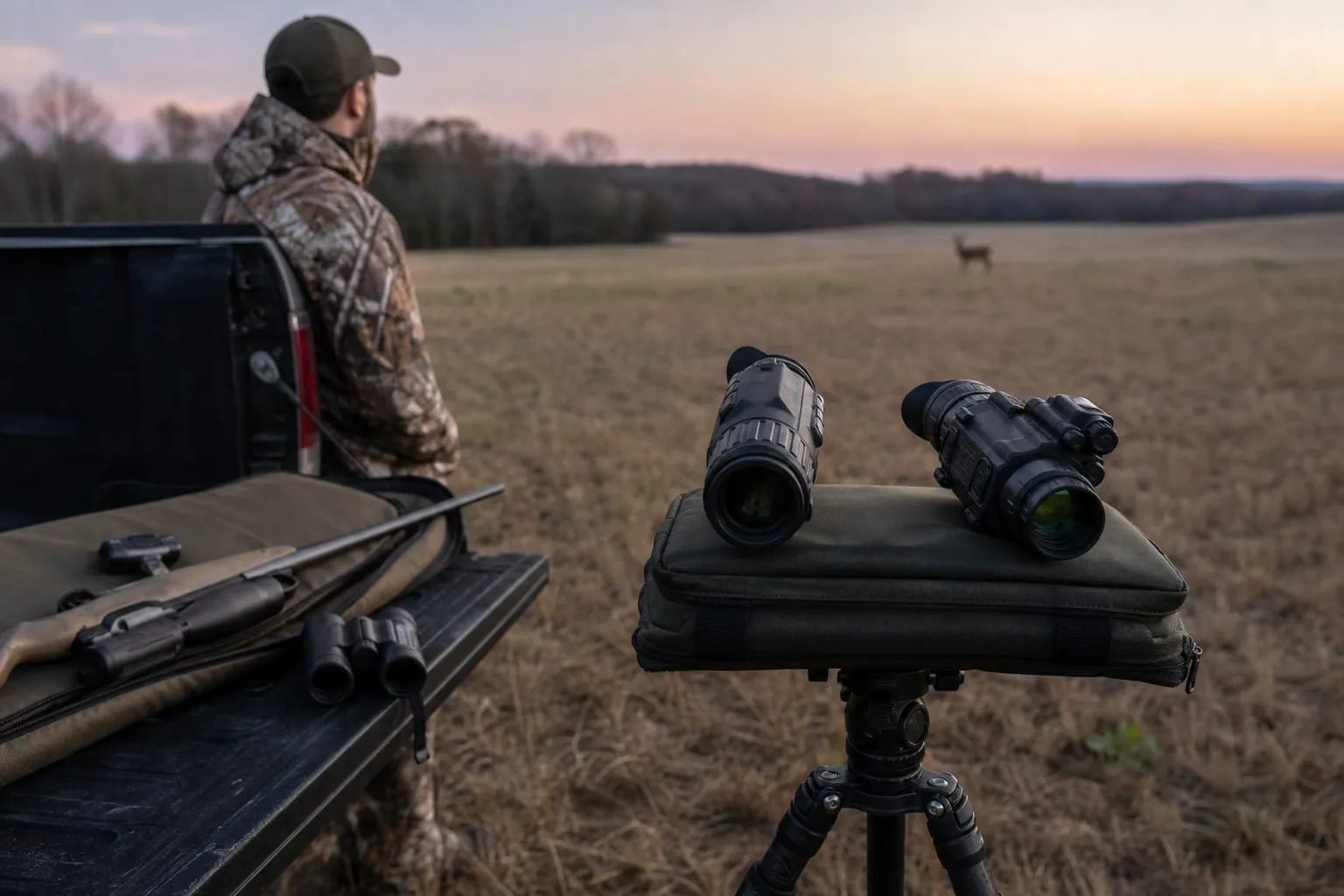
Thermal optics and night vision do different jobs. Thermal imaging detects heat differences and turns them into a visible image, while analog night vision amplifies available light. Digital night vision uses an electronic image sensor, digital processing, and a display, often with infrared illumination. None of these technologies is magic: each has real limits with glass, fog, rain, darkness, and visual camouflage.
The three technologies in plain English
Image intensification works by amplifying available light. Thermal imaging works by detecting infrared radiation naturally emitted by objects.
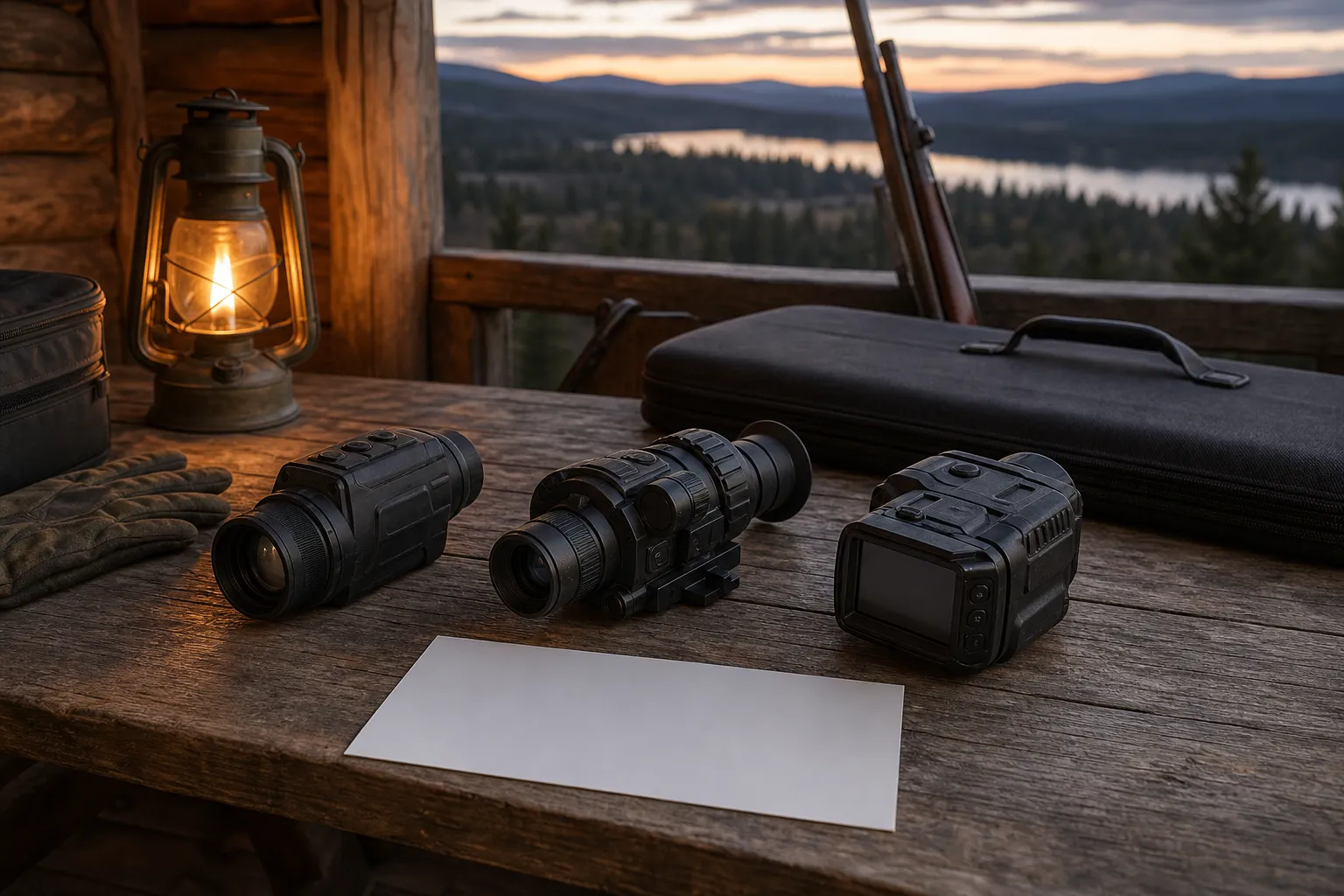
Digital night vision is a third category commonly seen in consumer optics. SIONYX explains that digital night vision converts light entering the objective lens into a digital signal using CMOS or CCD sensors. Pulsar says infrared illuminators are used with digital devices to improve image quality in low light or full darkness.
| Technology | What it uses | Basic result |
|---|---|---|
| Analog image intensifier night vision | Available light | A brighter image made from amplified light |
| Digital night vision | CMOS or CCD sensor, digital processing, display, often IR illumination | A digital image made from visible or near-infrared light |
| Thermal imaging | Infrared radiation naturally emitted by objects | A visible image based on temperature differences |
The practical difference is simple: night vision needs light, either natural or supplied by an illuminator. Thermal does not need visible light, because it relies on emitted heat instead of light.
How analog image intensifier night vision works
The National Institute of Justice and Office of Justice Programs describe image intensifier systems as using an objective lens, an image intensification tube, and an eyepiece. Available light enters the objective lens and is amplified inside the tube.
At a high level, the tube is the heart of the system. NIJ/OJP identifies major tube components and developments by generation, including the photocathode and the microchannel plate. L3Harris also discusses image intensifier tube generations in the context of U.S. military specifications.
Generation 1
NIJ/OJP describes early “starlight scopes” developed during the early 1960s for Vietnam-era use as first generation image intensifier devices.
For a comparison shopper, the important point is that Gen 1 refers to an older image intensifier approach from the early history of practical night vision.
Generation 2
NIJ/OJP identifies the microchannel plate as the key development that brought second generation night vision. NIJ/OJP says the microchannel plate reduced image intensifier tube size, weight, and distortion compared with Gen 1.
That is why Gen 2 is usually discussed as a major step in tube design, not just a marketing label. The microchannel plate changed the way amplification was achieved inside the tube.
Generation 3
NIJ/OJP states that Gen 3 image intensifiers were developed in the mid 1970s and became available in the early 1980s. NIJ/OJP says Gen 3 introduced a gallium arsenide photocathode, which increased the tube’s sensitivity, including near-infrared sensitivity.
L3Harris says U.S. military specifications exist for Generations I, II, and III. L3Harris also says an agreed-upon U.S. military specification to define a Gen IV designation does not yet exist. For readers comparing products, that means “Gen 4” should be treated carefully unless the maker explains exactly what performance standard or design feature it is describing.
How thermal microbolometers work
Lynred explains thermal imaging as detecting infrared radiation naturally emitted by objects according to temperature. Lynred says thermal images show temperature variations as color tones or in grayscale.
A common detector type in uncooled thermal imaging is the microbolometer. Lynred identifies uncooled detectors as microbolometers and explains that their electrical resistance changes according to the temperature of the radiation received.
Pulsar says calibration levels the background temperature of the microbolometer and eliminates image flaws.
For a hunter or wildlife observer, the big takeaway is that a thermal image is not a normal photograph. It is a picture built from detected heat differences. It may show a warm animal plainly against a cooler background, but it will not show color, markings, or fine visual detail the same way a light-based optic can.
How digital night vision works
Digital night vision is not an image intensifier tube. SIONYX explains that light entering the objective lens is transformed into a digital signal by a CMOS or CCD sensor. SIONYX also says larger CMOS or CCD sensor pixels improve reduced-light performance.
Digital systems can use visible light and near-infrared light. Axis explains that night mode in day-and-night cameras uses visible light as well as the closest region of near-infrared.
Pulsar says IR illuminators are used with digital devices to improve image quality in low light or full darkness. That is the key tradeoff. Digital night vision can give a familiar camera-like image, but in very low light it may depend on an illuminator.
What each technology can and cannot see
Thermal imaging can be useful in conditions where light-based night vision struggles.
Darkness and visual camouflage
Thermal has a major advantage in darkness because it does not need visible light.
Thermal can also help with visual camouflage. That advantage is about visual camouflage, not every possible method of reducing a thermal signature.
Analog and digital night vision work differently. They depend on visible or near-infrared light. Because they are light-based, they can preserve visual detail better in some situations, such as shape, texture, and scene layout, but they need enough light or an illuminator to form the image.
Glass and windows
Thermal is poor for looking through ordinary glass. Axis says thermal cameras cannot see through glass.
Digital or visual cameras using IR illumination are different. Axis says visual cameras using IR illumination can see through glass. Axis also warns that integrated IR illumination can reflect back into the camera lens and reduce image quality. In practical terms, a nearby window, dome, or reflective surface can create glare or washout for an IR-assisted digital system.
Walls, metal, and tree trunks
The same caution applies to hard barriers generally in this comparison. Thermal should not be understood as “seeing through” solid cover. It is detecting infrared radiation reaching the sensor from surfaces in view.
Fog and rain
Weather matters.
Night vision and digital IR systems can also be affected by what is between the optic and the target, because they depend on light reaching the sensor or tube. The exact result depends on the light, atmosphere, and device, so published specifications and manufacturer explanations matter.
Side-by-side comparison for hunters and curious readers
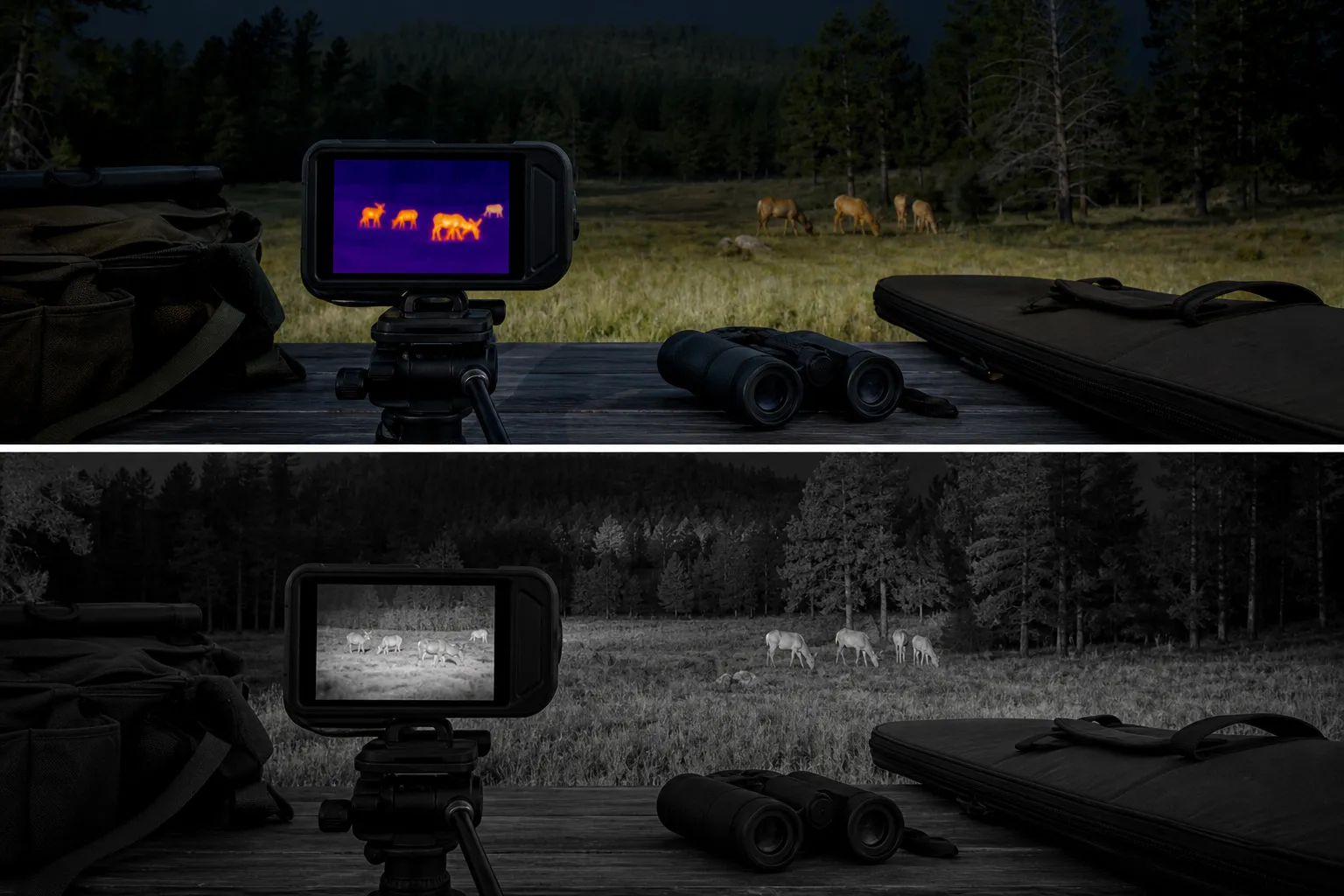
| Question | Thermal imaging | Analog image intensifier night vision | Digital night vision | |---|---|---| | Does it need visible light? | No. It forms images from infrared radiation naturally emitted by objects. | It amplifies available light through an image intensifier system. | It uses light on a CMOS or CCD sensor, according to SIONYX, and often uses IR illumination. | | What kind of image does it make? | Temperature variations shown as color tones or grayscale, according to Lynred. | An intensified light image viewed through an eyepiece. | A processed digital image shown on a display. | | Can it work in complete darkness? | It can be useful when there is no visible light if temperature differences are detectable. | It depends on available light. | It may use an IR illuminator in low light or full darkness, according to Pulsar. | | Can it see through glass? | No. Axis says thermal cameras cannot see through glass. | Not covered here as a separate glass claim. | Axis says visual cameras using IR illumination can see through glass, but reflections can reduce image quality. | | Can it see through walls or tree trunks? | Not a see-through-barriers technology. | Not a see-through-barriers technology. | Not a see-through-barriers technology. | | What is its main strength? | Detecting temperature differences in dark or visually camouflaged scenes. | Amplifying available light with an image intensifier tube. | Producing a digital image from visible and near-infrared light, often with IR illumination. |
Which is “better”?
Neither category is automatically better. They answer different questions.
If the question is, “Is there a warm object that stands out from the background?” thermal is the technology built for that.
If the question is, “What does the scene look like in a light-based view?” analog or digital night vision may be the better conceptual fit. Image intensifier night vision amplifies available light. Digital night vision uses a sensor and processing to turn light into a digital image.
Published specifications still matter. Sensor resolution, tube generation, illumination method, calibration, optics, display, and environmental limits can all affect what a user sees, but this comparison does not rank products.
Hunting regulation note
Use of thermal optics, analog night vision, digital night vision, and IR illumination for hunting is regulated differently by U.S. states and Canadian provinces or territories. Confirm the current rule with the agency that regulates the place, species, season, and method of take.
In the United States, the U.S. Fish and Wildlife Service says hunters generally must comply with the state fish and game agency requirements associated with the license, and that some National Wildlife Refuges require their own permits or user fees. The Association of Fish and Wildlife Agencies lists U.S. state and territorial fish and wildlife agencies.
In Canada, Environment and Climate Change Canada publishes annual migratory game bird hunting summaries for each province and territory. Provincial and territorial agencies publish their own hunting rules. For example, Québec says its sport hunting regulations set out seasons, bag limits, permitted weapons, licences, and basic rules.
Before hunting with any night-capable optic, check the current state, provincial, territorial, refuge, and migratory bird rules that apply to that hunt.
Frequently asked questions
Is thermal the same as night vision?
No. Thermal imaging forms images from detected infrared radiation naturally emitted by objects, while analog night vision amplifies available light. Digital night vision uses a CMOS or CCD sensor to turn light into a digital signal.
Can thermal optics see in total darkness?
Yes, when detectable temperature differences are present. Thermal imaging does not depend on visible light.
Can thermal see through glass?
No. Axis says thermal cameras cannot see through glass.
What is Gen 4 night vision?
L3Harris says U.S. military specifications exist for Generations I, II, and III, and that an agreed-upon U.S. military specification for Gen IV does not yet exist. Treat the term carefully unless a manufacturer defines exactly what it means.
Does digital night vision need an IR illuminator?
Digital night vision uses light on a CMOS or CCD sensor. Pulsar says IR illuminators are used with digital devices to improve image quality in low light or full darkness.
Can hunters use thermal or night vision optics?
Hunting use is regulated differently by state, province, territory, species, season, and land type. Check the current rules with the responsible fish and wildlife agency before using any night-capable optic.
Sources
- Seeing around corners, United States ArmyOfficial source. Accessed October 22, 2026.
- Scoping Out Night Vision, National Institute of Justice / Office of Justice ProgramsOfficial source. Accessed October 22, 2026.
- Gen III Image Intensifier Tubes: A Buyer’s Guide to Tube Technology, L3Harris. Accessed October 22, 2026.
- About our technologies, Lynred. Accessed October 22, 2026.
- Infrared Sensors, Leonardo DRS. Accessed October 22, 2026.
- Cooled vs Uncooled Optical Gas Imaging Cameras, Teledyne FLIR. Accessed October 22, 2026.
- How Do Thermal Cameras Work?, Teledyne FLIR. Accessed October 22, 2026.
- Can Thermal Imaging See Through Walls? And Other Common Questions, Teledyne FLIR. Accessed October 22, 2026.
- A Perfect Tool for Finding Wildlife, Teledyne FLIR. Accessed October 22, 2026.
- Night Vision 101, SIONYX. Accessed October 22, 2026.
- FAQ, Pulsar Vision. Accessed October 22, 2026.
- IR in surveillance, Axis Communications. Accessed October 22, 2026.
- Purchase a Hunting License, U.S. Fish and Wildlife ServiceOfficial source. Accessed October 22, 2026.
- Hunting regulations for migratory game birds: provincial and territorial summaries 2026 to 2027, Environment and Climate Change CanadaOfficial source. Accessed October 22, 2026.
- Hunting in Quebec, Gouvernement du QuébecOfficial source. Accessed October 22, 2026.
- AFWA Member List, Association of Fish and Wildlife Agencies. Accessed October 22, 2026.
- FLIR Scout thermal imagin. Accessed October 22, 2026.