What Is an ACOG? Fixed-Power Prism Optics Explained
An ACOG is Trijicon’s Advanced Combat Optical Gunsight, a fixed power prism riflescope family known for illuminated reticles, BDC references, and U.S. military Rifle Combat Optic use. It is different from a red dot or LPVO because it uses fixed magnification rather than a 1x dot sight or a variable magnification range.
By RaiS. Reviewed by RaiS. Published . 5 min read.
Research and drafting were assisted by AI. RaiS checked the facts against the sources below and approved this page.
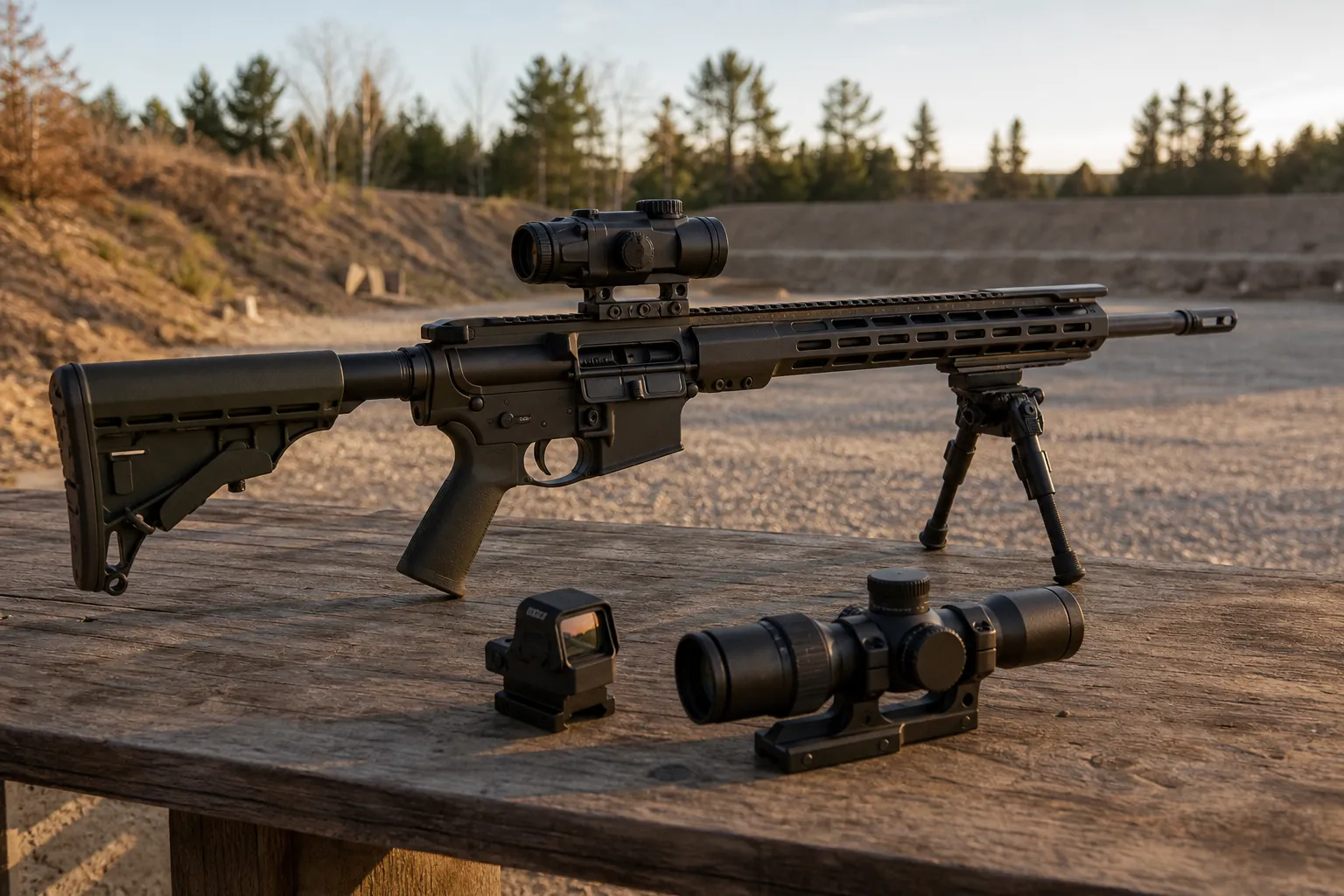
An ACOG is Trijicon’s Advanced Combat Optical Gunsight, a fixed-power riflescope family best known for prism-style magnified optics, illuminated reticles, bullet-drop-compensating reticles, and U.S. military Rifle Combat Optic use. Many ACOG models use fiber optics and tritium instead of batteries, while some LED ACOG models use a single AA battery, according to Trijicon.
People often search for an “ACOG scope,” but ACOG is a Trijicon product name, not a generic label for every prism scope. The wider prism-scope category includes other optics, but not every prism scope is an ACOG.
What an ACOG is
Trijicon’s ACOG manual expands ACOG as “Advanced Combat Optical Gunsight.” Trijicon describes the ACOG line as fixed power, and says that fixed-power construction allows minimal moving parts.
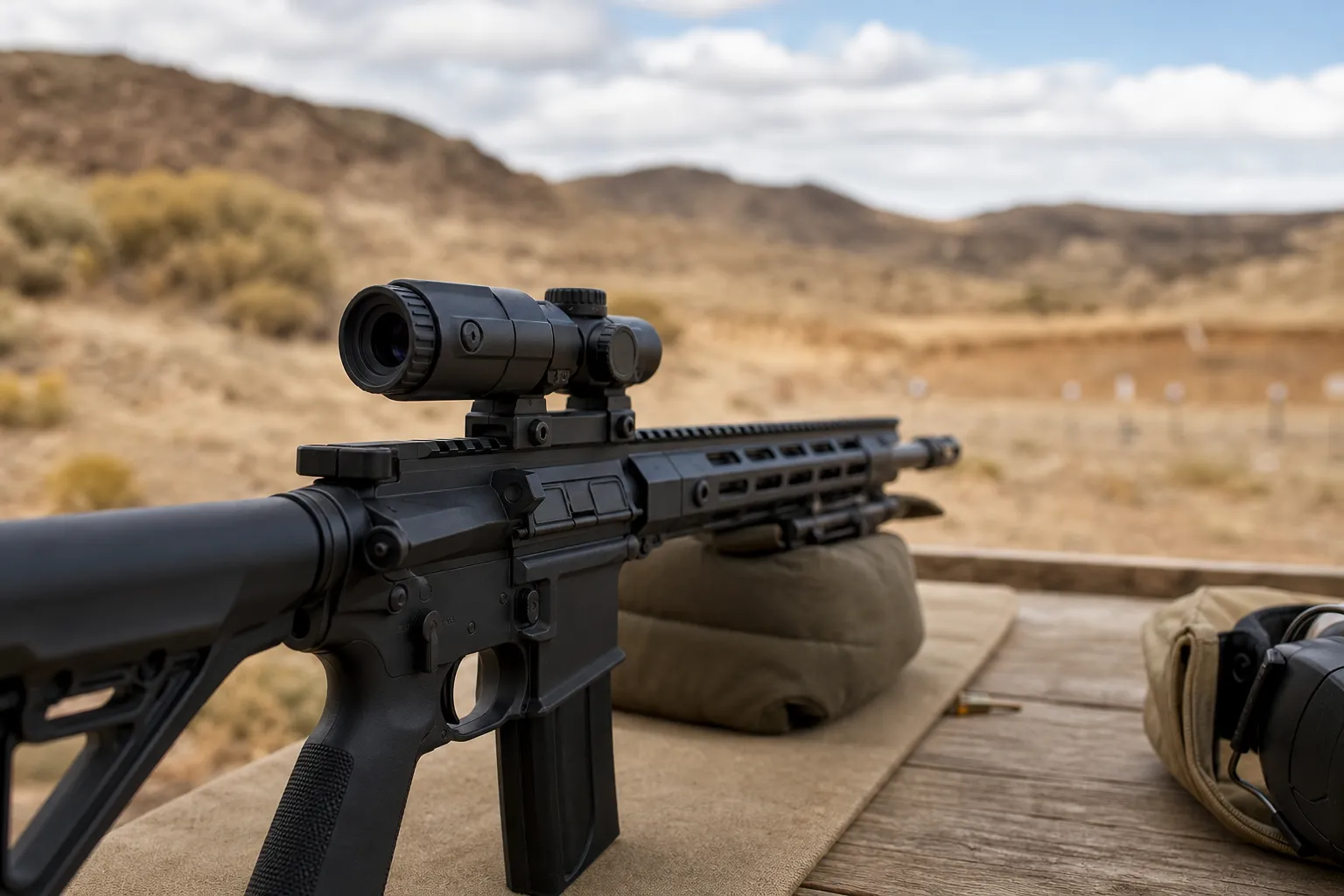
The family includes several magnification and objective-size combinations. Trijicon’s ACOG page lists model families such as 1.5x16S, 1.5x24, 2x20, 3x24, 3x30, 3.5x35, 4x32, 5.5x50, and 6x48. One of the best-known examples is the TA31, which Trijicon lists as a 4x32 riflescope.
The basic idea is simple: an ACOG gives the shooter a magnified view, an aiming reticle, and, on most models, bullet-drop and range-estimation references. Trijicon says most ACOG models feature bullet drop compensating and target-ranging reticles.
Most ACOG models are battery free, according to Trijicon, and use tritium and fiber optic illumination that automatically adjusts reticle brightness based on available light. Trijicon also says several ACOG models use LED illumination with user-adjustable brightness powered by a single AA battery.
How ACOG illumination works
On ACOG models with dual illumination, tritium can provide aiming-point illumination in darkness, while a fiber-optic collector can gather available light in brighter conditions.
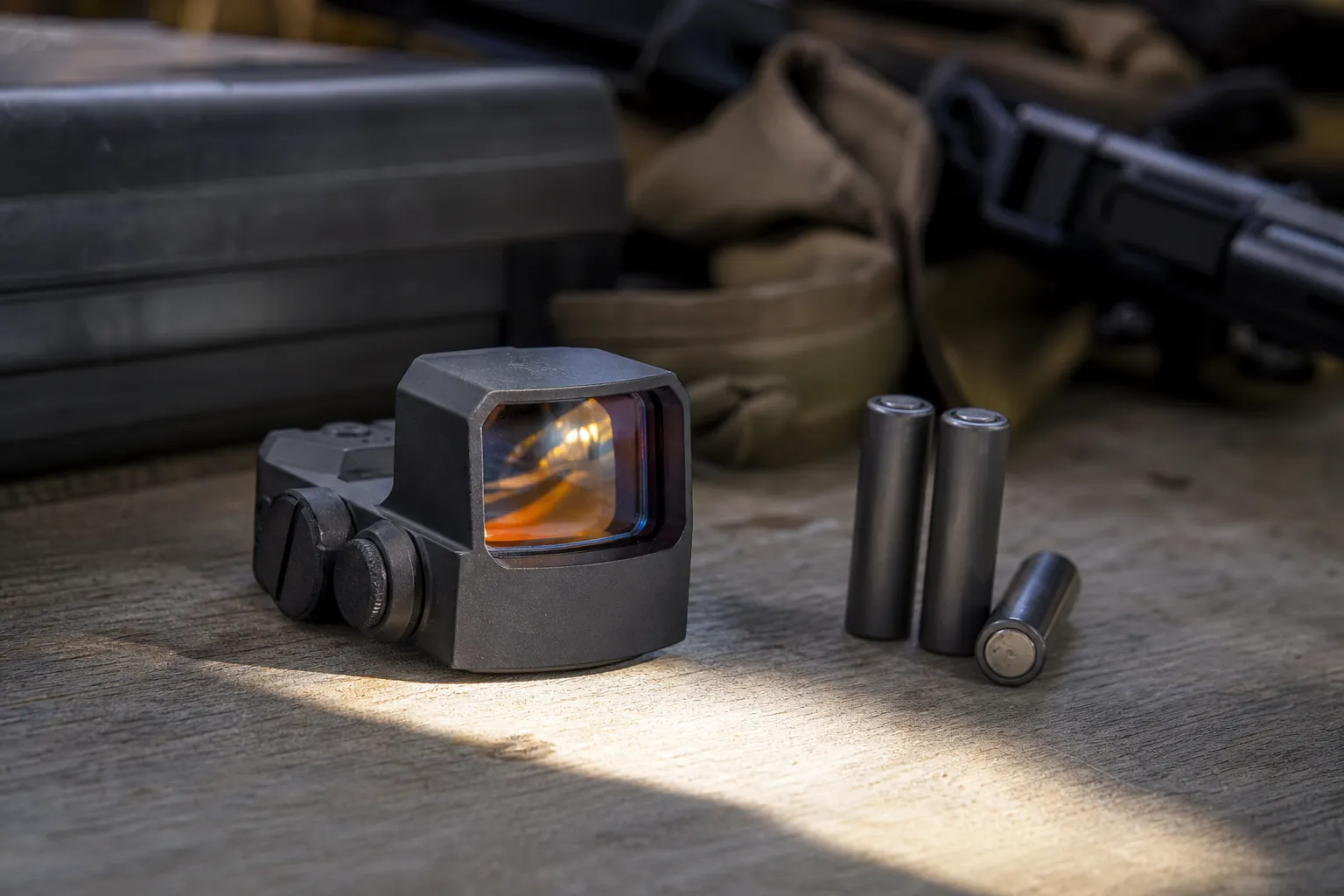
That means many ACOGs do not depend on a battery for reticle illumination. In daylight, the fiber optic collector gathers available light. In darkness, tritium provides the aiming-point illumination.
Trijicon’s manual also states that BAC ACOGs contain radioactive material for nighttime illumination, specifically Hydrogen-3, commonly known as tritium. The same manual says disassembly of the scope is prohibited except by Trijicon. If an ACOG is damaged or needs service, follow the current Trijicon manual for that exact model and do not take the optic apart.
Reticles, BDC, and range references
A major part of the ACOG concept is the reticle. Trijicon says most ACOG models include bullet drop compensating and target-ranging reticles.
A BDC reticle is not a universal solution for every rifle, cartridge, and distance. Trijicon’s technical glossary says its BDC reticles are calibrated for specific rounds, such as 5.56 NATO, 7.62x51 NATO, or 6.8mm Remington SPC. The same glossary says ACOG BDC reticles compensate for bullet drop from 100 to 1800 meters depending on the model.
For the 4x32 and 3.5x35 BAC ACOG manual, Trijicon describes the entire reticle pattern as a BDC for 5.56 mm, 6.8 mm, or 7.62 mm rounds depending on model, from 100 to 800 meters, without making mechanical adjustments to the sight. The TA31 product page says its reticle ranges out to 800 meters for 5.56 or .223 caliber.
Some ACOG reticles also include range-estimation references. Trijicon’s BAC ACOG manual says some reticles use the base of the reticle and horizontal stadia lines to represent 19 inches at the indicated range, with 19 inches described in the manual as the average width of a man’s shoulders.
Because ACOG reticles are model specific, the important point is to read the manual for the exact optic and reticle. The calibration, cartridge, and distance references can differ by model.
What BAC means
BAC stands for Bindon Aiming Concept in Trijicon’s ACOG materials. Trijicon describes BAC as a both-eyes-open aiming method that lets the shooter track and engage moving targets quickly.
Trijicon also says both-eyes-open shooting using BAC allows improved situational awareness. In practical comparison terms, BAC is part of how Trijicon explains using an illuminated reticle in a magnified fixed-power optic, especially when speed matters.
U.S. military use and the Rifle Combat Optic
The ACOG family is closely associated with U.S. military Rifle Combat Optic programs. Trijicon says it introduced the TA01 4x32 ACOG in 1987 and that it was included in the U.S. Army Advanced Combat Rifle program almost immediately.
Trijicon also says U.S. Special Operations Command purchased 12,000 ACOG 4x32 scopes in 1995 and chose the TA01 as its official scope for M4 carbines. Trijicon’s history page says the TA31RCO became the first official Rifle Combat Optic of the U.S. Marine Corps in 2005.
Trijicon’s ACOG history page says the Marine Corps RCO adoption was a multiyear contract with a first delivery order of 104,000 ACOG 4x32 TA31 scopes.
Marine Corps training material describes the RCO as a day and night dual-source illuminated telescopic sight with a tritium illuminated reticle pattern designed for the M16 family of weapons.
ACOG vs. red dots
An ACOG is a magnified fixed-power optic. A red dot sight is different in both magnification and aiming system.
For example, Trijicon’s RMR Type 2 product page lists 1x magnification, a dot reticle, no BDC, LED illumination, and a 3V lithium battery power source for one red dot model. Trijicon’s RMR manual describes the Ruggedized Miniature Reflex as intended for quick target acquisition and both-eyes-open use.
Trijicon also says an RMR can be used as a secondary sight with a magnified optic.
In short, an ACOG gives fixed magnification and, on most models, BDC and ranging features. A red dot such as an RMR gives a 1x dot sight picture and is described by Trijicon as intended for quick target acquisition. For more background, see our guide to red dot sights.
ACOG vs. LPVOs
An ACOG is fixed power. An LPVO-style optic gives variable magnification.
Trijicon describes the VCOG, or Variable Combat Optical Gunsight, as a rugged variable-powered riflescope with an LED-illuminated first focal plane reticle. Trijicon says the VCOG magnification range accommodates CQB and long-distance marksmanship, and lists 1-6x24 and 1-8x28 models. Trijicon also says the VCOG’s illuminated reticle is powered by a single AA battery.
That is the main contrast. An ACOG does not provide the on-the-fly magnification range of a variable-power riflescope. In exchange, Trijicon describes the ACOG as a fixed-power system with minimal moving parts, and says most ACOG models are battery free. For more on variable low-power rifle optics, see our guide to LPVO scopes.
ACOG and the wider prism-scope category
The ACOG is one of the best-known examples of a prism scope, but the terms are not interchangeable. ACOG is Trijicon’s product name. Prism scope is the broader optical category.
That is the broad comparison: ACOG models are fixed-power optics, while LPVOs are variable-power riflescopes.
Bottom line
An ACOG scope is Trijicon’s Advanced Combat Optical Gunsight, a fixed-power magnified optic family with a strong military history. Many models use battery-free fiber optic and tritium illumination, most include BDC and target-ranging reticles, and Rifle Combat Optic programs are part of its U.S. military history.
Before relying on a specific ACOG reticle or feature set, check Trijicon’s current manual and product page for that exact model. Confirm the illumination type, reticle, cartridge calibration, BDC distances, ranging references, and tritium handling instructions from the official documentation.
Frequently asked questions
What does ACOG stand for?
ACOG stands for Advanced Combat Optical Gunsight, according to Trijicon’s ACOG operator’s manual.
Is every prism scope an ACOG?
No. ACOG is Trijicon’s product name. Prism scope is the broader category, and not every prism scope is an ACOG.
Does an ACOG need batteries?
Trijicon says most ACOG models are battery free and use tritium and fiber optic illumination. Trijicon also says several LED ACOG models use a single AA battery.
What is an ACOG BDC reticle?
Trijicon says its BDC reticles are calibrated for specific rounds and compensate for bullet drop over model-specific distance ranges. In the 4x32 and 3.5x35 BAC ACOG manual, Trijicon describes reticle patterns for 5.56 mm, 6.8 mm, or 7.62 mm models from 100 to 800 meters.
How is an ACOG different from a red dot?
An ACOG is a fixed-power magnified optic. Trijicon’s RMR red dot example is listed as 1x with a dot reticle, LED illumination, no BDC, and a 3V lithium battery power source.
How is an ACOG different from an LPVO?
An ACOG is fixed power. Trijicon describes the VCOG as a variable-powered riflescope with 1-6x24 and 1-8x28 models, so it offers adjustable magnification that an ACOG does not.
Sources
- Trijicon VCOG Riflescope, TrijiconOfficial source. Accessed October 23, 2026.
- Operator’s Manual: Trijicon ACOG BAC Models 3.5x35 and 4x32, TrijiconOfficial source. Accessed October 23, 2026.
- Trijicon ACOG Riflescopes, TrijiconOfficial source. Accessed October 23, 2026.
- Trijicon ACOG 4x32 BAC Riflescope.223 / 5.56 BDC, TrijiconOfficial source. Accessed October 23, 2026.
- Technical Glossary, TrijiconOfficial source. Accessed October 23, 2026.
- Trijicon History, TrijiconOfficial source. Accessed October 23, 2026.
- Trijicon ACOG History, TrijiconOfficial source. Accessed October 23, 2026.
- M150 Rifle Combat Optic, U.S. Army Program Executive Office SoldierOfficial source. Accessed October 23, 2026.
- Introduction to Observation Theory / Night Optics, U.S. Marine Corps Training CommandOfficial source. Accessed October 23, 2026.
- Department of Defense Contract Notice, April 2020, U.S. Department of DefenseOfficial source. Accessed October 23, 2026.
- Trijicon RMR Manual, TrijiconOfficial source. Accessed October 23, 2026.
- Trijicon RMR Type 2 Red Dot Sight, TrijiconOfficial source. Accessed October 23, 2026.
- What Is A Prism Scope?, Primary Arms. Accessed October 23, 2026.