What Is a Spotting Scope?
A spotting scope is a high magnification optic used with one eye when binoculars do not show enough detail at distance. Hunters and target shooters usually choose between binoculars and a spotting scope by weighing field of view, portability, detail, magnification, body style and tripod use.
By RaiS. Reviewed by RaiS. Published . 7 min read.
Research and drafting were assisted by AI. RaiS checked the facts against the sources below and approved this page.
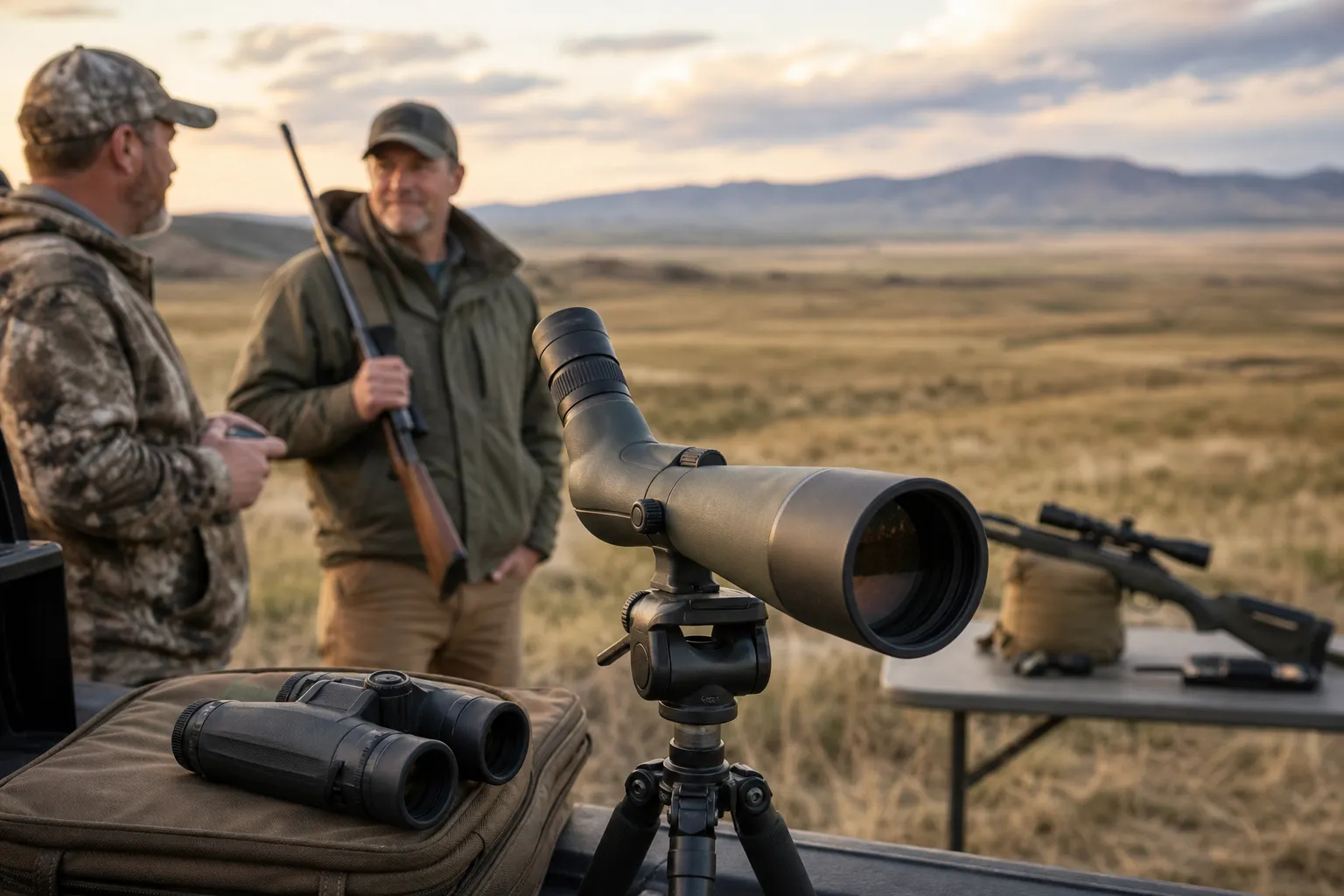
A spotting scope is a one eye viewing optic with higher magnification than most binoculars. Kowa explains that binoculars are viewed with both eyes, while a spotting scope is viewed with one eye, and that spotting scopes generally make faraway images appear larger. For hunters and target shooters, that means a spotting scope is the tool you reach for when binoculars are not showing enough detail at distance.
Spotting scope vs binoculars
The short version is simple: binoculars are better for scanning, carrying and comfortable two eye viewing, while spotting scopes are better for seeing more detail on a distant subject.
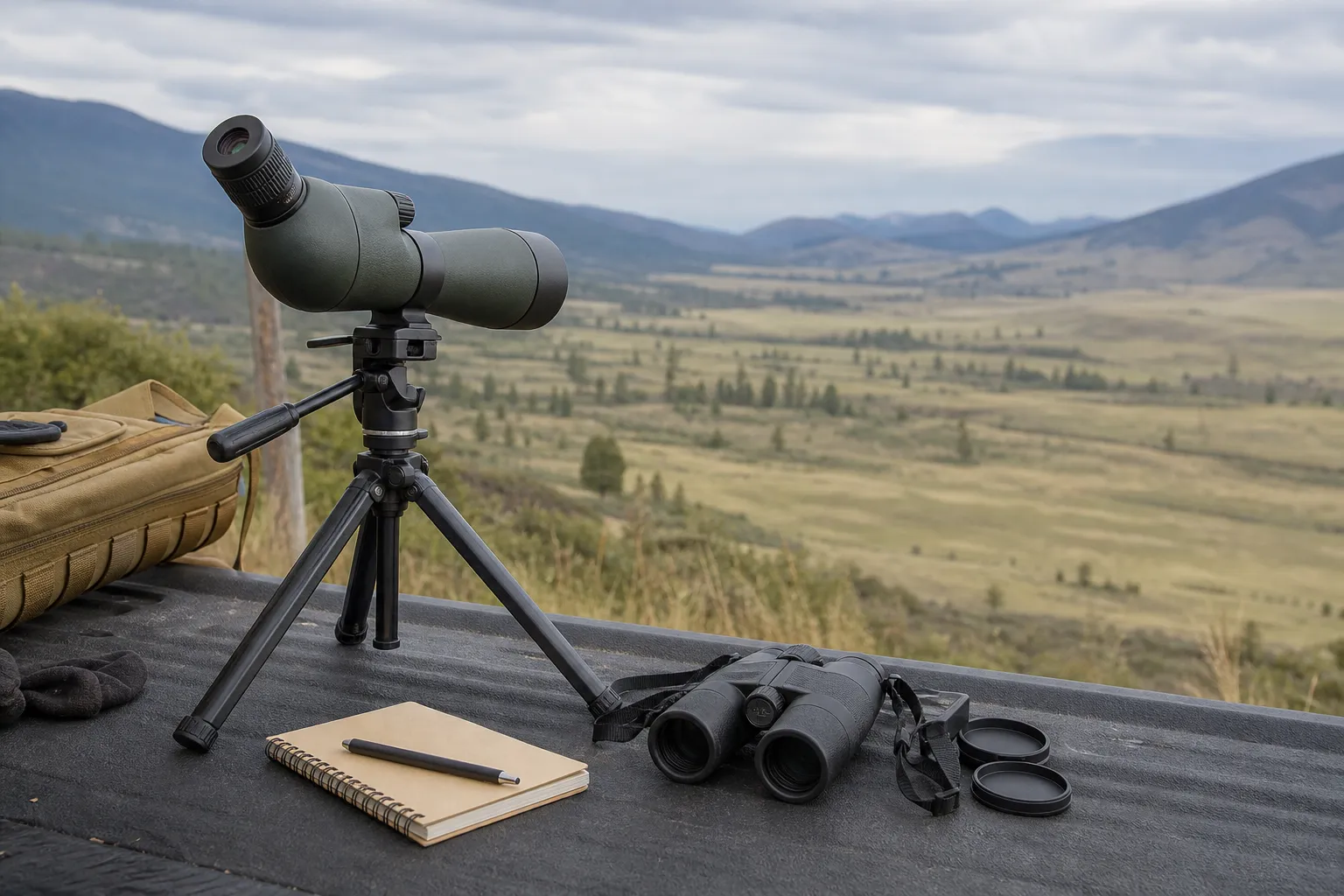
Kowa says binoculars are easier to handle and more portable than spotting scopes. Kowa also notes that binoculars can give a better three dimensional image because both eyes are used. Swarovski Optik explains that binoculars have a larger field of view than spotting scopes, so you can see a larger area at once.
A spotting scope gives up some of that wide view for magnification. Swarovski Optik states that spotting scopes have higher magnification, which makes the field of view smaller but lets you see more detail. Vortex describes high magnification as useful for observing distant targets, identifying game, studying trophy potential, long range shooting and spotting small targets.
For a hunter, the Alaska Department of Fish and Game describes spotting scopes as specialized optics for finding game at extremely long ranges or looking at a specific animal in great detail. The agency says they can help hunters determine details such as the sex of mountain goats, horn size on rams and the sex and size of brown bears.
For a target shooter, the same basic advantage applies: a spotting scope is chosen when the shooter or spotter needs more detail than binoculars provide. Vortex specifically lists long range shooting and small targets among the uses for high magnification optics.
What do spotting scope numbers mean?
Spotting scope markings usually tell you magnification first and objective lens size second. Swarovski Optik gives the example 30-70x95, which means 30x to 70x magnification and a 95 mm objective lens.
So a marking such as 20-60x60 follows the same pattern: a variable magnification range from 20x to 60x, with a 60 mm objective lens. If you already know binocular markings such as 10x42, the idea is similar. See our guide to binocular numbers explained for the binocular version.
Swarovski Optik says most spotting scopes have variable magnification, which lets the user adjust magnification within a range. That zoom range is useful because high power is not always the best view.
Magnification tradeoffs
Higher magnification shows more detail, but it also brings tradeoffs. Swarovski Optik explains that as magnification increases, field of view becomes smaller. Vortex lists three common tradeoffs of higher magnification: narrower field of view, lower brightness and more visible image movement from hand motion or vibration.
That is why a spotting scope often works best at a lower setting first. A wider view can help you locate the subject. Once you are on it, you can increase magnification to study detail.
The Alaska Department of Fish and Game also cautions hunters that more power is not always better. The agency says heat wave mirage can make it difficult to see a clear long distance image above 20x to 30x.
Objective lens size and brightness
The objective lens is the end of the optic facing the subject. Swarovski Optik explains that objective lens diameter determines how much light can enter the optic.
A larger objective can help brightness, especially in poor light, but it usually comes with more bulk. Leupold explains that a smaller objective lens can result in a slightly darker image, while 40 to 50 mm objective spotting scopes reduce total weight and are easier to pack. Leupold also describes 80 to 85 mm objective spotting scopes as useful for extreme distances and low light, but they are larger than smaller objective models.
Exit pupil is another useful number. Kowa defines exit pupil as objective lens diameter divided by magnification. Kowa also states that a larger exit pupil generally gives a brighter image, especially in low light, because it allows more light into your eyes.
That means magnification and objective size work together. As magnification rises, exit pupil gets smaller if the objective size stays the same.
ED, XD, fluorite and HD glass
Spotting scope makers often use terms such as ED, XD, fluorite and HD when describing optical systems. These terms are tied to how a manufacturer designs and markets its glass and lens system, so compare them by reading the maker’s own specification and explanation rather than treating every label as identical.
Kowa explains chromatic aberration as color blur or fringing that happens when different wavelengths of light do not focus at the same point after passing through a lens. Kowa states that low dispersion glass and advanced lens materials are used to reduce chromatic aberration.
Kowa’s catalog defines XD as extra low dispersion glass with characteristics close to fluorite crystal, and says it reduces a high percentage of chromatic aberration. ZEISS describes its Conquest Apia 85 spotting scope as using HD optics, ED glass and aspherical lenses, with ED glass and aspherical lenses used for faithful colors and detail reproduction.
Coatings also matter. Kowa says optical coatings reduce reflection and increase light transmission, brightness, contrast and color accuracy.
Angled vs straight spotting scopes
Spotting scopes commonly come in angled and straight body styles. The best choice depends on how you glass, how you share the scope and where you set it up.
Leupold says angled spotting scopes are more comfortable for prolonged glassing, give multiple viewing positions and help when glassing uphill. Leupold also says an angled eyepiece makes sharing easier because people of different heights can view the same target without adjusting the spotting scope or tripod.
Straight spotting scopes have a different advantage. Leupold says a straight spotting scope can be more comfortable from a truck, for downhill glassing and for quick target acquisition because it matches the line of sight. Vortex also says straight spotting scopes are intuitive for new users because the user’s eyes are already pointed at the target.
If several people will use the same scope from a fixed tripod, angled can be easier to share. If you value a direct line from your eye to the subject, straight may feel more natural.
Eyepieces, zoom and eye relief
Most spotting scopes use variable magnification, according to Swarovski Optik. In everyday terms, that means the eyepiece or zoom control lets you move through a magnification range instead of being locked at one power.
Eye relief is important for comfort. Kowa defines eye relief as the distance between your eye and the eyepiece where you can see the full field of view without dark edges or vignetting. Kowa notes that eye relief is especially important for people who wear glasses.
Tripods and mounts
A spotting scope needs stable support. Vortex states that higher magnification amplifies hand movements and vibrations, making a tripod essential for a steady image. Vortex also says spotting scopes need a stable platform to be effective.
Many spotting scopes use familiar tripod connections, but check the manual for the exact model. Leupold’s spotting scope manual says Leupold spotting scopes use a 1/4-20 tripod adapter that accepts the standard 1/4-20 mounting screw found on most tripods. Kowa’s catalog states that some Kowa spotting scopes can be secured to both 1/4 inch and 3/8 inch mount tripods.
For field use, tripod stability matters as much as magnification. The higher the zoom setting, the more vibration you will see in the image.
Digiscoping with a spotting scope
A safety note for hunters
A spotting scope or binocular is an observation tool. A riflescope is not a substitute.
The Alaska Department of Fish and Game says a responsible hunter never uses a riflescope like binoculars or a spotting scope. If you need to identify game, study an animal or scan terrain, use observation optics rather than pointing a firearm-mounted optic at something you have not already identified.
How to choose between a spotting scope and binoculars
Choose binoculars when you want portability, easier handling, a larger field of view and two eye viewing. Kowa says binoculars are easier to handle and more portable, and Swarovski Optik explains that binoculars show a larger area than spotting scopes.
Choose a spotting scope when distance and detail matter more than field of view. Swarovski Optik says spotting scopes offer higher magnification and more detail with a smaller field of view. Vortex lists distant targets, game identification, long range shooting and small targets as uses for high magnification.
Before buying or using one, compare the manufacturer’s specifications for magnification range, objective size, eye relief, mount type and optical design. If you use optics while hunting, confirm current rules, seasons and species requirements with the wildlife agency for the place you hunt.
Frequently asked questions
What is a spotting scope used for?
A spotting scope is used for one eye, high magnification viewing when binoculars do not provide enough detail. The Alaska Department of Fish and Game describes spotting scopes as specialized optics for finding game at extremely long ranges or looking at a specific animal in great detail.
What does 20-60x60 mean on a spotting scope?
The first numbers are the magnification range, and the second number is the objective lens diameter in millimeters. Swarovski Optik explains that a marking such as 30-70x95 means 30x to 70x magnification with a 95 mm objective lens.
Is a spotting scope better than binoculars?
It depends on the job. Kowa says binoculars are easier to handle and more portable, while Swarovski Optik explains that binoculars have a wider field of view. A spotting scope provides higher magnification and more detail, but with a smaller field of view.
Do spotting scopes need tripods?
For practical use at high magnification, yes. Vortex states that higher magnification amplifies hand movements and vibrations, making a tripod essential for a steady image.
Are angled or straight spotting scopes better?
Leupold says angled spotting scopes are comfortable for prolonged glassing, uphill viewing and sharing between people of different heights. Leupold says straight spotting scopes can be more comfortable from a truck, for downhill glassing and for quick target acquisition because they match the line of sight.
Sources
- Insights into observation optics, Swarovski OptikOfficial source. Accessed October 23, 2026.
- How To Choose A Spotting Scope, LeupoldOfficial source. Accessed October 23, 2026.
- Spotting Scopes Manual, LeupoldOfficial source. Accessed October 23, 2026.
- ZEISS Conquest Apia 85, ZEISSOfficial source. Accessed October 23, 2026.
- Optical Terminology Explained, Kowa OpticsOfficial source. Accessed October 23, 2026.
- FAQ, Spotting Scopes / Binoculars, Kowa OptronicsOfficial source. Accessed October 23, 2026.
- Kowa Catalogue Scopes, KowaOfficial source. Accessed October 23, 2026.
- Understanding Magnification and Field of View, Vortex OpticsOfficial source. Accessed October 23, 2026.
- Straight or Angled Spotting Scopes: Which is Right for You?, Vortex OpticsOfficial source. Accessed October 23, 2026.
- Spotting Alaskan Game, Alaska Department of Fish and GameOfficial source. Accessed October 23, 2026.
- Shooting Accessories: Binoculars & Spotting Scopes, NRA Family. Accessed October 23, 2026.
- The Audubon Guide to Spotting Scope, Audubon. Accessed October 23, 2026.