Rifle Scope Parallax Explained
Rifle scope parallax can appear as reticle movement against the target when your eye is not centered behind the scope. It is often easier to notice at higher magnification or when the target distance does not match the scope’s parallax setting.
By RaiS. Reviewed by RaiS. Published . 6 min read.
Research and drafting were assisted by AI. RaiS checked the facts against the sources below and approved this page.
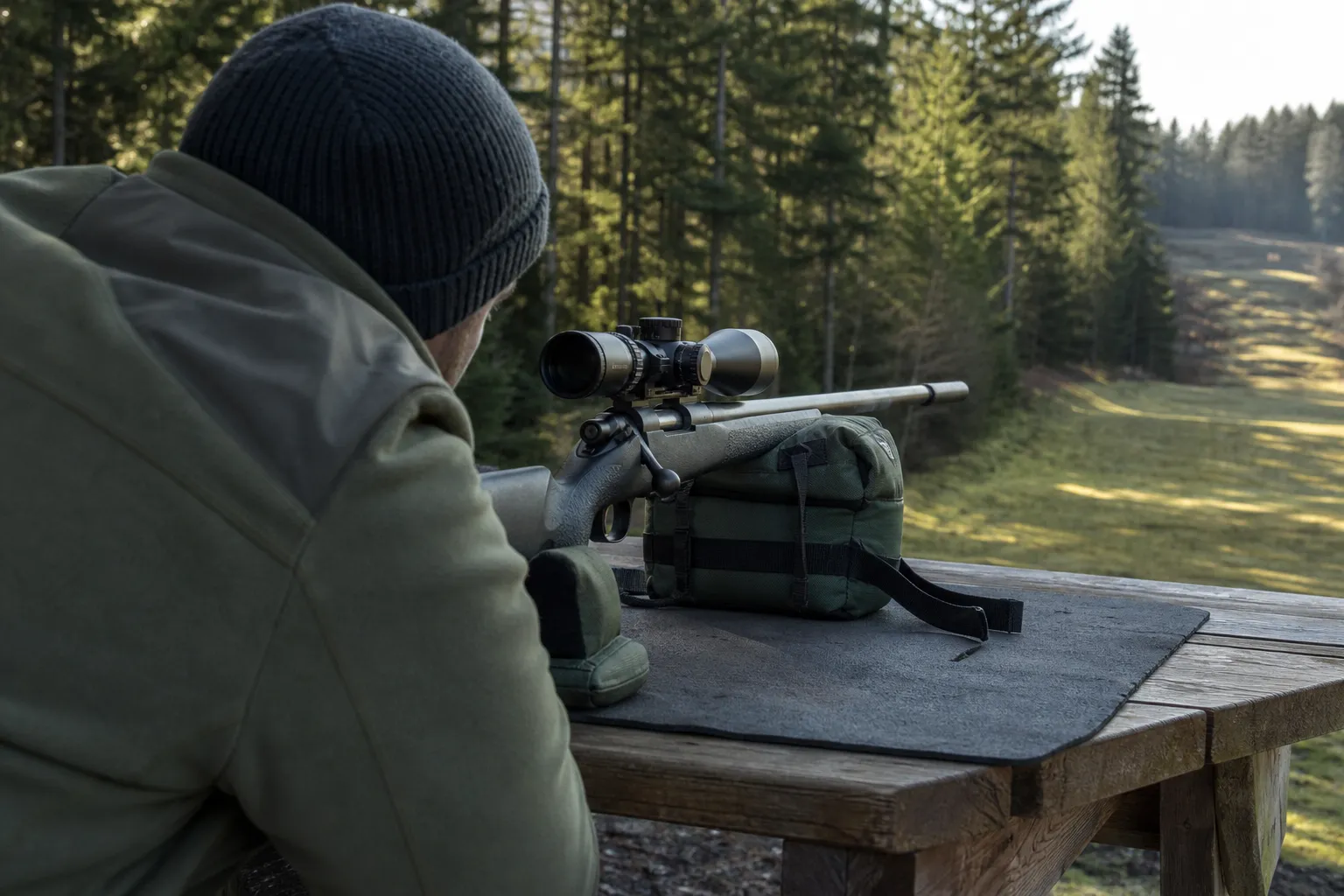
Rifle scope parallax is the apparent movement of the reticle against the target when your eye moves behind the scope. Nightforce describes the effect as apparent reticle movement as the eye moves across the scope’s exit pupil. In plain terms, if the rifle and scope are still but the crosshair seems to slide on the target when you shift your head, you may be seeing a parallax effect.
What parallax is in a riflescope
A riflescope forms an image of the target inside the scope, and the reticle must visually line up with that image.
The U.S. Small Arms Marksmanship Training Manual discusses telescopic sight parallax in connection with the position of the primary image and the eye moving off the optical axis of the scope. That second part matters. If your eye stays in exactly the same centered position, parallax may be hard to notice. When your eye shifts, the effect can become visible as reticle movement.
Optical engineering references use the same idea. Edmund Optics notes that parallax can cause inaccurate optical measurements, which is why the same optical problem matters in a sighting system.
A helpful way to think about it is this: the reticle should appear to stay on the same aiming point as your eye position changes. If it seems to wander on the target even though the rifle has not moved, parallax may be visible.
What parallax looks like to the shooter
The most common symptom is simple: the reticle appears to drift over the target while the rifle and scope are stationary. Nightforce describes this as the reticle appearing to move when the shooter nods the head up and down, even though the riflescope itself is not moving.
Parallax can also affect where the shot is aimed. ZEISS explains that looking through the eyepiece at an angle can create lateral offset between the reticle and the image, which can cause a deviation in point of impact.
Blur can show up with the same problem. ZEISS describes parallax compensation as having two effects: the image is sharply focused and parallax errors do not occur even when looking through the eyepiece at an angle.
Why distance and magnification matter
Distance alone is not the whole issue. The key question is whether the scope’s parallax or focus setting matches the actual target distance.
ZEISS gives an example in which a normal riflescope may behave differently at 100 meters than at 300 meters. If the shooter then looks through the eyepiece at an angle, the view can create lateral offset.
Higher magnification makes the effect easier to see. Burris states that parallax is more noticeable with higher magnification scopes. Nightforce also warns that at longer distances and higher magnification settings, significant sighting error can result if parallax is not removed.
Close distances can matter too. Vortex cautions that a target can be too close for a fixed parallax scope’s focusing capability. Vortex gives examples of fixed 100 yard parallax or 50 to infinity parallax scopes showing distortion at 10 or 25 yards because the target is too close for the rifle’s focusing capability.
So the practical rule is not simply “far targets have parallax.” A close target, a long target, or any target at a distance different from the scope’s parallax setting can show the problem. Magnification can make it easier to detect.
Fixed parallax scopes
A fixed parallax scope has no external parallax adjustment for the shooter to turn. Leupold states that any fixed focus optical system can be adjusted to be parallax free at only one distance.
That does not mean a fixed parallax scope cannot be used at other distances. It means the scope may have some residual parallax when the target is not at the distance for which that optical system is set.
Manufacturers use different fixed parallax distances for different scope types, so the specific manual matters. Leupold says most Leupold scopes are parallax free at 150 yards, while Leupold rimfire scopes are set to 60 yards and Leupold shotgun and muzzleloader scopes are set to 75 yards.
Those examples are not universal standards for every optic. They show why the manual for the exact scope is the best place to confirm the fixed parallax distance.
Adjustable objective and side focus controls
Adjustable objective and side focus controls are both parallax and focus controls. Their job is to reduce apparent reticle movement and refine target focus.
Burris describes an adjustable objective design in which parallax is adjusted by rotating a ring on the objective bell. Burris describes a side focus design as a parallax and focus adjustment knob on the left side of the adjustment turret.
Burris explains what the control does inside the optical system: the parallax and focus adjustment moves the focal point forward or backward, allowing the image to appear sharp and clear.
Vortex describes side focus or adjustable objective scopes as having a separate focus used to fine tune the image focus. Vortex states that when the image is sharply focused, parallax error will also be eliminated.
The distance numbers on these controls should be treated as starting points, not exact range readings. Vortex cautions that yardage numbers on side focus or adjustable objective controls are guidelines rather than exact distance references. Nightforce similarly says parallax yardage or meter markings are approximate guidelines to begin adjustment and are not intended for ranging.
How to check for parallax in a simple way
Start by focusing the reticle. Leupold instructs shooters to make sure the reticle is clear before adjusting parallax.
Then use a stable aiming setup and look at the aiming point. Leupold describes a method: move your head slightly up and down while turning the side parallax dial or adjustable objective ring until the reticle does not move in relation to the target.
A simple beginner checklist looks like this:
- Focus the reticle first so it appears clear.
- Aim at the target while keeping the rifle still.
- Move your head slightly while watching the reticle against the target.
- If the reticle appears to move, adjust the parallax control if your scope has one.
- Stop when the reticle no longer appears to move against the target.
SIG Sauer’s WHISKEY4 manual says parallax should be adjusted every time the distance to target changes. For a scope with a parallax control, that means the check is not a one time setup. A new distance can require a new adjustment.
Parallax, focus and eye position
Parallax and focus are closely related in many scope manuals because both involve where the target image forms inside the scope. Burris says the parallax and focus adjustment moves the focal point. ZEISS also describes parallax compensation as making the image sharp.
Even so, the reticle focus comes first. Leupold’s instruction to focus the reticle before adjusting parallax is important because the reticle needs to be clear before you judge parallax.
Eye position still matters. The U.S. Small Arms Marksmanship Training Manual discusses telescopic sight parallax in connection with the eye moving off the optical axis. Nightforce describes the same idea as reticle movement when the eye moves across the exit pupil.
That is why a consistent head position helps, and why the head movement check reveals the problem. If the reticle moves on the target as your eye moves, the scope is showing parallax for that distance and setting.
What to check in your scope manual
Check the manual for your exact scope model. Confirm whether it has fixed parallax, an adjustable objective, or side focus. If it has fixed parallax, check the manufacturer’s stated parallax distance. If it has a parallax control, use the yardage marks only as a starting point, then verify by watching for reticle movement against the target.
Frequently asked questions
What is rifle scope parallax?
Rifle scope parallax is commonly noticed as apparent reticle movement against the target as the shooter changes eye or head position behind the scope.
How can I tell if my scope has parallax error?
Keep the rifle still, aim at the target, and move your head slightly while watching the reticle. Leupold describes turning the side parallax dial or adjustable objective ring until the reticle does not move in relation to the target.
Does higher magnification make parallax worse?
Burris states that parallax is more noticeable with higher magnification scopes. Nightforce warns that longer distances and higher magnification settings can create significant sighting error if parallax is not removed.
What does a side focus or adjustable objective control do?
Burris explains that a parallax and focus adjustment moves the focal point forward or backward so the image can appear sharp and clear. Adjustable objective designs use a ring on the objective bell, while many side focus designs use a knob on the left side of the turret area.
Are the yardage marks on a parallax knob exact?
No. Vortex says the yardage numbers are guidelines rather than exact references, and Nightforce says parallax yardage or meter markings are approximate starting points and are not intended for ranging.
Can a fixed parallax scope still be used at other distances?
A fixed focus optical system can be parallax free at only one distance, according to Leupold. At other distances, a fixed parallax scope may still be usable, but some residual parallax can remain.
Sources
- Adjusting Parallax, BushnellOfficial source. Accessed October 23, 2026.
- NXS Owner’s Manual, Nightforce OpticsOfficial source. Accessed October 23, 2026.
- Small Arms Marksmanship Training Manual, ERIC archived document. Accessed October 23, 2026.
- Information & Instructions, Autocollimator, Edmund OpticsOfficial source. Accessed October 23, 2026.
- Eliminator III User Guide, Burris OpticsOfficial source. Accessed October 23, 2026.
- FAQs, Vortex OpticsOfficial source. Accessed October 23, 2026.
- Parallax Compensation, ZEISS Hunting BlogOfficial source. Accessed October 23, 2026.
- Riflescope Owner’s Manual, Complete Instructions, LeupoldOfficial source. Accessed October 23, 2026.
- Match Pro Riflescope Owner’s Guide, BushnellOfficial source. Accessed October 23, 2026.
- RT Riflescope User Guide, Burris OpticsOfficial source. Accessed October 23, 2026.
- Fullfield User Guide, Burris OpticsOfficial source. Accessed October 23, 2026.
- WHISKEY4 Riflescope Operator’s Manual, SIG SauerOfficial source. Accessed October 23, 2026.