Rifle Scope Reticles Explained: Duplex, Mil-Dot, BDC and More
A rifle scope reticle is the aiming pattern you see in the scope. The best reticle choice depends on whether you want a simple hunting sight picture, measured hold marks, ballistic holdovers, wind references, illumination, or a reticle scale that stays constant through magnification changes.
By RaiS. Reviewed by RaiS. Published . 9 min read.
Research and drafting were assisted by AI. RaiS checked the facts against the sources below and approved this page.
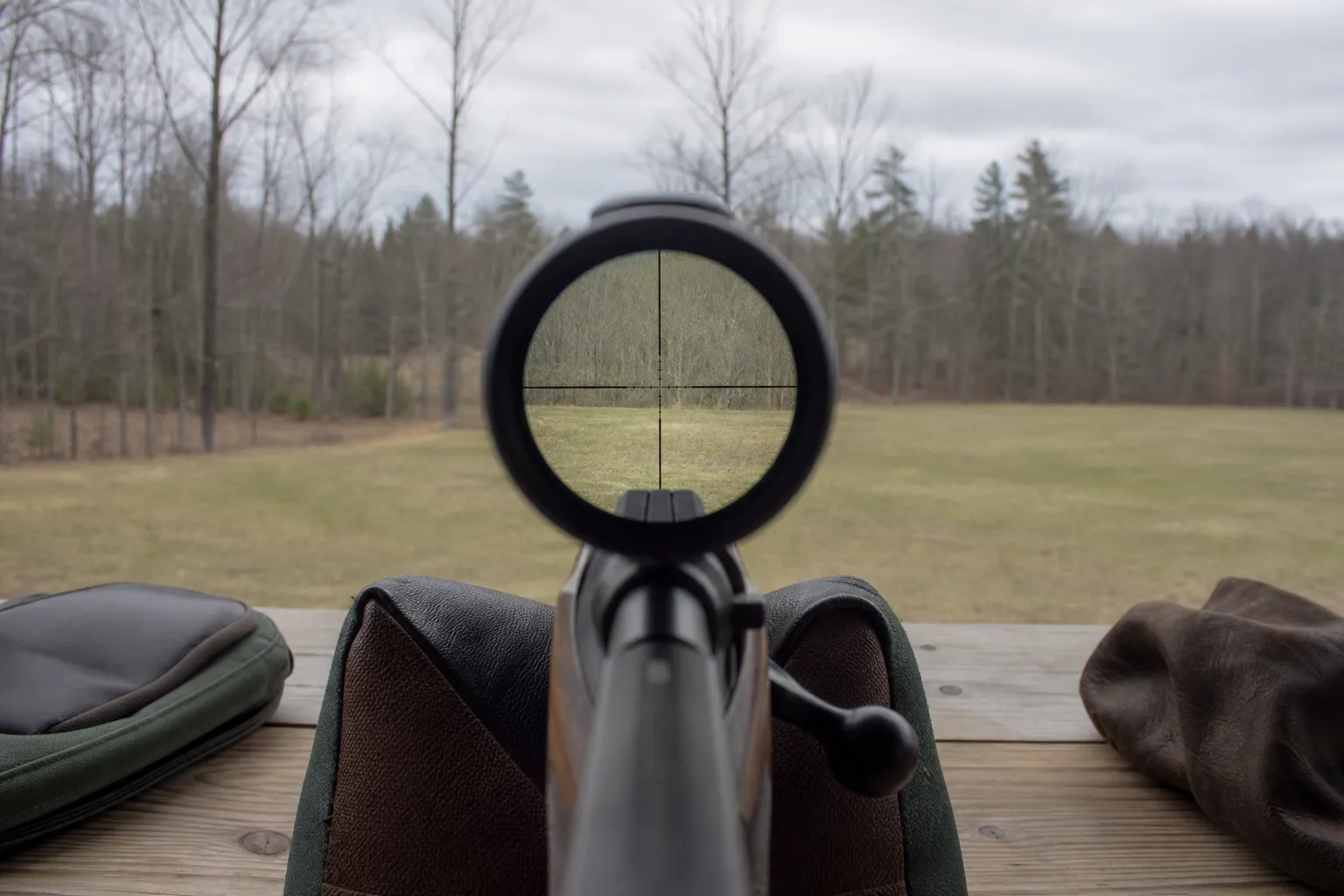
A rifle scope reticle is the aiming pattern you see when you look through the scope. Reticles differ in line thickness, aiming marks, illumination, focal plane placement, and measurement system. The right one depends on the job: quick hunting shots, small target precision, range estimation, holdover, wind holds, or low light aiming.
The most important rule is simple: read the maker’s reticle manual or subtension chart for your exact scope and reticle. Reticle family names are useful, but the actual dimensions, hold marks, and magnification rules can vary by model.
What a reticle does
A reticle gives you a reference point for aiming. A very simple reticle may only provide a central crosshair. A more complex reticle may add dots, hash marks, numbers, wind references, ballistic holdover marks, or an illuminated center.
Those marks matter because they cover a certain angular amount of the target. That is called subtension. Manufacturers publish subtension charts in MOA or mils, and the numbers may depend on magnification in second focal plane scopes.
Simple hunting reticles: duplex, fine crosshair, and plex styles
Simple hunting reticles are built around speed and an uncluttered sight picture. They usually give the eye bold outer references and a finer center aiming point.

Leupold says its Duplex reticle was invented in 1962. Leupold describes the Duplex as defined by heavy posts, with heavy posts that stand out in cover and low light and thin center lines for quick target acquisition. Leupold lists its Duplex as a rear, or second, focal plane reticle.
A fine duplex or fine crosshair style shifts the balance toward precision. Leupold describes Fine Duplex as based on its Duplex style design, but with thinner posts and crosshairs. Leupold says that makes it better for precision shots and helps make small target acquisition easier.
ZEISS gives a similar example with its non-illuminated reticle 20. ZEISS describes it as a very fine second image plane reticle for precise daytime aiming at long distances and small targets.
Plex style reticles are another simple hunting pattern. ZEISS says its plex-style #6 has heavy outer bars that draw the eye to center and a finer inner crosshair that remains precise at higher magnification. ZEISS describes #6 as offering an uncluttered field of view for classic stand and stalk hunting at short to mid-range distances.
Best fit:
- Duplex: general hunting, cover, and low light sight pictures.
- Fine duplex or fine crosshair: smaller targets and more precise aiming.
- Plex style #6: a clean hunting view with bold outer references and a fine center.
German #4 and modern 4A style reticles
German #4 and 4A style reticles are simple hunting patterns built around bold bars that guide the eye toward the center. Do not assume one exact universal specification, because manufacturers use different drawings and names.
Nightforce describes its 4A-i reticle as having thickened side and bottom bars that guide the shooter’s eye to the center for fast acquisition. Nightforce also describes an illuminated center dot and ultra fine stadia lines for an uncluttered view.
Nightforce lists hunting and dangerous game as applications for the 4A-i. That makes the general 4A idea easy to understand: bold outer references help the eye find the center quickly, while the center aiming area stays clean.
Best fit:
- Hunters who want a fast, uncluttered aiming pattern.
- Low light situations where a bold reticle outline helps visibility.
- Readers who prefer a simple center instead of a busy grid.
Mil-dot, MIL, and MOA hash reticles
Mil-dot, MIL, and MOA hash reticles add measured aiming references. They are used for range estimation, holdover, windage, and other measured holds when the shooter understands the scale and the scope’s focal plane rules.
Nightforce says a Mil-Dot reticle allows precise estimation of range and has 1 mil spacing between dots. Nightforce also states that its Mil-Dot dot spacing represents 3.6 inches at 100 yards at the specified power.
The phrase “specified power” matters. Nightforce warns that accurate rangefinding with its Mil-Dot reticle can only be done at the listed power settings for each model. Leupold gives the same focal plane warning in its tactical milling reticle material: if a reticle is installed in the second focal plane, it is calibrated to a specific magnification for range estimating purposes.
Modern MIL reticles often use more than simple dots. Leupold says the TMR’s mil-based holdover features can be correlated to any ballistic trajectory and can estimate windage and lead moving targets.
MOA hash reticles use the minute of angle system instead. ZEISS states that 1 MOA equals 1.047 inches at 100 yards. Nightforce describes its MOAR first focal plane reticle as having a floating center crosshair and one-MOA elevation and windage spacings. Nightforce lists field tactical, varmint hunting, long-range hunting, tactical competition, and all-around use as applications for the MOAR first focal plane reticle.
Nightforce also describes the second focal plane MOAR as designed for shooters and hunters needing precision and simplicity, with one-MOA subtensions for holds and rangefinding.
Best fit:
- MIL reticles: shooters who want milliradian-based marks for ranging and holds.
- MOA reticles: shooters who want minute of angle marks for holds and rangefinding.
- Hash reticles: users who want finer references than a plain crosshair.
BDC and ballistic reticles
BDC means bullet drop compensating. These reticles provide pre-marked holdover references tied to example trajectories, cartridge classes, or ballistic information. They are useful because they put additional aiming references below the main crosshair.
Burris describes Ballistic Plex as a trajectory compensating reticle for hunting, with long-range accuracy and trajectory compensation out to 500 yards. Burris also says some Ballistic Plex models are calibrated for specific cartridges and provide exact holdover measurements for those caliber examples.
Burris describes Ballistic Plex E1 as meant to help with determining holdover at distance and hold-off for wind drift. Burris says the lower vertical hash marks are calibrated for dead-on aiming from 100 to 500 yards for nearly any big-game hunting cartridge. Burris also says Ballistic Plex E1 wind dots represent a 10 mph crosswind and can be halved or doubled for 5 or 20 mph crosswinds.
A BDC reticle is not a promise that every rifle and ammunition combination will match the marks perfectly. Treat the marks as a starting point, then confirm them with the rifle, ammunition, and distances you will actually use.
Best fit:
- Hunters who want simple pre-marked holdover references.
- Users who prefer a less technical reticle than a full MIL or MOA grid.
- Shooters who will confirm their holds with their own rifle and ammunition.
Christmas tree reticles
A Christmas tree reticle uses a lower-half grid or widening set of hold points below the center. The shape gives the shooter vertical references for drop and horizontal references for wind.

ZEISS says ZBR ballistic reticle tick marks extend in a Christmas tree shape over the lower half of the field of view. ZEISS says that shape is suitable for quickly and simultaneously compensating for bullet drop and correcting wind drift.
Tree reticles can use different measurement systems. ZEISS describes an MRAD tree-style reticle with hash marks, dots, reference numbers, and points of aim represented in 0.2, 0.5, and 1.0 MRAD increments. Other tree reticles may be MOA based, so the reticle manual is essential.
Best fit:
- Shooters who want elevation and wind references visible at the same time.
- Longer distance use where both drop and wind drift matter.
- Users comfortable reading a more detailed reticle.
Illuminated reticles
An illuminated reticle lights part of the aiming pattern, such as a dot, cross, or center section. It does not necessarily mean the entire reticle is lit.
ZEISS says illuminated reticles may be bright enough for daylight and twilight and can aid rapid target acquisition on fast moving game. ZEISS also says some illuminated reticles allow brightness adjustment manually or automatically with the riflescope.
Brightness control matters. ZEISS warns that if the illuminated dot or cross is too bright in deep twilight, flare would obscure the target. In other words, illumination is most useful when it is bright enough to see without washing out the aiming point.
Best fit:
- Changing light.
- Fast target acquisition.
- Reticles where only the center needs extra visibility.
First focal plane vs second focal plane
First focal plane and second focal plane describe where the reticle is placed inside the scope’s optical system. Vortex explains that in a first focal plane scope, the image and reticle get larger and smaller together while maintaining the same scale to one another regardless of magnification.
That constant scale is useful for measured reticles. Leupold says if a Mil Dot or TMR reticle is in the first focal plane, no specific magnification setting is required to obtain the proper subtension for accurate range estimating. Burris says the first focal plane version of Ballistic Plex E1 makes trajectory compensation and wind hold-off references accurate at any magnification.
In a second focal plane scope, Vortex says the image grows and shrinks with magnification, but the reticle does not. That means the apparent reticle size stays the same while the target image changes size.
For measured reticles, that creates a magnification rule. Leupold says that if a reticle is installed in the second focal plane, it is calibrated to a specific magnification for range estimating purposes. Nightforce gives the same warning for its Mil-Dot reticle, saying accurate rangefinding can only be accomplished at the listed power settings for each model.
Best fit:
- First focal plane: measured reticle users who want subtensions to remain correct through magnification changes.
- Second focal plane: users who prefer the reticle to appear the same size as magnification changes, while following the maker’s specified magnification for ranging or measured holds.
How to read subtension charts
Subtension is the angular distance or target coverage represented by reticle marks. Reticle manuals and charts show what the lines, dots, gaps, and hash marks mean.
Manufacturers may publish subtensions in MOA or mils. ZEISS states that 1 MOA equals 1.047 inches at 100 yards. ZEISS also states that dots exactly 10 cm apart at 100 m have an angle of exactly 1 millirad at the reference magnification for reticle 43.
When reading a chart, check three things:
- The exact reticle name.
- The exact scope model.
- Whether the reticle is first focal plane or second focal plane.
Do not rely only on a broad family name like duplex, 4A, BDC, MOA, or MIL. The drawing, mark spacing, illumination, and focal plane behavior can differ by manufacturer and model.
Quick comparison table
| Reticle type | What it is for | Watch for |
|---|---|---|
| Duplex | Fast hunting sight picture with bold posts and a finer center | Exact design varies by maker |
| Fine duplex or fine crosshair | Precision aiming and small targets | Thin lines may be less bold than heavy-post designs |
| German #4 or 4A style | Fast, uncluttered hunting sight picture | No universal dimensions across makers |
| Mil-dot | Range estimation and measured holds in mils | SFP versions require the listed magnification |
| MIL or MOA hash | More detailed holdover, windage, and ranging references | Match the reticle scale to the manual |
| BDC | Pre-marked trajectory holdovers | Confirm with your rifle, ammunition, and distance |
| Christmas tree | Combined elevation and wind holds | Can be MOA or MRAD based |
| Illuminated | Better center visibility in daylight, twilight, or changing light | Too much brightness can obscure the target in deep twilight |
What to check before you choose
Before choosing a scope reticle, decide whether you want simplicity or measurement. A duplex, fine duplex, plex, or 4A style reticle keeps the view clean. A MIL, MOA, BDC, or Christmas tree reticle gives more references, but it also asks the user to understand the marks.
Then check the manufacturer’s reticle page, manual, and subtension chart for the exact scope. Confirm whether the reticle is first focal plane or second focal plane, what magnification applies to any measured references, and whether the reticle uses MOA, MIL, MRAD, or a cartridge-based ballistic system.
Frequently asked questions
What is a duplex reticle best for?
A duplex reticle is a simple hunting reticle. Leupold describes its Duplex as having heavy posts that stand out in cover and low light, with thin center lines for quick target acquisition.
What is the difference between a mil-dot reticle and an MOA hash reticle?
A mil-dot reticle uses milliradian spacing, and Nightforce describes its Mil-Dot as having 1 mil spacing between dots. An MOA hash reticle uses minute of angle references, and Nightforce describes its MOAR reticle as using one-MOA elevation and windage spacings.
Are BDC reticles exact for every rifle?
No. Burris describes Ballistic Plex and Ballistic Plex E1 as trajectory compensating reticles with calibrated holdover references, but the shooter should confirm the marks with the actual rifle, ammunition, and distances being used.
What is a Christmas tree reticle?
ZEISS describes Christmas tree reticle marks as extending over the lower half of the field of view. ZEISS says this shape is suitable for quickly and simultaneously compensating for bullet drop and correcting wind drift.
Why does focal plane matter for reticle marks?
Vortex says a first focal plane reticle and image grow or shrink together while maintaining the same scale. In a second focal plane scope, the image changes size but the reticle does not, so measured subtensions are tied to a specified magnification or reference magnification.
Does an illuminated reticle light the whole reticle?
Not necessarily. Illumination may be a lit dot, cross, or center section. ZEISS says illuminated reticles may be suitable for daylight and twilight, but warns that excessive brightness in deep twilight can create flare that obscures the target.
Sources
- Duplex Reticle, LeupoldOfficial source. Accessed October 27, 2026.
- Fine Duplex Reticle, LeupoldOfficial source. Accessed October 27, 2026.
- Tactical Milling Reticle Manual, LeupoldOfficial source. Accessed October 27, 2026.
- Ballistic Plex, Burris OpticsOfficial source. Accessed October 27, 2026.
- Ballistic Plex E1, Burris OpticsOfficial source. Accessed October 27, 2026.
- Ballistic Plex E1 FFP 2-10x and 3-15x, Burris OpticsOfficial source. Accessed October 27, 2026.
- Fullfield E1 Riflescopes User Guide, Burris OpticsOfficial source. Accessed October 27, 2026.
- ZEISS Reticles, ZEISS HuntingOfficial source. Accessed October 27, 2026.
- FAQS, Vortex OpticsOfficial source. Accessed October 27, 2026.
- Mil-Dot Reticle Sheet, Nightforce OpticsOfficial source. Accessed October 27, 2026.
- MOAR First Focal Plane Reticle Sheet, Nightforce OpticsOfficial source. Accessed October 27, 2026.
- MOAR Reticle Sheet 2026, Nightforce OpticsOfficial source. Accessed October 27, 2026.
- 4A-i Reticle Sheet, Nightforce OpticsOfficial source. Accessed October 27, 2026.