Flying With a Firearm in the U.S. and Canada
In the United States and Canada, official aviation sources say firearms do not go in carry on baggage. TSA, CATSA, and Transport Canada describe checked baggage procedures involving unloaded firearms, declaration to the airline, and locked hard sided containers. Airline, ammunition, destination, and border rules still need to be confirmed for the exact trip.
By RaiS. Reviewed by RaiS. Published . 7 min read.
Research and drafting were assisted by AI. RaiS checked the facts against the sources below and approved this page.
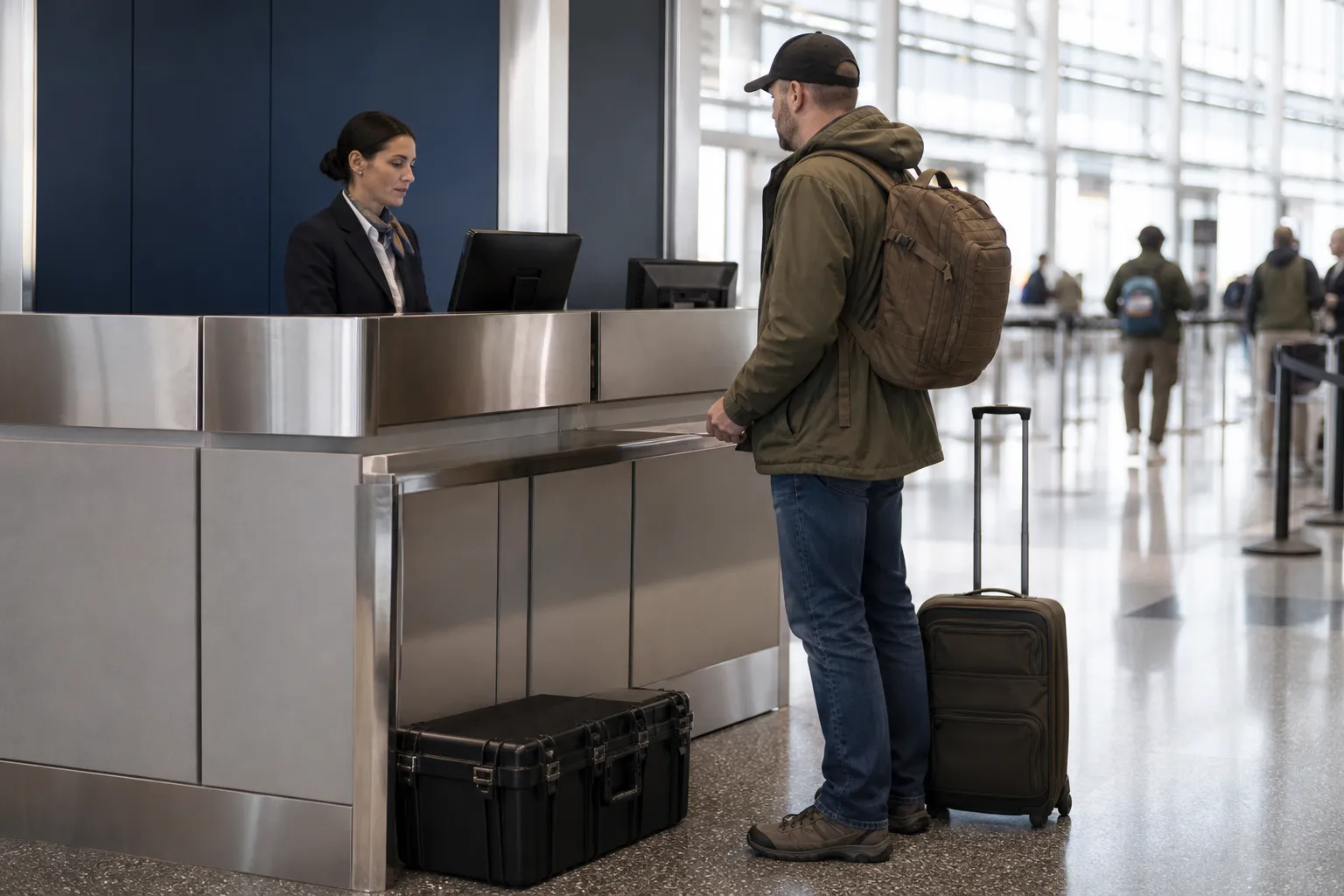
If you want to know how to fly with a gun in the United States or Canada, the basic answer from official aviation sources is simple: do not bring it to the passenger checkpoint or put it in carry on baggage. For checked baggage, TSA, CATSA, and Transport Canada describe unloaded firearm, airline declaration, and locked hard sided container rules. In Canada, CBSA and the RCMP Canadian Firearms Program add border and transport requirements for firearms entering or moving within Canada.
This guide summarizes the official sources in the fact ledger. Confirm the current rule with your airline, TSA or CATSA, CBSA, the RCMP Canadian Firearms Program, and the firearm authority at your destination before travel.
U.S. flights: the core TSA checked baggage rule
TSA states that firearms are never allowed through the passenger screening checkpoint and may only be transported in checked baggage. The TSA national firearms document identified in the source as published in 2025 says: “Firearms are never allowed to travel through the passenger screening checkpoint. Firearms may only be transported in checked baggage.” TSA national firearms document, accessed October 20, 2026
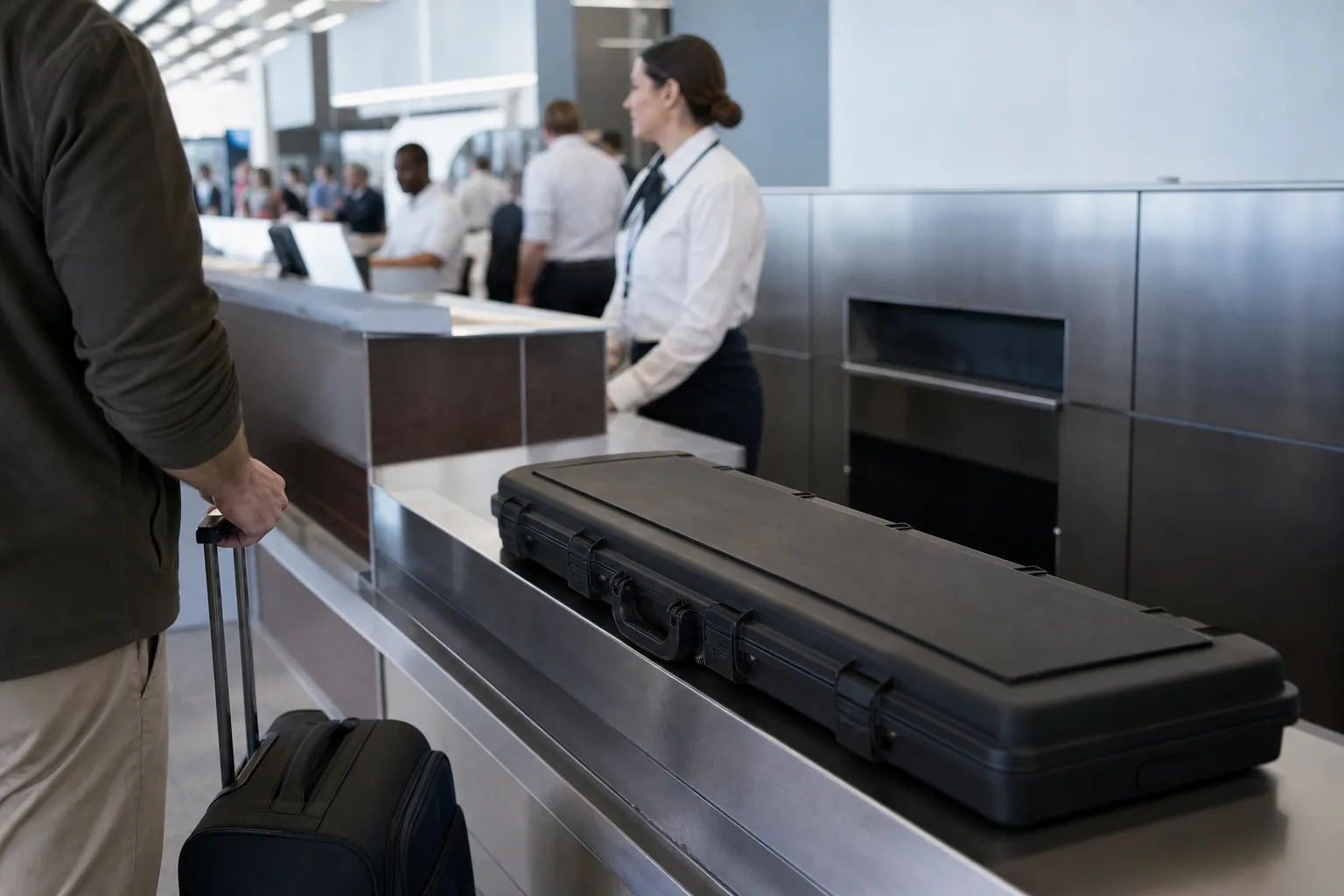
For checked baggage, TSA states that firearms must be unloaded, packed in a locked hard sided container, and declared to the airline at check in. TSA What Can I Bring, accessed October 20, 2026
In plain language, the U.S. baseline is:
| Step | U.S. official source requirement | |, -|, -| | Carry on | TSA says firearms are never allowed through the passenger checkpoint. | | Checked bag | TSA says checked firearms must be unloaded, declared, and in a locked hard sided container. |
U.S. ammunition rules
Confirm current U.S. ammunition rules with the airline and appropriate U.S. aviation and hazardous materials sources before travel.
Airline policies can add requirements
TSA tells travelers to check with the airline to see if the airline allows firearms in checked bags. TSA also says firearm possession laws vary by local, state, and international government. TSA What Can I Bring, accessed October 20, 2026
Airlines can add their own requirements for containers, notice, fees, ammunition, and connecting carriers.
Treat the airline policy as a separate rule set you must confirm before the trip. If the trip has more than one airline, confirm the requirements for each carrier.
Destination, state, local, and international rules
TSA says that when traveling, passengers must comply with firearm possession laws because they vary by local, state, and international government. TSA What Can I Bring, accessed October 20, 2026
That means the air travel rule is not the whole answer. A checked firearm procedure at the airport does not answer whether a firearm may be possessed, transported, imported, exported, or used at the destination. The official source to check depends on the destination, such as a state agency, provincial or territorial authority, CBSA, or the RCMP Canadian Firearms Program.
Canadian flights: CATSA and Transport Canada screening rules
CATSA says firearms, firearm parts, real ammunition, and cartridges are not permitted in carry on baggage under any circumstances. CATSA also says all firearms, firearm parts, ammunition, and cartridges must be declared to the air carrier during check in, and firearms in checked baggage must be unloaded and packed in a locked hard sided container. CATSA firearms page, date modified December 22, 2022
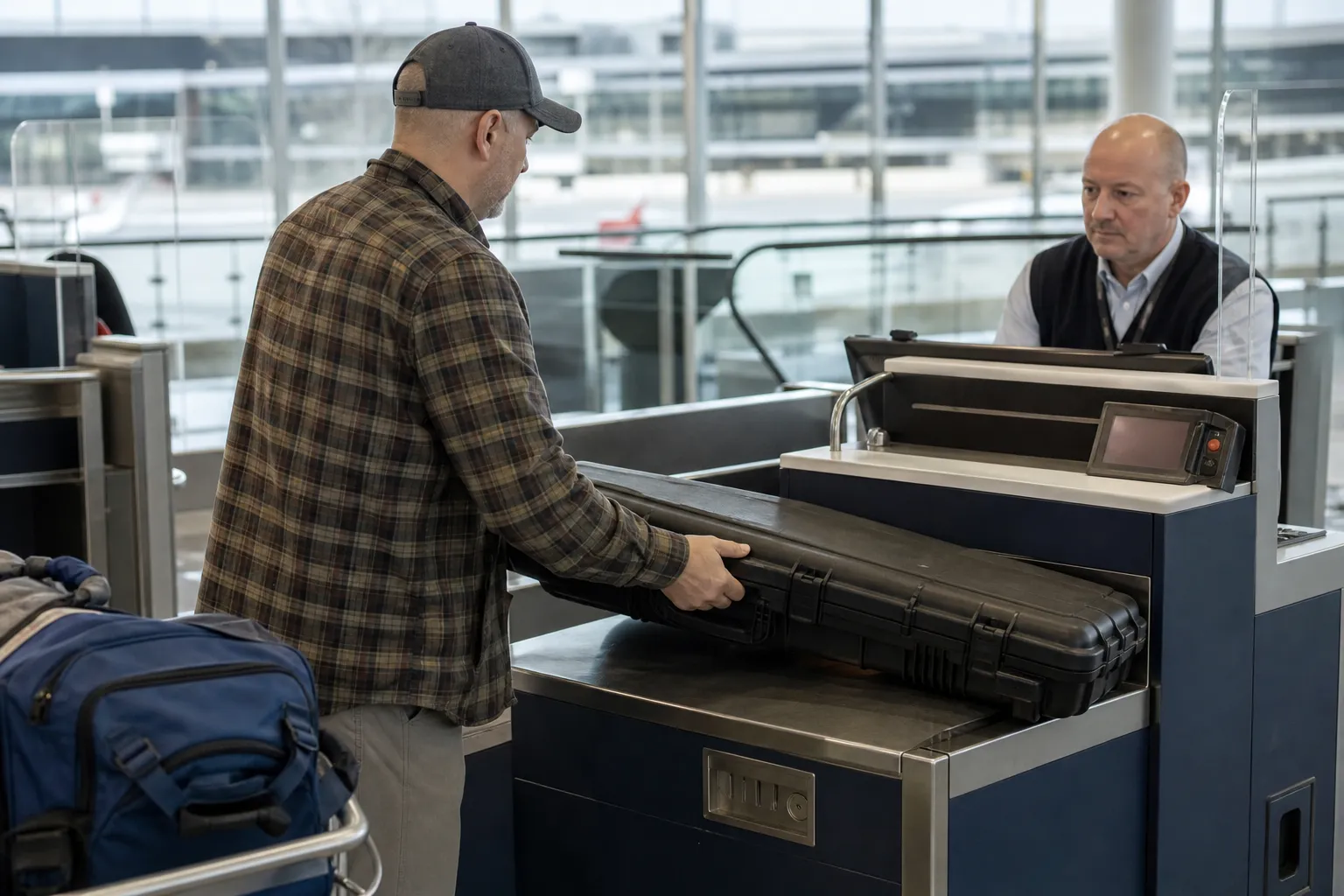
Transport Canada says passengers are not allowed to pack any type of firearm, firearm parts except telescopic sights, ammunition, propellant powder, or gunpowder in carry on baggage. Transport Canada also says an unloaded firearm may be packed in checked baggage if it is placed in a locked hard sided container, and that firearms, firearm parts, bullets, and cartridges must be declared to the airline during check in. Transport Canada, date modified August 9, 2021
CATSA’s cartridge page says cartridges are not permitted in carry on baggage, and that certain items may be transported in checked baggage if properly packaged and approved by the air carrier. It also repeats that all firearms, firearm parts, ammunition, and cartridges must be declared to the air carrier during check in. CATSA cartridges page, date modified December 22, 2022
Canadian airline example: Air Canada
Air Canada is one example of why travelers must check the airline’s own policy. Air Canada says accepted firearms must be unloaded, rendered inoperable by a secure locking device after the check in process has been completed, and packed and locked in a specially designed, non transparent case that cannot be easily broken into during transport. Air Canada, accessed October 20, 2026
Air Canada also says firearms and ammunition must not be packed in the same container, and that ammunition allowance is limited to 5 kg, or 11 lb, per passenger. Air Canada, accessed October 20, 2026
This is a good example of why you need both the government rule and the airline rule before packing.
Entering Canada with a firearm: CBSA rules
CBSA says individuals entering Canada with firearms must declare all firearms to a border services officer, provide all required documents, and answer all questions truthfully. CBSA also says failure to declare a firearm or being untruthful can lead to seizure, criminal charges, and/or monetary penalties. CBSA, date modified July 24, 2025
CBSA says anyone importing firearms to Canada must be at least 18 years old and must have a valid purpose. CBSA lists examples of valid purposes, including hunting during hunting season for non restricted firearms only, use in competitions, repair, direct in transit movement through Canada, or protection against wildlife in remote areas for non restricted firearms only. CBSA, date modified July 24, 2025
For visitors importing non restricted firearms without a valid Canadian firearms licence, CBSA says they must complete RCMP 5589, the Non Resident Firearm Declaration, and pay CAN$25. Once confirmed by a border services officer, CBSA says the declaration has the same effect as a temporary licence for the firearms for up to 60 days. CBSA, date modified July 24, 2025
For restricted firearms, CBSA says visitors need an Authorization to Transport and must apply for and receive approval from the Chief Firearms Officer of the province they will visit. CBSA says visitors to Canada cannot, under any circumstances, import prohibited firearms, prohibited devices, or prohibited weapons. CBSA, date modified July 24, 2025
CBSA also says non residents with a PAL or NRFD can import 200 rounds duty free for hunting purposes, or up to 1,500 rounds duty free for use at a recognized competition. CBSA, date modified July 24, 2025
Transporting firearms within Canada: RCMP Canadian Firearms Program
The RCMP Canadian Firearms Program says non restricted firearms must be unloaded during transportation. RCMP CFP, date modified November 12, 2024
For restricted and prohibited firearms, RCMP says the firearm must be unloaded, have secure locking devices attached, and be locked in a sturdy, non transparent container. RCMP also says to obtain an Authorization to Transport. RCMP CFP, date modified November 12, 2024
RCMP’s Authorization to Transport page says an ATT is not needed for non restricted firearms transported personally, but is needed for restricted or prohibited firearms in specified circumstances. RCMP also says a non resident using RCMP 5589 to bring a restricted firearm into Canada should contact the Chief Firearms Officer of the entry point in advance to apply for an ATT. RCMP CFP, date modified October 25, 2024
CBSA separately states that Canadian law requires all firearms, including antique firearms, to be transported unloaded, and that restricted and prohibited firearms must be in a locked case with locked safety devices to prevent firing. CBSA, date modified July 24, 2025
Practical preflight checklist from the official sources
Before flying with a firearm, check each of these official source items for your exact trip:
- TSA for U.S. screening and checked baggage firearm rules, or CATSA and Transport Canada for Canadian screening rules.
- Your airline’s current firearm and ammunition policy, including container rules, declaration procedure, ammunition limits, fees, and connecting carrier requirements.
- Current U.S. ammunition carriage requirements if traveling in or from the United States.
- CBSA requirements if entering Canada with a firearm, including declaration, documents, valid purpose, age requirement, NRFD or licence rules, and any ATT requirement.
- RCMP Canadian Firearms Program rules for transporting firearms within Canada.
- The firearm authority at the destination, because TSA warns that firearm possession laws differ by location.
Open questions to verify before travel: whether your airline accepts your firearm type on your exact itinerary, how your airline wants the declaration handled at the counter, whether any connecting carrier has a different rule, and what the destination authority requires for possession, transport, hunting, or competition on the travel dates.
Frequently asked questions
Can I bring a firearm in carry on baggage?
No. TSA says firearms are never allowed through the passenger screening checkpoint and may only be transported in checked baggage. CATSA says firearms, firearm parts, real ammunition, and cartridges are not permitted in carry on baggage under any circumstances.
How does TSA say a firearm must be packed for checked baggage?
TSA says firearms in checked bags must be unloaded, packed in a locked hard sided container, and declared to the airline at check in.
Do airline rules matter if I follow TSA rules?
Yes. TSA tells travelers to check with the airline to see whether it allows firearms in checked bags. Airlines can add their own container, ammunition, notice, fee, and connecting carrier requirements.
What does CBSA require when entering Canada with a firearm?
CBSA says travelers entering Canada with firearms must declare all firearms to a border services officer, provide required documents, and answer all questions truthfully. CBSA also lists age, valid purpose, NRFD or licence, and ATT requirements depending on the firearm and traveler.
Do non restricted firearms in Canada need an Authorization to Transport?
RCMP says an Authorization to Transport is not needed for non restricted firearms transported personally. RCMP says restricted or prohibited firearms need an ATT in specified circumstances.
Sources
- Complete List (Alphabetical), Transportation Security AdministrationOfficial source. Accessed October 20, 2026.
- Traveling With Your Firearm Is Easy, Transportation Security AdministrationOfficial source. Accessed October 20, 2026.
- 49 CFR 1540.111, Carriage of weapons, explosives, and incendiaries by individuals, Electronic Code of Federal RegulationsOfficial source. Accessed October 20, 2026.
- 49 CFR 175.10, Exceptions for passengers, crewmembers, and air operators, Electronic Code of Federal RegulationsOfficial source. Accessed October 20, 2026.
- PackSafe, Ammunition, Federal Aviation AdministrationOfficial source. Accessed October 20, 2026.
- Firearms and ammunition rules, American AirlinesOfficial source. Accessed October 20, 2026.
- Firearms, Canadian Air Transport Security AuthorityOfficial source. Accessed October 20, 2026.
- Cartridges, Canadian Air Transport Security AuthorityOfficial source. Accessed October 20, 2026.
- What you can’t bring on a plane, Transport CanadaOfficial source. Accessed October 20, 2026.
- Special items, Air CanadaOfficial source. Accessed October 20, 2026.
- Firearms and weapons: Canadian border requirements, Canada Border Services AgencyOfficial source. Accessed October 20, 2026.
- Storing, transporting and displaying firearms, Royal Canadian Mounted Police, Canadian Firearms ProgramOfficial source. Accessed October 20, 2026.
- Authorization to transport, Royal Canadian Mounted Police, Canadian Firearms ProgramOfficial source. Accessed October 20, 2026.