Red Dot Magnifiers: How They Work with a Red Dot Sight
A red dot magnifier is a separate fixed power optic mounted behind a red dot or holographic sight. It enlarges the view while the front optic still provides the aiming reticle.
By RaiS. Reviewed by RaiS. Published . 7 min read.
Research and drafting were assisted by AI. RaiS checked the facts against the sources below and approved this page.

A red dot magnifier is a separate fixed power optic that sits behind a red dot sight, or behind a compatible holographic sight, to give a magnified view without replacing the primary sight. The aiming point still comes from the front optic: Aimpoint describes its magnifiers as using the red dot in the optic as the aiming reticle. In practical terms, the magnifier makes the target image larger, and the dot appears larger too, while the dot stays the same size relative to the target.
What a red dot magnifier is
A red dot magnifier is not a scope with its own aiming system. It is an optical module placed behind the primary sight. Aimpoint says its magnifier can be mounted behind an Aimpoint red dot sight, and Holosun describes the HM3X as a 3x magnifier designed to extend the capability of red dot optics on rifles and carbines. EOTECH describes the G43 as a 3x switch-to-side magnifier compatible with all EOTECH HWS models.
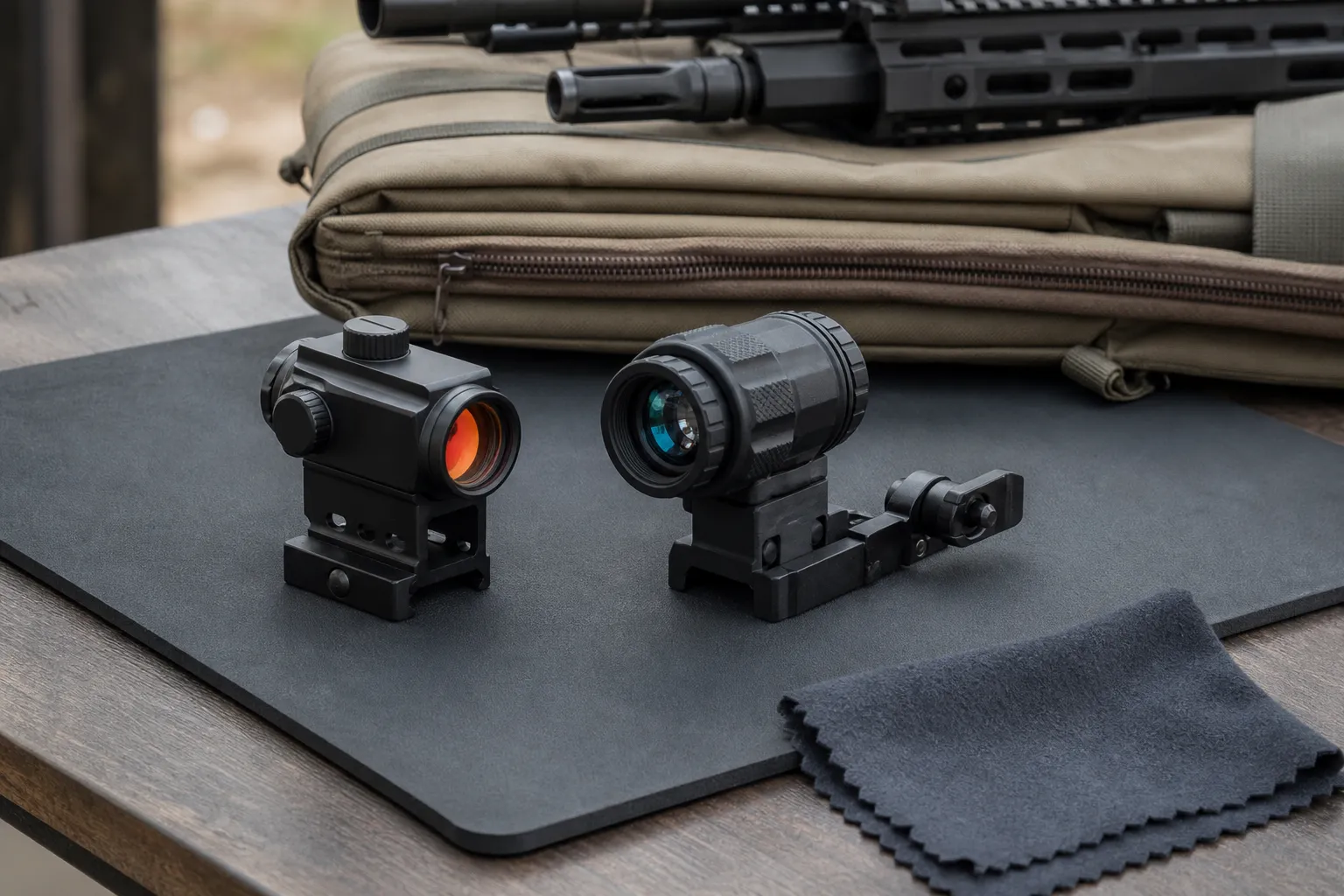
Many examples are fixed 3x optics. Aimpoint lists the 3X-C as a 3x magnifier. Holosun lists the HM3X as 3x. Vortex lists the VMX-3T as 3x. There are also higher fixed power examples, such as the EOTECH G45, which EOTECH describes as a 5x magnifier.
Optics designers would describe this kind of module as afocal. Ansys Zemax defines an afocal optical system as one whose object and image conjugates are both at infinity, and gives binoculars as an example of an afocal system with angular magnification. Ansys also notes that afocal systems are analyzed in angular units rather than ordinary spatial image units. That fits the basic idea of a telescope-like magnifier used behind a sighting optic.
The red dot itself is still only visible inside the sight. Aimpoint explains that the dot is not projected onto the target. When you add a magnifier, you are looking through the magnifier at the sight picture from the red dot or holographic sight.
What changes in the sight picture
The big change is magnification. The target image appears larger through the magnifier. That can make details easier to see than with the unmagnified red dot alone.
The dot appears larger too. A Primary Arms red dot manual explains that when a magnifier is placed behind a microdot, the dot appears to grow in size, but the dot stays the same size relative to the target. In other words, magnification makes both the target and dot appear larger together.
That point matters because the magnifier does not turn a red dot into a scope reticle. Aimpoint says its magnifiers use the red dot as the aiming reticle. The magnifier adds optical enlargement, while the primary sight still supplies the aiming reference.
Aimpoint also defines MOA as minutes of angle and gives the example that 1 MOA equals 1 inch at 100 yards, or 3 cm at 100 meters. That is why dot size is usually discussed as an angular size rather than as a fixed physical size on the target.
Mounts and transitions
Most red dot magnifiers are meant to move in and out of the optical path. A Primary Arms manual says magnifiers are often mounted in quick-detach or quick-flip mounts so they can be removed from the rail or flipped out of the shooter’s line of sight quickly.
Manufacturers use different names for these systems. EOTECH describes the G43 as using a switch-to-side mount, and the G45 as a 5x magnifier with a switch-to-side mount. Holosun says the HM3X has an ambidextrous quick-detach mount that enables rapid transitions between magnified and 1x views. Aimpoint lists the TwistMount and FlipMount as magnifier mounts that attach to MIL-STD-1913 Picatinny rails.
The purpose is simple: leave the magnifier behind the sight when you want magnification, then move it aside when you want the unmagnified red dot view. Vortex summarizes the tradeoff by saying a red dot and magnifier gives two magnification options: non-magnified and the fixed power of the magnifier.
Mount height matters. Vortex says the VMX-3T allows lower 1/3 or absolute co-witness mounting heights. Holosun says the HM3X includes a spacer that supports common red dot mounting heights, including absolute and lower 1/3 co-witness setups. The goal is to put the magnifier and primary optic on a compatible visual axis.
Alignment and setup concepts
The magnifier should sit behind the primary sight and line up with it. Holosun says the HM3X has integrated windage and elevation adjustments for alignment with the primary red dot optic. Aimpoint says internal optical adjustments make aligning the magnifier and sight quick and easy.
Those adjustments are for aligning the magnifier with the sight picture. They should not be confused with zeroing the red dot itself. Aimpoint says that when its magnifier is used with the red dot as the reticle, the shooter can shift between magnified and non-magnified aiming without needing to re-zero the optic.
That is one of the main reasons this setup is appealing: the red dot remains the aiming system. The magnifier changes the view, not the basic role of the primary sight.
Eye relief, field of view, and diopter
A red dot by itself is often described very differently from a magnified optic. Vortex says a red dot offers unlimited eye relief, which helps with fast target acquisition and a wide field of view. Once a magnifier is added, eye relief becomes a real specification.
Eye relief is the distance from the rear lens where the eye needs to be positioned to see the image properly. Manufacturer examples show the range clearly:
| Magnifier example | Magnification | Listed eye relief | Listed field of view |
|---|---|---|---|
| Aimpoint 3X-C | 3x | 56 mm, or 2.2 in | 6 degrees |
| Vortex VMX-3T | 3x | 2.2 in | 7.3 degrees, or 38.2 ft at 100 yd |
| Holosun HM3X | 3x | 70 mm, or 2.75 in | 7 degrees |
| EOTECH G43 | 3x | 2.5 in | 7.5 degrees |
| EOTECH G45 | 5x | 2.6 in | 4 degrees |
Field of view tells you how much of the scene is visible through the magnifier. Makers often list it in angular degrees. Vortex also lists the VMX-3T as 38.2 feet at 100 yards, which is a linear field of view example.
Higher magnification does not automatically mean a wider view. EOTECH lists the 3x G43 at 7.5 degrees, while it lists the 5x G45 at 4 degrees. Those examples show why field of view is worth checking separately from magnification.
Many magnifiers also include a diopter, which is a focus adjustment for the user’s eye. Aimpoint says the 3X-C has a variable -2 to +2 dioptric setting so the magnifier can be adapted to the individual shooter’s eye. Holosun says the HM3X has a plus or minus 3 diopter adjustment for fine tuning focus based on individual eyesight.
Red dot plus magnifier vs LPVO vs prism scope
A red dot and magnifier is a two-setting system. Vortex says the magnifier setup gives two options: magnified and non-magnified. If the magnifier is flipped away, the shooter uses the red dot at 1x. If the magnifier is in line, the view is the fixed power of that magnifier, such as 3x or 5x.
An LPVO is different. Vortex says an LPVO is a low power variable optic that usually starts at 1x and goes to 4x, 6x, 8x, or 10x. Vortex also says LPVOs usually have more comprehensive reticle systems for ranging targets and accurate holdovers, but can add weight and require a precision mount. For more background on that category, see ProjectGuns’ What Is an LPVO guide.
A prism scope is different again. Vortex describes prism scopes as fixed power optics, and says prism scopes with etched reticles provide a point of aim even without power. Vortex’s Spitfire HD Gen II 3x product page describes a fixed magnification prism scope with an etched-glass reticle that stays visible even without illumination. That is unlike a red dot magnifier, which relies on the red dot sight’s reticle rather than its own etched reticle. ProjectGuns’ Prism Scope guide covers that category in more detail.
Vortex also notes that its VMX-3T magnifier works with Vortex red dots but is not recommended for prism scopes. That is a useful reminder that a magnifier is designed around use behind a compatible primary sight, not as a universal add-on for every optic.
What to check before choosing a setup
Start with compatibility. Check the magnifier maker’s information for the sight type it is intended to work with. Aimpoint describes its magnifiers in relation to Aimpoint red dot sights. Holosun describes the HM3X as a magnifier for red dot optics. EOTECH lists compatibility for its G43 with EOTECH HWS models.
Then check the mount. Look for the height options listed by the manufacturer, such as absolute co-witness or lower 1/3 co-witness. Also check whether the mount flips, switches to the side, flips to center, or uses quick detach removal.
Finally, check the optical specifications. Eye relief, field of view, magnification, and diopter range are not all the same from one magnifier to another. The numbers above show why a 3x magnifier and a 5x magnifier can feel different behind the same general type of sight.
A red dot magnifier is best understood as a removable magnified view for a red dot sight, not as a replacement for an LPVO or a prism scope. Confirm compatibility, mount height, eye relief, field of view, and adjustment details in the official documentation for the exact sight and magnifier you plan to pair.
Frequently asked questions
Does a red dot magnifier have its own reticle?
The magnifier itself is not the aiming reticle in the setup described by Aimpoint. Aimpoint says its magnifiers use the red dot in the optic as the aiming reticle.
Does the red dot get bigger through a magnifier?
Yes. A Primary Arms red dot manual says the dot appears to grow when a magnifier is placed behind a microdot, but the dot stays the same size relative to the target.
Do I need to re-zero when flipping a magnifier in and out?
Aimpoint says its magnifier setup allows shifting between magnified and non-magnified aiming without the need to re-zero the optic, because the red dot sight remains the aiming reticle.
What magnification is common for red dot magnifiers?
Many examples are 3x, including the Aimpoint 3X-C, Holosun HM3X, Vortex VMX-3T, and EOTECH G43. EOTECH also lists the G45 as a 5x magnifier.
How is a red dot magnifier different from an LPVO?
Vortex says a red dot and magnifier gives two options: non-magnified and the fixed power of the magnifier. Vortex describes an LPVO as a low power variable optic that usually starts at 1x and goes to higher magnification such as 4x, 6x, 8x, or 10x.
How is a red dot magnifier different from a prism scope?
A prism scope is a fixed power optic with its own reticle. Vortex says prism scopes with etched reticles provide a point of aim even without power, while a red dot magnifier relies on the red dot sight’s reticle.
Sources
- How to design afocal systems, Ansys Optics, Zemax OpticStudio. Accessed October 25, 2026.
- Magnifiers, AimpointOfficial source. Accessed October 25, 2026.
- 3X-C Magnifier without ring, AimpointOfficial source. Accessed October 25, 2026.
- Aimpoint FAQ, AimpointOfficial source. Accessed October 25, 2026.
- HM3X, HolosunOfficial source. Accessed October 25, 2026.
- VMX-3T Magnifier, Vortex OpticsOfficial source. Accessed October 25, 2026.
- G43 Magnifier, EOTECHOfficial source. Accessed October 25, 2026.
- G45 Magnifier, EOTECHOfficial source. Accessed October 25, 2026.
- Primary Arms MD-RBGII manual, dot size and magnifier use, Primary ArmsOfficial source. Accessed October 25, 2026.
- How To Pick the Perfect Optic for Your AR, Vortex OpticsOfficial source. Accessed October 25, 2026.
- LPVO 101, Vortex OpticsOfficial source. Accessed October 25, 2026.
- Making Sense of Magnified Optics on a Tactical Carbine Part 2, Vortex OpticsOfficial source. Accessed October 25, 2026.
- Spitfire HD Gen II 3x Prism Scope, Vortex OpticsOfficial source. Accessed October 25, 2026.
- How to design afocal systems, Ansys Optics. Accessed October 25, 2026.
- How to design afocal systems, Ansys Optics. Accessed October 25, 2026.
- How To Pick the Perfect Optic for Your AR. Accessed October 25, 2026.
- How To Pick the Perfect Optic for Your AR. Accessed October 25, 2026.