The Winchester Model 70: History and Variants
The Winchester Model 70 is a famous sporting bolt action rifle introduced in the 1930s and long known as the “Rifleman’s Rifle.” Its history is usually divided into the pre 1964 controlled round feed rifles, the 1964 push feed redesign, and the later return of controlled round feed.
By RaiS. Reviewed by RaiS. Published . 8 min read.
Research and drafting were assisted by AI. RaiS checked the facts against the sources below and approved this page.
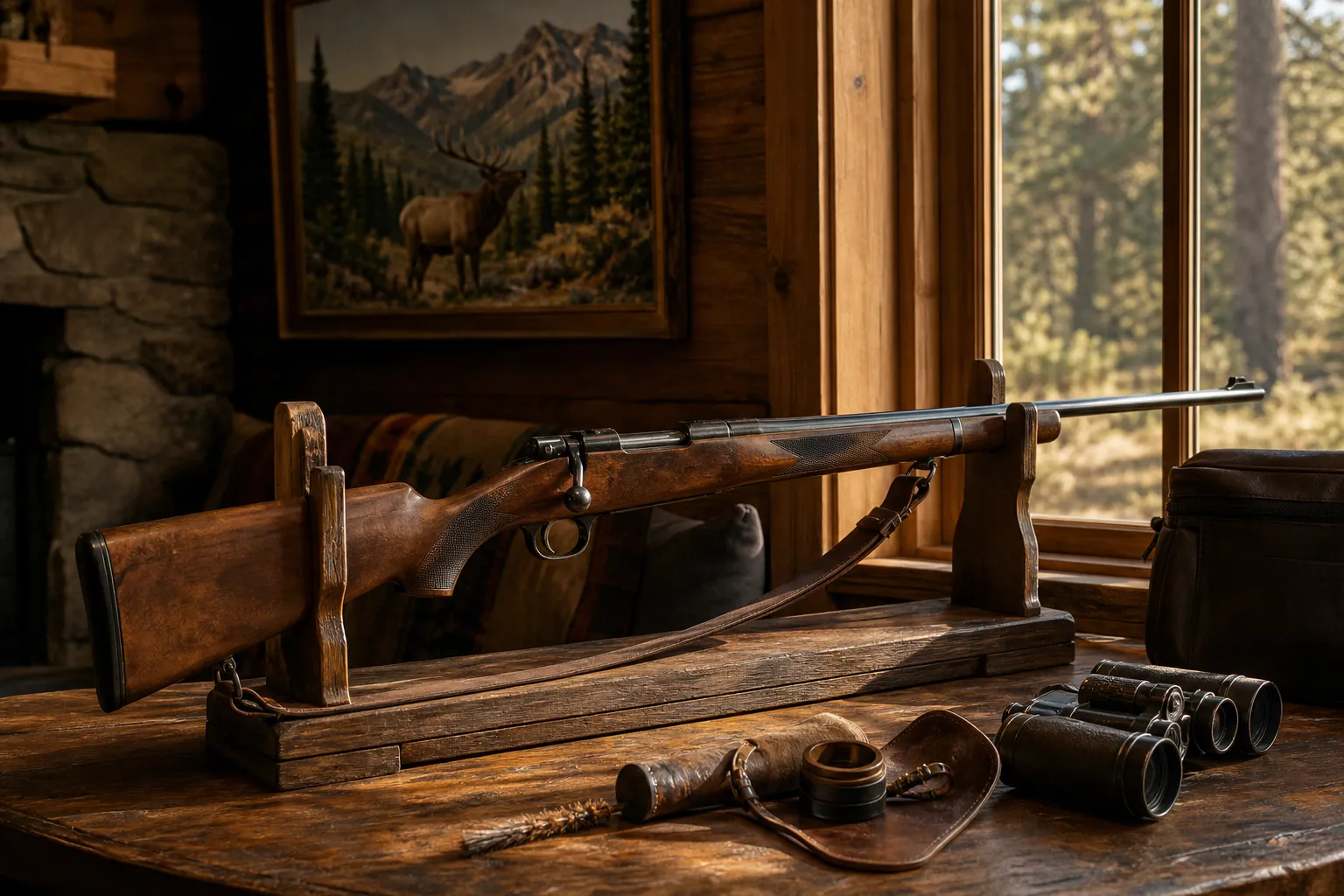
The Winchester Model 70 is Winchester’s classic sporting bolt-action rifle, introduced for production in 1936 and long known as the “Rifleman’s Rifle.” Its story centers on a few major eras: the original pre-1964 controlled-round-feed rifles, the 1964 push-feed redesign, the early 1990s return of controlled round feed, the 2006 end of New Haven production, and the 2008 market return of the modern rifle.
If you are new to the action type, start with our bolt-action rifle guide for the basic cycle of loading, locking, firing, extracting, and ejecting. This guide focuses on the Model 70’s history and high-level identification, not values or buying advice. For broader company background, see our Winchester Repeating Arms guide.
Why the Model 70 matters
Cody Firearms Museum describes the Winchester Model 70 as an iconic American bolt-action rifle designed in the 1930s, and says it has long been called the “rifleman’s rifle.” Winchester’s own historical timeline says the rifle quickly gained an international reputation for accuracy and reliability and soon became known as “The Rifleman’s Rifle.”
The Model 70 matters because it became one of the best-known American sporting bolt-action rifles. Winchester’s timeline identifies it as the first centerfire bolt-action designed by Winchester specifically for sporting use.
That sporting focus is important. Cody Firearms Museum notes that the Model 70 itself was only used commercially, while its design roots reach back to Winchester’s World War I rifle work.
Pre-war origins and design roots
Cody Firearms Museum’s Danny Michael traces the Model 70’s design roots to World War I, when Winchester was building rifles for Britain. The museum says Winchester built the Pattern 14 for Britain, then built the same gun as the Model 1917 for the United States government.
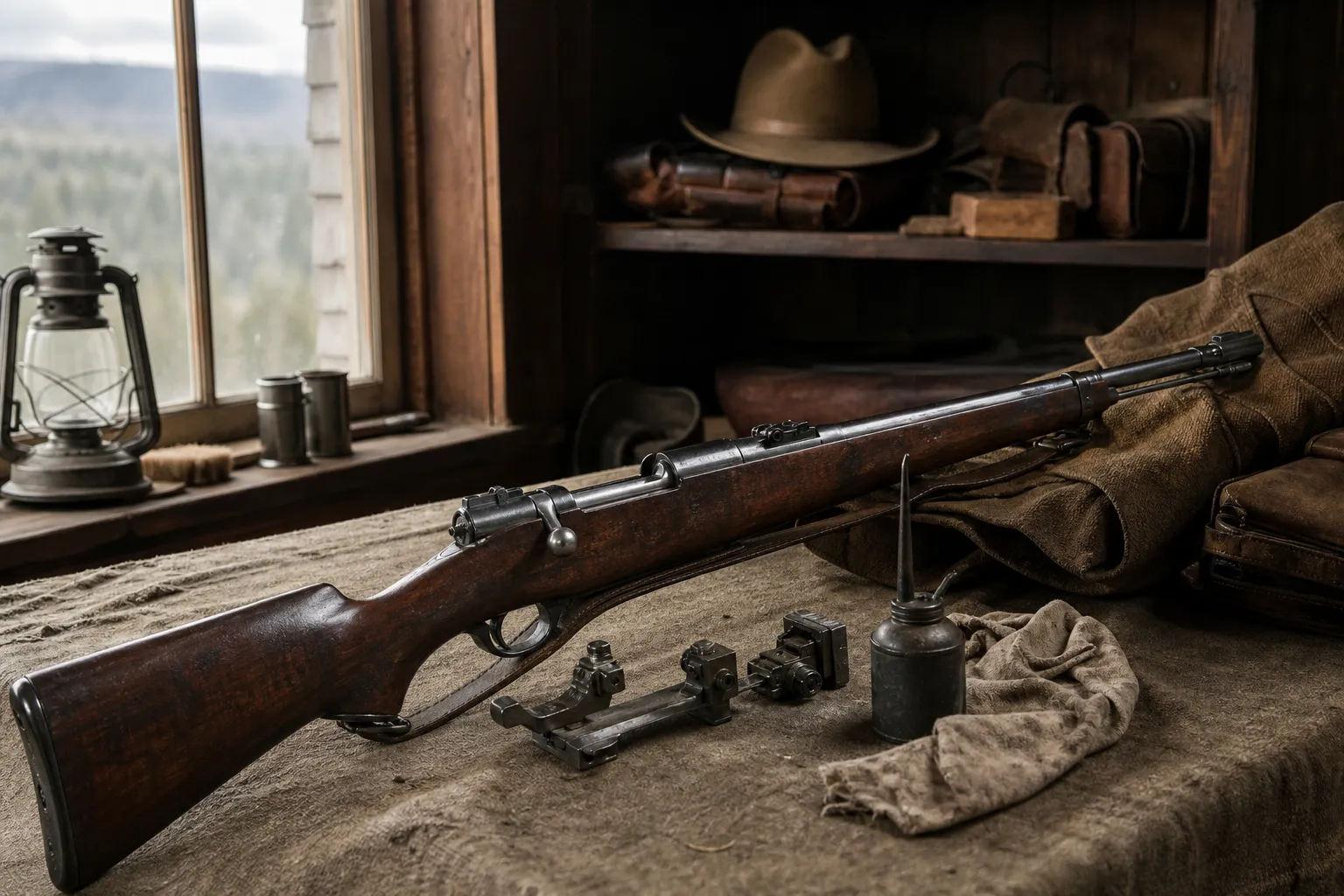
Winchester’s official timeline places the Model 70’s production start in 1936. Winchester calls it the first Winchester centerfire bolt-action rifle designed specifically for sporting use.
Winchester also warns that there is no single, original, totally accurate serial-number database from 1866 forward that it is aware of. That means serial-number dating should be treated as approximate unless confirmed by more specific factory or museum records.
The pre-1964 Model 70
Winchester’s timeline says the original Model 70 was discontinued in 1963, and that rifles before this date became known as Pre-’64 Model 70s. This is the era most closely tied to the original controlled-round-feed action.
At a high level, the pre-1964 action is associated with a Mauser-style controlled-round-feed system, a large claw extractor, a blade ejector, and a three-position safety. Winchester’s current Model 70 material describes its modern Pre-’64 style controlled round feed as using a claw extractor that controls the cartridge from magazine to chamber to ejection.
Winchester’s Model 70 manual explains the controlled-round-feed bolt design this way: its massive claw extractor secures about one-quarter of the cartridge base and fully controls the cartridge as it enters the chamber. The manual also says this system can extract a cartridge even when it is not fully chambered.
The blade ejector is another important feature. Winchester’s manual says the Pre-’64 type design uses a blade system that lets the shooter vary ejection force by how sharply the bolt is drawn rearward.
The three-position safety is part of the Model 70’s identity as well. Winchester’s manual defines the positions as follows: rear is on-safe and locks both the firing pin and bolt, the middle position locks the firing pin but not the bolt, and forward is off-safe.
The 1964 redesign
Winchester’s historical timeline says the Model 70 underwent a significant redesign in 1964 to adapt to a changing marketplace. The company’s timeline also identifies 1964 as the year the New Model 70 was introduced.
The best-known mechanical change was the move away from the original controlled-round-feed system. NRA Museums says the 1964 Model 70 adopted a push-feed bolt design with a small hook extractor built into the right locking lug and a plunger-type ejector working from the bolt face.
Reception was difficult. NRA Museums says the new rifle failed to capture the market as Winchester had hoped, and that older Model 70s became cherished by both sportsmen and collectors.
NRA Museums also identifies specific areas of criticism on early post-1964 rifles. It says the fit and finish of the new design was considered inferior to earlier models, and that the stock drew especially harsh criticism. The museum points to stock quality, pressed checkering, and the large barrel channel among the criticized features.
For collectors, this is why “pre-64” and “post-64” became such common shorthand. The terms are not just date labels. They point to a major change in the rifle’s action design and its public reception.
The return of controlled round feed
Winchester’s own pages describe the return of controlled round feed in the early 1990s, with a small date nuance. Winchester’s 1950 to 1999 timeline says a Model 70 Custom Shop Super Grade with controlled round feeding was the lead item in the 1991 catalog. The same timeline says the Pre-’64 Model 70 action returned to general production in 1992.
Winchester’s current Model 70 article says that in 1992, Winchester Repeating Arms returned to the claw-style extractor and controlled round feed. For a broad historical timeline, it is fair to say controlled round feed returned through the 1991 catalog offering and 1992 general production return.
Winchester’s current overview says today’s Model 70 has the M.O.A. Trigger System, improved fit and finish, enhanced accuracy, classic Pre-’64 controlled round feeding, and a three-position safety. Winchester describes the current controlled-round-feed system as a Pre-’64 style design with a claw extractor that fully controls the cartridge from magazine to chamber to ejection.
One caution: Winchester’s Model 70 manual covers rifles manufactured from 1992 to the present and notes that Model 70s in that period may have controlled round feed, controlled round push feed, or push feed bolts. So a post-1992 date alone does not identify every individual rifle’s bolt type.
New Haven production, the 2008 return, and current manufacture
Winchester’s 2000 to present timeline says production ceased in 2006 at the New Haven, Connecticut factory operated by U.S. Repeating Arms Company, Inc. for Winchester-branded firearms.
The same Winchester timeline says the Model 70 returned to the market in 2008. Winchester says the returning rifle was equipped with the three-lever M.O.A. Trigger System and an improved three-position safety.
For current manufacture, the most careful answer is that official Browning Viana material says its Viana do Castelo factory produces rifles and shotguns under the Browning and Winchester trademarks, mainly for export. Browning Viana also identifies Winchester as a registered trademark owned by Olin Corporation.
Browning’s manufacturing FAQ says today’s Herstal Group includes Browning, Winchester Repeating Arms, FN Herstal, and FNH USA. RifleMagazine reports that current Model 70 production moved to Portugal and that a newly manufactured Model 70 barrel was marked “Imported by BACO, Inc., Morgan, Utah, Made in Portugal by Browning Viana.” NRA Shooting Illustrated also states that Model 70s are currently manufactured in Portugal.
Action features in plain English
The Model 70’s reputation is closely tied to a few action features. These terms come up often in descriptions of different eras.
Controlled round feed
Winchester describes the current system as Pre-’64 style controlled round feed. In that system, the claw extractor controls the cartridge from the magazine to the chamber to ejection.
Winchester’s manual says the claw extractor secures about one-quarter of the cartridge base as the cartridge enters the chamber. The manual also says it can extract a cartridge even when the cartridge is not fully chambered.
Claw extractor
The claw extractor is the large extractor associated with the controlled-round-feed Model 70. Winchester calls it a massive claw extractor and says it smoothly slips onto and secures about one-quarter of the cartridge base.
This is one of the easiest high-level visual differences between a controlled-round-feed Model 70 and a 1964-type push-feed action.
Blade ejector
Winchester’s manual says the Pre-’64 type design uses a blade ejector. It describes this as a manual ejector that gives more control over cartridge ejection, because ejection force varies with how sharply the bolt is drawn rearward.
Three-position safety
Winchester’s manual defines the three safety positions clearly. Rear is on-safe and locks both the firing pin and bolt. The middle position keeps the firing pin locked but allows the bolt to move. Forward is off-safe.
How to tell the main eras apart at a high level
The Model 70’s eras can be separated at a broad level by date, action type, and factory history. This is not a substitute for a factory letter, museum record, or detailed collector reference, but it helps readers understand the main divisions.
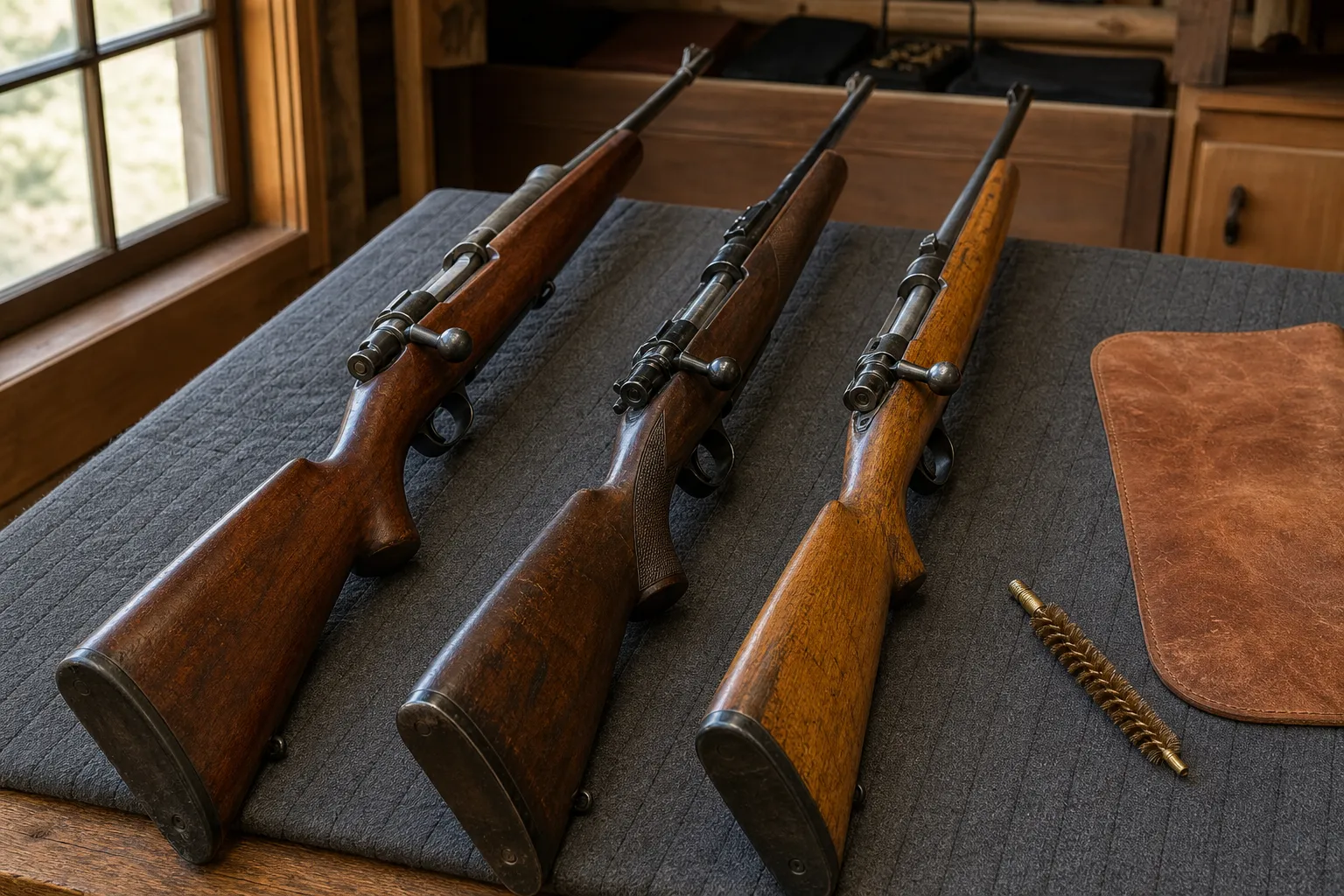
| Era | High-level traits |
|---|---|
| Pre-1964 | Original Model 70 era. Winchester says rifles before the 1963 discontinuation became known as Pre-’64 Model 70s. Associated with controlled round feed, a large claw extractor, blade ejector, and three-position safety. |
| 1964 to early 1990s | Winchester says the New Model 70 was introduced in 1964 after a significant redesign. NRA Museums describes the redesigned action as push feed, with a small hook extractor in the right locking lug and a plunger ejector in the bolt face. |
| Early 1990s return of controlled feed | Winchester says controlled round feeding appeared as the lead item in the 1991 catalog on a Custom Shop Super Grade, and that the Pre-’64 action returned to general production in 1992. |
| 2006 to 2008 transition | Winchester says New Haven production ceased in 2006, and the Model 70 returned to the market in 2008 with the M.O.A. Trigger System and improved three-position safety. |
| Current production | Winchester’s current overview describes classic Pre-’64 controlled round feeding, a claw extractor, a three-position safety, and the M.O.A. Trigger System. Browning Viana officially says it produces rifles under the Winchester trademark in Portugal, and RifleMagazine reports current Model 70 barrels marked as made in Portugal by Browning Viana. |
Serial numbers can help narrow an era, but Winchester cautions that there is no single, original, totally accurate serial-number database for all Winchester firearms. Treat serial-number tables as a starting point, not the final word.
What to verify before identifying a specific rifle
For a specific Winchester Model 70, confirm the serial number range, bolt type, extractor type, ejector type, safety configuration, barrel markings, and any factory records that may exist. Winchester’s own serial data are useful, but the company warns that the historic records are not a complete original database.
If the question involves collectibility, originality, or a precise production date, check Winchester information, Cody Firearms Museum resources, and established collector references. This guide is a historical overview, not an appraisal or authentication document.
Frequently asked questions
Why is the Winchester Model 70 called the “Rifleman’s Rifle”?
Cody Firearms Museum says the Model 70 has long been called the “rifleman’s rifle,” and Winchester’s timeline says it gained an international reputation for accuracy and reliability and soon became known as “The Rifleman’s Rifle.”
When did Winchester introduce the Model 70?
Winchester’s historical timeline says Model 70 production began in 1936.
What changed in the 1964 Model 70 redesign?
Winchester says the rifle underwent a significant redesign in 1964. NRA Museums says the 1964 version used a push-feed bolt, a small hook extractor in the right locking lug, and a plunger-type ejector in the bolt face.
When did controlled round feed return to the Model 70?
Winchester’s timeline says a controlled-round-feed Model 70 Custom Shop Super Grade was the lead item in the 1991 catalog, and that the Pre-’64 Model 70 action returned to general production in 1992.
Who makes the current Winchester Model 70?
Browning Viana officially says its factory in Viana do Castelo, Portugal produces rifles and shotguns under the Browning and Winchester trademarks. RifleMagazine reports current Model 70 barrels marked as made in Portugal by Browning Viana.
Can serial numbers precisely date every Model 70?
Winchester says there is no single, original, totally accurate serial-number database for Winchester firearms from 1866 forward. Serial-number dating should be treated as approximate unless confirmed by more specific records.
Sources
- Historical Timeline 1900-1949, Winchester Repeating ArmsOfficial source. Accessed October 23, 2026.
- Historical Timeline 1950-1999, Winchester Repeating ArmsOfficial source. Accessed October 23, 2026.
- Historical Timeline 2000-Present, Winchester Repeating ArmsOfficial source. Accessed October 23, 2026.
- What is the historical timeline for Winchester firearms?, Winchester Repeating ArmsOfficial source. Accessed October 23, 2026.
- What year was my Winchester manufactured? Serial Number Reference, Winchester Repeating ArmsOfficial source. Accessed October 23, 2026.
- Winchester Firearms Manufacturing Dates by Serial Number and Year, Winchester Repeating ArmsOfficial source. Accessed October 23, 2026.
- Model 70 Bolt-Action Rifles Overview, Winchester Repeating ArmsOfficial source. Accessed October 23, 2026.
- Model 70 Owner's Manual, Winchester Repeating ArmsOfficial source. Accessed October 23, 2026.
- Modern Winchester Model 70 vs. Pre-64: Control Round Feed and New Technology, Winchester Repeating ArmsOfficial source. Accessed October 23, 2026.
- Museum Minute: Winchester Model 70, Buffalo Bill Center of the West, Cody Firearms Museum. Accessed October 23, 2026.
- Winchester Model 70 Featherweight Bolt Action Rifle, NRA Museums. Accessed October 23, 2026.
- The Classics: Winchester Model 70, Shooting Illustrated, NRA Publications. Accessed October 23, 2026.
- Shooting 70 Years Of Model 70s, American Rifleman, NRA Publications. Accessed October 23, 2026.
- History of Winchester, Winchester Arms Collectors Association. Accessed October 23, 2026.
- Browning Viana, Browning VianaOfficial source. Accessed October 23, 2026.
- Where are Browning firearms manufactured?, BrowningOfficial source. Accessed October 23, 2026.
- Winchester Post-’64 Model 70, RifleMagazine. Accessed October 23, 2026.
- Model 70, Winchester Europe, Browning International S.A.Official source. Accessed October 23, 2026.