The Mosin-Nagant Rifle: History and Variants
The Mosin-Nagant began as Russia’s Model 1891 three-line rifle and remained a major Russian and Soviet bolt-action system through both world wars. Its best-known collector variants include the M91, M91/30, M38, M44 and scoped M91/30 sniper rifles.
By RaiS. Reviewed by RaiS. Published . 6 min read.
Research and drafting were assisted by AI. RaiS checked the facts against the sources below and approved this page.
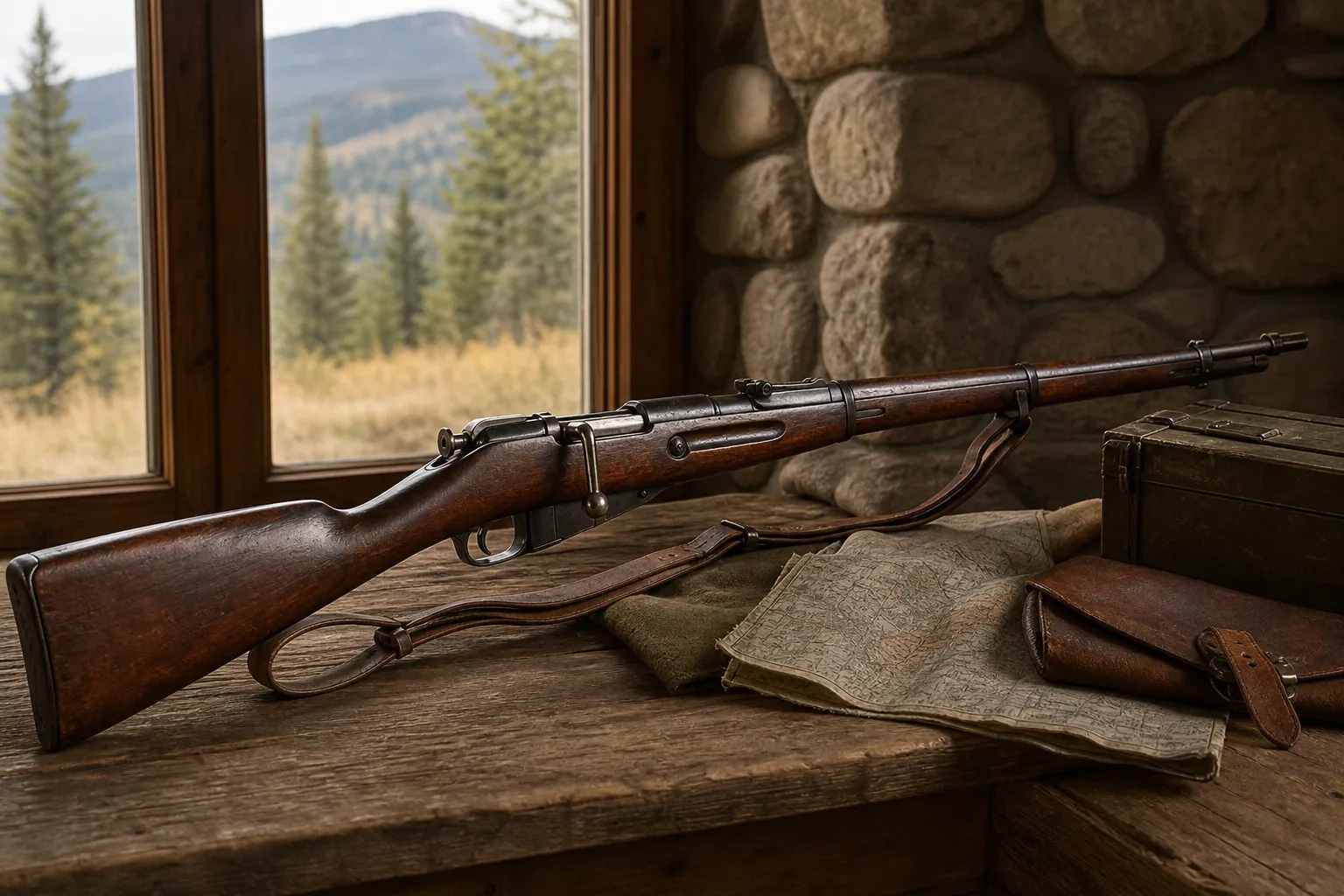
The Mosin-Nagant is the common collector name for the Russian and Soviet bolt-action rifle family that began with Russia’s Model 1891 rifle. Museum and arms-history references describe a design that combined elements associated with Sergei Mosin and Léon Nagant, served through the Russo-Japanese War, the First World War and the Second World War, and continued to appear in later conflicts through rifles, carbines and sniper variants.
Names and origins
Royal Armouries notes that the rifle was known in Russia as Vintovka Mosina, meaning Mosin’s rifle. It is also widely described as the three-line rifle, a Russian designation connected to its caliber. The longer name Mosin-Nagant is especially familiar to English-language collectors because the final pattern included parts associated with both Mosin and Nagant.
The National Army Museum states that the rifle was developed in the 1880s and adopted by Russia in 1891. The NRA National Firearms Museum describes the final service design as combining Mosin’s receiver and bolt with Nagant’s clip-loaded magazine element. The Australian War Memorial attributes the design to Captain S. I. Mosin of the Imperial Artillery.
That mixed origin is why the rifle can appear under several names in museum labels and collector writing. In Russian service context, Vintovka Mosina and three-line rifle are historically important. In North American collecting language, Mosin-Nagant has become the common umbrella term.
Model 1891: the original service rifle
The Model 1891 was the original long rifle pattern in the family.
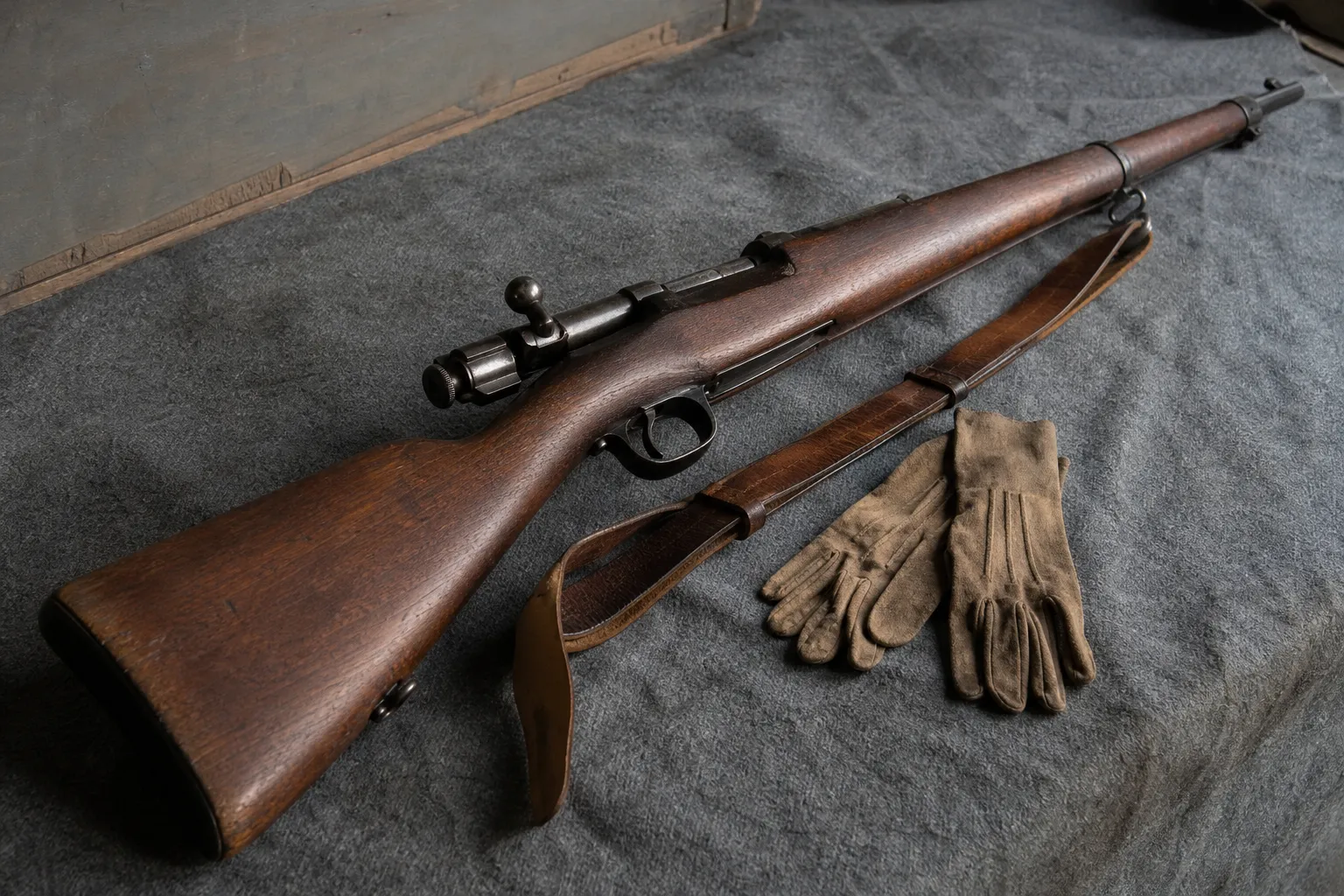
At a high level, the Model 1891 belonged to the generation of manually operated military rifles that became standard infantry arms in the late nineteenth century. The Australian War Memorial describes the later M1891/1930 in the same family as a manually operated bolt-action rifle fed from a five-round fixed magazine.
The Model 1891 was the long rifle foundation for the family. Later Russian and Soviet versions changed sights, length, receiver form, bayonet arrangements and optical equipment, but the basic identity remained tied to the Model 1891 line.
Before the Soviet era: Russo-Japanese War and First World War
The National Army Museum states that the Mosin-Nagant saw extensive Russian service in the Russo-Japanese War. By the First World War, the rifle was one of the key arms of the Russian Empire.
During the First World War, Russia contracted American arms companies Remington and Westinghouse to produce Mosin-Nagant rifles, according to the National Army Museum. The museum states that nearly half a million of those U.S.-contract rifles reached Russia before the 1917 Revolution stopped production.
Those American contracts are an important part of the rifle’s North American story. The NRA National Firearms Museum says that some U.S.-retained Model 91 rifles were later sold to NRA members through the Director of Civilian Marksmanship. That helps explain why some Model 1891 rifles in North American collections have a direct link to First World War U.S. production rather than later surplus import stories.
The main variants at a glance
The Mosin-Nagant family is broad, but several versions explain most of the names seen by history readers and collectors. The table below stays to the principal variants in the brief.
| Variant | What it is | Key identifying point from the record |
|---|---|---|
| Model 1891, M91 | Original Russian service rifle | Long rifle foundation for the family. |
| M91/30 | Soviet modernized long rifle | The NRA National Firearms Museum describes the Soviet M91/30 modernization as including meter-calibrated sights and commonly a round receiver ring. |
| M38 | Soviet carbine | The NRA National Firearms Museum describes it as a carbine without a bayonet mount. |
| M44 | Soviet carbine | The NRA National Firearms Museum identifies the permanent folding bayonet as its defining feature. |
| M91/30 sniper | Scoped selected rifle | Modern Firearms describes M91/30 sniper rifles as accuracy-selected rifles with left-side scope mounts and bent-down bolt handles. |
Soviet modernization: the M91/30
The M91/30 was the best-known Soviet long-rifle modernization of the Mosin-Nagant family. The NRA National Firearms Museum describes the modernization as including meter-calibrated sights and commonly a round receiver ring.
Those changes matter because they make the M91/30 visually and historically distinct from the older Model 1891. It remained a full-length bolt-action service rifle, but with features associated with Soviet standardization.
The Australian War Memorial describes the M1891/1930 as a manually operated bolt-action rifle with a five-round fixed magazine. In its Korean War material, the museum also states that the M1891/1930 was the standard North Korean and Chinese rifle of that war, showing the model’s post-Second World War reach.
Carbines: M38 and M44
The M38 and M44 were shorter Soviet carbines in the Mosin-Nagant family. The NRA National Firearms Museum describes the M38 as a carbine adopted without a bayonet mount, while Modern Firearms describes the M1938 carbine as shorter, lighter and handier than the basic rifle.
The M44 kept the carbine idea but added a bayonet solution. The NRA National Firearms Museum describes the M44’s defining feature as a permanently attached folding bayonet. Modern Firearms describes that bayonet as a side-folding spike bayonet.
This makes the M38 and M44 easy to separate in basic terms. The M38 is the short carbine pattern without the bayonet mount. The M44 is the later carbine pattern with the permanent folding spike bayonet.
The Australian War Memorial also records later use of the M44 pattern: a 1944 M44 carbine in its collection was captured in Vietnam at Long Tan in 1966.
Soviet sniper rifles
The Mosin-Nagant sniper rifle was built around selected M91/30 rifles fitted for optical sights. Modern Firearms describes M91/30 sniper rifles as accuracy-selected rifles with left-side scope mounts and bent-down bolt handles.
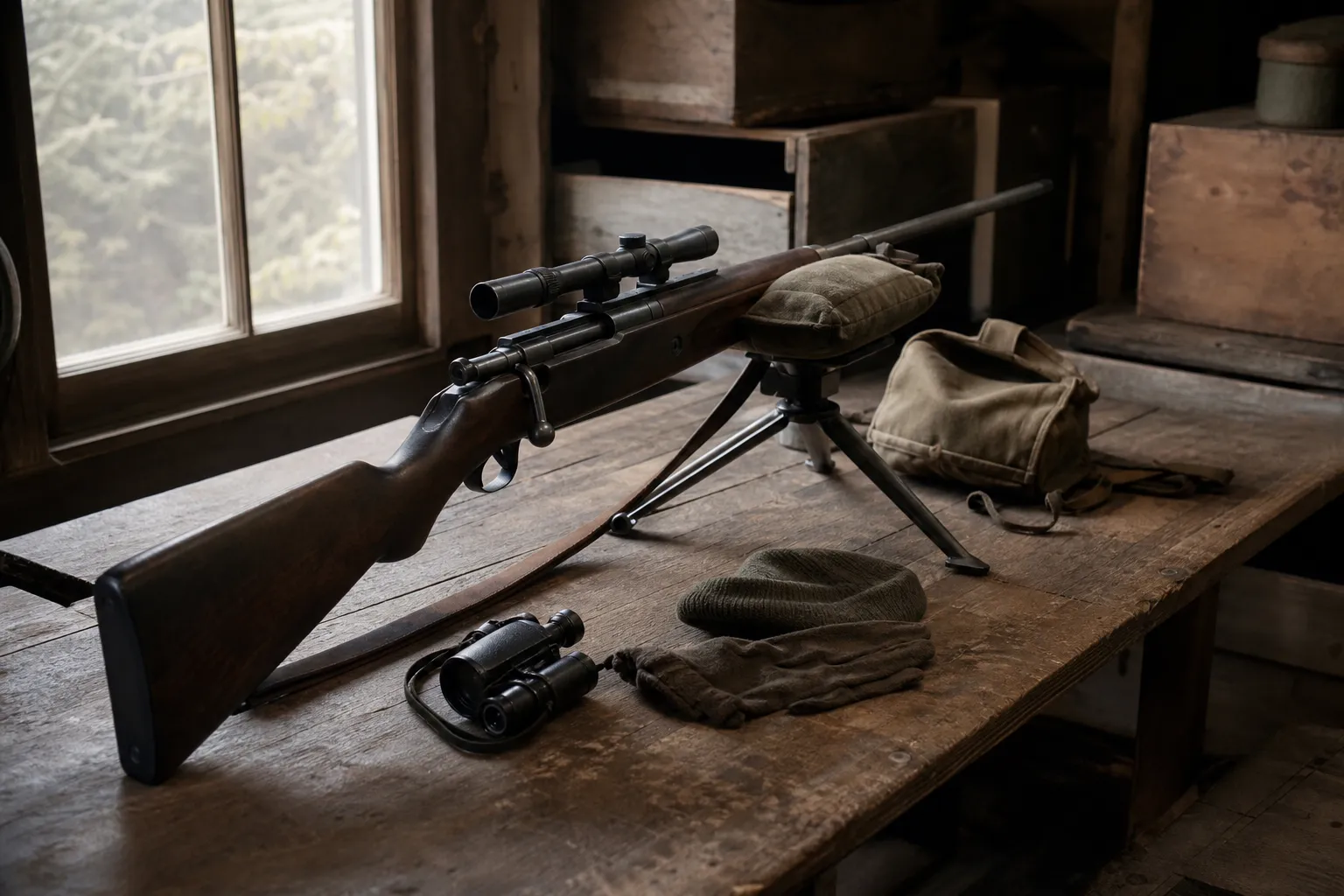
The Australian War Memorial states that the Mosin-Nagant sniper rifle was first issued in the late 1930s and used extensively in the Second World War. One 1944 M1891/30PU sniper rifle in the museum’s collection has a 3.5-power PU telescopic sight.
The bent bolt handle is a practical identifying feature of the sniper configuration because the optical sight and mount changed the space around the receiver. The PU-equipped M91/30 is therefore one of the most recognizable Soviet Second World War sniper rifles in the Mosin-Nagant family.
The 7.62x54R cartridge in brief
The 7.62x54R cartridge is closely associated with the Mosin-Nagant family. C.I.P. lists the 7.62 x 54 R as a rimmed cartridge with Soviet country of origin and headspace on the rim.
The “R” in the common designation refers to the rimmed case form. In a rimmed cartridge, the projecting rim is part of how the cartridge is positioned in the chamber. C.I.P.’s listing specifically notes headspace on the rim for this cartridge.
The cartridge remains in use in SVD rifles and PKM machine guns. That long service life is one reason the cartridge is often discussed separately from the original rifle.
Why North American collectors see so many
One verified North American path begins during the First World War. The National Army Museum states that Russia contracted Westinghouse and Remington in the United States to make Mosin-Nagant rifles, and that nearly half a million reached Russia before the 1917 Revolution stopped production.
Another path involves rifles that remained under U.S. control. The NRA National Firearms Museum says some U.S.-retained Model 91 rifles were later sold to NRA members through the Director of Civilian Marksmanship.
Later service and historical reach
The Australian War Memorial says the Mosin-Nagant served with Soviet armed forces in both world wars and later conflicts. Its collection records connect the family not only to Russian and Soviet history, but also to Korea and Vietnam.
For Korea, the Australian War Memorial states that the M1891/1930 was the standard North Korean and Chinese rifle of the Korean War. For Vietnam, the museum records a 1944 M44 carbine captured at the Battle of Long Tan in 1966.
Those later examples show why the rifle is not only a First World War or Second World War subject. Its long service life, simple family of variants and durable 7.62x54R cartridge kept it visible well beyond its original adoption.
What to check with official sources
For historical identification, compare markings, configuration and variant features with museum references and published arms-history records. For legal questions in the United States, check current ATF material and applicable state or local law. For Canada, check current RCMP and Canadian Firearms Program material. Do not rely on collector shorthand alone for legal classification or ownership rules.
Frequently asked questions
When was the Mosin-Nagant adopted?
The National Army Museum states that Russia adopted the rifle in 1891.
Why is it called the Mosin-Nagant?
The NRA National Firearms Museum describes the final rifle as combining Mosin’s receiver and bolt with Nagant’s clip-loaded magazine element. Royal Armouries notes that in Russia it was known as Vintovka Mosina.
What cartridge does the Mosin-Nagant use?
The common designation is 7.62x54R. The “R” refers to the rimmed case form, and C.I.P. lists 7.62 x 54 R with headspace on the rim.
What is the difference between the M38 and M44 carbines?
The NRA National Firearms Museum describes the M38 as a carbine without a bayonet mount. It describes the M44 as having a permanently attached folding bayonet, and Modern Firearms describes that bayonet as a side-folding spike bayonet.
What made the Mosin-Nagant sniper rifle different?
Modern Firearms describes M91/30 sniper rifles as accuracy-selected rifles with left-side scope mounts and bent-down bolt handles. The Australian War Memorial records a 1944 M1891/30PU sniper rifle with a 3.5-power PU telescopic sight.
Why are Mosin-Nagant rifles common in North American collecting?
The National Army Museum records First World War U.S. contracts with Remington and Westinghouse, and the NRA National Firearms Museum says some U.S.-retained Model 91 rifles were later sold through the Director of Civilian Marksmanship.
Sources
- Arms of the First World War, Royal ArmouriesOfficial source. Accessed October 24, 2026.
- Russian Mosin-Nagant 7.62 mm 3-line M1891 rifle, 1919 (c), National Army Museum, LondonOfficial source. Accessed October 24, 2026.
- Mosin Nagant M1891 Dragoon Rifle, Australian War MemorialOfficial source. Accessed October 24, 2026.
- Mosin Nagant M1891/30PU Sniper Rifle, Australian War MemorialOfficial source. Accessed October 24, 2026.
- Out in the Cold: Mosin-Nagant M1891/1930, Australian War MemorialOfficial source. Accessed October 24, 2026.
- Moisin Nagant M1944 Carbine, Australian War MemorialOfficial source. Accessed October 24, 2026.
- Mosin-Nagant Model 1891 Bolt Action Rifle, NRA National Firearms Museum. Accessed October 24, 2026.
- Mosin Nagant Model 1944 Bolt Action Carbine, NRA National Firearms Museum. Accessed October 24, 2026.
- Mosin-Nagant Rifle, Modern Firearms. Accessed October 24, 2026.
- C.I.P. 7,62 x 54 R TAB. II, Commission Internationale Permanente pour l'Epreuve des Armes à Feu PortativesOfficial source. Accessed October 24, 2026.
- Curios & Relics, Bureau of Alcohol, Tobacco, Firearms and ExplosivesOfficial source. Accessed October 24, 2026.
- Curios or Relics List, January 1972 through April 2025, Bureau of Alcohol, Tobacco, Firearms and ExplosivesOfficial source. Accessed October 24, 2026.