The M16 Rifle: History and Development
The M16 began in the AR-15 rifle lineage, passed through Colt and early Southeast Asia trials, and became a central U.S. service rifle in the Vietnam era. Its history includes a serious early reliability crisis and later development into the M16A1, M16A2, M16A4, and M4 family.
By RaiS. Reviewed by RaiS. Published . 4 min read.
Research and drafting were assisted by AI. RaiS checked the facts against the sources below and approved this page.
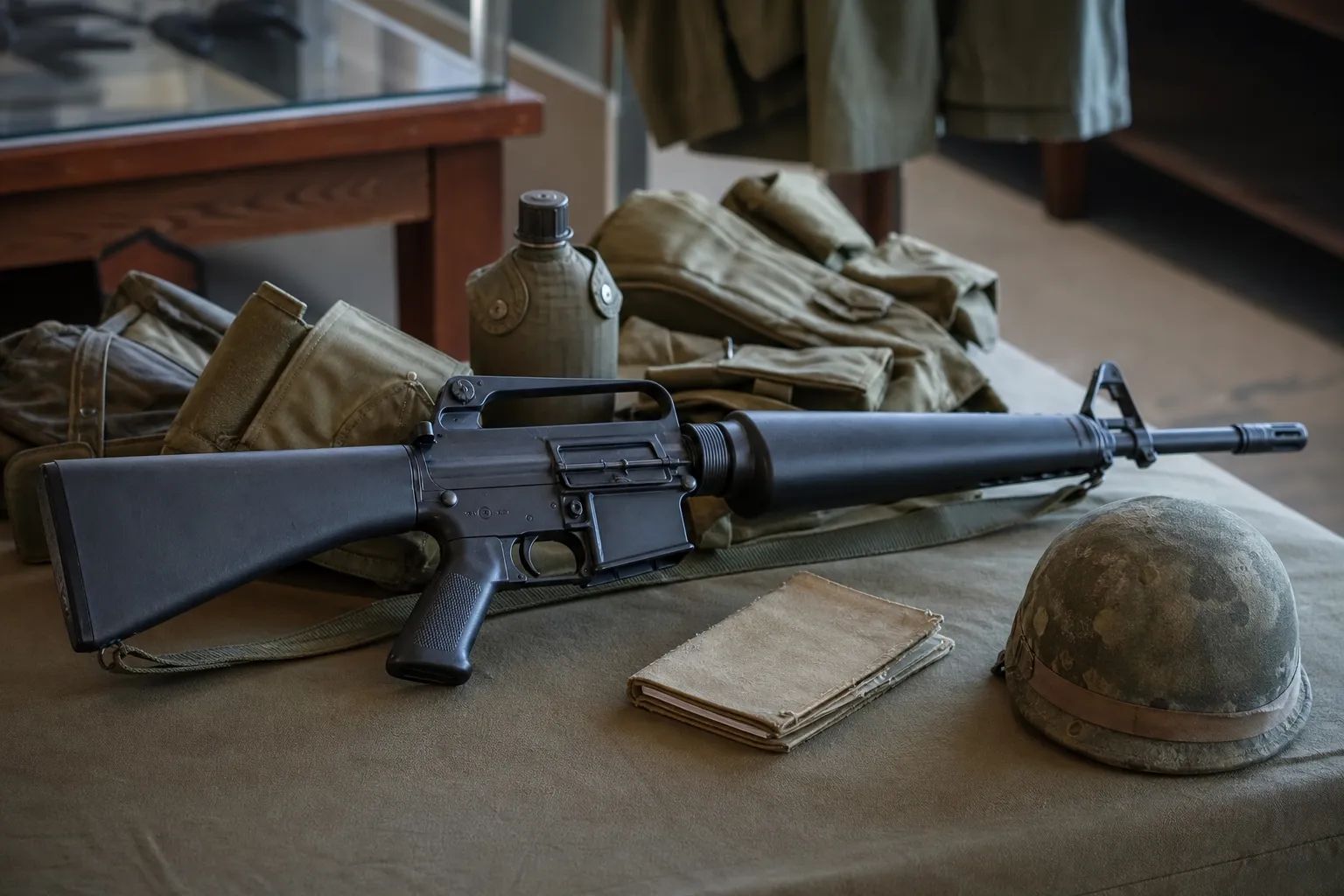
The M16 rifle was the U.S. military’s Vietnam era shift away from the heavier 7.62 mm M14 toward a lighter rifle lineage that began with the AR-15 line. Its story is not just a story of one design. It is also a story of Army requirements, Colt production rights, DARPA field trials, wartime procurement, early reliability failures, and decades of incremental changes that led to the M16A1, M16A2, M16A4, and M4 carbine.
Why the M16 mattered
The M16 mattered because it arrived during a major change in U.S. infantry small arms. DARPA describes the M16 as based on the Colt AR-15, a design that had already been rejected by the Chief of Staff of the Army in favor of the heavier 7.62 mm M14.
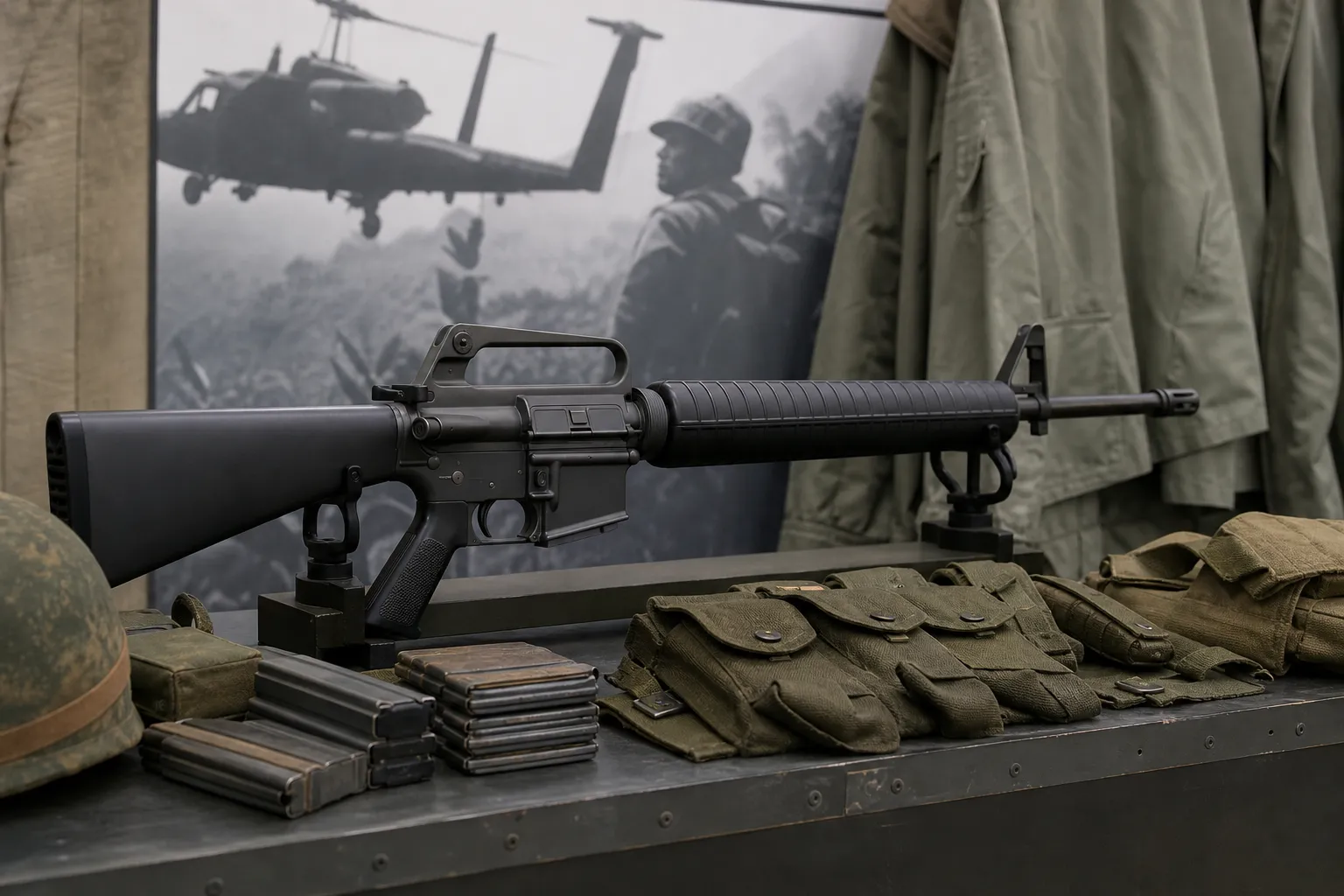
That did not mean the change happened all at once. Springfield Armory National Historic Site states that the M14 was replaced by the M16 in the late 1960s.
That transition helps explain why the M16 remains so discussed. It was a new rifle family pushed into a major war, then reshaped by field experience, investigations, training changes, and later model updates.
ArmaLite, Stoner, and the AR-15
The M16 story begins with Eugene Stoner at ArmaLite.
Springfield Armory National Historic Site says Stoner began development of the AR-15 during 1957 to 1958 while working for ArmaLite. Springfield also describes the AR-15 prototype as a scaled-down AR-10 in .223 caliber, developed in less than nine months and turned over to the Army for testing. Springfield states directly that this rifle later evolved into the M16.
The letters “AR” are often misunderstood. For the name background, see What Does AR Stand For. In the M16 story, the important point is that the AR-15 began as an ArmaLite rifle design before the military M16 name became attached to later versions.
The National Firearms Museum also places the AR-15 name in the early history of the M16 rifle family.
Colt, DARPA, and early Vietnam use
ArmaLite did not remain the only company in the story. The National Firearms Museum says ArmaLite licensed manufacturing rights of the AR-15 to Colt in 1959. From that point, the design entered a new stage of military evaluation and procurement.

DARPA’s account is central to the early Vietnam chapter. Through Project AGILE, DARPA purchased 1,000 AR-15 rifles and issued them to combat troops in Southeast Asia for field trials. DARPA says its report helped lead to the first large-scale procurement in 1966 of a modified AR-15, called the M16, for deployment in the Vietnam conflict.
So the M16 did not arrive as a fully settled rifle family. It moved from an early AR-15 design, to Colt manufacturing rights, to DARPA field trials, to larger Vietnam procurement, all while the Army was still transitioning away from the M14.
The reliability crisis and the M16A1 era
The early M16 reputation was shaped by a serious reliability crisis in Vietnam. A 1968 Department of the Army M16 Rifle Review Panel found that the principal direct cause of stoppages in South Vietnam was failure to extract the spent case. The same review attributed that failure to dirty or corroded cartridges and improperly maintained chambers.
Contemporary investigations included the Army’s M16 Rifle Review Panel and a House Armed Services subcommittee. The important historical point is that the rifle’s early combat record forced official attention on ammunition condition, chamber condition, maintenance, and training.
The Army review panel reported that field performance improved steadily after June 1967 as a result of increased training and discipline in care, cleaning, and maintenance. That finding is a useful way to frame the M16A1 era: the rifle family did not disappear after the crisis. Instead, the U.S. military worked through the problems as the rifle family continued in service.
M16A2, M16A4, and M4
After the Vietnam era, the M16 family continued to change. Later variants included the M16A2, M16A4, and M4 family.
A short version of the family line looks like this:
| Model | How official sources describe its role |
|---|---|
| AR-15 prototype | Springfield Armory National Historic Site describes it as a scaled-down AR-10 in .223 caliber that later evolved into the M16. |
| M16 | DARPA describes it as a modified AR-15 procured for Vietnam. |
| M16A1 | Army review documents discuss stoppages in South Vietnam, then improved field performance after June 1967 with better training and maintenance. |
M16 vs AR-15
The M16 vs AR-15 question can be answered simply at a high level: they are visually and historically related, but they are not the same in function or application. The military M16 family developed from the AR-15 line, but the modern civilian AR-15 and the military M16 are described differently by official and museum sources.
The National Firearms Museum states that today an AR-15 refers to a semi-automatic sporting rifle, capable of firing one shot with each pull of the trigger. The museum says the term M16 refers to the selective-fire rifle used by the military.
That distinction matters. This article does not provide parts guidance, conversion instructions, or legal advice. Readers with legal or classification questions should confirm current requirements directly with ATF or the relevant government authority.
What to check with official sources
For history, the best starting points are the U.S. Army Center of Military History, Springfield Armory National Historic Site, the Smithsonian, DARPA, and the National Firearms Museum. For current U.S. legal classification questions involving AR-15 type rifles, do not rely on summaries or internet discussions. Check ATF materials directly and, when needed, consult qualified legal counsel.
Frequently asked questions
Who designed the rifle that became the M16?
Eugene Stoner developed the AR-15 while working for ArmaLite in 1957 to 1958, according to Springfield Armory National Historic Site.
What caused the early M16 reliability crisis?
A 1968 Department of the Army M16 Rifle Review Panel found that the main direct stoppage cause in South Vietnam was failure to extract the spent case. The review linked that to dirty or corroded cartridges and improperly maintained chambers.
How is an M16 different from an AR-15?
The National Firearms Museum says that today an AR-15 refers to a semi-automatic sporting rifle that fires one shot per trigger pull, while M16 refers to a military selective-fire rifle.
Sources
- Stoner, Twentieth Century Small Arms Development Videohistory Collection, Smithsonian Institution ArchivesOfficial source. Accessed October 22, 2026.
- Post WWII Rifle, Springfield Armory National Historic Site, National Park ServiceOfficial source. Accessed October 22, 2026.
- Department of the Army, Chief of Ordnance, Springfield Armory Records, Springfield Armory National Historic Site, National Park ServiceOfficial source. Accessed October 22, 2026.
- M16 Rifle, DARPAOfficial source. Accessed October 22, 2026.
- The Army Before Vietnam, 1953-1965, U.S. Army Center of Military HistoryOfficial source. Accessed October 22, 2026.
- Survey of U.S. Army Uniforms, Weapons and Accoutrements, U.S. Army Center of Military HistoryOfficial source. Accessed October 22, 2026.
- Weapon Systems Handbook 2001, Operations and Support, U.S. Army Acquisition Support CenterOfficial source. Accessed October 22, 2026.
- M16A4 Rifle, U.S. Army CPE Ground, Project Manager Soldier LethalityOfficial source. Accessed October 22, 2026.
- M4A1 Carbine, U.S. Army CPE Ground, Project Manager Soldier LethalityOfficial source. Accessed October 22, 2026.
- Federal Firearms Regulations Reference Guide, General Information Concerning M16 Parts and AR-15 Type Rifles, Bureau of Alcohol, Tobacco, Firearms and ExplosivesOfficial source. Accessed October 22, 2026.
- Colt AR-15 Semiautomatic Rifle and Carbine Manual, Colt. Accessed October 22, 2026.
- Colt AR-15 Automatic Rifle, National Firearms Museum. Accessed October 22, 2026.
- Report of the M16 Rifle Review Panel, History of the M16, Department of the Army, hosted by The Colt AR-15 Resource. Accessed October 22, 2026.
- Report of the M16 Rifle Review Panel, Appendix 6, Department of the Army, hosted by The Colt AR-15 Resource. Accessed October 22, 2026.
- Report of the M16 Rifle Review Panel, Appendix 7, Department of the Army, hosted by The Colt AR-15 Resource. Accessed October 22, 2026.
- Speed versus Quality: Problems with the M-16 Rifle in Vietnam, Army University Press, Military Review. Accessed October 22, 2026.