The M14 Rifle: History and Service
The M14 was approved in 1957 after development work connected to the M1 Garand line. It marked a transition from the Garand era toward the M16 era, and its story continued through specialist roles and civilian semi automatic descendants.
By RaiS. Reviewed by RaiS. Published . 3 min read.
Research and drafting were assisted by AI. RaiS checked the facts against the sources below and approved this page.
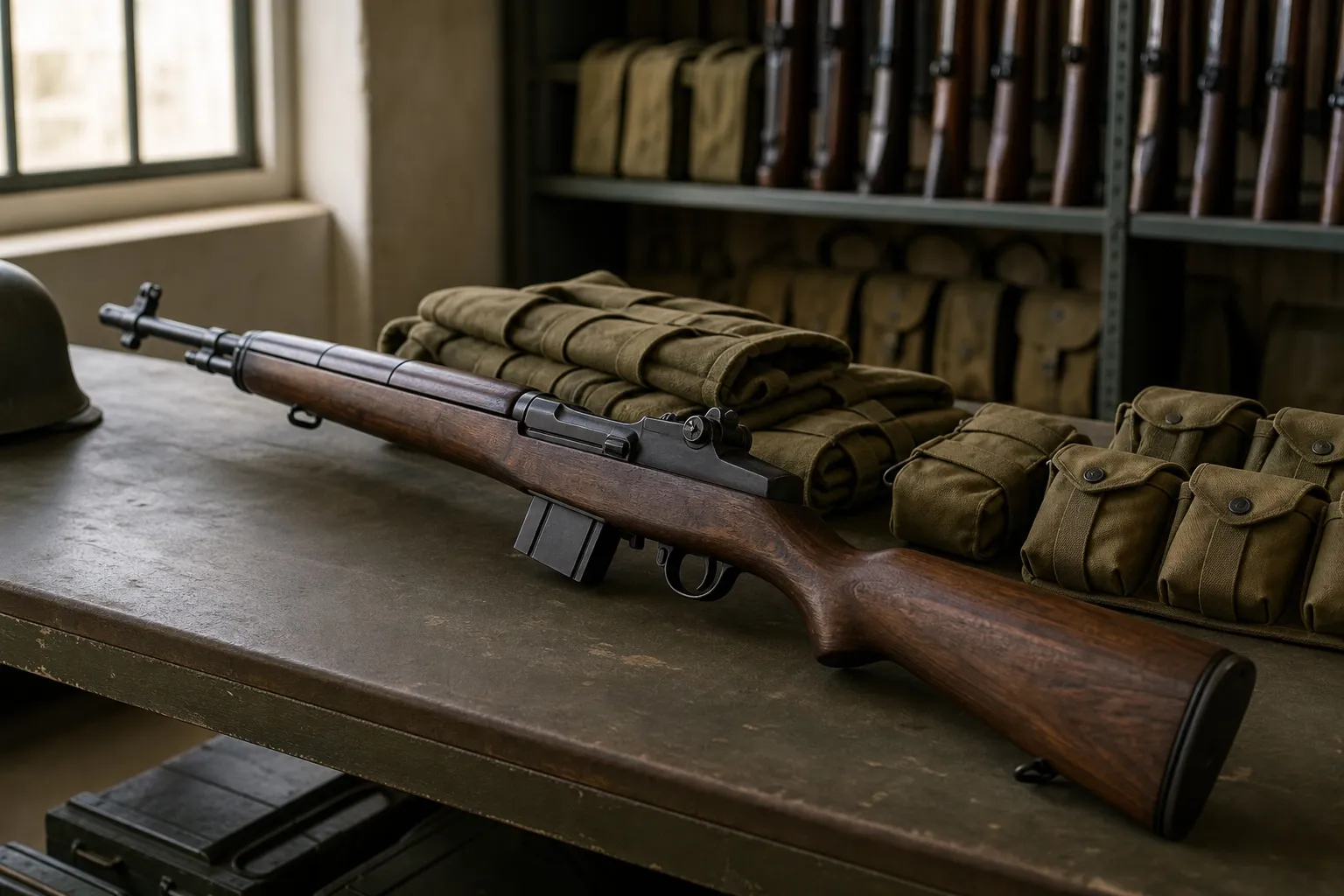
The M14 rifle was the U.S. military’s postwar bridge between the M1 Garand era and the M16 rifle era. It grew out of wartime lessons from the M1 Rifle, and the Army approved the T44E4 as the M14 on May 1, 1957.
From the M1 Garand to the T44
World War II experience with the M1 Rifle showed the need for a lighter rifle with more magazine capacity and selective fire capability. That need did not produce the M14 immediately. It started as a long series of M1 improvement experiments and postwar test rifles.
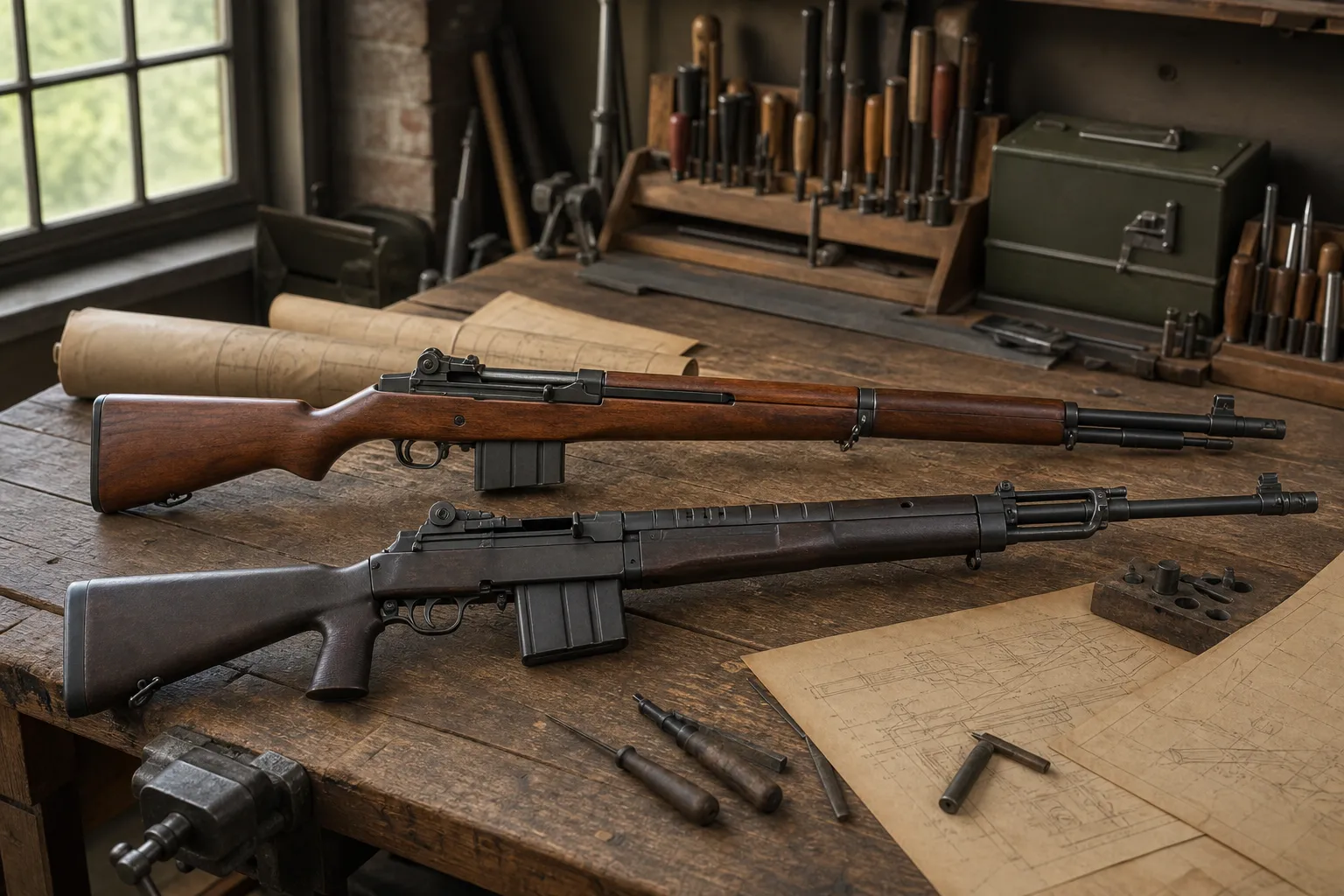
Springfield Armory’s experiments to improve the M1, designated the M1E series, began as early as December 1942. John Garand completed the T20 in October 1944. The T20 was the first of the T series, fitted with a BAR style magazine, a lengthened M1 receiver, and selective fire capability.
The cartridge story was just as important as the rifle story. The shorter T65 cartridge was connected to late World War II German work with smaller cartridges and American advances in propellant technology. Those developments allowed a shorter cartridge with about the same range and ballistics as the earlier U.S. service cartridge.
Around 1949, the long receiver T20E2 rifles were converted to the now standard T65 cartridge and designated the T36 and T37 series. Those rifles led to the T44. That made the M14 a direct descendant of the M1 Garand, but also a product of the early Cold War push toward a new cartridge and a new standard rifle.
Adoption in the 7.62 mm NATO era
The M14 arrived during a period of small arms standardization.
The Secretary of the Army announced on May 1, 1957 that the T44E4 had been approved and designated the M14.
The Army wanted the new rifle to simplify a mixed small arms inventory. The M14 was slated to replace the M1 rifle, M2 carbine, and M3A1 submachine gun.
That goal explains why the M14 was more than just an updated Garand. It was meant to reduce the variety of weapons carried across U.S. units.
Production and early issue
Adoption did not mean instant fielding. Production did not begin until 1959.
Design and technology
At a historical level, the important change was the move from the M1 Rifle’s earlier service pattern to a rifle shaped by a new generation of postwar design ideas.
The M14’s design was rooted in the Garand family, but it belonged to a different era of rifle doctrine. It was expected to do several jobs once divided among several older arms.
Vietnam and replacement by the M16
The M14 is part of the Vietnam War story.
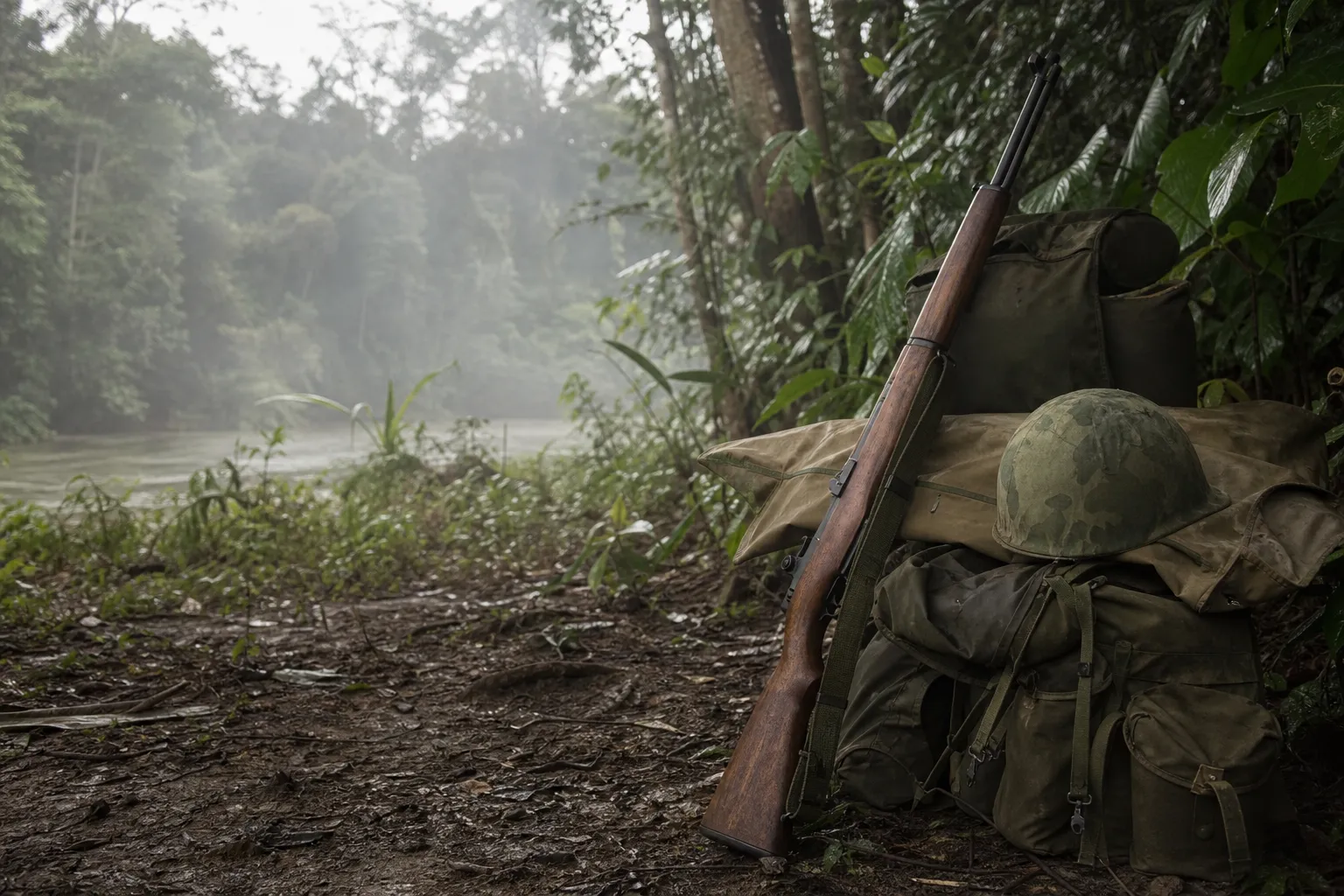
The U.S. M14 was used during the war in Vietnam. The wider transition to the M16 family changed its place in U.S. service.
The M21 sniper system
The M14 did not disappear when the M16 family became prominent. One later path connected the M14 design family with sniper rifle development known as the M21.
That later association shows how the M14’s service history continued after its period as a general infantry rifle.
Designated marksman and Enhanced Battle Rifle use
The M14 also appeared in later designated marksman style roles.
That role was different from the M14’s original place as a general service rifle. Instead of replacing several older weapons across the force, later specialist use reflected a more focused role for particular units and conditions.
Ceremonial use
Civilian semi-automatic descendants
The M14 also has a civilian semi automatic descendant in the Springfield Armory M1A. The Springfield Armory M1A is a semi automatic version of the U.S. M14 service rifle used during the war in Vietnam.
The M1A is a civilian version of the M14 rifle, and the M1A product line has been produced since 1974.
That civilian line belongs in the M14 story because it kept the rifle’s profile familiar outside military service. This article treats it only at a historical level, not as buyer guidance or legal advice.
Why the M14 matters
The M14 matters because it marks a brief but important transition in U.S. rifle history. It came from the M1 Garand development line and was intended to simplify the Army’s small arms mix.
Its standard service life was short. Yet the rifle’s later life kept the M14 design family in view through later specialist roles and the civilian M1A.
Current military status, ceremonial procedures, and civilian ownership rules can change by jurisdiction.
Frequently asked questions
When was the M14 adopted?
The T44E4 was approved and designated the M14 on May 1, 1957.
What rifle did the M14 come from?
It grew out of M1 improvement experiments that included the T20, T36, T37, and T44.
Did the M14 serve in Vietnam?
Yes. The U.S. M14 was used during the war in Vietnam.
What is the Springfield Armory M1A?
The M1A is a civilian semi automatic version connected to the M14 design family, and the product line has been produced since 1974.
Sources
- Post WWII Rifle Development, Springfield Armory National Historic Site, National Park ServiceOfficial source. Accessed October 23, 2026.
- The Army Before Vietnam, 1953-1965, U.S. Army Center of Military HistoryOfficial source. Accessed October 23, 2026.
- Survey of U.S. Army Uniforms, Weapons and Accoutrements, U.S. Army Center of Military HistoryOfficial source. Accessed October 23, 2026.
- Fortitudine, Vol. 33, No. 1, Iron and Wood: The U.S. M14 Service Rifle, National Museum of the Marine Corps, U.S. Marine CorpsOfficial source. Accessed October 23, 2026.
- Small Arms of U.S. Forces in Vietnam, U.S. Marine Corps UniversityOfficial source. Accessed October 23, 2026.
- Forging Precision: Inside the US Army Marksmanship Unit’s Custom Firearms Shop, U.S. ArmyOfficial source. Accessed October 23, 2026.
- Project Manager Soldier Weapons, Product Manager Individual Weapons, M14 7.62mm Enhanced Battle Rifle (EBR), PEO Soldier, U.S. ArmyOfficial source. Accessed October 23, 2026.
- The Changing of the Guard, U.S. ArmyOfficial source. Accessed October 23, 2026.
- TC 3-21.5 Drill and Ceremonies, May 2021, U.S. ArmyOfficial source. Accessed October 23, 2026.
- Springfield Armory M 1A Semi Automatic Rifle, NRA National Firearms Museum. Accessed October 23, 2026.
- Springfield Armory Celebrates M1A Series with Behind-the-Scenes Video, Springfield Armory, Inc.. Accessed October 23, 2026.