The SKS Rifle: History of the Simonov Carbine
The SKS was Sergei Simonov’s Soviet self loading carbine for the 7.62x39 mm M1943 intermediate cartridge. Adopted in 1949 and soon overshadowed by the AK, it became one of the most widely recognized Cold War carbines through Soviet, Chinese, Yugoslav and other national variants.
By RaiS. Reviewed by RaiS. Published . 6 min read.
Research and drafting were assisted by AI. RaiS checked the facts against the sources below and approved this page.
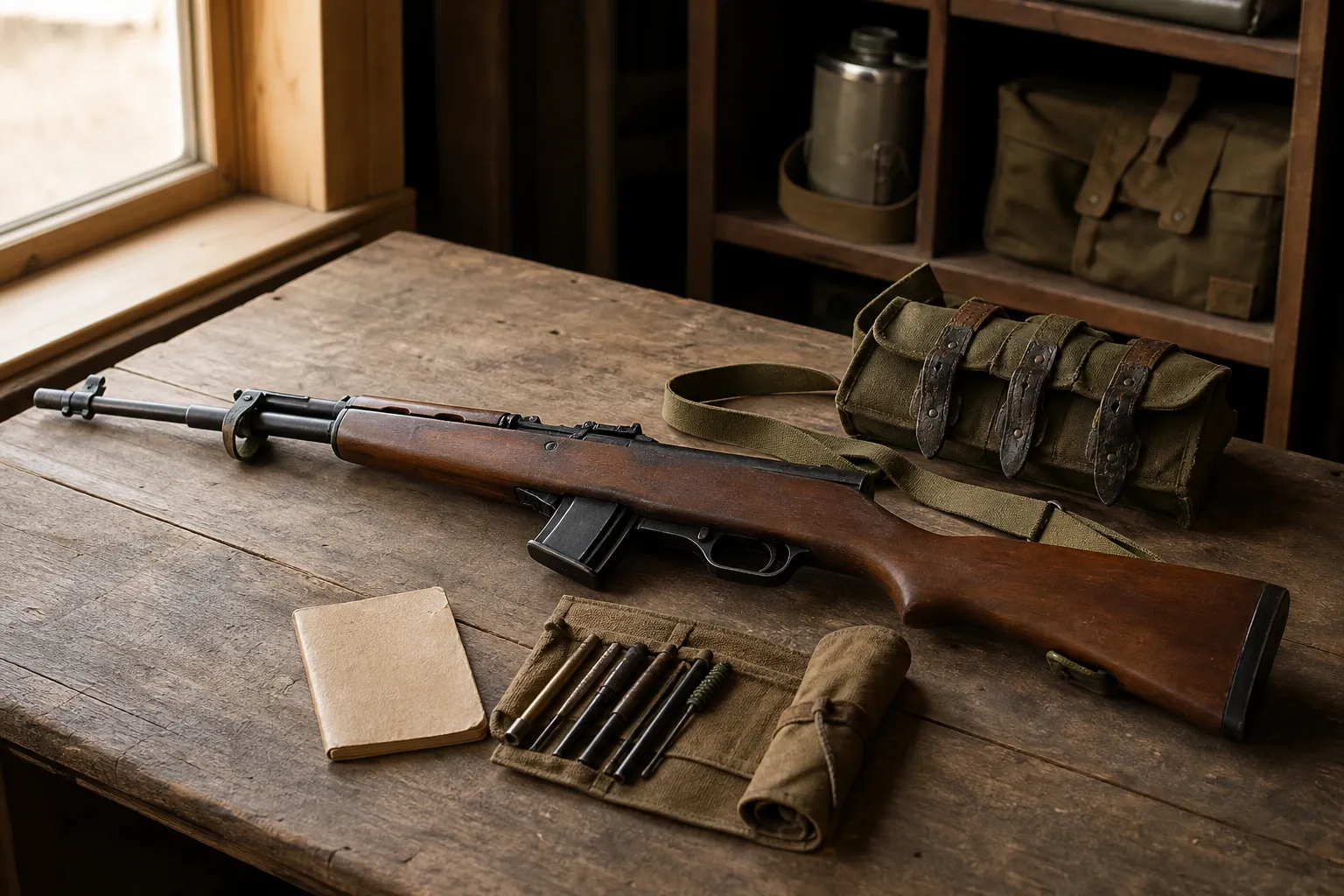
The SKS is Sergei Gavrilovich Simonov’s Soviet self loading carbine, known in Russian designation as the Simonov system self loading carbine and widely referred to as the SKS or Simonov. Small Arms Survey describes it as a gas operated, self loading rifle chambered for the 7.62x39 mm M1943 cartridge, fed by a 10 round internal box magazine and commonly recognized by its tubular receiver profile and folding bayonet. Historically, it sits between full power Second World War service rifles and the postwar move toward intermediate cartridge infantry arms such as the AK.
Sergei Simonov before the SKS
Simonov was already an established Soviet arms designer before the SKS reached adoption. The Tula State Museum of Weapons places one of his major earlier designs, the AVS 36 automatic rifle, in Red Army adoption in 1936.
The same museum states that in 1941 Simonov designed a 14.5 mm five shot anti tank rifle. These earlier arms do not make the SKS a simple copy of a previous Simonov weapon, but they show that Simonov had worked on self loading and military small arms projects well before the postwar carbine became famous.
The 7.62x39 mm M1943 cartridge
The SKS story is inseparable from the Soviet 7.62 mm Model 1943 cartridge. NRA Museums describes the M43 cartridge as using a 7.62 mm bullet in a short, rimless 39 mm case.
Modern Firearms describes the SKS as part of a new Soviet small arms system built around the 7.62 mm Model 1943 cartridge. That same system also included the Kalashnikov AK assault rifle and the Degtyarov RPD light machine gun.
This is why the SKS is often described as a transitional design. It was not a full power rifle in the older Second World War pattern, and it was not the same kind of general infantry weapon that the Soviet Army later preferred in the AK family. It was a self loading carbine built around the intermediate cartridge that became one of the defining Soviet small arms rounds of the Cold War.
Development and Soviet adoption
The Tula State Museum of Weapons also states that in 1949 the Soviet Army adopted the 7.62 mm self loading carbine of Simonov’s system, identified as the SKS 45 M1945. NRA Museums gives the expanded Russian designation as Samozaryadnyi Karabin sistemi Simonova obrazets 1945g, or SKS45, after modification.
Victory Museum states that Soviet production ended in 1956 and gives a total Soviet production figure of 2,685,900 carbines.
Why the SKS was quickly displaced
The SKS entered service at almost the same time that the Soviet small arms system was moving toward the AK as the preferred general infantry arm. NRA Museums states that within a few years of adoption, the SKS had been replaced by Mikhail Kalashnikov’s AK 47.
Modern Firearms explains the shift by stating that the Soviet Army decided an assault rifle was a better general purpose individual infantry weapon, and that production in the USSR was completed in 1956. The SKS remained a self loading carbine with a 10 round internal magazine, while the AK represented the assault rifle part of the same 7.62 mm Model 1943 system.
That quick replacement is one reason the SKS can feel historically unusual. It was officially adopted, produced in large numbers, and then rapidly overshadowed in front line Soviet service by another weapon family built around the same cartridge.
Mechanism and layout
Small Arms Survey describes the SKS as gas operated and self loading. It lists the caliber as 7.62 x 39 mm M1943 and the feed device as a 10 round internal box magazine.
At a visual level, Small Arms Survey highlights two recognition cues: the tubular appearance of the receiver and an attached folding bayonet. Australian War Memorial describes a Chinese Type 56 example with a pivoting magazine, a trigger guard safety catch, and a folding blade bayonet.
For a collector or historian, the important point is the overall layout rather than any user level procedure. The SKS is a self loading military carbine with an internal magazine and bayonet, not a bolt action rifle and not the same pattern as the later AK assault rifle.
Production beyond the Soviet Union
Although Soviet production ended in 1956, the SKS pattern spread widely. NRA Museums states that the SKS was adopted by the People’s Republic of China as the Type 56 Carbine and manufactured in quantity in the Soviet Union, China, North Korea, East Germany and Yugoslavia.
The National Army Museum also describes the Simonov Carbine as produced in large numbers by the Soviet Union and using the short 7.62 mm cartridge later used by the AK 47. Small Arms Review states that Chinese Type 56 production began in 1956 and lasted longer than production in any other country.
Yugoslavia became another major SKS producer. The Croatian Police Museum states that Yugoslavia bought a Soviet license for the SKS and produced the weapon at Crvena Zastava in Kragujevac. The same museum identifies its PAP M59/66 as a Crvena Zastava semi automatic rifle in 7.62x39 mm with a 10 round magazine.
Museum collections also show the carbine’s Cold War reach. Australian War Memorial identifies a Chinese Type 56 SKS captured in Vietnam and describes the Type 56 carbine as a copy of the Russian SKS45 developed during the Second World War.
Recognizing major national variants
The SKS family is best approached through visible national features rather than assumptions about value or condition. The table below stays with identification points reported by museums, Small Arms Survey and collector reference writing.
| Variant or family | Recognition notes |
|---|---|
| Soviet SKS | Small Arms Survey’s general SKS description notes the gas operated, self loading layout, 10 round internal magazine, tubular receiver appearance and folding bayonet. |
| Chinese Type 56 | NRA Museums states that China adopted the SKS as the Type 56 Carbine. Australian War Memorial describes a Type 56 example marked with 56 in a triangle, with a pivoting magazine, trigger guard safety catch and folding blade bayonet. Small Arms Review states that Chinese military Type 56 carbines can be identified by an arsenal symbol on the left side of the receiver, and that 26 inside a triangle is a common Jianshe Arsenal mark. |
| Yugoslav M59 and M59/66 | Small Arms Survey gives a simple distinction: the M59/66 has a grenade launching muzzle, while other listed models do not. The Croatian Police Museum states that later Yugoslav changes created the M59/66 and M59/66A1 with grenade launching equipment, sights and buttpad changes. Small Arms Review describes the M59/66 as having a permanently attached 22 mm grenade launcher, gas cut off valve and flip up grenade sight, and states that Yugoslav SKS variants do not have chrome lined barrels and chambers. |
| East German Karabiner S | Small Arms Review describes East German Karabiner S recognition features as a sling slot in the buttstock, no butt trap door, no cleaning rod under the barrel and SV rear sight markings. |
| North Korean Type 63 and related rifles | Small Arms Review describes North Korean Type 63 recognition marks as a star in circle logo plus 63 and a Hangul character on the receiver cover. |
| Romanian M56 | Small Arms Review states that the Romanian SKS, designated Model 56, was manufactured in Romania from 1956 to 1962. |
| Albanian SKS style rifle | Small Arms Review describes the Albanian SKS as having a long three vent handguard, two separate buttstock compartments and an obvious hook type cocking handle. |
These visible cues are useful because SKS carbines from different countries can look similar at first glance. Markings, bayonet style, muzzle equipment, stock details and sight markings are often the clearest starting points for identifying a national pattern.
The SKS in historical perspective
The SKS had a short life as a primary Soviet infantry carbine, but a long life as a recognizable military pattern. NRA Museums and Modern Firearms both describe its rapid displacement by the AK.
That combination makes the Simonov carbine important to collectors and military history readers. It belongs to the Soviet move away from older full power rifles, it shares the 7.62 mm Model 1943 cartridge family with the AK and RPD, and it became a widely produced Cold War arm through Chinese, Yugoslav and other national versions.
For identification, confirm markings and features against museum records and established reference works. For any question involving current possession, import status, transport or use, check the current official rules from the relevant government agency in your jurisdiction.
Frequently asked questions
What does SKS stand for?
NRA Museums gives the expanded Russian designation as Samozaryadnyi Karabin sistemi Simonova obrazets 1945g, or SKS45. Small Arms Survey notes that the rifle is also referred to as SKS or Simonov.
What cartridge does the SKS use?
Small Arms Survey lists the SKS caliber as 7.62 x 39 mm M1943. NRA Museums describes the M43 cartridge as using a 7.62 mm bullet in a short, rimless 39 mm case.
When did the Soviet Army adopt the SKS?
The Tula State Museum of Weapons gives 1949 for adoption of the SKS 45 M1945.
Why did the AK replace the SKS so quickly?
NRA Museums states that the SKS was replaced by the AK 47 within a few years of adoption. Modern Firearms states that the Soviet Army decided an assault rifle was a better general purpose individual infantry weapon, and that Soviet SKS production was completed in 1956.
How can a Chinese Type 56 SKS be recognized?
NRA Museums states that China adopted the SKS as the Type 56 Carbine. Australian War Memorial describes a Type 56 example marked with 56 in a triangle, while Small Arms Review notes that Chinese military Type 56 carbines can have an arsenal symbol on the left side of the receiver, including the common 26 inside a triangle mark.
What makes the Yugoslav M59/66 stand out?
Small Arms Survey states that the Yugoslav M59/66 is distinguished by a grenade launching muzzle. Small Arms Review describes the M59/66 as having a permanently attached 22 mm grenade launcher, gas cut off valve and flip up grenade sight.
Sources
- Weapon Identification Sheet: Simonov SKS (& close derivatives), Small Arms Survey, with technical assistance of the National Firearms Centre, Royal Armouries, United Kingdom. Accessed October 23, 2026.
- 7.62 mm Simonov Self-loading Carbine SKS, Victory Museum, MoscowOfficial source. Accessed October 23, 2026.
- Weapons of Heroes, Virtual Museum of Tula State Museum of WeaponsOfficial source. Accessed October 23, 2026.
- The Simonov SKS carbine (USSR), Modern Firearms, Maxim Popenker. Accessed October 23, 2026.
- SKS Type 56 Semi-Automatic Carbine, NRA MuseumsOfficial source. Accessed October 23, 2026.
- Simonov SKS Model 1943 7.62 mm self-loading rifle, 1956 (c), National Army Museum, LondonOfficial source. Accessed October 23, 2026.
- Chicom Type 56 SKS Carbine: North Vietnamese Forces, Australian War MemorialOfficial source. Accessed October 23, 2026.
- Vojničke puške, Muzej policije, CroatiaOfficial source. Accessed October 23, 2026.
- The SKS Rifle, Small Arms Review. Accessed October 23, 2026.
- SAAMI Z299.4 2025, Centerfire Rifle, Sporting Arms and Ammunition Manufacturers’ Institute. Accessed October 23, 2026.
- 7,62 x 39 TDCC, Commission Internationale Permanente, C.I.P.. Accessed October 23, 2026.