The Musket
A musket is a long smoothbore infantry firearm, while a rifle has grooves in the barrel that spin the bullet for better range and accuracy. Muskets evolved through matchlock, flintlock, and percussion ignition, then gave way to rifled muskets and the Minié ball in the Civil War era.
By RaiS. Reviewed by RaiS. Published . 7 min read.
Research and drafting were assisted by AI. RaiS checked the facts against the sources below and approved this page.
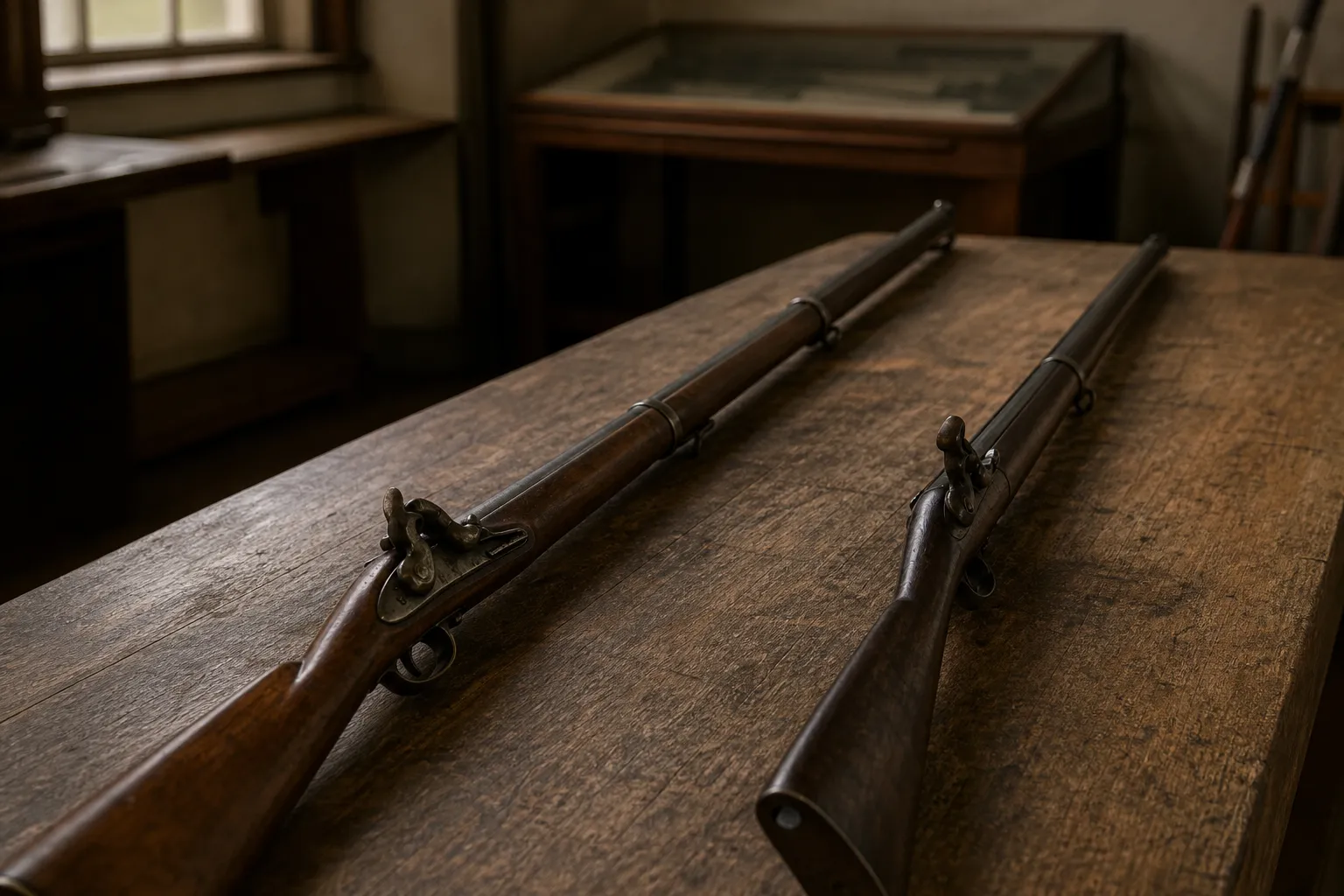
A musket is a long-barreled smoothbore infantry firearm, as the National Park Service Fort Smith glossary defines it. A rifle differs because its barrel has twisted grooves, called rifling, that spin the bullet and make it fire farther and more accurately. That simple smoothbore versus rifled difference explains much of the musket’s history: armies valued the smoothbore musket because it was easier, simpler, and faster to load, until rifled arms and the Minié ball changed infantry warfare in the mid-19th century.
What is a musket, and how is it different from a rifle?
The National Park Service Fort Smith glossary defines a smoothbore as a barrel that is completely smooth on the inside. It defines a musket as a long-barreled smoothbore firearm used by infantry.
A rifle is different inside the barrel. The National Park Service Fort Smith glossary defines a rifle as a firearm with twisted grooves inside the barrel. Those grooves make the bullet spin, which gives the weapon greater range and accuracy.
That difference mattered on the battlefield. The National Park Service at Fort Necessity explains that armies relied on smoothbore muskets despite the rifle’s advantages in range and accuracy because smoothbores were easier, simpler, and faster to load. Fort Necessity states that, in the time needed to load and fire one rifle shot, three shots could be loaded and fired from a smoothbore musket.
The National Park Service at Fort Scott gives another reason smoothbores remained the principal infantry weapon until the 1850s. In an early muzzle-loading rifle, a bullet large enough to take the rifling was hard to ram down the barrel, especially as fouling built up in the grooves.
The term “rifled musket” can be confusing. The National Park Service Fort Smith glossary notes that the term first referred to smoothbore firearms that had rifling added. Later, it described rifles built in the same general design as a smoothbore musket.
Ignition evolution: matchlock to flintlock to percussion
Musket history is also a history of ignition systems. Royal Armouries describes medieval handguns as arms ignited by placing a length of smouldering matchcord onto priming powder in a pan. That basic idea continued into the matchlock.
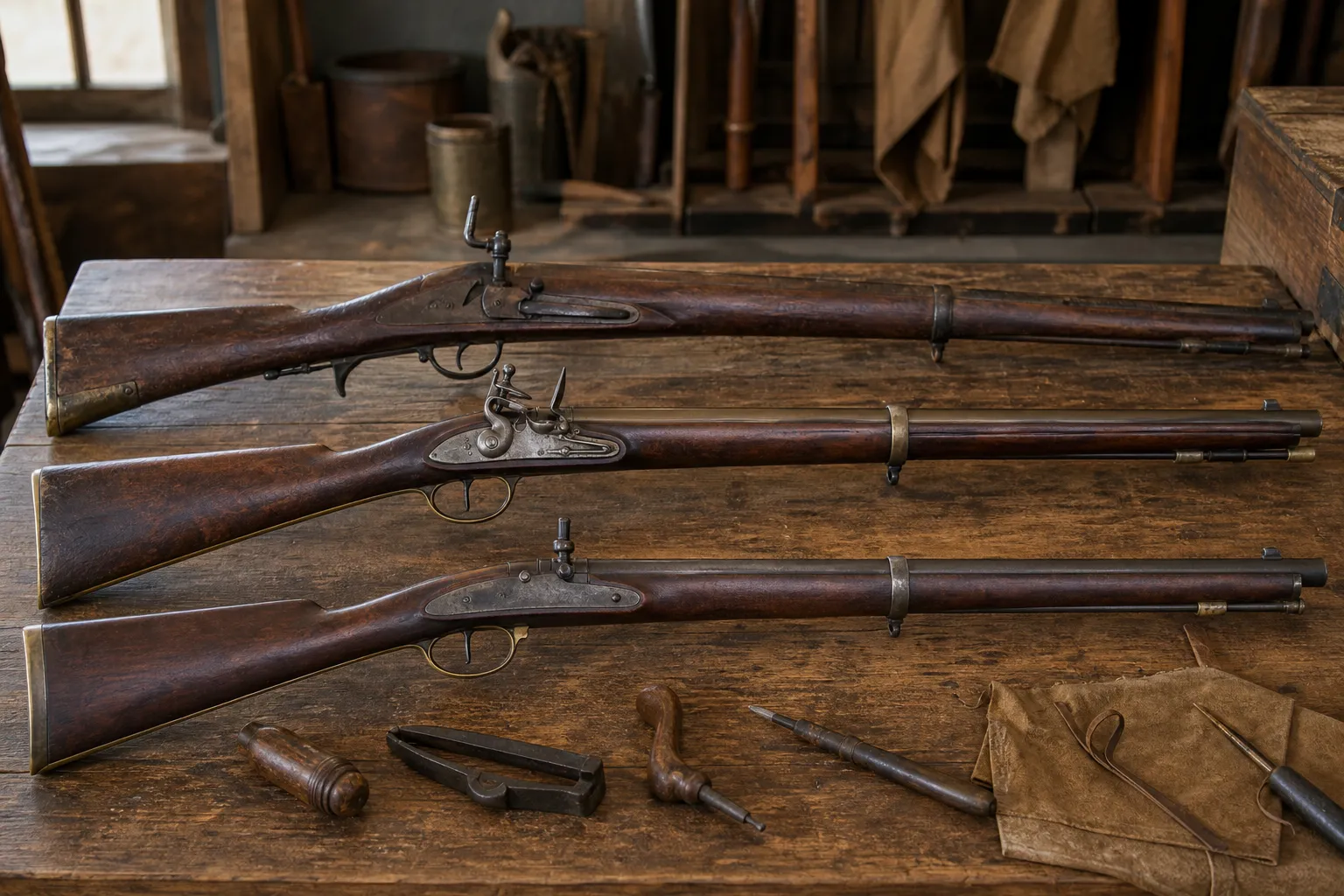
Matchlock
Royal Armouries states that matchlock muskets were the most common muskets in the British Civil Wars, partly because they cost less than flintlock arms. In its description of matchlock operation, the musketeer loaded through the barrel, then lowered a slow-burning match to the priming pan by using the trigger.
The matchlock was a major step because the trigger mechanism brought the burning match to the priming powder. It was still tied to a visible, burning match and an exposed priming pan.
Flintlock
Flintlock ignition replaced the burning match with sparks. Royal Armouries explains that flintlock firearms used sparks made when flint struck a steel surface to light the gunpowder.
The National Park Service at Fort Scott gives a more detailed description. In a flintlock, flint struck steel and sent sparks into a priming charge of gunpowder. When that priming powder ignited, fire passed through a small hole and set off the main powder charge.
Flintlock muskets became central to famous military arms such as the Brown Bess. They are also the type of musket associated with much of the Revolutionary War, Napoleonic, and War of 1812 context discussed below.
Percussion
The next major ignition change was the percussion cap. The National Park Service at Fort Scott states that the small brass percussion cap appeared in the 1830s with a self-contained explosive charge. It eliminated the need for flint, steel, and priming powder, and eventually made flintlock arms obsolete.
Royal Armouries describes the military adoption of percussion ignition for muskets, along with rifling, as a gradual improvement accepted by the mid-19th century.
The U.S. Model 1842 Springfield is a key percussion-era example. The National Park Service Fort Smith identifies the 1842 Springfield Musket as a .69 caliber percussion musket with a 42-inch barrel, fired with a brass cap.
The Brown Bess
The Brown Bess is one of the best-known military muskets.
The National Park Service states that the Brown Bess was the standard weapon of British infantry for more than a century. NPS also notes its use in the War of Independence, the Napoleonic wars, and the War of 1812.
Royal Armouries adds that muskets of the Waterloo era were often called “Brown Bess.” It states that its research links the name to a nickname for a working-class woman, alluding to the close relationship between a soldier and his weapon.
The Brown Bess also shows the limits of the smoothbore musket. The National Park Service states that its barrel was smooth inside, with no grooves to make fire more accurate. NPS also states that even trained soldiers could fire only two or three shots per minute.
Those limits shaped tactics. The National Park Service explains that smoothbore muskets like the Brown Bess encouraged linear tactics, with hundreds of soldiers standing shoulder to shoulder and firing volleys.
Royal Armouries notes that the Baker rifle was more accurate and longer-ranged than smoothbore muskets, but it had a lower rate of fire than a musket.
Springfield muskets and rifle-muskets
Springfield Armory is central to the American musket story. Springfield Armory National Historic Site states that Springfield began in 1795 with a copy of the French Charleville flintlock musket, and that it manufactured that pattern for the first 50 years.
Springfield Armory NHS lists the .69 caliber Model 1795 flintlock musket among major Springfield shoulder arms. It also lists the .69 caliber Model 1842 percussion musket and the .58 caliber Model 1855 percussion rifle-musket.
The Model 1842 marked an important transition. Springfield Armory records state that the Model 1842 was Springfield’s first weapon assembled entirely from machine-made, totally interchangeable parts. The same records state that it replaced flintlock ignition with a more dependable percussion ignition lock.
The National Park Service Fort Smith identifies the 1842 Springfield as the last U.S. musket made as a smoothbore. Fort Smith states that it was used during the Mexican War and saw use by both Union and Confederate soldiers during the Civil War.
The Model 1855 took Springfield into the rifle-musket era. Springfield Armory records describe the Model 1855 as the first rifle-musket. Those records also state that it used a Maynard primer system that proved unreliable.
During the Civil War, the Model 1861 replaced the Model 1855. Springfield Armory records state that the Model 1861 used a percussion ignition lock and became the most commonly carried weapon in the Union infantry. The same records state that, at the height of Civil War production, Springfield Armory produced 1,000 rifle-muskets per day.
The National Park Service Shenandoah Valley article identifies the M1861 Springfield Rifle Musket as the most popular infantry shoulder arm of the Civil War. It lists its caliber as a .58 Minié ball paper cartridge. NPS also states that the M1861 had a rifled barrel and, in the right hands, could be fired three times per minute with a deadly effective range over 400 yards.
The Minié ball and the Civil War rifle-musket
The Minié ball solved a problem that had limited early muzzle-loading rifles. The National Park Service at Fort Scott states that smoothbore muskets remained the principal infantry weapon until the 1850s because a bullet large enough to take the rifling was hard to ram down a muzzle-loading barrel. Fort Scott explains that the Minié ball solved the dilemma with an elongated bullet whose base expanded to grab the rifling as it traveled through the barrel.
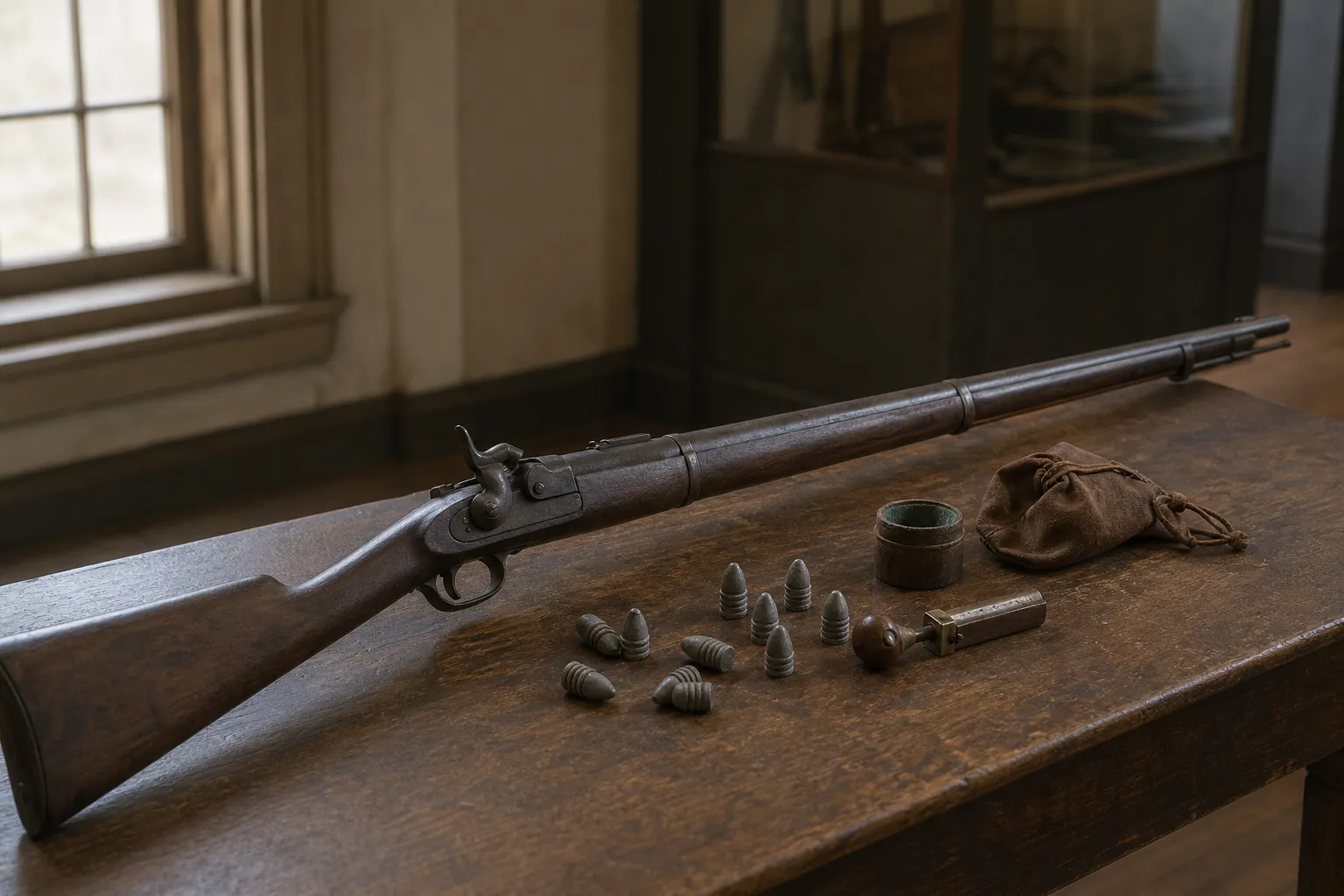
The National Park Service Shenandoah Valley article defines the Minié ball as a hollow-based, conical lead bullet produced for rifled muskets and designed by Claude Minié. NPS notes that it was not actually a ball, and that the term does not mean small.
When fired, the Minié ball’s hollow base expanded and gripped the rifling, according to the National Park Service Shenandoah Valley article. That allowed a rifled musket to combine easier loading with the benefits of rifling.
The battlefield effect was significant. The National Park Service at Corinth states that, when the Civil War began, more than half of Confederate and Federal units were armed with smoothbore muskets, but both sides soon equipped front-line troops with rifle-muskets.
NPS Corinth also states that an experienced soldier could load and fire a rifle-musket as quickly as a smoothbore musket, and could kill at 300 yards, three times the distance of the old smoothbores. NPS battlefield material also notes that Civil War soldiers carried rifled muskets and Minié balls, which were faster and more accurate than earlier round-ball smoothbore systems and could cause severe damage to tissue and bone.
Why the musket matters
The musket matters because it sits at the center of a long technical transition. It began as a smoothbore infantry firearm, valued because it could be loaded and fired quickly under military conditions. It passed through matchlock, flintlock, and percussion ignition. It then overlapped with rifled arms as the Minié ball made the rifle-musket practical for mass infantry use.
The Brown Bess shows the classic smoothbore flintlock musket at its most famous. The Springfield line shows the American transition from flintlock smoothbore muskets to percussion smoothbores and then to percussion rifle-muskets. By the Civil War era, the musket had not simply vanished. It had evolved into the rifle-musket, a weapon that kept the familiar infantry long gun form while using rifling and Minié ball ammunition.
Readers comparing specific arms should check museum catalog records and National Park Service battlefield materials for the exact model, caliber, ignition system, and historical context, because “musket,” “rifled musket,” and “rifle-musket” can refer to different stages in that evolution.
Frequently asked questions
What is a musket?
The National Park Service Fort Smith glossary defines a musket as a long-barreled smoothbore firearm used by infantry.
What is the main difference between a musket and a rifle?
A musket is smoothbore, meaning the barrel is smooth inside. A rifle has twisted grooves in the barrel that spin the bullet for greater range and accuracy, according to the National Park Service Fort Smith glossary.
Why did armies keep using smoothbore muskets when rifles were more accurate?
The National Park Service at Fort Necessity explains that smoothbore muskets were easier, simpler, and faster to load. NPS Fort Scott adds that early muzzle-loading rifles could be hard to load because the bullet had to engage the rifling.
What was the Brown Bess?
The National Park Service states that the Brown Bess was the standard weapon of British infantry for more than a century. NPS also notes its use in the War of Independence, the Napoleonic wars, and the War of 1812.
What did the percussion cap change?
The National Park Service at Fort Scott states that the small brass percussion cap of the 1830s had a self-contained explosive charge, eliminating the need for flint, steel, and priming powder and eventually making flintlock arms obsolete.
What was the Minié ball?
The National Park Service Shenandoah Valley article defines the Minié ball as a hollow-based, conical lead bullet made for rifled muskets. Its hollow base expanded when fired and gripped the rifling.
Sources
- Glossary of Weapons Terminology, National Park Service, Fort Smith National Historic SiteOfficial source. Accessed October 23, 2026.
- The Hundred Years' War 1337-1453, Royal ArmouriesOfficial source. Accessed October 23, 2026.
- British Civil Wars, Royal ArmouriesOfficial source. Accessed October 23, 2026.
- Weapons, Infantry Weapons, National Park Service, Fort Scott National Historic SiteOfficial source. Accessed October 23, 2026.
- Fort Nelson History, Royal ArmouriesOfficial source. Accessed October 23, 2026.
- 1842 Springfield Musket, National Park Service, Fort Smith National Historic SiteOfficial source. Accessed October 23, 2026.
- Brown Bess Musket, National Museum of American History, Smithsonian InstitutionOfficial source. Accessed October 23, 2026.
- Soldiers stare down the barrel of the Brown Bess, National Park ServiceOfficial source. Accessed October 23, 2026.
- Waterloo 1815, Royal ArmouriesOfficial source. Accessed October 23, 2026.
- Historic Weapons Program, National Park Service, Fort Necessity National BattlefieldOfficial source. Accessed October 23, 2026.
- Frequently Asked Questions, National Park Service, Springfield Armory National Historic SiteOfficial source. Accessed October 23, 2026.
- The Federal Armories, National Park Service, Springfield Armory National Historic SiteOfficial source. Accessed October 23, 2026.
- Department of the Army, Chief of Ordnance, Springfield Armory Records, National Park Service, Springfield Armory National Historic SiteOfficial source. Accessed October 23, 2026.
- Civil War Weapons in the Shenandoah Valley, National Park ServiceOfficial source. Accessed October 23, 2026.
- Weapons, Evolution of Weapons, National Park Service, Fort Scott National Historic SiteOfficial source. Accessed October 23, 2026.
- The Siege and Battle of Corinth: A New Kind of War, National Park ServiceOfficial source. Accessed October 23, 2026.
- The Reason Medical Practices Changed, National Park ServiceOfficial source. Accessed October 23, 2026.