The MG 42: History, Design and Legacy
The MG 42 was a German Second World War general purpose machine gun developed for faster, cheaper wartime production than the MG 34. Its stamped steel manufacturing, high rate of fire, roller locked mechanism, and later influence helped make it one of the best known machine gun designs of the 20th century.
By RaiS. Reviewed by RaiS. Published . 5 min read.
Research and drafting were assisted by AI. RaiS checked the facts against the sources below and approved this page.
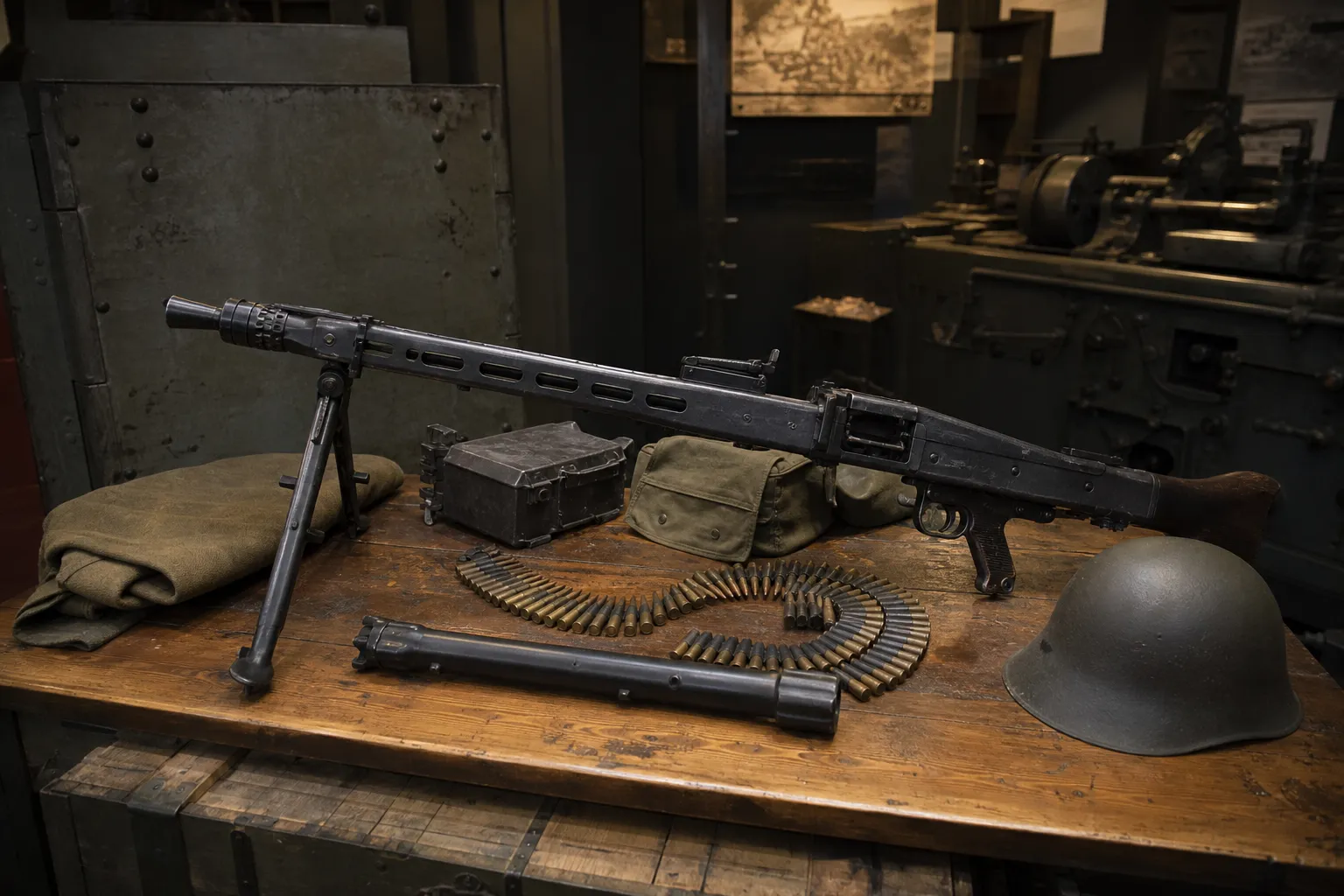
The MG 42 was a German general-purpose machine gun of the Second World War, developed to do much of what the earlier MG 34 did, but with faster, cheaper wartime production. Royal Armouries describes it as the main German machine gun toward the end of the war.
From MG 34 to MG 42
The MG 34 came first. The NRA National Firearms Museum says the MG 34 was developed in 1932 to 1933 and was the standard machine gun of Nazi military forces between 1935 and 1943.
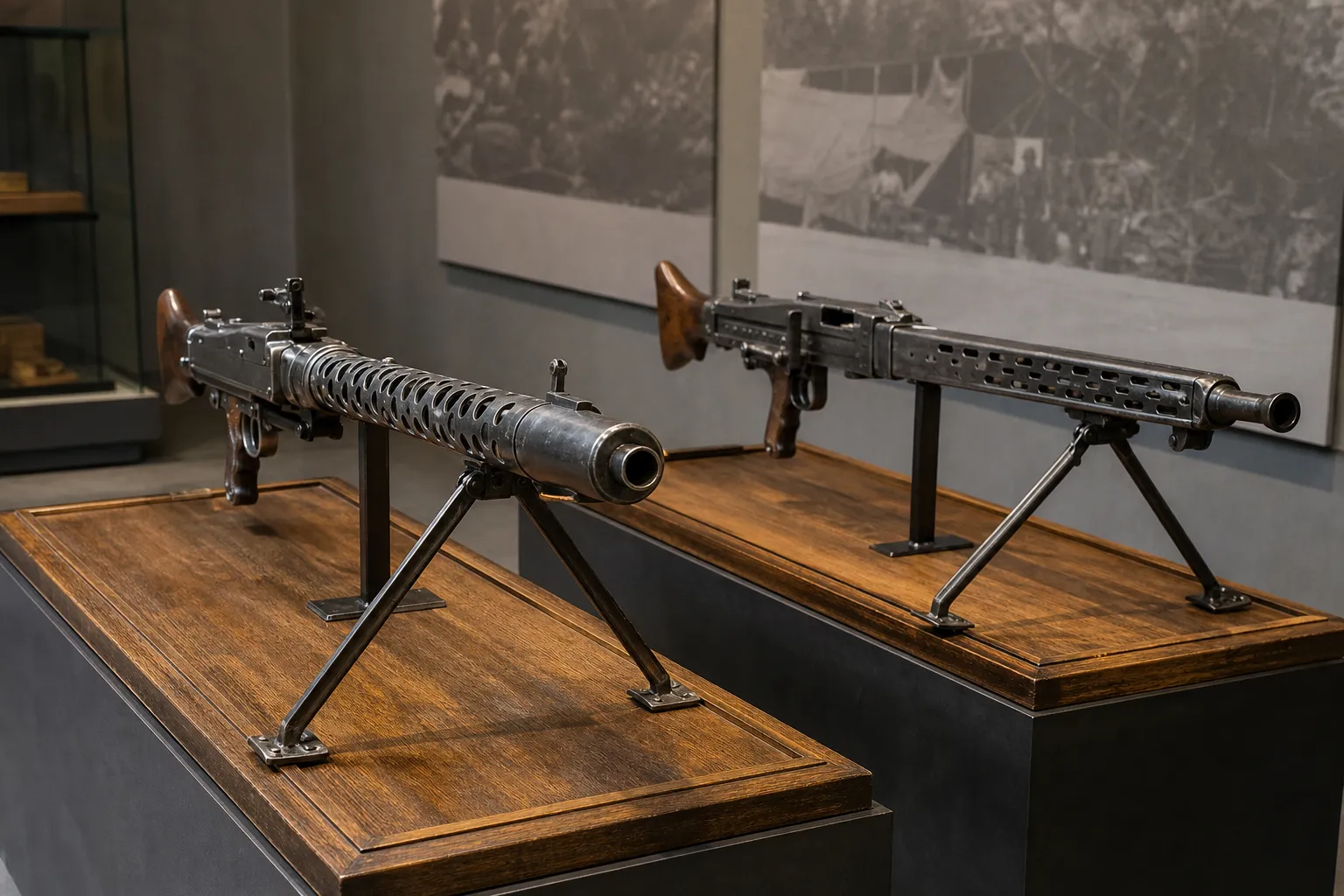
The MG 34 was advanced, but it was not ideal for wartime mass production. The National Army Museum similarly describes the MG 42 as replacing the earlier MG 34, which it says was heavier and took more time and money to produce.
That production problem shaped the MG 42 from the beginning. The German Army wanted a general-purpose machine gun with quick-change barrels, belt feed, and mounts and accessories for several functions, according to the NRA National Firearms Museum. The answer came from Großfuß AG, which Royal Armouries credits as the MG 42’s designer. The NRA National Firearms Museum notes that Johannes Großfuß Metall Fabrik had not previously produced firearms, but did have extensive experience with stamped and pressed metal fabrication.
Large-scale combat trials followed. The NRA National Firearms Museum says 1,500 guns were used in large-scale combat trials in 1941 and, after favorable reports, the design was formally adopted as the MG 42.
Stamped steel and wartime manufacturing
The MG 42’s manufacturing method is one of the biggest reasons it became famous. Royal Armouries says it was made by forming shapes from sheets of steel under extreme pressure.
That mattered because stamped and pressed parts could be made in a more production-line-friendly way than heavily machined components. Royal Armouries explains that workers could be trained on specific machines for specific components, rather than needing the skill to make the whole gun. Royal Armouries gives the practical comparison: about 75 hours to make an MG 42, compared with 150 hours for its predecessor, the MG 34.
The goal was not just to make a simpler gun. It was to make a machine gun that could be produced in large quantities while still filling the battlefield role expected of a German general-purpose machine gun. The NRA National Firearms Museum says the MG 42 was easier, faster, and cheaper to produce than the MG 34, and that more than 400,000 were produced before Germany’s surrender in 1945.
How the MG 42 worked, at a conceptual level
The NRA National Firearms Museum says the MG 42’s flash hider also served as a recoil booster, improving battlefield reliability.
The MG 42 is often described as roller-locked. At a conceptual level, that means the bolt group locks by using rollers that engage matching surfaces while the cartridge is fired. The NRA National Firearms Museum says the MG 42 used a bolt mechanism locked by a pair of rollers that engaged recesses in the receiver. The Bundeswehr’s MG3 description says the bolt locks with locking rollers in the locking piece at the end of the barrel.
The important point is that this was not the same as a simple unlocked blowback action. The roller-locked system kept the bolt group locked during firing. The NRA National Firearms Museum says this roller-locked mechanism reduced the weight of the gun’s mechanism and helped raise the cyclic rate to 1,200 rounds per minute.
Rate of fire, heat, and the quick-change barrel
The MG 42’s rate of fire was unusually high. The U.S. War Department listed its cyclic rate as 1,200 to 1,400 rounds per minute. The National Army Museum gives a range of 1,200 to 1,500 rounds per minute and says Allied soldiers nicknamed it “Hitler’s buzzsaw” because it sounded like a giant mechanical saw.
That rate of fire had an obvious consequence: heat.
The Bundeswehr’s MG3 page, describing the postwar descendant, also ties barrel changing to overheating. It says the MG3’s barrel-change flap permits a quick barrel change and gives a barrel-change interval to avoid overheating. That postwar description helps show why the barrel-change concept remained important in the MG 42 family.
The March 1945 U.S. War Department handbook listed the wartime MG 42 as a 7.92 mm weapon, 49 inches overall, weighing 23.75 pounds.
Battlefield role in the Second World War
The MG 42 was a general-purpose machine gun, not just a light gun for one task.
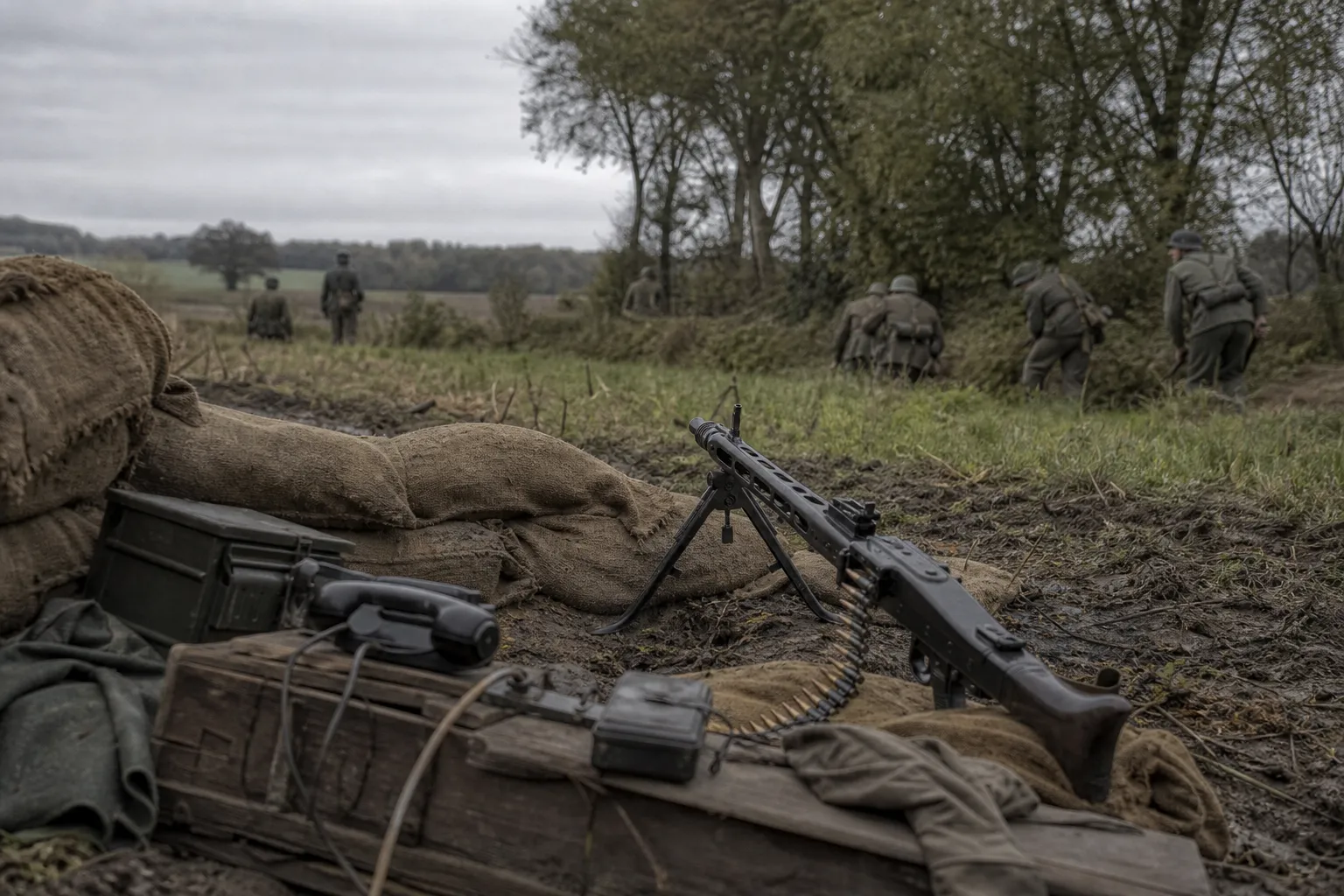
The MG 42’s battlefield reputation came from a combination of traits rather than one feature alone. The National Army Museum describes it as reliable, sturdy, fairly easy to use, and very fast firing. Together, those traits explain why it became one of the best-known machine guns of the war.
Postwar legacy: MG 1, MG 2, and MG 3
The MG 42 did not disappear in 1945. The NRA National Firearms Museum says it served after the war as the basis for machine guns produced for the armies of several NATO member nations.
The Bundeswehr says the MG3 entered service in 1969 and remains in current use as a standard machine gun in many Bundeswehr units. It lists the MG3 as a 7.62 mm weapon with a maximum rate of 1,200 rounds per minute. The Bundeswehr also describes it as a recoil-operated, belt-fed automatic weapon for short or longer bursts.
Influence beyond Germany
The MG 42 also influenced other machine gun development. The U.S. Army Ordnance Corps says that after the Second World War, the U.S. Army began work on a more portable replacement for the Browning 1919 and used features from German weapons. In the development path that led to the M60, the Ordnance Corps says the accepted T161E3 model borrowed its changeable barrel and camming feed mechanism from the MG 42.
That does not mean later guns were simply copies. It means the MG 42’s solutions were studied and reused where designers found them useful. The NRA National Firearms Museum also says the MG 42’s roller-driven reciprocating feed arm was widely copied in other machine gun designs.
A short U.S. regulatory note
In the United States, the eCFR definition of “machine gun” includes a weapon that shoots, is designed to shoot, or can be readily restored to shoot automatically more than one shot, without manual reloading, by a single function of the trigger.
For current legal definitions and requirements, readers should check the ATF and the current eCFR text directly.
Frequently asked questions
Why did Germany develop the MG 42 if it already had the MG 34?
The MG 34 was effective, but it was heavier and took more time and money to produce. The MG 42 used stamped and pressed steel methods that made production faster and cheaper.
Who designed the MG 42?
Royal Armouries credits the design to Großfuß AG. The NRA National Firearms Museum notes that Johannes Großfuß Metall Fabrik had experience with stamped and pressed metal fabrication, even though it had not previously produced firearms.
How fast did the MG 42 fire?
The U.S. War Department’s March 1945 handbook listed the MG 42’s cyclic rate as 1,200 to 1,400 rounds per minute. The National Army Museum gives a range of 1,200 to 1,500 rounds per minute.
What does roller-locked mean on the MG 42?
At a high level, the bolt group locks using rollers during firing. The NRA National Firearms Museum says the MG 42 used a bolt mechanism locked by paired rollers engaging recesses in the receiver.
Is the MG3 still used by the Bundeswehr?
Yes. The Bundeswehr says the MG3 entered service in 1969 and is currently a standard machine gun in many Bundeswehr units.
Sources
- MG42 Machine Gun (PR.13309), Royal ArmouriesOfficial source. Accessed November 8, 2026.
- Mauser MG 42 7.92 mm machine gun, 1943 (c), National Army Museum, LondonOfficial source. Accessed November 8, 2026.
- Handbook on German Military Forces, TM-E 30-451, March 1945, U.S. War Department. Accessed November 8, 2026.
- German MG34 Machine Gun, Naval History and Heritage CommandOfficial source. Accessed November 8, 2026.
- MG42 Machine Gun, NRA National Firearms Museum. Accessed November 8, 2026.
- MG 3 / MG 42 Fact Sheet, BICC and Bundeswehr Verification Center. Accessed November 8, 2026.
- Maschinengewehr MG3, BundeswehrOfficial source. Accessed November 8, 2026.
- M60 Development, U.S. Army Ordnance Corps and SchoolOfficial source. Accessed November 8, 2026.
- 27 CFR Regulation 479, Bureau of Alcohol, Tobacco, Firearms and Explosives eRegulationsOfficial source. Accessed November 8, 2026.
- 27 CFR § 479.11, Meaning of terms, Legal Information Institute, Cornell Law School, reproducing eCFR text. Accessed November 8, 2026.
- HyperWar: Handbook on German Military Forces (Chapter 7). Accessed November 8, 2026.