The AK-47 and AKM: History, Design and Common Misconceptions
The AK story begins with a Soviet postwar infantry rifle program tied to Mikhail Kalashnikov and the 7.62 x 39 mm M43 cartridge. The AKM was the later modernized model, and Kalashnikov terminology can be imprecise when similar rifles are grouped under one familiar name.
By RaiS. Reviewed by RaiS. Published . 4 min read.
Research and drafting were assisted by AI. RaiS checked the facts against the sources below and approved this page.
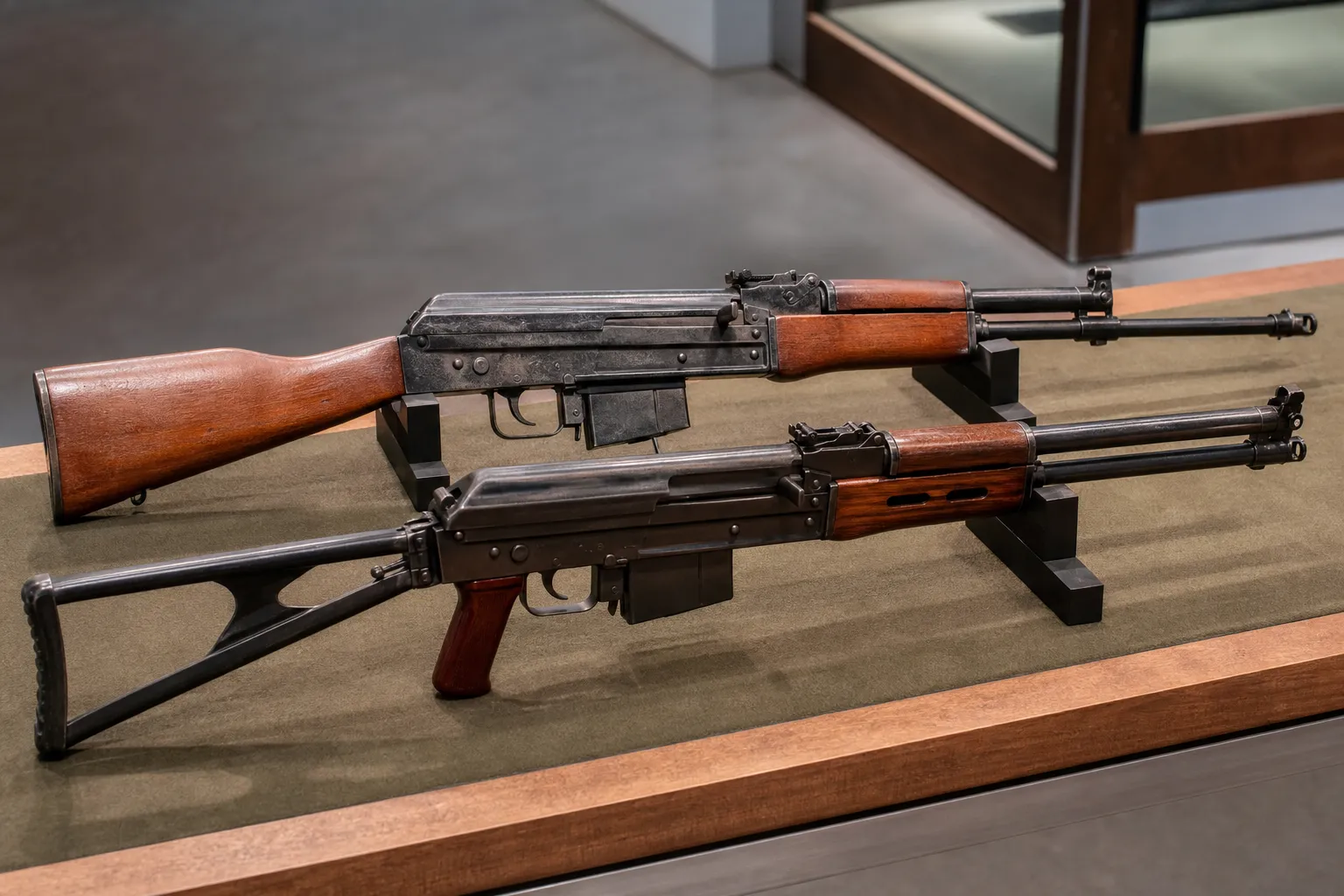
The AK-47 is best understood as the famous early Kalashnikov rifle associated with Soviet postwar trials and the 7.62 x 39 mm M43 cartridge, while the AKM is the modernized Kalashnikov rifle adopted in 1959. The names can be confusing because Kalashnikov-derived rifles include many related models.
Origins: Mikhail Kalashnikov and Soviet small-arms development
Mikhail Kalashnikov was born in Kuria, Altai Territory, on November 10, 1919. At the start of World War II, he was a senior sergeant and tank commander in the 108th Tank Division.
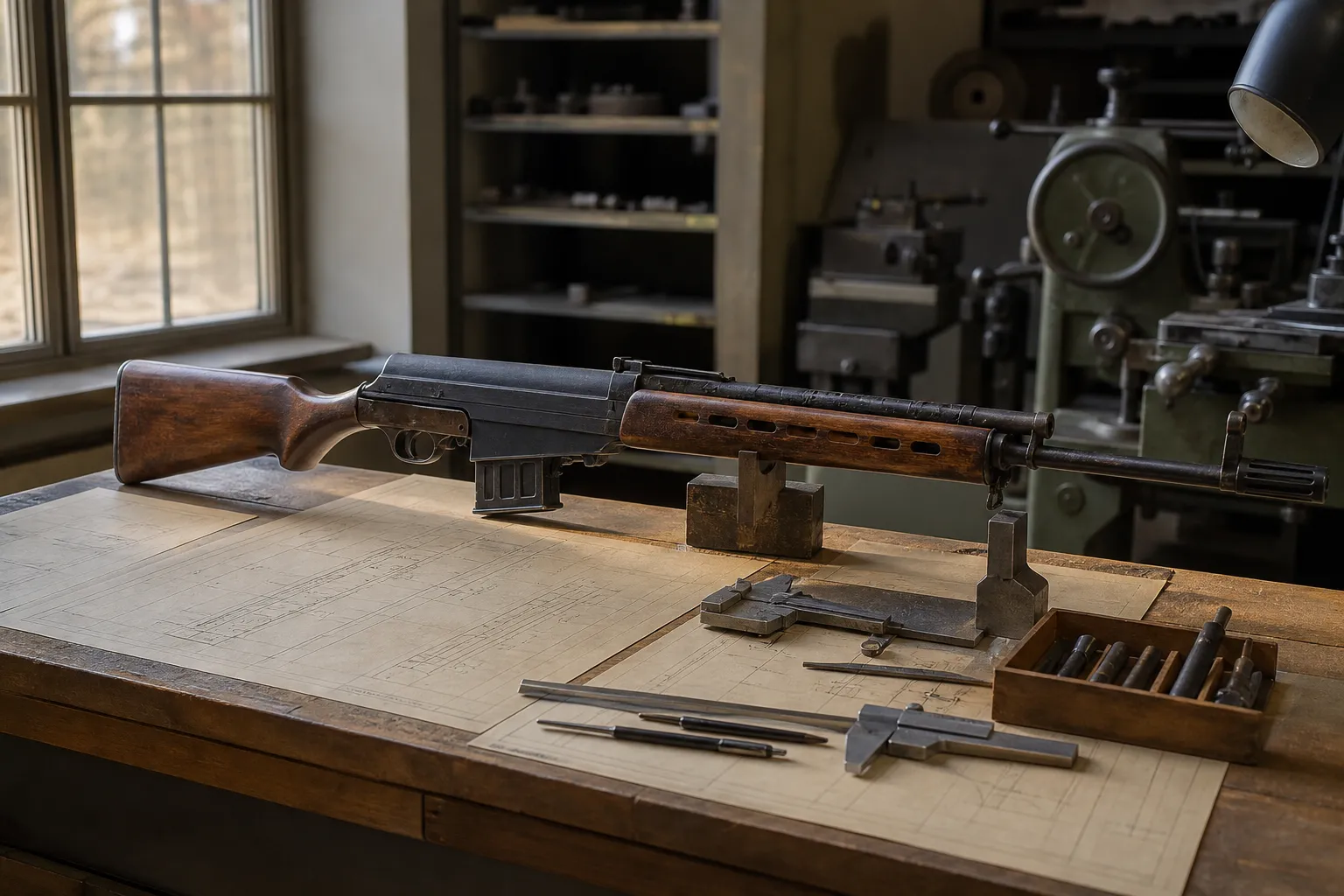
Kalashnikov was seriously wounded near Briansk in September 1941. He conceived the idea of an automatic weapon while in hospital.
Kalashnikov read Fedorov’s treatise on automatic weapons in 1942 while recovering from war wounds. He devised his first 7.62 mm submachine gun in 1942, and he was later assigned to the Central Research Small Arms Range at the Main Artillery Administration after a recommendation from A. A. Blagonravov.
That background matters because the AK was not simply a private design appearing out of nowhere. It emerged from Soviet military development, testing, and institutional support. The rifle bears Kalashnikov’s name. At the same time, the best short description is not “one man alone invented the AK,” but that Kalashnikov’s design became the accepted rifle within a Soviet postwar program.
The early AK and the M43 cartridge
The cartridge context is important. For a cartridge-focused overview, see our guide to the 7.62x39mm cartridge.
This article keeps the mechanism discussion general. For a general explanation of gas systems, see Gas-Operated Rifles Explained.
Different references and casual usage can treat the familiar name “AK-47” differently. That is why model names should be handled carefully.
Early versions: fixed stock and folding stock
Stock configuration is one visible distinction within the Kalashnikov family, but it is not just a cosmetic detail.
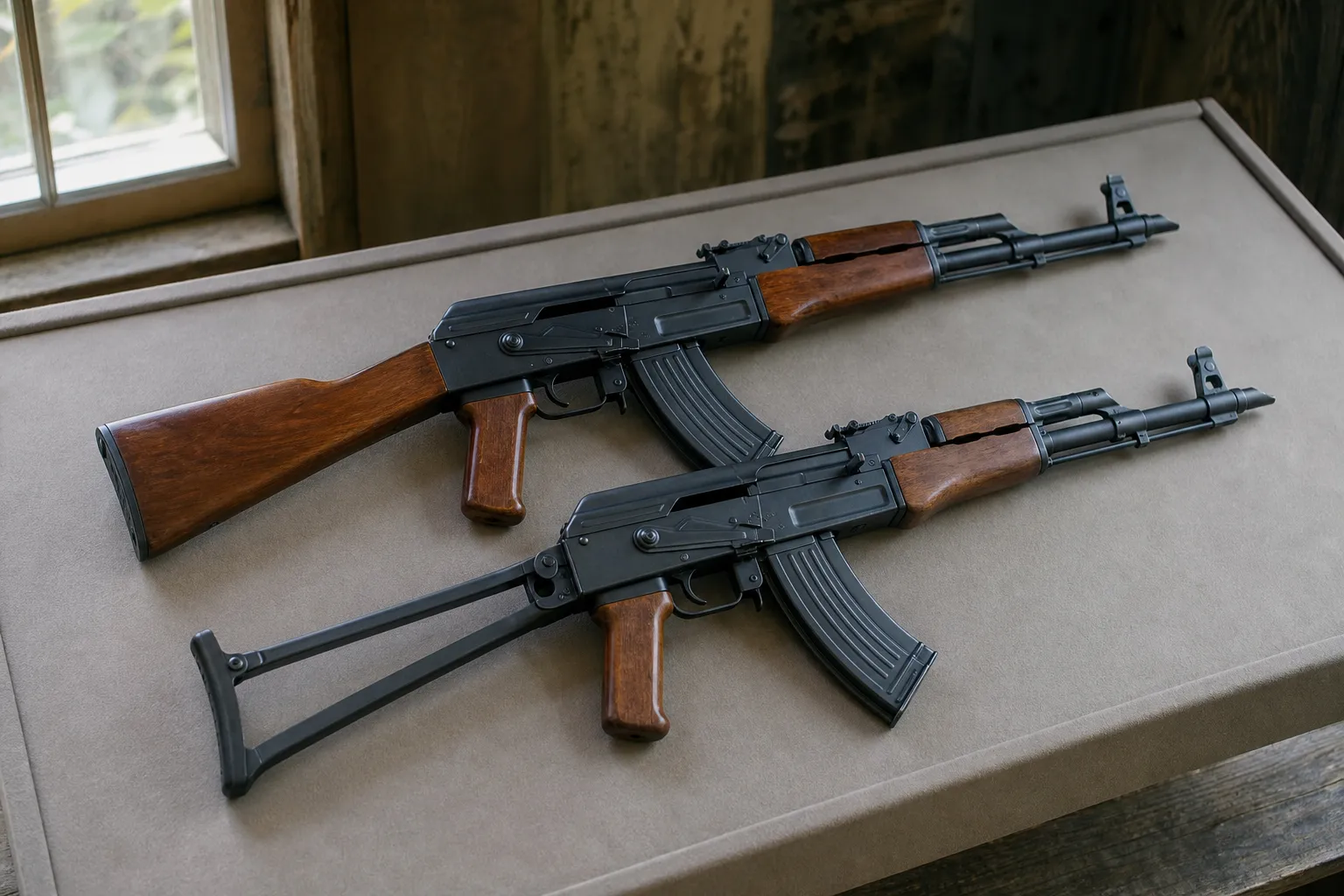
Broad visual features help explain why many rifles look similar at a glance, but they do not by themselves identify an exact model.
That point is especially important for readers new to firearm terminology. Parts such as the barrel, action, stock, magazine, and sights can be described generally, but visual similarity does not prove that two rifles have the same model designation. For a basic vocabulary guide, see Parts of a Rifle.
The AKM: the modernized Kalashnikov rifle
The AKM was the modernized Kalashnikov rifle that followed the early AK.
The Soviet Army adopted the AKM based system on April 8, 1959.
The main AKM changes were about production, materials, and weight.
AKM development aimed at a rifle that was lighter, easier, and cheaper to produce than the AK-47, without lower tactical and operational characteristics. The upgraded rifle received a stamped receiver and had its weight reduced by about one kilogram compared with the AK-47.
The AKM did not appear without competition. In 1955 and 1956, designers German Korobov, Alexey Konstantinov, Sergey Simonov, Vladimir Degtyaryov, Georgy Garanin, and Mikhail Kalashnikov participated in the competition. Comparative tests took place at the end of 1956 and in summer 1957, and Korobov’s rifle proved more accurate while Kalashnikov’s proved more rugged and robust.
AKMS refers to a folding stock version of the AKM. That is enough for a historical overview. Model identification should not be treated as a guide to parts interchange, conversion, or legal status.
Why “AK-47” gets used so imprecisely
“AK-47” became the best-known name, but it is not always the most precise name. The Kalashnikov family includes many related rifles, and similar appearance can blur distinctions.
Careful language matters because the Kalashnikov family is large.
The Avtomat Kalashnikova, or AK assault rifle, is widely described as among the most common firearms in the world. That broad fame helps explain the shortcut. A short, familiar name often wins in casual speech, even when it blurs important distinctions.
Common misconceptions
Misconception: every Kalashnikov-pattern rifle is an AK-47
Visual similarity alone does not identify an exact model. If the exact model is not known, a broader description is safer than guessing.
Misconception: AKM is just another nickname for AK-47
AKM is a specific modernized model associated with changes in production, materials, and weight.
Misconception: chambering alone identifies the model
Many rifles can share the same chambering. A 7.62 x 39 mm Kalashnikov pattern rifle is not automatically an AK-47.
Misconception: “AK-49” was the missing official name
The early AK and the AKM should not be blended into another designation.
A practical terminology guide
For general historical discussion, “AK” can refer to the early Kalashnikov rifle family when the context is clear. “AK-47” is widely understood by the public, but it can be imprecise.
Use “AKM” when referring to the modernized rifle adopted in 1959, especially when discussing stamped receiver production, reduced weight, and the later standard pattern.
If the model is not known, avoid guessing. Remember that a rifle’s cartridge, magazine shape, or general silhouette is not enough to prove an exact designation.
Frequently asked questions
How was the AKM different from the earlier AK?
It was associated with production and material changes, including a stamped receiver and lower weight compared with the earlier rifle.
Is every 7.62 x 39 mm Kalashnikov rifle an AK-47?
No. Chambering alone does not identify an exact model. Rifles in the same cartridge can belong to different Kalashnikov patterns.
Sources
- Kalashnikov: A Man, a Weapon, a Legend, Military-Historical Museum of Artillery, Engineer and Signal CorpsOfficial source. Accessed November 6, 2026.
- Kalashnikov, Twentieth Century Small Arms Development Videohistory Collection, Smithsonian Institution ArchivesOfficial source. Accessed November 6, 2026.
- AK-47 Automatic Rifle, National Museum of American History, Smithsonian InstitutionOfficial source. Accessed November 6, 2026.
- FM 100-2-3, The Soviet Army: Troops, Organization, and Equipment, U.S. Army, hosted by U.S. Marine Corps Training CommandOfficial source. Accessed November 6, 2026.
- Modernized Kalashnikov Assault Rifle, Culture.ru, Ministry of Culture of the Russian FederationOfficial source. Accessed November 6, 2026.
- An Introductory Guide to the Identification of Small Arms, Light Weapons, and Associated Ammunition, Small Arms Survey. Accessed November 6, 2026.
- ARES Research Note 6: An Introduction to Basic AK Type Rifle Identification, Armament Research Services. Accessed November 6, 2026.
- Dillon AK (PR.5428), Royal ArmouriesOfficial source. Accessed November 6, 2026.
- Arms of the First World War, Royal ArmouriesOfficial source. Accessed November 6, 2026.
- Small Arms Survey 2001, Chapter 1, Small Arms Survey. Accessed November 6, 2026.