Gas-Operated Rifles Explained: Direct Impingement, Piston and Long-Stroke Systems
Gas-operated semi-automatic rifles use propellant gas to unlock, extract, eject, feed and lock the action after each shot. The main concepts are internal gas systems such as the AR-15/M16 family, short-stroke piston systems such as the FN SCAR, and long-stroke piston systems such as the Galil ACE.
By RaiS. Reviewed by RaiS. Published . 8 min read.
Research and drafting were assisted by AI. RaiS checked the facts against the sources below and approved this page.
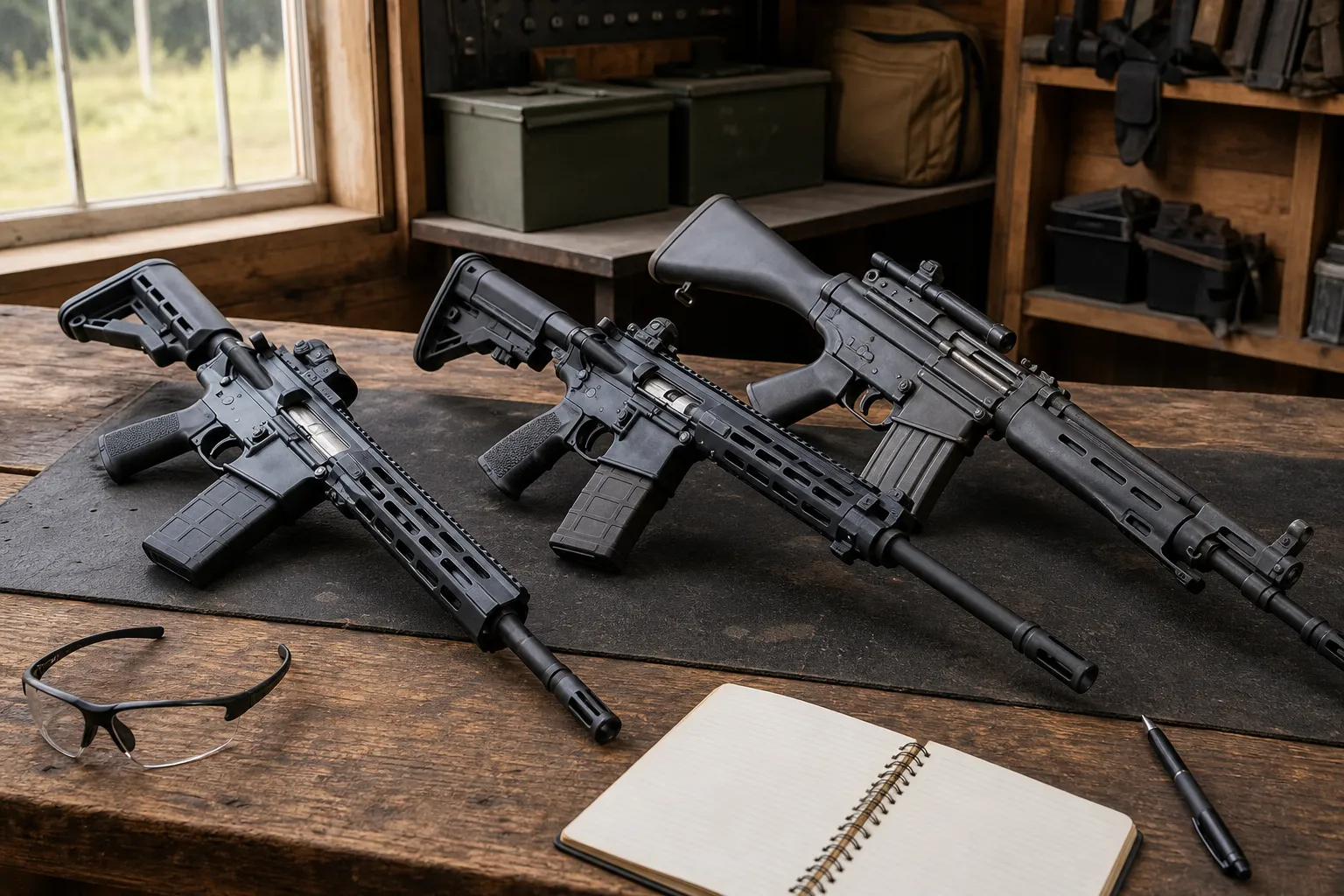
A gas-operated semi-automatic rifle uses part of the energy from a fired cartridge to cycle the action, then it needs a separate trigger pull for the next shot. U.S. federal regulations define a semiautomatic rifle as a repeating rifle that uses cartridge energy to extract the fired case and chamber the next round, with a separate trigger pull required for each cartridge. In a gas-operated rifle, expanding propellant gas is tapped or directed so it can help unlock the action, extract and eject the fired case, and chamber the next round.
The basic gas-operated cycle
The National Institute of Justice describes gas operation in simple terms: a discharging cartridge produces a large volume of hot gas, and that gas can be harnessed to do work. In most gas-operated firearms, the NIJ says the barrel is ported so gas can be bled off.
A simplified cycle looks like this:
- The cartridge fires and propellant gas pushes the bullet down the barrel.
- After the bullet passes a gas port or vent, some gas is directed into the operating system.
- That gas acts on a part of the mechanism, either inside the bolt carrier or on a piston.
- The operating group begins moving rearward.
- The bolt unlocks.
- The fired case is extracted and ejected.
- A spring drives the action forward.
- The next cartridge is fed from the magazine and the bolt locks.
That is the high-level idea. The differences between direct impingement, short-stroke piston and long-stroke piston systems are mainly about where the gas goes and what moving parts it pushes.
For a beginner, it helps to separate the gas system from the rest of the rifle. The barrel, action, magazine and sights all have their own jobs, as covered in our guide to parts of a rifle. The gas system is the part that borrows energy from the shot to operate the action.
Direct impingement and the Stoner internal gas system
The AR-15, M16 and M4 family is the familiar reference point for this category.
The BICC Small Arms and Light Weapons Guide describes the AR-15/M16/M4 direct gas system as one that uses no conventional gas piston and rod to move the bolt group after firing. It says gas is fed from the barrel through a tube to the receiver and gas key. Once the gas enters the bolt carrier, it expands in a hollow cavity and acts against the bolt carrier and the collar around the bolt body.
That wording is why the terminology can get confusing. Many people call this direct impingement because gas is routed back to the bolt carrier assembly rather than to a separate operating piston up front. Eugene Stoner’s 1960 patent, however, describes the bolt carrier as a movable cylinder and the bolt as a stationary piston. The patent says this arrangement eliminates the need for a conventional gas cylinder, piston and actuating rod assembly.
Stoner’s patent also describes the system as directly using a metered amount of gas from the barrel to actuate the rifle mechanism. It explains that pressure drives the bolt carrier rearward, and bolt-carrier motion then rotates and unlocks the bolt.
So, in plain English: the AR-15/M16 type system sends gas through a tube into the bolt carrier assembly. It does not use a separate, conventional piston and operating rod in front of the receiver. But the original patent still describes piston and cylinder action inside the bolt and carrier.
For more on the service history of that family, see our guide to the M16 rifle.
Short-stroke piston systems
The NIJ training material says gas pistons can use either a short or long stroke. In a short-stroke piston system, the piston does not travel through the full cycle with the bolt group. Small Arms Review describes a short-stroke, or tappet, system as one where the piston is not connected to the operating system’s bolt group and gives the operating group a short rearward impulse.
The important concept is impulse. Gas acts on a piston. The piston or push rod hits or drives the operating group rearward. Then the piston stops or returns forward instead of staying attached to the bolt group for the whole rearward and forward cycle.
FN SCAR example
FN America describes the MK 16 and MK 17 SCAR rifles as short-stroke gas piston designs. FN’s description says gas is routed through a regulator to a piston. The gas pushes rearward against the piston, and the piston drives the moving parts assembly rearward to eject the fired case and load a new cartridge from the magazine.
FN America also states a piston system advantage over direct gas impingement: heat, soot and carbon from propellant combustion are not routed into the bolt or chamber. That is a functional comparison, not a statement that every piston rifle is automatically better for every use.
FN FAL example
The FN FAL manual lists the rifle’s system of operation as gas. It also describes a gas regulator based on the exhaust principle. According to the manual, the regulator allows only enough gas to enter the gas cylinder for correct function, while surplus gas is vented outside the weapon.
The FAL manual also supports the short-stroke concept at a high level. It describes gas passing through the gas plug to the piston head, moving the piston backward. As the piston moves backward, it contacts the slide and thrusts it to the rear. The manual also describes a piston spring returning the piston forward.
That makes the FAL a useful example of a gas-operated rifle with a piston, a separate operating group and an adjustable, vented gas regulator.
HK SL8 example
Long-stroke piston systems
In a long-stroke piston system, the piston, rod or carrier group moves with the operating group through the cycle. Small Arms Review defines a long-stroke gas piston system as one where the piston is mechanically fixed to the bolt group and moves through the entire operating cycle.
The key difference from a short-stroke system is moving mass. A short-stroke piston gives a brief impulse and then stops or returns. A long-stroke piston stays mechanically tied to the operating group as it moves through the cycle, so more of the gas system moves with the action.
IWI Galil ACE example
IWI lists the Galil ACE operating system as a closed rotating bolt with a long-stroke gas piston. IWI also says the modernized Galil ACE is based on the mechanism of the original Galil rifle developed by IMI in the late 1960s.
That is a clean manufacturer example of the long-stroke category: closed rotating bolt, long-stroke gas piston.
M1 Garand and Garand-type examples
The 1943 U.S. Army M1 Garand field manual describes the M1 as a gas-operated, clip-loaded, air-cooled, semiautomatic shoulder weapon.
The M1 Garand is important historically because it shows a service rifle using gas operation long before many modern commercial semi-automatic rifles. For more background, see our guide to the M1 Garand.
Ruger describes the Mini-14 Ranch Rifle as a gas-operated, box-magazine-fed autoloading rifle. Ruger says its mechanism uses a fixed-piston, moving-cylinder gas system with a simplified Garand-type rotating bolt.
That Ruger description is also a reminder that not every gas-operated rifle fits neatly into the three labels people use online. Some designs use their own terms, and manufacturer manuals are usually the best starting point for a specific model.
AKM example
Because design details can vary by model and source, it is best to use the exact wording from a reliable manual or manufacturer description when comparing a specific AK-family rifle to other systems.
Comparing the three concepts
Here is the practical comparison at a high level.
| System concept | Where the gas does its work | What moves | Examples from official or reference descriptions |
|---|---|---|---|
| Direct gas system, often called direct impingement | Gas travels through a tube into the bolt carrier assembly | The bolt carrier is driven rearward, with the bolt and carrier acting as internal piston and cylinder parts in Stoner’s patent | AR-15/M16/M4 family described by BICC |
| Short-stroke piston | Gas acts on a piston near the gas block or gas cylinder | The piston or push rod gives the operating group a rearward impulse, then stops or returns | FN SCAR, FN FAL |
| Long-stroke piston | Gas acts on a piston mechanically tied to the operating group | The piston and operating group move through the cycle together | IWI Galil ACE |
These labels are useful, but they are not a substitute for a model’s manual. For example, Stoner’s patent describes an internal piston and cylinder relationship inside a system many shooters call direct impingement. Ruger uses the phrase fixed-piston, moving-cylinder for the Mini-14 Ranch Rifle. Those details matter when precision matters.
Heat, fouling and gas regulation
One common difference is where hot gas and combustion residue go. FN America states that a piston system advantage over direct gas impingement is that heat, soot and carbon from propellant combustion are not routed into the bolt or chamber.
That does not mean a piston rifle has no heat or fouling. It means the gas system routes those effects differently. In a direct gas system like the AR-15/M16/M4 family, BICC describes hot gases entering the bolt carrier through the gas key and expanding inside the carrier.
Gas regulation is another design difference. FN America describes SCAR gas as routed through a regulator to the piston. The FN FAL manual describes an exhaust-principle gas regulator that vents surplus gas outside the weapon. Those are design features built into specific rifles, not general instructions for changing a rifle.
This is not an upgrade or conversion guide
Gas systems are often discussed in the context of parts, conversions and tuning. This guide is not about altering a firearm. It is a functional explanation of how common operating systems are described in manuals, patents and manufacturer literature.
Ruger warns that its product was designed to function properly in its original condition and that alterations can make it unsafe. That is a good general reading habit for any firearm: use the correct manual for the specific model, and do not treat a broad operating-system comparison as a set of modification instructions.
What to check in the manual
When you are trying to identify a rifle’s gas system, look for the manufacturer’s own wording first. Useful phrases include gas-operated, direct gas system, short-stroke gas piston, long-stroke gas piston, rotating bolt, gas regulator, gas cylinder, piston, push rod, bolt carrier and operating rod.
Also check whether the manual describes the rifle as semi-automatic, autoloading, magazine-fed or clip-loaded. Those terms describe different parts of the action and feeding system. If you are reading about legal classification, transport or hunting use, confirm the current wording with the relevant government agency for your location, because this guide only explains operating concepts.
Frequently asked questions
What is a gas-operated rifle?
A gas-operated rifle uses expanding propellant gas from a fired cartridge to help cycle the action. U.S. federal regulations define a semiautomatic rifle as one that uses cartridge energy to extract the fired case and chamber the next round, with a separate trigger pull for each cartridge.
What is direct impingement in an AR-15 or M16 type rifle?
BICC describes the AR-15/M16/M4 direct gas system as using no conventional gas piston and rod, while Stoner’s patent describes the bolt as a stationary piston and the carrier as a movable cylinder.
How does a short-stroke piston differ from a long-stroke piston?
Small Arms Review describes a short-stroke piston as not connected to the bolt group and giving the operating group a short rearward impulse. It describes a long-stroke piston as mechanically fixed to the bolt group and moving through the entire operating cycle.
Which rifles are examples of short-stroke piston systems?
FN America describes the MK 16 and MK 17 SCAR rifles as short-stroke gas piston designs. The FN FAL manual also describes piston and slide operation consistent with the short-stroke concept.
Which rifle is an official example of a long-stroke piston system?
IWI lists the Galil ACE operating system as a closed rotating bolt with a long-stroke gas piston.
Sources
- 27 CFR § 478.11, Meaning of terms, Legal Information Institute, Cornell Law School, reflecting federal regulation textOfficial source. Accessed November 3, 2026.
- Firearms Examiner Training, Semiautomatic and Automatic, National Institute of JusticeOfficial source. Accessed November 3, 2026.
- M16/M4 Rifle and Carbine Operator's Manual, TM 9-1005-319-10, U.S. Army manual copy hosted by StudyLib. Accessed November 3, 2026.
- AR 15 (M16/M4), SALW Guide, Bonn International Centre for Conflict Studies. Accessed November 3, 2026.
- US2951424A, Gas operated bolt and carrier system, Google Patents, U.S. patent record. Accessed November 3, 2026.
- Why the FN SCAR, FN AmericaOfficial source. Accessed November 3, 2026.
- FN FAL Manual, Operation of Mechanism, FN manual copy hosted by Forgotten Weapons. Accessed November 3, 2026.
- SL8 Operator’s Manual, Heckler & Koch USAOfficial source. Accessed November 3, 2026.
- FM 23-5, U.S. Rifle, Caliber .30, M1, July 30, 1943, War Department manual copy hosted by HyperWar Foundation and ibiblio. Accessed November 3, 2026.
- Galil ACE Pistol Firearm Specs, IWI USOfficial source. Accessed November 3, 2026.
- MCWP 3-11.1, Marine Rifle Squad, United States Marine CorpsOfficial source. Accessed November 3, 2026.
- Gassed! Examining Gas Operating Systems: Direct Impingement vs. Gas Piston, Small Arms Review. Accessed November 3, 2026.
- Mini-14 Ranch Rifle Instruction Manual, Sturm, Ruger & Co.Official source. Accessed November 3, 2026.
- FM 23-5 DEPARTMENT OF THE ARMY FIELD MANUAL. Accessed November 3, 2026.