Rifle Twist Rate Explained: What 1:8 and 1:10 Mean
Rifle twist rate is the distance a bullet travels in the barrel while the rifling makes one full turn. A 1:8 twist is faster than a 1:10 twist, and bullet length, bullet weight, velocity, and air density all affect stability.
By RaiS. Reviewed by RaiS. Published . 7 min read.
Research and drafting were assisted by AI. RaiS checked the facts against the sources below and approved this page.
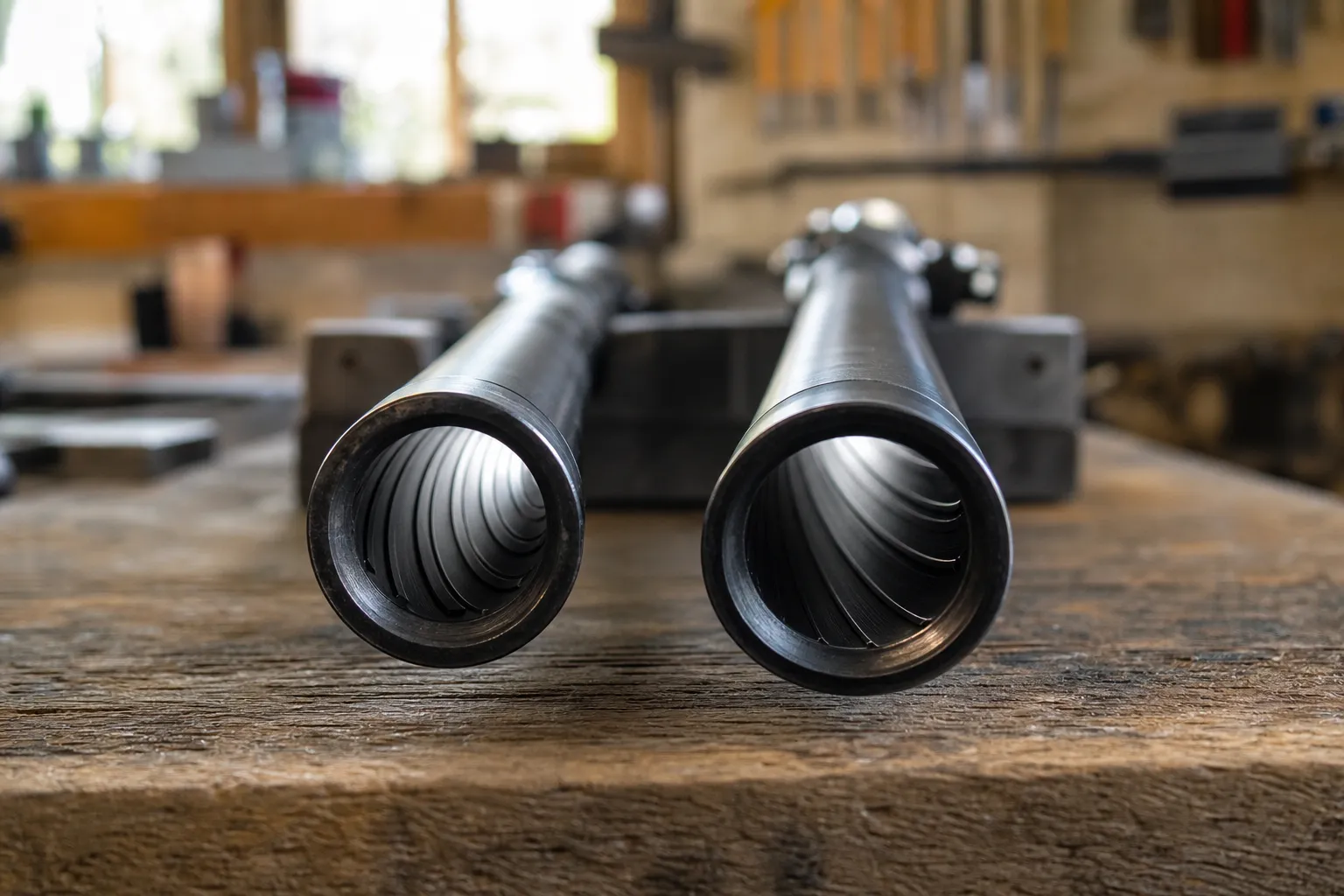
Rifle twist rate tells you how quickly the rifling inside a barrel spins the bullet. SAAMI defines twist as the distance required for one complete turn of rifling, usually written as a ratio such as 1 in 10 inches. In plain language, 1:8 means one full bullet rotation in eight inches of barrel travel, while 1:10 means one full rotation in ten inches. Because the bullet turns in a shorter distance, 1:8 is the faster twist.
What rifling and twist rate mean
SAAMI defines a rifle as a shoulder fired firearm with helical features in the bore that impart spin to a single projectile. SAAMI also defines rifling as helical internal barrel features that spin the projectile for the purpose of stabilizing it in flight.
That spin is what twist rate is describing. SAAMI defines rate of twist as the distance required for the rifling to complete one revolution. SAAMI also describes rifling pitch as the distance the projectile must move along a rifled bore to make one revolution, usually expressed as one turn in a certain number of inches or millimeters.
So a twist marking is not a bullet weight, a cartridge name, or a pressure rating. It is a barrel measurement.
| Marking | Meaning | Relative twist speed |
|---|---|---|
| 1:8 | One full rotation in eight inches of barrel travel | Faster than 1:10 |
| 1:10 | One full rotation in ten inches of barrel travel | Slower than 1:8 |
| 1:12 | One full rotation in twelve inches of barrel travel | Slower than 1:10 |
Savage Arms explains that 1:10 means the bullet makes one full rotation every ten inches of barrel. Savage also explains that 1:8 means the bullet spins faster because it completes one revolution every eight inches. Barnes gives the same basic rule: a lower twist ratio is a faster twist rate, using 1:7 as an example of one rotation in seven inches.
Why 1:8 is faster than 1:10
The part that confuses many new rifle owners is that the smaller number is the faster twist. The second number is not speed in miles per hour. It is the barrel distance needed for one full rifling turn.
A 1:8 barrel completes one turn in eight inches. A 1:10 barrel needs ten inches for the same one turn. Because the 1:8 barrel makes the same rotation in less distance, it is the faster twist.
This is why bullet and barrel makers often use phrases such as “1:10 or faster.” Berger explains that if a bullet has a 1:10 twist recommendation, it should be stable when fired from a rifle with a 1:10 or faster twist barrel, while a slower twist may not work.
Why twist rate matters for stability
Rifling matters because it spins the projectile for stability in flight. SAAMI’s rifling definition states that rifling imparts spin on the projectile for the purpose of stabilizing it in flight.
When a bullet is not stabilized well enough, accuracy can suffer. Savage Arms states that too slow a twist can prevent stabilization, causing the bullet to tumble through the air inaccurately and produce keyholing. Lapua describes a similar effect: if the bullet is too long for the twist rate, it may wobble or even turn crosswise, causing poor accuracy and oval or keyhole target holes.
In this context, a “keyhole” is an oval or sideways target hole that can appear when the bullet is not flying point forward. It is a sign to stop guessing and check the rifle maker’s and ammunition or bullet maker’s guidance for that specific combination.
Bullet length and weight: why heavier often means faster, but not always
A common shortcut is to say heavier bullets need faster twist. That is often useful, but it is not the whole story.
Savage Arms states that heavier or longer bullets need a faster twist, while lighter bullets can use a slower twist. Savage also adds that bullet length is often even more important than bullet weight for twist selection.
Lapua gives the same core idea in stability terms. Lapua lists barrel twist rate and projectile length as the most important factors affecting stability, with projectile shape, velocity, and environment also contributing.
The reason weight can be an imperfect shortcut is that weight and length are related, but they are not identical. Bullet construction and shape matter. Two bullets of the same caliber and weight can differ in length and shape, and stability guidance is normally published for the specific bullet, not just the weight number.
The lesson is not to treat bullet weight as the only input. It is better to match the rifle’s twist rate to the ammunition or bullet maker’s guidance for that bullet.
Velocity, air density, and stability margin
Twist rate and bullet length are central, but they are not the only factors. Lapua states that projectile shape, velocity, and environment also affect stability. Lapua also says stability can increase with a tighter twist rate, a shorter bullet, and lower air density conditions.
Hornady describes gyroscopic stability calculations in a similar multi factor way. Hornady says its 4DOF calculator computes gyroscopic stability from the rifle’s twist rate, bullet physical characteristics, center of gravity, aerodynamic properties, and velocity.
Lapua defines gyroscopic stability, often written as Sg, as the ability of a rotating object to resist changes to its rotating axis. Hornady recommends a muzzle gyroscopic stability above 1.4 for acceptable aerodynamic performance in its 4DOF instructions.
For a new shooter, the practical point is simple: twist rate is important, but stability is not controlled by twist alone. If a bullet is near the edge of stability, changes in bullet design, velocity, or atmospheric conditions can matter.
How manufacturers publish twist guidance
There is no single twist rate that is best for every rifle, cartridge, and bullet. Berger states that stability requirements depend on individual conditions, so one size fits all twist recommendations require assumptions. Berger also says its recommended twist rates are based on achieving optimal performance in nominal conditions and may be conservative.
Manufacturers present twist information in several ways:
- Standards documents. SAAMI says its standards provide safety, reliability, and interchangeability standards for commercial manufacturers of firearms, ammunition, and components.
- Cartridge and test barrel information. SAAMI Z299.4-2025 lists a 6.5 Creedmoor standard velocity and pressure test barrel twist rate of 8.00 inches right hand. The same SAAMI standard lists a .308 Winchester cartridge and chamber drawing twist of 12.00 inches right hand as optional.
- Rifle maker specifications. Rifle makers commonly publish twist rates by model and chambering.
- Bullet maker recommendations. Bullet makers publish minimum or recommended twist rates for specific bullets.
Hornady’s discussion of the 6.5 Creedmoor is a good example of design intent. Hornady says the 6.5 Creedmoor was designed with a 1:8 twist to allow use of the heaviest 6.5 mm bullets available.
How to read a twist recommendation
If a bullet maker recommends 1:10 or faster, the “or faster” part means a smaller second number, such as 1:9 or 1:8. Berger explains that a bullet with a 1:10 twist recommendation should be stable from any rifle having a 1:10 or faster twist.
Here is the basic reading method:
- Find the rifle’s twist rate from the barrel marking or the rifle maker’s model specifications.
- Read the ammunition or bullet maker’s twist guidance for the exact bullet or load.
- Remember that a smaller second number is faster.
- Use factory ammunition and manufacturer guidance rather than guessing from bullet weight alone.
Avoid turning twist rate into a handloading formula. Stability guidance does not replace the rifle maker’s instructions, ammunition manufacturer guidance, or the bullet maker’s published recommendations.
Practical examples without recipes
A 1:8 marking means one turn in eight inches. Savage Arms and Barnes both describe lower ratio twist rates as faster. A 1:8 barrel is therefore faster than a 1:10 barrel.
A bullet that is longer for its caliber may need a faster twist than a shorter bullet. Savage Arms says heavier or longer bullets need faster twist, and Lapua identifies projectile length and barrel twist rate as the most important stability factors.
A bullet that is not stabilized may wobble, tumble, or strike the target in an oval or keyhole shape. Savage Arms and Lapua both describe this kind of instability.
A stability calculator may express the result as Sg. Lapua describes gyroscopic stability Sg as resistance to changes in the rotating axis, and Hornady’s 4DOF instructions recommend muzzle Sg above 1.4 for acceptable aerodynamic performance.
What to check before choosing ammunition
Before relying on any twist rule of thumb, check the exact rifle and ammunition information. The most relevant items are:
- The rifle maker’s twist rate for the exact model and chambering.
- The ammunition maker’s guidance for that factory load.
- The bullet maker’s minimum or recommended twist rate for that specific bullet.
- Any current SAAMI information that applies to the cartridge.
Twist rate is a stability clue, not a complete compatibility chart. The safest general approach is to use factory ammunition that fits the rifle maker’s instructions and matches the ammunition or bullet maker’s twist guidance. If the information is unclear, confirm it with the rifle maker and the ammunition or bullet manufacturer before shooting.
Frequently asked questions
What does 1:8 twist mean on a rifle barrel?
SAAMI defines twist as the distance required for one complete turn of rifling. A 1:8 twist means the bullet makes one full rotation in eight inches of barrel travel.
Is 1:8 faster than 1:10?
Yes. Savage Arms explains that 1:8 is faster than 1:10 because the bullet completes one revolution in eight inches instead of ten. Barnes also states that the lower the twist ratio, the faster the twist rate.
Why do longer bullets often need faster twist?
Savage Arms states that heavier or longer bullets need faster twist, and that length is often even more important than weight. Lapua also lists projectile length and barrel twist rate as the most important stability factors.
What happens if twist is too slow for a bullet?
Savage Arms states that too slow a twist can prevent stabilization, leading to tumbling and keyholing. Lapua says a bullet that is too long for the twist may wobble or turn crosswise, causing poor accuracy and oval or keyhole target holes.
What is Sg in bullet stability?
Lapua describes gyroscopic stability, or Sg, as the ability of a rotating object to resist changes to its rotating axis. Hornady says its 4DOF calculator computes gyroscopic stability using twist rate, bullet characteristics, center of gravity, aerodynamics, and velocity.
Should I choose ammunition by twist rate alone?
No. Twist rate is important, but Lapua and Hornady both describe other stability factors such as bullet characteristics, velocity, and environment. Check the rifle maker’s instructions and the ammunition or bullet maker’s twist guidance for the specific rifle and load.
Sources
- SAAMI Glossary, Letter R, Sporting Arms and Ammunition Manufacturers’ InstituteOfficial source. Accessed October 23, 2026.
- TWIST, Sporting Arms and Ammunition Manufacturers’ InstituteOfficial source. Accessed October 23, 2026.
- SAAMI Standards, Sporting Arms and Ammunition Manufacturers’ InstituteOfficial source. Accessed October 23, 2026.
- SAAMI Z299.4-2025, Voluntary Industry Performance Standards for Pressure and Velocity of Centerfire Rifle Ammunition, Sporting Arms and Ammunition Manufacturers’ InstituteOfficial source. Accessed October 23, 2026.
- Breaking Down Barrel Twist Rate, Savage ArmsOfficial source. Accessed October 23, 2026.
- How Rifling Works: Button Rifling, Twist Rates & More, Savage ArmsOfficial source. Accessed October 23, 2026.
- Load Data, Twist Rate, Barnes BulletsOfficial source. Accessed October 23, 2026.
- What do you mean by faster and slower twist rate?, Berger BulletsOfficial source. Accessed October 23, 2026.
- Berger Bullets Twist Rate Recommendations by Eric Stecker & Bryan Litz, Berger BulletsOfficial source. Accessed October 23, 2026.
- Bullet Reference Charts, Berger BulletsOfficial source. Accessed October 23, 2026.
- 4DOF Instructions, Hornady ManufacturingOfficial source. Accessed October 23, 2026.
- The 6.5 Creedmoor, An interview with Hornady’s senior ballistician, Dave Emary, Hornady ManufacturingOfficial source. Accessed October 23, 2026.
- Lapua Ballistics Tips: Stability Estimation, LapuaOfficial source. Accessed October 23, 2026.