Trap vs Skeet vs Sporting Clays: What’s Different?
Trap, skeet, and sporting clays are all clay target shotgun games, but they feel very different on the field. Trap uses five posts and targets that generally go away, skeet uses crossing targets from high and low houses, and sporting clays uses varied target presentations over a course.
By RaiS. Reviewed by RaiS. Published . 7 min read.
Research and drafting were assisted by AI. RaiS checked the facts against the sources below and approved this page.
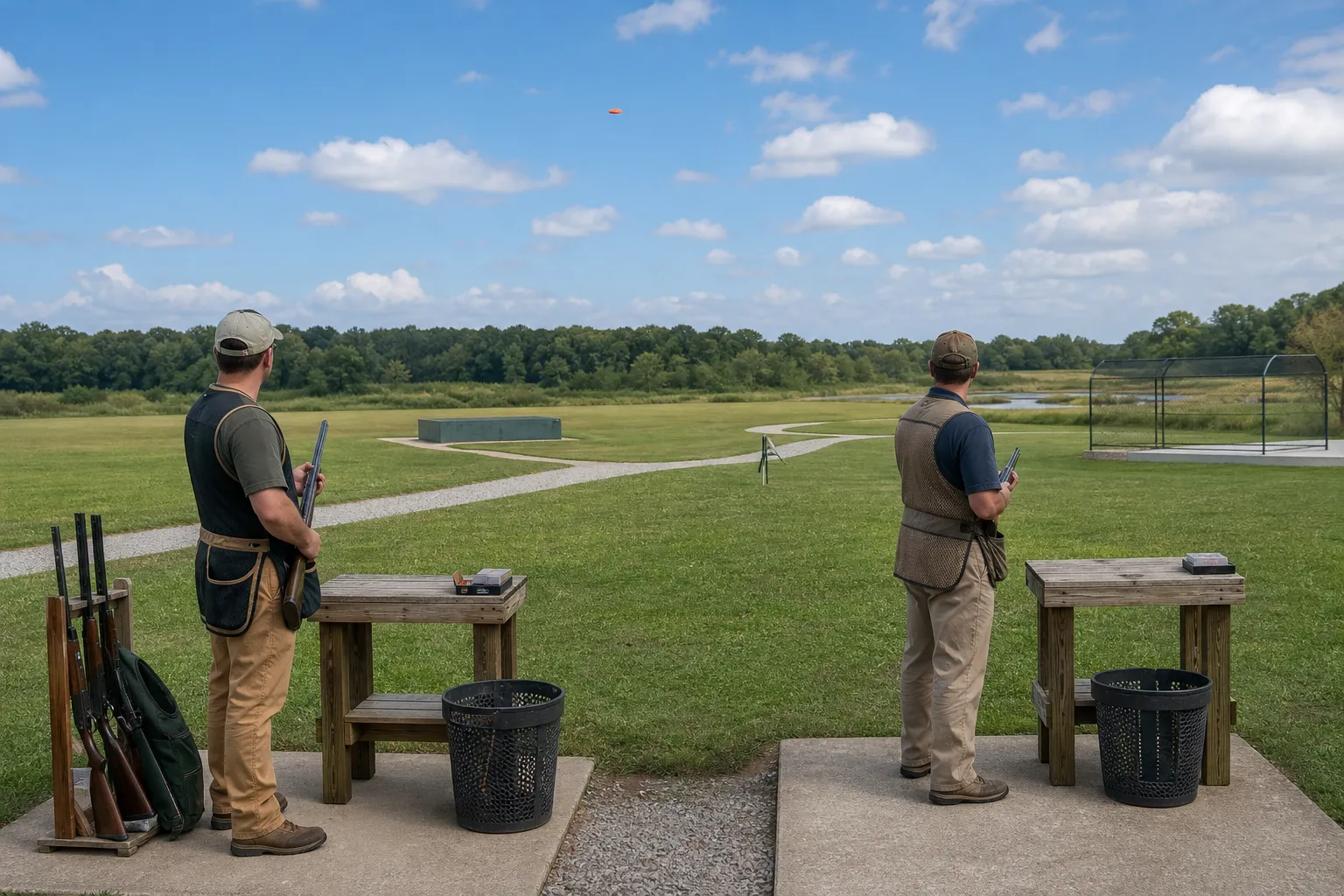
Trap, skeet, and sporting clays are three different shotgun games built around breaking flying clay targets. In plain terms, trap generally sends targets away from the shooter, skeet uses crossing targets from high and low houses, and sporting clays uses varied presentations over a course that NSCA describes as non-standardized compared with skeet or trap.
Quick comparison
For new shooters and spectators, the easiest way to separate the games is to look at the field. ATA registered trap uses five firing positions. NSSA skeet uses high-house and low-house targets, including doubles thrown from both houses at the same time. NSCA sporting clays is intentionally varied, with courses designed to simulate hunting presentations such as ducks, pheasants, upland birds, and rabbits.
| Discipline | Field layout and stations | Target presentation | Round or event size | Gauges listed or allowed by the rules | Scoring terms |
|---|---|---|---|---|---|
| ATA trap | ATA rules use five firing positions, numbered 1 through 5. For 16-yard targets, posts are set 16 yards from Point B and are spaced three yards apart. | ATA Singles targets must be 8 to 10 feet high when measured 10 yards from Point B. | An ATA sub-event is one full rotation on all five posts. ATA examples include 25 or 50 Singles or Handicap targets, and 10, 15, or 25 pairs of Doubles. | ATA rules do not allow a shotgun chamber larger than 12 gauge, but smaller gauges are permitted in registered and tournament shooting. | ATA records targets as DEAD or LOST, with marks such as a slash or X for DEAD and 0 for LOST. |
| NSSA skeet | NSSA’s regular sequence starts at Station 1 with a high-house single, a low-house single, then doubles. | NSSA defines a regular double as one target thrown from each skeet house at the same time. | NSSA defines a round of skeet as 25 shots. NSSA also says a regulation 25-shot round includes four sets of doubles. | NSSA says standard skeet competitions include 12 gauge, 20 gauge, 28 gauge, and .410 bore. | NSSA defines a dead target as one where a visible piece is broken before it hits the ground after a legal shot. |
| NSCA sporting clays | NSCA describes sporting clays as non-standardized compared with skeet or trap, and says no two sporting clays courses are alike. | Target presentations can vary by club and event. | NSCA registered events must throw at least 25 targets, and events generally consist of multiples of 25 targets. | NSCA tournament rules list gauge-specific events for 12 gauge, 20 gauge, 28 gauge, and .410 bore. | Scoring is based on whether targets are broken. |
Trap: five posts and targets going away
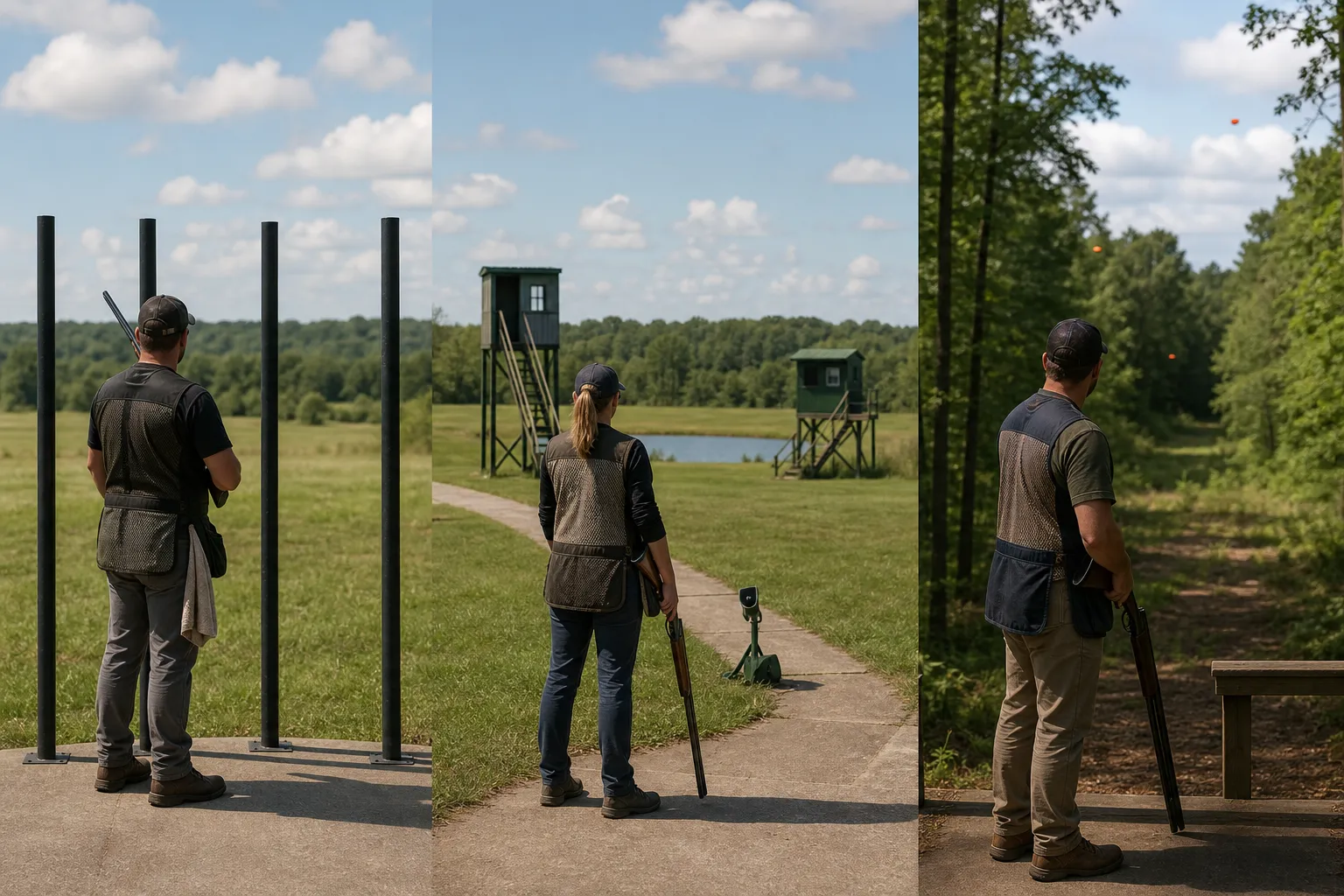
The American Trapshooting Association says its Official Rules govern registered trapshooting targets and conduct. In ATA trap, the field uses five firing positions, numbered 1 through 5. For 16-yard targets, ATA rules place the posts 16 yards from Point B, with posts spaced three yards apart.
A standard ATA sub-event is one full rotation on all five posts. The rule book gives examples that include 25 or 50 Singles or Handicap targets, plus 10, 15, or 25 pairs of Doubles.
The most important spectator clue is the direction of the targets. In trap, the target presentation generally moves away from the shooter. ATA specifies a height of 8 to 10 feet when measured 10 yards from Point B.
ATA Handicap changes the shooter’s distance. That means shooters in the same event may stand at different distances behind the trap, according to the ATA system.
For equipment, ATA rules do not allow a shotgun chamber larger than 12 gauge. Smaller gauges are permitted in registered and tournament shooting. If gauge terms are new, see our shotgun gauge guide for the difference between 12 gauge, 20 gauge, 28 gauge, and .410 bore.
ATA scoring is simple to follow from the score sheet. Targets are recorded as DEAD or LOST, with marks such as a slash or X for DEAD and 0 for LOST.
Skeet: high house, low house, and crossing targets
The National Skeet Shooting Association rule book defines a round of skeet as 25 shots, with the object of scoring the greatest number of dead targets. NSSA’s regular sequence starts at Station 1 with a high-house single, a low-house single, then doubles.
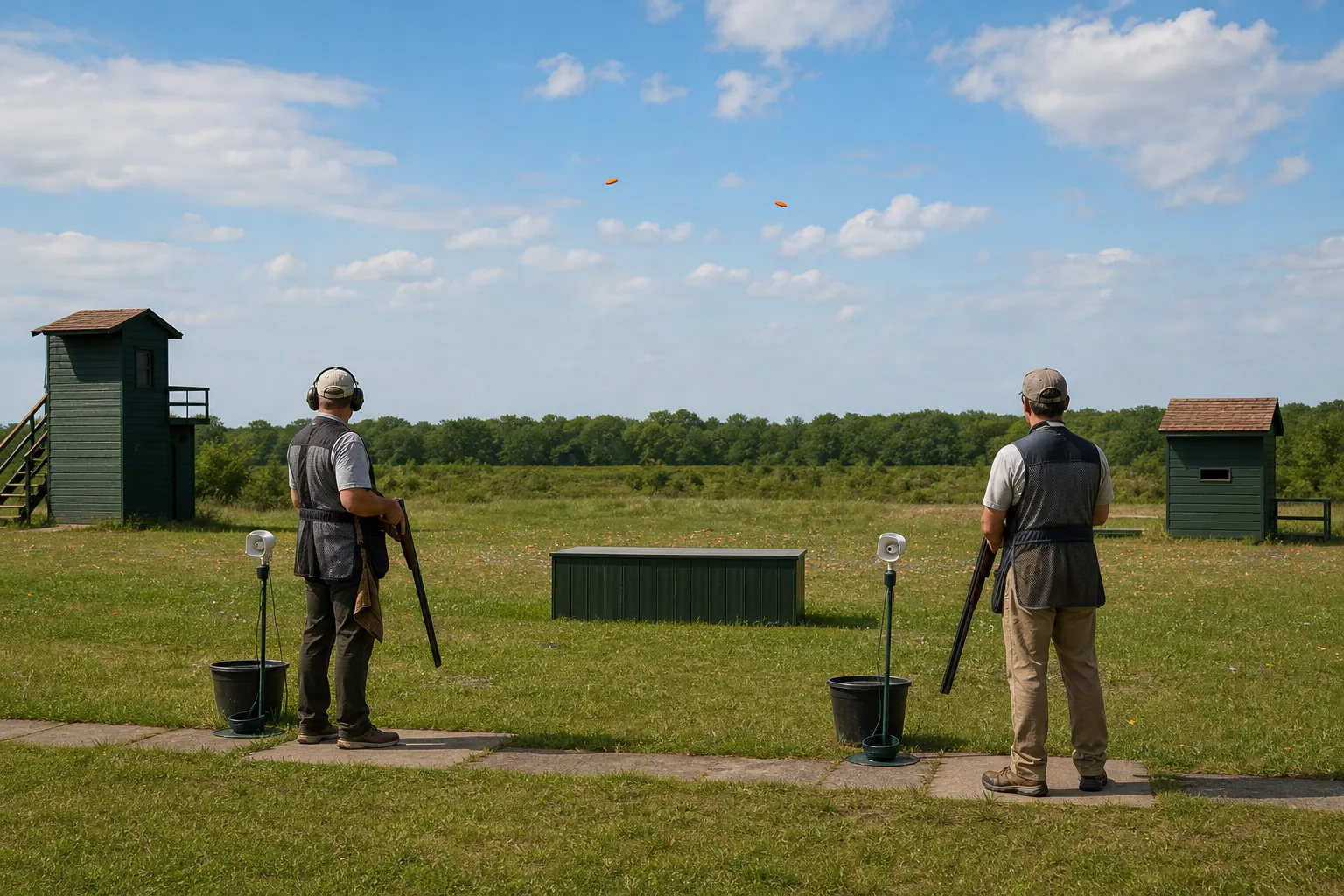
The key visual feature is the pair of skeet houses. NSSA defines a regular double as one target thrown from each skeet house simultaneously. That is why skeet often looks like a crossing-target game to spectators.
NSSA also says skeet guns must be capable of two shots because a regulation 25-shot round includes four sets of doubles. That rule is about the course of fire, not a recommendation for a specific shotgun model.
NSSA says standard skeet competitions include 12 gauge, 20 gauge, 28 gauge, and .410 bore. Those categories are useful to know when reading a program or watching a multi-gauge event.
Scoring turns on visible breakage. NSSA defines a dead target as one where a visible piece is observed broken from the target before it hits the ground after a legal shot.
Sporting clays: varied targets over a course
The National Sporting Clays Association states that it is America’s official governing and sanctioning body for sporting clays. NSCA describes sporting clays as non-standardized compared with skeet or trap, and says courses are designed to simulate hunting ducks, pheasants, upland birds, and rabbits.
That variety is the point of the game. Instead of one fixed presentation, target presentations can vary by club and event.
NSCA registered events must throw at least 25 targets, and events generally consist of multiples of 25 targets. Because NSCA describes the game as non-standardized, the exact course layout and target presentations can vary by club and event.
NSCA tournament rules list gauge-specific events for 12 gauge, 20 gauge, 28 gauge, and .410 bore. As with skeet, those gauge names describe event categories under the rules, not a ranking of what a beginner should buy.
What about chokes?
Choke affects how a shotgun pattern spreads, so it often comes up when people compare trap, skeet, and sporting clays. This page does not make choke recommendations for any discipline. For the basic terms, see our shotgun chokes guide.
For this comparison, the important rule-based point is that the governing bodies define the games by targets, stations, event formats, and scoring. Choosing a choke is a separate equipment question that should be checked against the rules for the event you plan to shoot.
Olympic and ISSF versions
USA Shooting says it is authorized by the International Shooting Sports Federation and the USOPC to host national and international matches. ISSF lists the Olympic shotgun events as Skeet Men, Skeet Women, Trap Men, Trap Women, and either Skeet Mixed Team or Trap Mixed Team in the open Men-Women category.
The current ISSF rules page lists the ISSF Rule Book 2026 Edition 2025 Third Print as effective October 19, 2026. Always check the current ISSF and USA Shooting documents before relying on event details, because Olympic and international formats can change.
| ISSF event | Final format listed by ISSF |
|---|---|
| ISSF Trap | ISSF lists eliminations with 25 targets for the bronze medal and 30 targets for gold and silver. |
| ISSF Skeet | ISSF lists eliminations with 32 targets for the Skeet bronze medal and 36 targets for Skeet gold and silver. |
How to watch the differences
If you are spectating for the first time, start with the target path.
In trap, watch the shooter call for a target from one of five posts, then track a target that generally travels away. In ATA Singles, the target setting includes a specified height, and Handicap changes the shooter’s distance.
In skeet, watch the houses. NSSA’s regular sequence includes high-house and low-house singles, plus doubles from both houses. The doubles are a clear sign that the game is testing crossing-target timing.
In sporting clays, expect variety. NSCA describes the game as non-standardized, so one station may not look like the next.
What to confirm before you shoot
Before entering a shoot, confirm the current rule book and program with the organizing body or club. For ATA registered trap, check ATA rules and the shoot program. For NSSA skeet, check NSSA rules and event details. For NSCA sporting clays, check NSCA rules and the specific course or tournament program. For Olympic-style events in the United States, check USA Shooting and the current ISSF rule book.
Frequently asked questions
What is the simplest difference between trap, skeet, and sporting clays?
Trap generally sends targets away from the shooter, skeet uses high-house and low-house targets including crossing doubles, and sporting clays uses varied presentations over a course.
How many shots are in a round of skeet?
NSSA defines a round of skeet as 25 shots. NSSA also says a regulation 25-shot round includes four sets of doubles.
How many stations are used in ATA trap?
ATA trap uses five firing positions, numbered 1 through 5. ATA sub-events involve one full rotation on all five posts.
Are sporting clays courses all the same?
No. NSCA describes sporting clays as non-standardized compared with skeet or trap, and says no two sporting clays courses are alike.
Which gauges are listed for skeet and sporting clays events?
NSSA says standard skeet competitions include 12 gauge, 20 gauge, 28 gauge, and .410 bore. NSCA tournament rules list gauge-specific events for 12 gauge, 20 gauge, 28 gauge, and .410 bore.
Sources
- Amateur Trapshooting Association Official Rules, Amateur Trapshooting AssociationOfficial source. Accessed October 22, 2026.
- National Skeet Shooting Association Official Rules & Regulations 2026, National Skeet Shooting AssociationOfficial source. Accessed October 22, 2026.
- 2026 Rules & Regulations: Sporting Clays, NSCA 5-Stand, Super Sporting, FITASC, American Field Sporting, National Sporting Clays AssociationOfficial source. Accessed October 22, 2026.
- NSCA: National Sporting Clays Association, National Sporting Clays AssociationOfficial source. Accessed October 22, 2026.
- Events, USA ShootingOfficial source. Accessed October 22, 2026.
- Rules, International Shooting Sport FederationOfficial source. Accessed October 22, 2026.
- ISSF Rule Book 2026 Edition 2025 Third Print 10/2026 Effective 19 October 2026, International Shooting Sport FederationOfficial source. Accessed October 22, 2026.
- ISSF, International Shooting Sport Federation. Accessed October 22, 2026.