Lynx vs Bobcat: How to Tell Them Apart
The fastest way to separate a Canada lynx from a bobcat is to check the tail tip, feet, tracks, ear tufts and body profile. Canada lynx are more tied to deep snow boreal forests and snowshoe hares, while bobcats are more adaptable and more widespread across the United States.
By RaiS. Reviewed by RaiS. Published . 6 min read.
Research and drafting were assisted by AI. RaiS checked the facts against the sources below and approved this page.
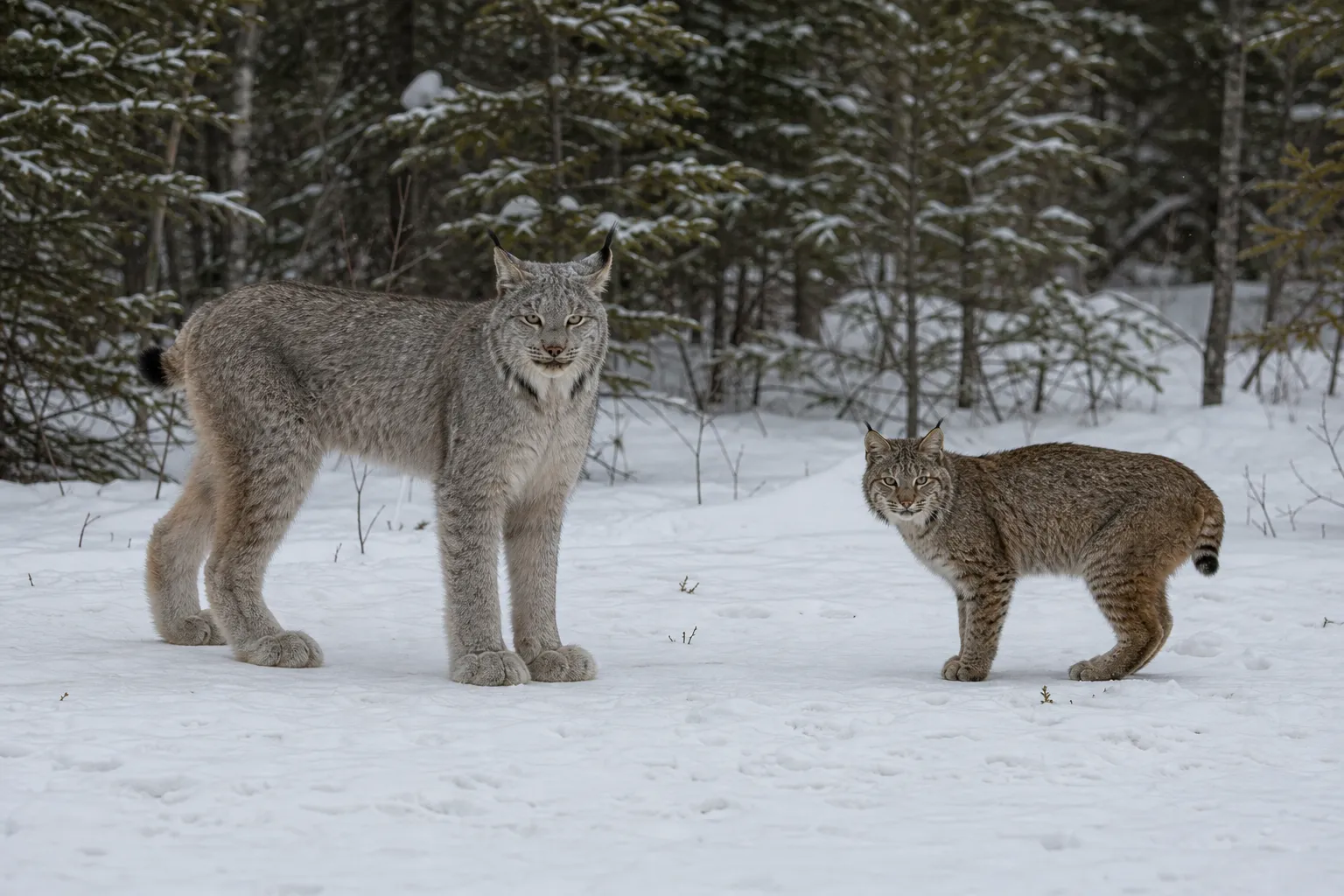
Canada lynx and bobcats can look similar at a quick glance, especially in the northern United States and southern Canada, but the best field marks are practical: a Canada lynx has a completely black tail tip, large well furred feet, long ear tufts and a long legged look, while a bobcat has a tail that is black on top and white underneath, smaller feet, usually shorter ear tufts and a flatter backed profile. Size helps less than many people expect because the two cats overlap in general body size.
Bobcat vs lynx: quick field ID
Start with the tail if you can see it. Maine Department of Inland Fisheries and Wildlife calls the tail the best point of comparison: a bobcat’s tail tip is black on top and white beneath, while a lynx’s tail is completely black tipped.
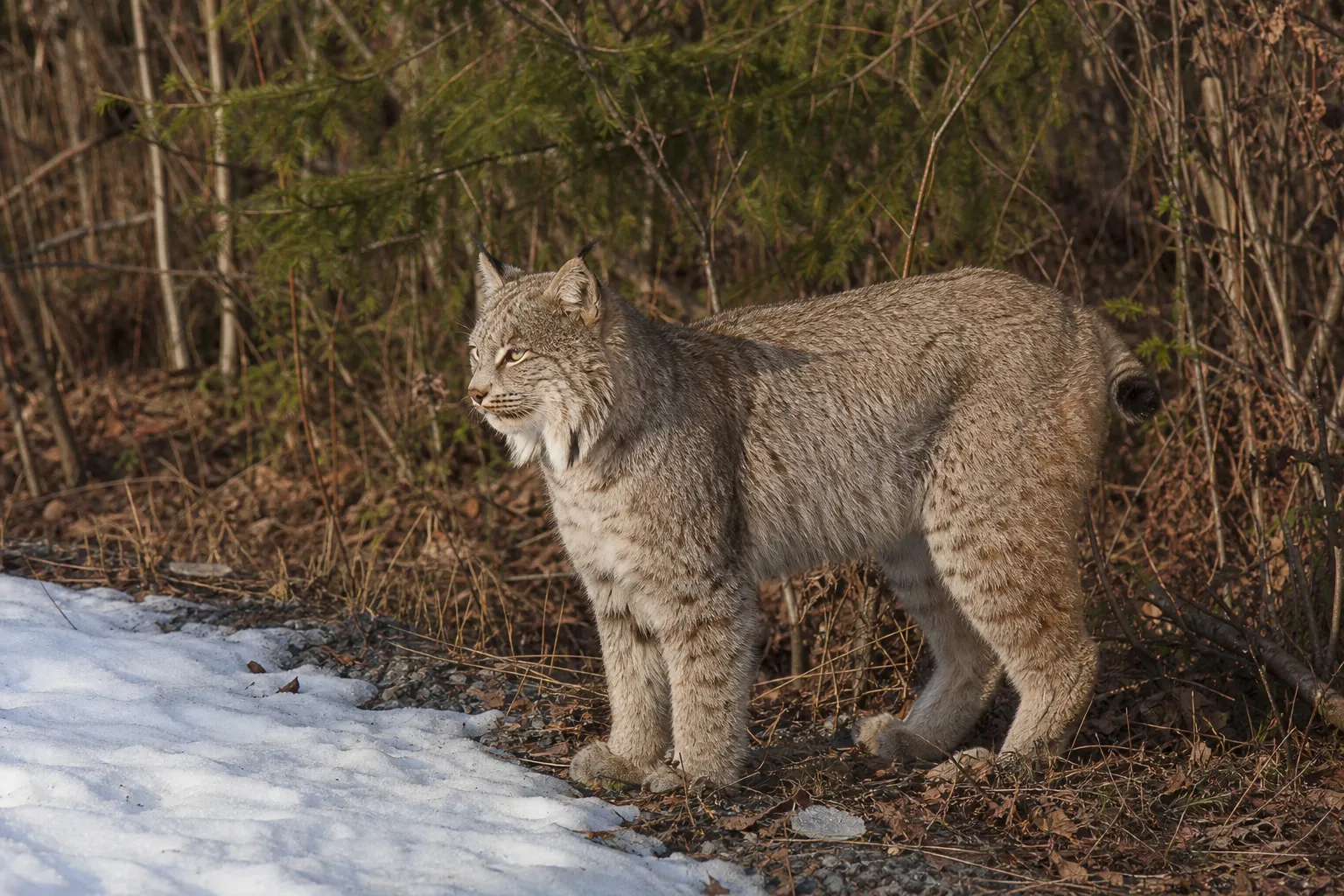
That underside view matters. From behind, from the side, or in trail camera photos, the white underside on a bobcat tail can be one of the clearest clues. A Canada lynx tail lacks that white underside at the tip in the comparison described by Maine wildlife officials.
Next, look at the feet and tracks. Maine Department of Inland Fisheries and Wildlife identifies the Canada lynx’s large, densely furred feet as its most distinguishing feature, describing them as snowshoe like. The same agency lists lynx tracks in snow as up to 5.5 by 5.5 inches and bobcat tracks in snow as up to 2.5 by 2.5 inches.
Ear tufts help, but do not use them alone. Maine wildlife officials describe Canada lynx as having long ear tufts, while bobcats have shorter tufts. Their field comparison lists lynx ear tufts as 1 inch or longer and bobcat ear tufts as absent to 1 inch.
A side view can also help. Maine Department of Inland Fisheries and Wildlife says the hind end of a lynx is slightly raised, while a bobcat’s back is relatively flat. That long legged, high rumped look is a useful clue when the animal is walking through snow or cover.
Field mark comparison table
| Feature | Canada lynx | Bobcat |
|---|---|---|
| Tail tip | Completely black tipped, according to Maine Department of Inland Fisheries and Wildlife | Black on top and white underneath, according to Maine Department of Inland Fisheries and Wildlife |
| Feet | Large, densely furred, snowshoe like feet | Smaller feet relative to body size |
| Track in snow | Maine lists up to 5.5 by 5.5 inches | Maine lists up to 2.5 by 2.5 inches |
| Ear tufts | Long ear tufts, listed by Maine as 1 inch or longer | Shorter tufts, listed by Maine as absent to 1 inch |
| Body profile | Often looks long legged, with a slightly raised hind end | Back is relatively flat in Maine’s comparison |
| Coat | Maine lists a more uniform coat color for lynx | Maine lists a less uniform, spotted coat with a white underbelly |
| Snow adaptation | Large, furry paws help them move on top of deep snow without sinking, according to Smithsonian | Maine says relatively small feet reduce bobcat mobility and ability to catch prey in snow |
Size and shape
Do not rely on size alone. Maine Department of Inland Fisheries and Wildlife says lynx are similar in size and appearance to bobcats, but lynx may appear larger because of their long legs.
For Canada lynx, Maine gives adult male averages of about 33.5 inches long and 26 to 30 pounds. Maine lists female lynx at about 32 inches long and 17 to 20 pounds.
For bobcats, Smithsonian says they generally stand 1.5 to 2 feet at the shoulder and weigh 9 to 33 pounds. Maine Department of Inland Fisheries and Wildlife says adult male bobcats weigh 20 to 30 pounds and average three feet long.
Those numbers show why size is a supporting clue, not a final answer. A large northern bobcat and a Canada lynx can fall into similar weight and length ranges. Shape, feet, track size and tail markings are safer field marks.
Feet, tracks and snow
The Canada lynx is built for snow. Smithsonian says Canada lynx have large, furry paws that allow them to move on top of deep snow without sinking. Maine Department of Inland Fisheries and Wildlife says the large, densely furred feet are the most distinguishing Canada lynx characteristic.
The difference is not just cosmetic. Maine’s bobcat account says bobcats have relatively small feet, so snow greatly reduces their mobility and ability to catch prey. Smithsonian also notes that the other lynx species have dense fur on their footpads, while bobcat footpads are bare.
For hunters, trappers and wildlife watchers looking at tracks in snow, this is often the most useful sign after the tail. Maine lists lynx tracks in snow as much larger than bobcat tracks, up to 5.5 by 5.5 inches for lynx compared with up to 2.5 by 2.5 inches for bobcat.
Coat, ear tufts and facial ruff
Bobcats are usually the more patterned looking cat. Smithsonian describes bobcat fur as buff to brown, sometimes with a reddish tinge, and marked with brown and black spots or stripes. Maine’s field comparison lists bobcats as having a less uniform coat, a white underbelly and spots.
Canada lynx are often described as more uniform in the field comparisons used by Maine wildlife officials. Smithsonian describes Canada lynx as having silvery gray spotted coats, dark pointed ear tips and oversized paws. The key point for field identification is that coat alone can vary in appearance, while the tail tip and feet are more dependable when visible.
Ear tufts and facial ruffs are also useful. Maine’s comparison lists lynx with longer ear tufts and a longer facial ruff, while bobcats have shorter ear tufts and a shorter facial ruff.
Still, both cats can show ear tufts. Treat tufts as one part of the overall picture, not the entire identification.
Habitat, range and overlap
The U.S. Fish and Wildlife Service describes the Canada lynx as a mid sized boreal forest carnivore that occurs across most of northern North America. Its 2024 recovery plan says most of the Canada lynx range is in boreal spruce fir forests from eastern Canada to Alaska.
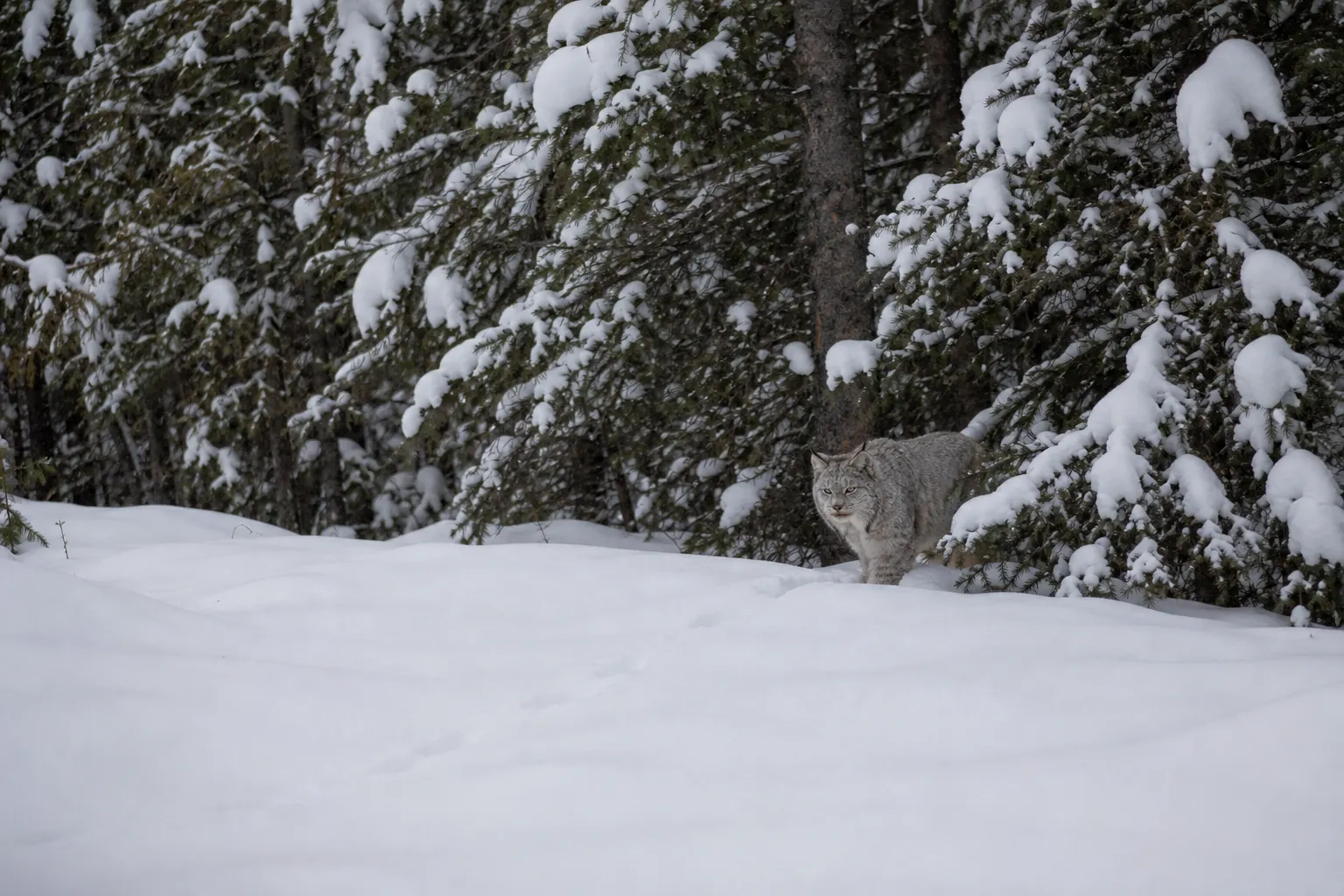
In the lower 48 states, the U.S. Fish and Wildlife Service says lynx populations are likely to persist in areas with deep snow, dense horizontal forest cover and enough snowshoe hares. The agency’s 2024 recovery plan lists five current resident breeding populations in the lower 48 distinct population segment: northern Maine and northeastern New Hampshire, northeastern Minnesota, northwestern Montana and northern Idaho, northcentral Washington and southwestern Colorado.
Bobcats use a wider range of habitats. Smithsonian says most of the world’s bobcats are in the United States, and that the species ranges from Mexico to southern Canada. Smithsonian also describes bobcats as very adaptable, using habitats that include northern boreal and mixed forests, southeastern bottomland hardwood forests and coastal swamps, and southwestern deserts and scrublands.
The lynx and snowshoe hare cycle
The Canada lynx is closely linked to snowshoe hares. The U.S. Fish and Wildlife Service 2024 recovery plan says Canada lynx populations are strongly tied to snowshoe hares, their primary prey.
For field identification, that connection helps explain why deep snow, coniferous forest and snowshoe hare habitat are important clues when you are trying to decide whether a cat is a lynx or a bobcat.
Conservation status and identification caution
In the contiguous United States, the U.S. Fish and Wildlife Service says the Canada lynx distinct population segment was listed as threatened under the Endangered Species Act in 2000. The agency’s final recovery plan for the contiguous United States Canada lynx distinct population segment is dated November 2024.
That status makes careful identification important in the lower 48. This comparison is for identification and natural history reference only. It does not cover hunting or trapping rules.
If you are in an area where bobcats and Canada lynx may overlap, confirm current identification guidance and any applicable rules with the relevant state, provincial, territorial or federal wildlife agency. Rules and agency guidance can change, and official agencies are the place to verify current requirements for the exact location and date.
Frequently asked questions
What is the easiest way to tell a lynx from a bobcat?
Maine Department of Inland Fisheries and Wildlife says the tail is the best comparison point. A Canada lynx has a completely black tipped tail, while a bobcat’s tail is black on top and white underneath.
Are lynx bigger than bobcats?
Not reliably. Maine Department of Inland Fisheries and Wildlife says lynx are similar in size and appearance to bobcats, though lynx may appear larger because of their long legs.
How are lynx tracks different from bobcat tracks in snow?
Maine Department of Inland Fisheries and Wildlife lists lynx tracks in snow as up to 5.5 by 5.5 inches and bobcat tracks in snow as up to 2.5 by 2.5 inches. Lynx also have large, densely furred feet.
Why are Canada lynx associated with snowshoe hares?
The U.S. Fish and Wildlife Service says Canada lynx populations are strongly tied to snowshoe hares, their primary prey.
What is the conservation status of Canada lynx in the lower 48 states?
The U.S. Fish and Wildlife Service says the contiguous United States Canada lynx distinct population segment was listed as threatened under the Endangered Species Act in 2000.
Sources
- Canada Lynx (Lynx canadensis), U.S. Fish and Wildlife ServiceOfficial source. Accessed October 23, 2026.
- Recovery Plan for the Contiguous United States Distinct Population Segment of Canada Lynx (Lynx canadensis), U.S. Fish and Wildlife ServiceOfficial source. Accessed October 23, 2026.
- Canada Lynx, Maine Department of Inland Fisheries and WildlifeOfficial source. Accessed October 23, 2026.
- Bobcat, Maine Department of Inland Fisheries and WildlifeOfficial source. Accessed October 23, 2026.
- Bobcat, Smithsonian’s National Zoo and Conservation Biology InstituteOfficial source. Accessed October 23, 2026.
- Meet the Canada Lynx, A Wild Cat Built for North America's Boreal Forest, Smithsonian’s National Zoo and Conservation Biology InstituteOfficial source. Accessed October 23, 2026.
- Lynx, Government of Northwest Territories, Environment and Climate ChangeOfficial source. Accessed October 23, 2026.
- Lynx-Snowshoe Hare Cycle, Government of Northwest Territories, Environment and Climate ChangeOfficial source. Accessed October 23, 2026.
- Fine-scale habitat selection by sympatric Canada lynx and bobcat, Ecology and Evolution. Accessed October 23, 2026.