Moose vs elk: how to tell them apart
Moose are generally larger, darker, longer-legged animals with a bulbous overhanging nose, a throat bell or dewlap, and palmated bull antlers. Elk are smaller, more herd-oriented deer with a slender snout, pale rump, darker mane or neck, and branching antlers on bulls.
By RaiS. Reviewed by RaiS. Published . 9 min read.
Research and drafting were assisted by AI. RaiS checked the facts against the sources below and approved this page.
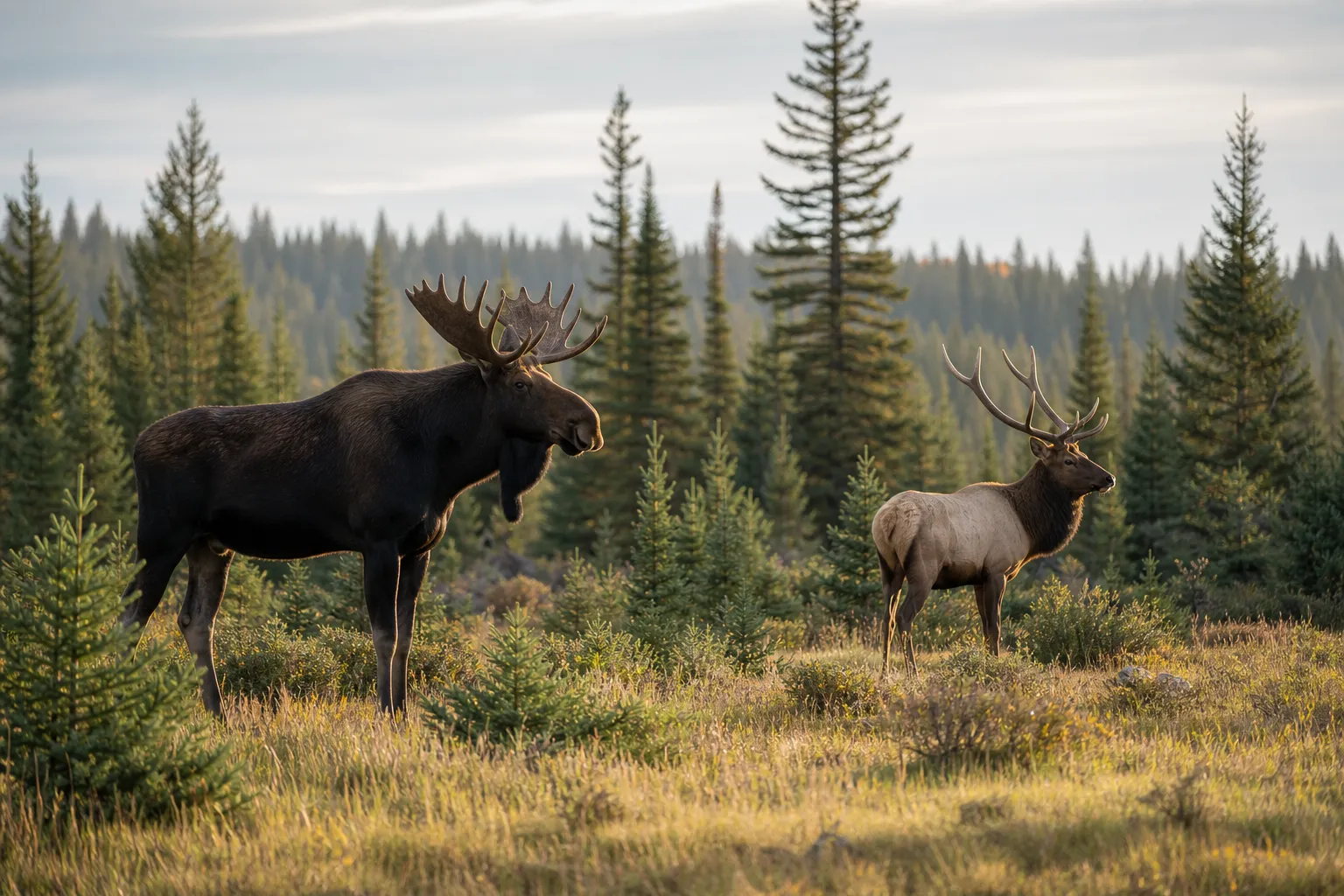
If you are comparing elk vs moose in the field, do not rely on antlers alone. Look at the whole animal: body size, leg length, nose shape, throat bell or dewlap, rump color, antler shape, behavior, tracks, and sounds. Moose are the bigger, darker, longer-legged animal, with a humped shoulder, bulbous overhanging nose, and often a hanging throat bell. Elk are generally smaller, more deer-like, more social, and easier to spot by a pale yellow or white rump and branching, non-palmated antlers on bulls.
Quick field comparison: moose vs elk
| Field mark | Moose | Elk | |, -|, -|, -| | Overall size | The largest members of the deer family. Rocky Mountain National Park gives adult moose an average shoulder height of 5 to 7 feet. Large bulls can weigh up to 1,500 pounds. | Large deer, but generally smaller than moose. Rocky Mountain National Park gives bull elk a shoulder height of 5 feet and weights of 700 to 1,000 pounds. | | Body shape | Long thin legs, humped shoulders, and a heavy head. Parks Canada highlights long, thin legs and a large overhanging muzzle. | More deer-like body. Rocky Mountain National Park describes a dark brown mane, light-brown body, and white rump. | | Nose | Large, bulbous, and overhanging, according to Colorado Parks and Wildlife and Parks Canada. | Slender snout, according to Colorado Parks and Wildlife. | | Throat | Moose have a throat bell or dewlap. Rocky Mountain National Park calls it a ball of skin called a “bell,” and Parks Canada calls it a dewlap. | The ledger sources do not list a comparable elk throat bell. Colorado Parks and Wildlife describes the elk neck as chestnut brown. | | Rump | Colorado Parks and Wildlife says the rump is the same color as the rest of the body. | Pale yellow rump, according to Colorado Parks and Wildlife. Rocky Mountain National Park describes a white rump. | | Bull antlers | Palmated, flattened antlers. Denali National Park says they have a flattened area like the palm of a hand, with tines pointing up. | Branching, non-palmated antlers. Colorado Parks and Wildlife says bull elk antlers are not palmated and have obvious brow tines off the main beam. | | Females and antlers | Parks Canada says antlers are normally only grown by males in deer, elk, and moose. | Same general rule from Parks Canada: antlers are normally only grown by males. | | Social behavior | Denali National Park says moose are mainly found as single animals or in small groups. | Rocky Mountain National Park says elk are highly social and may travel in herds as large as a few hundred individuals. | | Rut timing | Denali National Park says moose breed in late September and early October. | Yellowstone National Park’s 2026 Resources and Issues Handbook says the elk rut generally occurs from early September to mid-October. | | Rut sounds | Denali National Park describes a cow moose sound as a nasal, bawling vocalization used to solicit a mate during the fall rut. | Rocky Mountain National Park describes the bull elk bugle as deep resonant tones rising to a high-pitched squeal, then dropping to grunts. | | Tracks | National Park Service educational material gives moose tracks as 5 to 7 inches long. Glacier National Park says moose tracks are larger and more pointed than elk tracks. | The same National Park Service material gives elk tracks as generally 4 inches long and 3 inches wide. | | Habitat clues | Parks Canada says moose are found across Canada and the northern United States. Waterton Lakes National Park says moose are usually found in wetlands, along lakes, streams, and rivers, and in new seasonal growth in spring and summer. | USDA NRCS describes elk habitat as a mosaic of woodland cover and large open areas, with woodland cover for escape and open areas for herbaceous forage. |
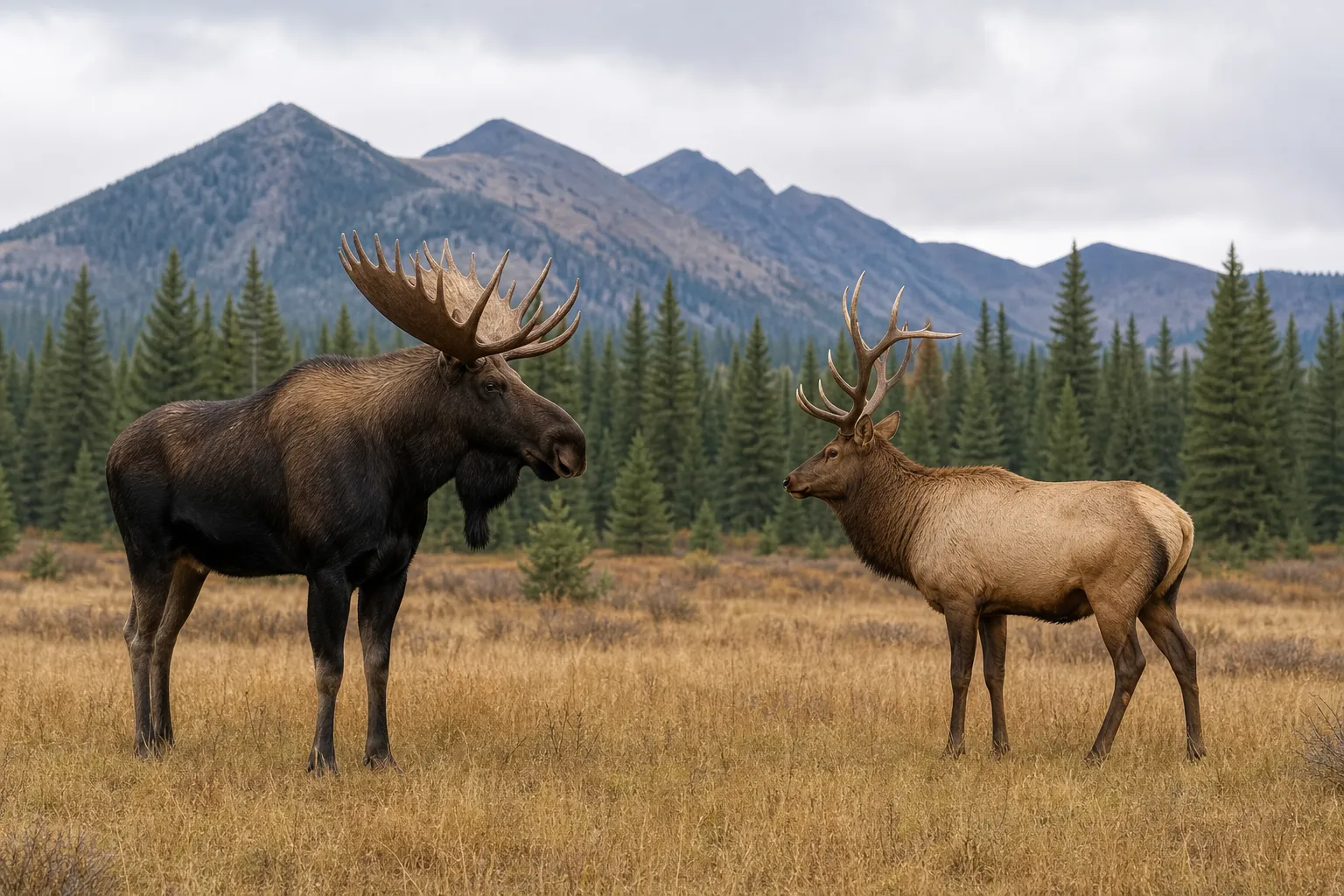
Body size and shape
Moose are the heavier, taller animal in this comparison. Rocky Mountain National Park says moose are the largest members of the deer family and that an adult moose averages 5 to 7 feet high at the shoulder. The same National Park Service page says large male moose can weigh as much as 1,500 pounds, with females roughly three-quarters of that size.
Denali National Park gives Alaska moose weights of 900 to 1,400 pounds for adult males and 700 to 1,100 pounds for adult females. Those numbers are regional, but they reinforce the same basic field lesson: a mature moose can be a very large animal.
Elk are also large. Rocky Mountain National Park says large bull elk can weigh 700 to 1,000 pounds and stand 5 feet at the shoulder. Cow elk weigh about 300 to 500 pounds and stand about 4.5 feet at the shoulder, according to the same source.
Shape is just as useful as size. Moose have long legs, humped shoulders, a bulbous nose, and a throat bell. Rocky Mountain National Park describes both sexes as having chocolate-brown fur, a humped shoulder, a bulbous nose, and a bell that hangs from the neck. Parks Canada describes moose as having long, thin legs, a large overhanging muzzle, and a neck dewlap.
Elk look more like a giant deer. Rocky Mountain National Park describes elk of both sexes as having a dark brown mane, light-brown body, and white rump. Colorado Parks and Wildlife describes elk as reddish, lighter brown, with darker legs and a chestnut-brown neck.
Antlers: palmated moose, branching elk
Antlers can help, especially on mature bulls in the right season, but they should not be the only feature you use.
Bull moose antlers are palmated. Denali National Park explains that palmated antlers have a flattened area like the palm of a hand, with the tines pointing up. Rocky Mountain National Park says bull moose antlers can reach 5 feet across and weigh up to 77 pounds.
Bull elk antlers are not palmated. Colorado Parks and Wildlife says bull elk antlers are not palmated and have obvious brow tines coming off the main beam. Rocky Mountain National Park says antlers on a mature male elk can weigh up to 40 pounds.
The U.S. Fish and Wildlife Service gives a useful clue for how people commonly describe these antlers. Elk are commonly counted by points on each side, such as a 6x6. For moose, the common measure is antler spread.
For cows and antlerless animals, antlers may not help at all. Parks Canada states that deer, elk, and moose have true antlers that are shed annually, and that antlers are normally only grown by males.
Color, nose, throat, and rump patch
For hunters, the face and rump are often clearer field marks than antlers.
Colorado Parks and Wildlife lists moose field marks as a black or dark brown body, paler gray legs and belly, a large bell or beard on the throat, an overhanging bulbous nose, a rump that is the same color as the rest of the body, and palmated antlers on bulls.
The same agency lists elk field marks as a reddish, lighter-brown body, darker legs, a chestnut-brown neck, a slender snout, a pale yellow rump, and bull antlers that are not palmated. Rocky Mountain National Park similarly describes elk as having a dark brown mane, light-brown body, and white rump.
In plain terms, look for these contrasts:
- Moose: dark body, long legs, overhanging bulbous snout, throat bell or dewlap, same-color rump.
- Elk: lighter brown body, darker mane or neck, slender snout, pale yellow or white rump.
Habitat and range in the United States and Canada
Moose and elk can overlap locally, especially where both species occur, so range should not be your only identification method. Use range as a supporting clue, then confirm with body shape, head shape, rump color, antlers, behavior, and tracks.
Parks Canada says moose may be found across Canada and the northern parts of the United States, and that Canada is home to four moose subspecies. The U.S. Forest Service Fire Effects Information System says that in the Great Lakes region, southeastern Canada, and the northeastern United States, moose occur in mixed-transition forests between boreal forest and temperate hardwood forest.
Moose also use wet places. Parks Canada’s Waterton information says that in spring and summer, moose are usually found in wetlands, alongside lakes, streams, and rivers, and in areas of new seasonal growth.
For elk, USDA NRCS states that four subspecies of American elk live in North America today: tule, Manitoba, Roosevelt, and Rocky Mountain elk. USDA NRCS gives a specific range for Roosevelt elk along the Pacific coast from northern California to Washington and Canada. NRCS also describes general elk habitat as a mosaic of woodland cover and large open areas, with woodland cover used for escape and open areas used for herbaceous forage.
Behavior and rut clues
Behavior is one of the best quick clues when you are watching animals at a distance.
Denali National Park says moose are not typically found in large herds and are mainly found as single animals or in small groups. Rocky Mountain National Park says elk are highly social and travel in various herd sizes throughout the year, with herds that can grow as large as a few hundred individuals.
Rut timing overlaps enough that season alone does not identify the animal. Denali National Park says moose breed in late September and early October. Yellowstone National Park’s 2026 Resources and Issues Handbook says the elk rut generally occurs from early September to mid-October.
Sounds are more distinctive. A bull elk bugle, as described by Rocky Mountain National Park, begins with deep resonant tones, rises rapidly to a high-pitched squeal, and drops to grunts. Denali National Park describes a cow moose rut call as a nasal, bawling vocalization used to solicit a mate.
Tracks and sign
Tracks can help when the animal is gone, but use them with caution. Mud, snow, slope, speed, and partial prints can change how a track looks.
National Park Service educational material gives moose tracks as 5 to 7 inches long and elk tracks as generally 4 inches long and 3 inches wide. Glacier National Park says moose tracks are larger and more pointed than elk tracks, and notes that long legs help moose move through deep snow.
Katahdin Woods and Waters National Monument says moose hoof prints look like inward-facing half moons with two dots at the base, and that moose tracks are about 6 inches wide.
As a field shortcut, a very large, pointed deer-family track may suggest moose, while a smaller track around the National Park Service’s elk dimensions may suggest elk. Still, tracks should support other evidence, not replace it.
Hunting caution: confirm before you shoot
For hunters, the safest rule is simple: identify the species with more than one field mark before making any decision. Antlers can be absent, partly hidden, immature, or confusing at a distance. A better check is the full combination of body size, nose shape, throat bell or dewlap, rump color, antler shape if present, behavior, sounds, and tracks.
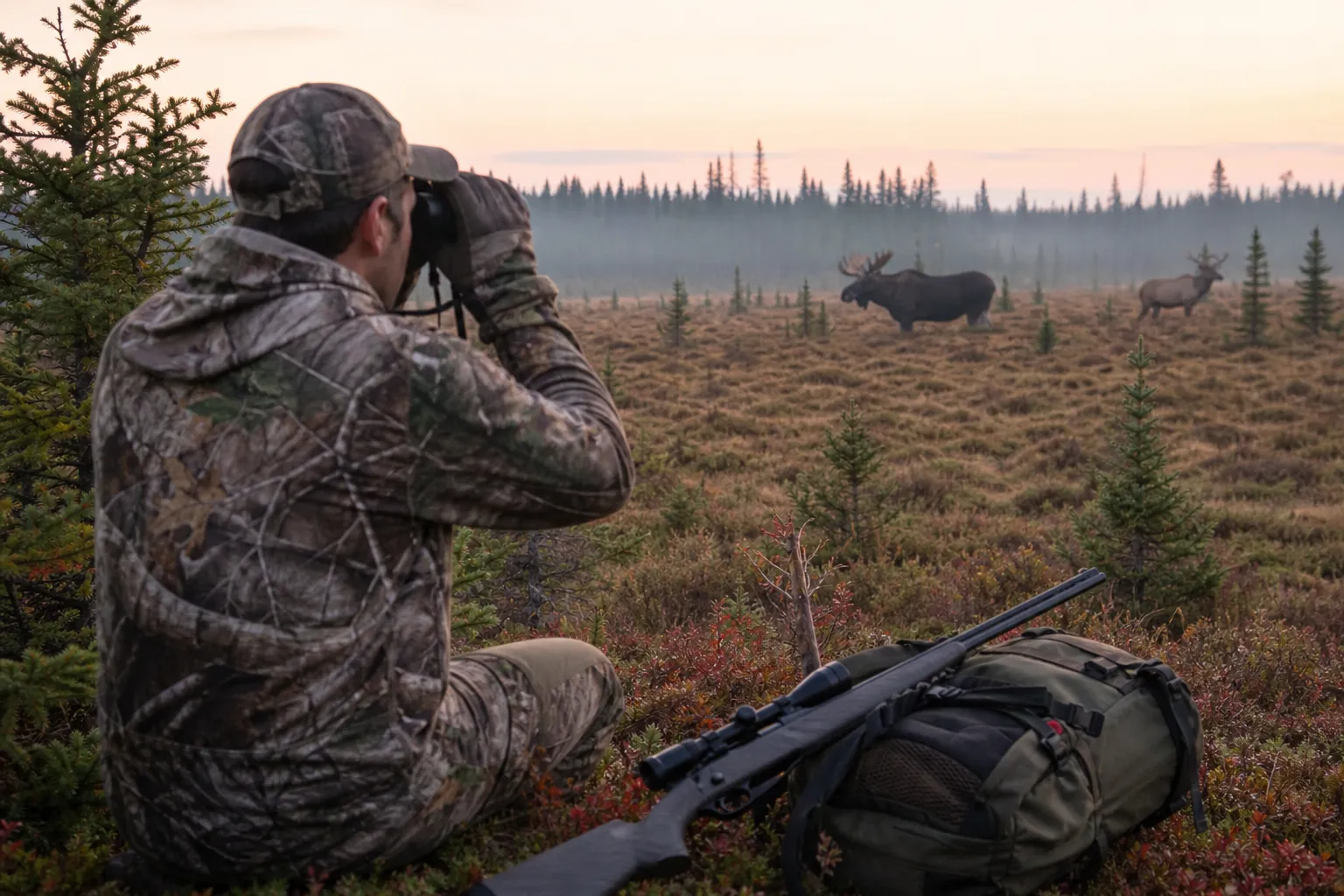
Before hunting, check current official regulations for the exact state, province, territory, federal land unit, or tribal authority involved. Seasons, licenses, tags, sex or antler rules, reporting rules, and unit boundaries can change. During editing, add jurisdiction-specific official regulation links for the places covered by the page.
Frequently asked questions
What is the easiest way to tell a moose from an elk?
Look at the whole animal. Moose are generally larger and darker, with long legs, a humped shoulder, a bulbous overhanging nose, and a throat bell or dewlap. Elk are generally smaller, more deer-like, with a slender snout and a pale yellow or white rump.
Are moose bigger than elk?
Yes, based on the cited National Park Service sources. Rocky Mountain National Park says adult moose average 5 to 7 feet at the shoulder and large males can weigh up to 1,500 pounds. The same park gives bull elk weights of 700 to 1,000 pounds and a shoulder height of 5 feet.
How are moose and elk antlers different?
Bull moose have palmated, flattened antlers, which Denali National Park compares to the palm of a hand with tines pointing up. Bull elk have branching, non-palmated antlers with brow tines off the main beam, according to Colorado Parks and Wildlife.
Do elk and moose make different rut sounds?
Yes. Rocky Mountain National Park describes the bull elk bugle as deep resonant tones that rise to a high-pitched squeal and drop to grunts. Denali National Park describes a cow moose rut call as a nasal, bawling vocalization.
Are moose tracks larger than elk tracks?
Yes. National Park Service educational material gives moose tracks as 5 to 7 inches long, while elk tracks are generally 4 inches long and 3 inches wide. Glacier National Park also says moose tracks are larger and more pointed than elk tracks.
Sources
- Moose, Rocky Mountain National Park, U.S. National Park ServiceOfficial source. Accessed October 20, 2026.
- Moose, Denali National Park & Preserve, U.S. National Park ServiceOfficial source. Accessed October 20, 2026.
- Elk, Rocky Mountain National Park, U.S. National Park ServiceOfficial source. Accessed October 20, 2026.
- Moose, In the Field, Colorado Parks and WildlifeOfficial source. Accessed October 20, 2026.
- Elk, In the Field, Colorado Parks and WildlifeOfficial source. Accessed October 20, 2026.
- Ungulates, Waterton Lakes National Park, Parks CanadaOfficial source. Accessed October 20, 2026.
- Eight points about antlers, U.S. Fish and Wildlife ServiceOfficial source. Accessed October 20, 2026.
- Yellowstone Resources and Issues Handbook 2026, Wildlife chapter, U.S. National Park ServiceOfficial source. Accessed October 20, 2026.
- City of Rocks National Reserve Junior Ranger Booklet, U.S. National Park ServiceOfficial source. Accessed October 20, 2026.
- Track Makers, Glacier National Park, U.S. National Park ServiceOfficial source. Accessed October 20, 2026.
- Moose, Katahdin Woods and Waters National Monument, U.S. National Park ServiceOfficial source. Accessed October 20, 2026.
- Moose, Cape Breton Highlands National Park, Parks CanadaOfficial source. Accessed October 20, 2026.
- Alces americanus, moose, US Forest Service Research and Development, Fire Effects Information SystemOfficial source. Accessed October 20, 2026.
- American Elk, Fish and Wildlife Habitat Management Leaflet Number 11, USDA Natural Resources Conservation ServiceOfficial source. Accessed October 20, 2026.