Coyote vs Wolf: How to Tell Them Apart
Coyotes and wolves can look similar at a distance, but adult wolves are usually much larger, with proportionally smaller rounded ears, a blockier snout and larger tracks. Identification can be difficult in poor light or in eastern coyote and eastern wolf areas, so confirm with official wildlife agencies before acting.
By RaiS. Reviewed by RaiS. Published . 7 min read.
Research and drafting were assisted by AI. RaiS checked the facts against the sources below and approved this page.
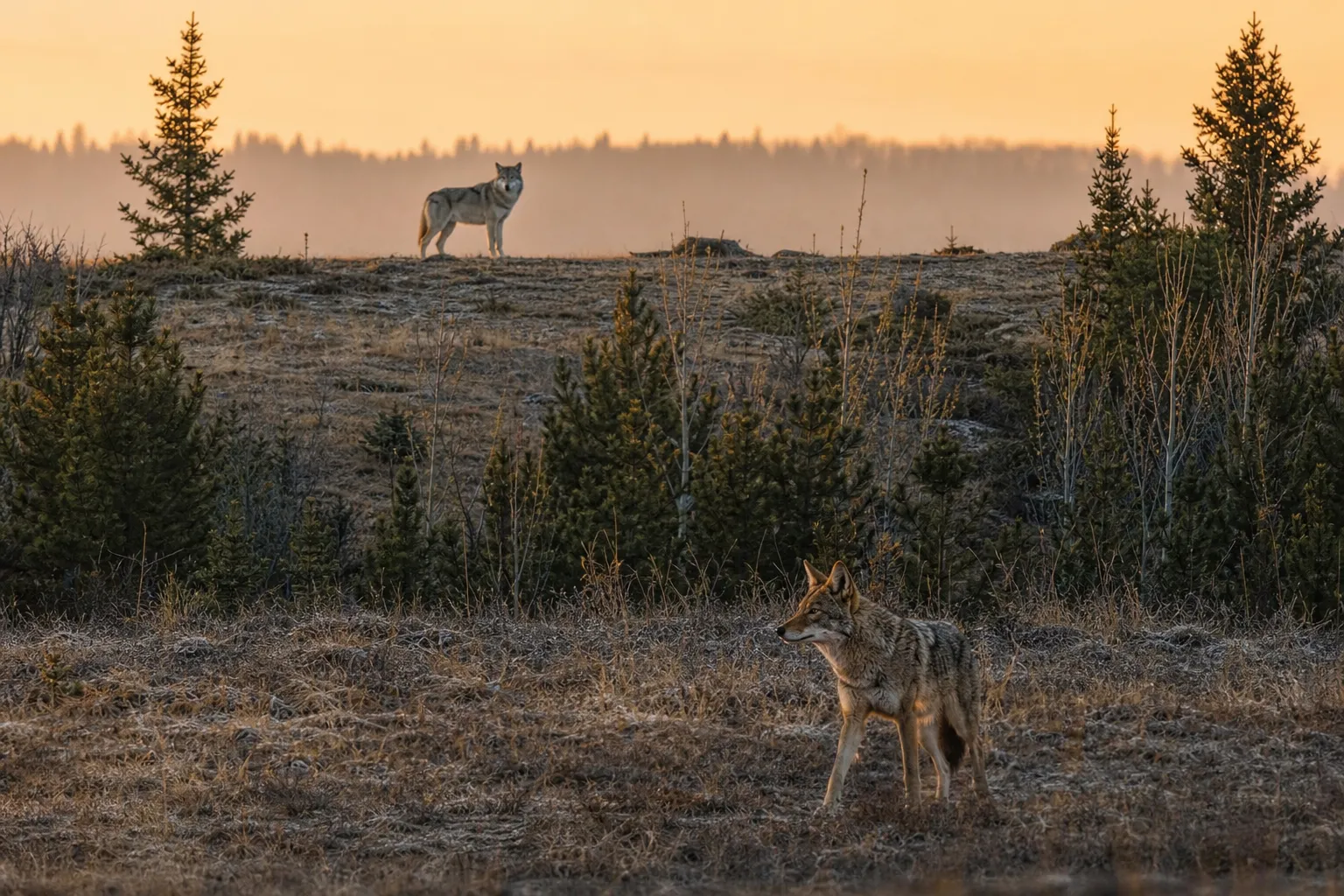
Coyotes and wolves are best separated by a combination of size, build, head shape, tracks and sound. Adult wolves are generally larger animals with bigger feet, smaller rounded ears in proportion to the head and a shorter, blockier muzzle. Coyotes are smaller, with a narrower face, pointier muzzle and larger pointed ears relative to the head. Do not rely on one clue in poor light or at long distance, because the National Park Service cautions that telling wolves from coyotes and dogs is not easy when lighting is poor, a sighting is brief or the animal is far away.
Quick identification table
| Feature | Coyote | Wolf |
|---|---|---|
| Adult height and weight | The National Park Service lists coyotes at 16 to 20 inches at the shoulder and 20 to 30 pounds. | The National Park Service lists gray wolves at 26 to 34 inches at the shoulder and 70 to 115 pounds. |
| Build | Parks Canada describes coyotes as medium sized grayish dogs with a slender muzzle, large pointed ears and a bushy tail. | Parks Canada describes wolves as similar to a large German shepherd, but lankier, with longer legs and larger feet. |
| Ears | NYSDEC describes coyote ears as large relative to the head and pointed. | NYSDEC describes wolf ears as proportionally small and rounded. |
| Snout | NYSDEC says coyotes have long, narrow snouts that end in a point. | NYSDEC says wolves have a shorter, blockier snout than coyotes. |
| Face and coat clues | Parks Canada at Riding Mountain says coyotes have a smaller, narrower face, a pointier nose, larger relative ears, smaller bodies and reddish gray coats compared with wolves. | Parks Canada at Riding Mountain contrasts wolves with coyotes by body size, face width, nose shape and relative ear size. |
| Track size | NYSDEC says coyote tracks typically measure 3 inches long by 2 inches wide. Parks Canada says coyote tracks in Banff average 6.4 centimeters long. | NYSDEC says wolf tracks are about 5 inches long by 4 inches wide. Parks Canada says wolf tracks in Banff measure 10 to 12 centimeters long. |
| Track shape | Parks Canada says coyote tracks have four toe pads, visible claws and an elongated, symmetrical footprint. The National Park Service says coyote tracks are narrower and more oval than a dog’s mostly round paw print. | Parks Canada says wolf tracks are elongated and symmetrical, have a triangular heel pad and often travel in trenches through deep snow. |
| Vocalizations | Florida FWC says coyotes make vocalizations ranging from barking to shrill yips and howls. Iowa DNR says high pitched yipping, yelping or an excited quality suggests coyote. | The National Park Service says adult wolf howls are long and clear, not broken by short yaps and barks. Iowa DNR describes wolf howls as usually longer, lower and more consistent in pitch. |
| Group behavior | Florida FWC says a resident coyote pair establishes a territory shared by members of the family group, and coyotes usually hunt alone, sometimes as a pair and rarely as a group. | The National Park Service says wolves live in family packs of two to 12 or more members. Alberta says wolves are found in packs of two to more than 20, with pack size tending to be largest in winter. |
| Range note | Parks Canada says coyotes occur over most of North America, from Alaska to Mexico and from the prairies east to southern Ontario, Quebec and the Atlantic Provinces. | Wolf protection and management status varies by country and jurisdiction. Confirm current status with the responsible wildlife agency. |
Size and build: the fastest field clue
When you have a clear look, size is usually the quickest clue. The National Park Service comparison lists coyotes at 16 to 20 inches at the shoulder and 20 to 30 pounds, while gray wolves are listed at 26 to 34 inches at the shoulder and 70 to 115 pounds.
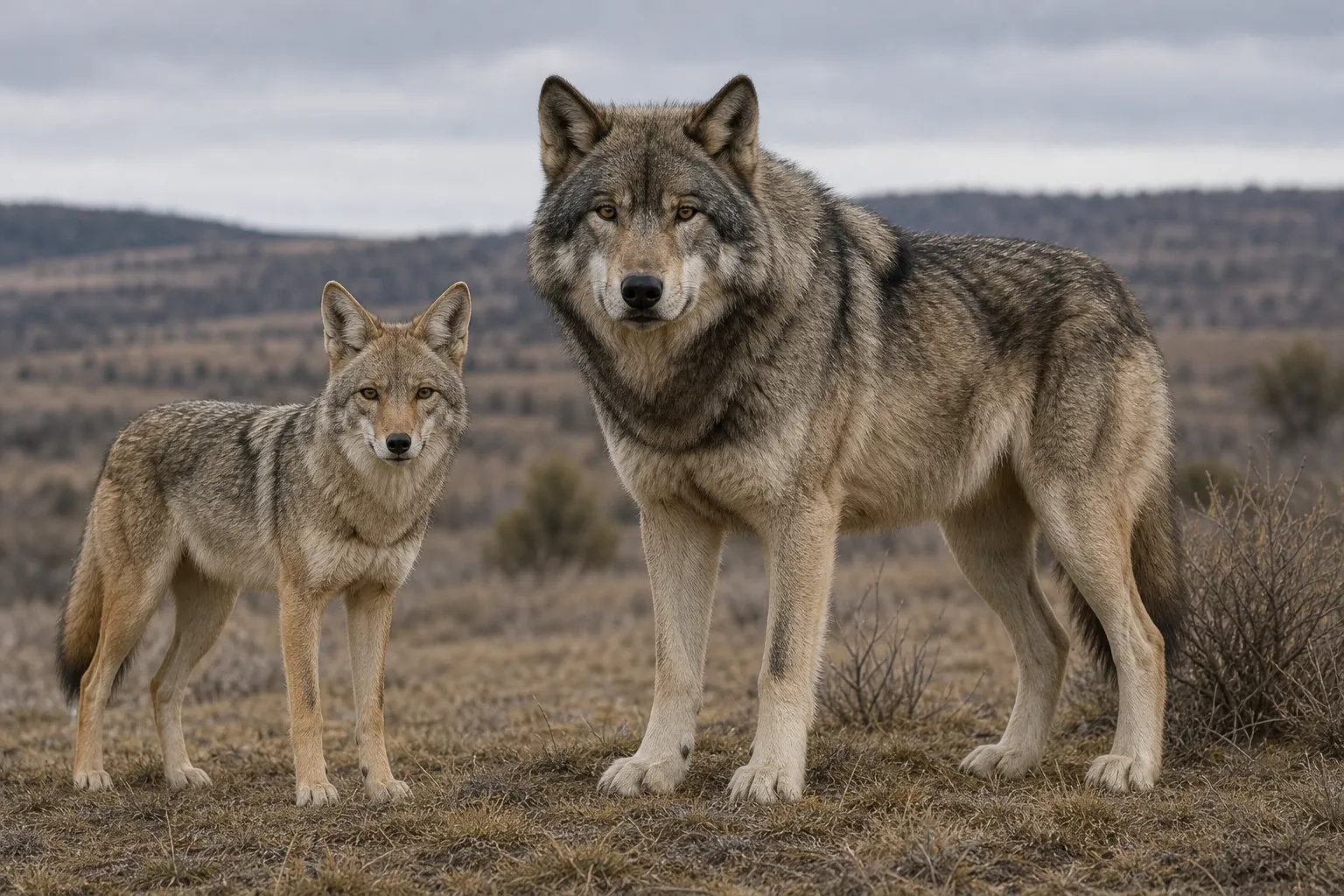
Build matters as much as raw size. Parks Canada describes a wolf as similar in appearance to a large German shepherd, but lankier, with longer legs and larger feet. Parks Canada describes coyotes as medium sized grayish dogs with a slender muzzle, large pointed ears and a bushy tail.
Head shape: ears and muzzle
If the animal pauses or faces sideways, look at the ears and muzzle. NYSDEC says wolves have proportionally small, rounded ears and a shorter, blockier snout than coyotes.
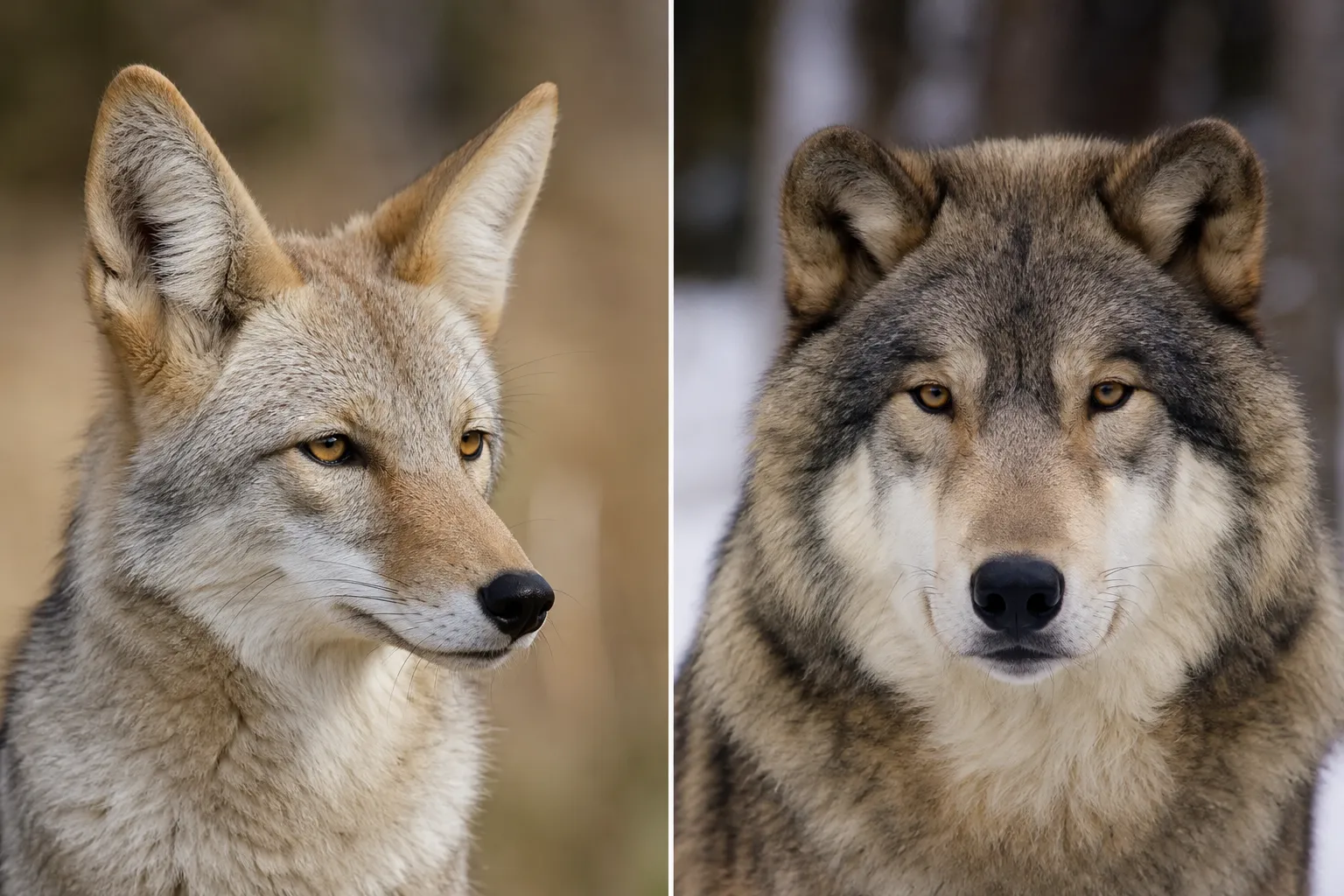
Coyotes show the opposite pattern. NYSDEC says coyotes have long, narrow snouts that end in a point, with ears that are large relative to the head and pointed in shape.
Parks Canada at Riding Mountain gives a useful overall comparison: coyotes have a smaller, narrower face, pointier nose, larger ears relative to head size, smaller bodies and reddish gray coats compared with wolves.
Tracks: size first, then shape
Tracks can be a strong clue when the print is clear. NYSDEC says wolf tracks are about 5 inches long by 4 inches wide, while coyote tracks typically measure 3 inches long by 2 inches wide. Parks Canada’s Banff track guide gives coyote tracks as averaging 6.4 centimeters long and wolf tracks as 10 to 12 centimeters long.
Shape can help, but overlap and substrate can make tracks tricky. Parks Canada says coyote tracks have four toe pads, visible claws and an elongated, symmetrical footprint. For wolves, Parks Canada describes elongated, symmetrical tracks with a triangular heel pad. It also notes that wolves often travel in trenches through deep snow.
Do not confuse every canid track with a coyote. The National Park Service says coyote tracks are narrower and more oval than a dog’s mostly round paw print.
Vocalizations: yips versus long clear howls
Sound is another clue, especially at night. The National Park Service says adult wolf calls differ from coyotes and dogs because wolf howls are long and clear, not interrupted by short yaps and barks. The same agency says wolf howling helps pack members keep track of each other, establish territories, assemble the pack and defend a kill.
Coyotes can be much more varied in sound. Florida FWC says coyotes make vocalizations ranging from barking to shrill yips and howls. Iowa DNR says wolf howls are usually longer, lower and more consistent in pitch, while high pitched yipping, yelping or an excited quality suggests coyote.
A single sound heard briefly may not be enough for a firm identification. Use vocalizations together with location, tracks and any visual clues.
Pack and family behavior
Wolves are strongly associated with family packs. The National Park Service says wolves live in family groups called packs made up of two to 12 or more members. Alberta says wolves are social animals found in packs numbering from two to more than 20, with pack size tending to be largest in winter.
Coyotes can live in family territories too, but their hunting behavior is different. Florida FWC says a resident coyote pair establishes a territory shared only by other members of its family group. The agency also says coyotes usually hunt alone, sometimes as a pair and rarely as a group.
Seeing several animals together does not automatically prove they are wolves, and seeing one animal alone does not automatically prove it is a coyote. Treat group size as supporting evidence, not the whole answer.
Range and eastern identification issues
Coyotes have a very broad North American range. Parks Canada says coyotes can be found over most of North America, from Alaska down to Mexico, and from the prairies east to southern Ontario, Quebec and the Atlantic Provinces.
Eastern Canada and parts of the northeastern United States can be more complicated for identification. Parks Canada says animals in eastern Canada are actually a coyote wolf mix and that the eastern coyote is somewhat larger than its western ancestors because of wolf ancestry.
Eastern wolf identification can also be complex. Environment and Climate Change Canada says the exact range of the Eastern Wolf is not known partly because it hybridizes with gray wolves, and that identification of this taxon requires molecular analysis.
Protection status and why confirmation matters
Wolf protection status varies by country and jurisdiction.
In Canada, Environment and Climate Change Canada says gray wolf is classified as Secure overall in Canada, while the eastern gray wolf has a separate Species at Risk Act status.
These status notes are not hunting regulations. Seasons, take rules, reporting rules, protected areas and species identification requirements can change. Before acting on any hunting, trapping, livestock protection or wildlife control decision, confirm the current rule and current species status with the responsible state, provincial, territorial, federal or tribal wildlife agency.
Practical field checklist
Use this order when you have only seconds:
- Overall size: wolf much larger, coyote smaller.
- Legs and feet: Parks Canada describes wolves as longer legged with larger feet.
- Ears: wolf ears smaller and rounded in proportion to the head, coyote ears larger and pointed.
- Muzzle: wolf muzzle shorter and blockier, coyote muzzle longer, narrower and pointed.
- Tracks: NYSDEC lists wolf tracks at about 5 by 4 inches, coyote tracks at about 3 by 2 inches.
- Sound: long, clear, lower howl suggests wolf. Barking, shrill yips, yelps or excited high pitched howls suggest coyote.
- Location and status: check the responsible wildlife agency, especially in wolf range or eastern coyote and eastern wolf areas.
Frequently asked questions
What is the easiest way to tell a coyote from a wolf?
Use several clues together, but size and head shape are the strongest quick checks. The National Park Service lists gray wolves as much taller and heavier than coyotes, while NYSDEC describes wolves as having smaller rounded ears and a blockier snout. Coyotes have larger pointed ears relative to the head and a narrower, pointier muzzle.
How big are coyote tracks compared with wolf tracks?
NYSDEC says coyote tracks typically measure 3 inches long by 2 inches wide, while wolf tracks are about 5 inches long by 4 inches wide. Parks Canada lists Banff coyote tracks at an average of 6.4 centimeters long and wolf tracks at 10 to 12 centimeters long.
Do coyotes and wolves sound different?
Yes. The National Park Service says adult wolf howls are long and clear, not broken by short yaps and barks. Florida FWC says coyotes make vocalizations ranging from barking to shrill yips and howls, and Iowa DNR says high pitched yipping or yelping suggests coyote.
Do wolves always travel in packs and coyotes always travel alone?
No. The National Park Service says wolves live in family packs of two to 12 or more members, and Alberta says wolf packs can number from two to more than 20. Florida FWC says coyotes usually hunt alone, sometimes as a pair and rarely as a group, while resident pairs share a territory with family group members.
Why are eastern coyotes harder to identify?
Parks Canada says eastern coyotes in eastern Canada are a coyote wolf mix and are somewhat larger than their western ancestors. Environment and Climate Change Canada also says Eastern Wolf identification can require molecular analysis because of hybridization.
Should I check regulations before hunting or taking action?
Yes. Wolf protection status varies by jurisdiction. Confirm current species status, hunting rules and any reporting or control requirements with the responsible wildlife agency before acting.
Sources
- Wolf Description and Biology, North Cascades National Park, National Park ServiceOfficial source. Accessed October 22, 2026.
- Coyotes, National Park ServiceOfficial source. Accessed October 22, 2026.
- Dog family, Banff National Park, Parks CanadaOfficial source. Accessed October 22, 2026.
- Identifying carnivore tracks, Banff National Park, Parks CanadaOfficial source. Accessed October 22, 2026.
- Wolves, Riding Mountain National Park, Parks CanadaOfficial source. Accessed October 22, 2026.
- Eastern coyote, Fundy National Park, Parks CanadaOfficial source. Accessed October 22, 2026.
- Wolf hunting and trapping, Wisconsin Department of Natural ResourcesOfficial source. Accessed October 22, 2026.
- Distinguishing Wolves from Coyotes, New York State Department of Environmental ConservationOfficial source. Accessed October 22, 2026.
- Wolves and outdoor recreation, Government of AlbertaOfficial source. Accessed October 22, 2026.
- Coyote, Florida Fish and Wildlife Conservation CommissionOfficial source. Accessed October 22, 2026.
- 4 Quick Ways to Tell A Wolf from a Coyote, Iowa Department of Natural ResourcesOfficial source. Accessed October 22, 2026.
- Gray Wolf Recovery News and Updates, U.S. Fish and Wildlife ServiceOfficial source. Accessed October 22, 2026.
- Eastern Wolf (Canis lupus lycaon): Management Plan 2021, Environment and Climate Change CanadaOfficial source. Accessed October 22, 2026.
- Grey wolf: non-detriment finding, Environment and Climate Change CanadaOfficial source. Accessed October 22, 2026.