Mule Deer vs Whitetail: How to Tell Them Apart
Mule deer and whitetail deer are usually easiest to separate by the tail, ears, escape gait and antler pattern on mature bucks. Antlers and body size can help, but they should not be used alone because both vary.
By RaiS. Reviewed by RaiS. Published . 7 min read.
Research and drafting were assisted by AI. RaiS checked the facts against the sources below and approved this page.
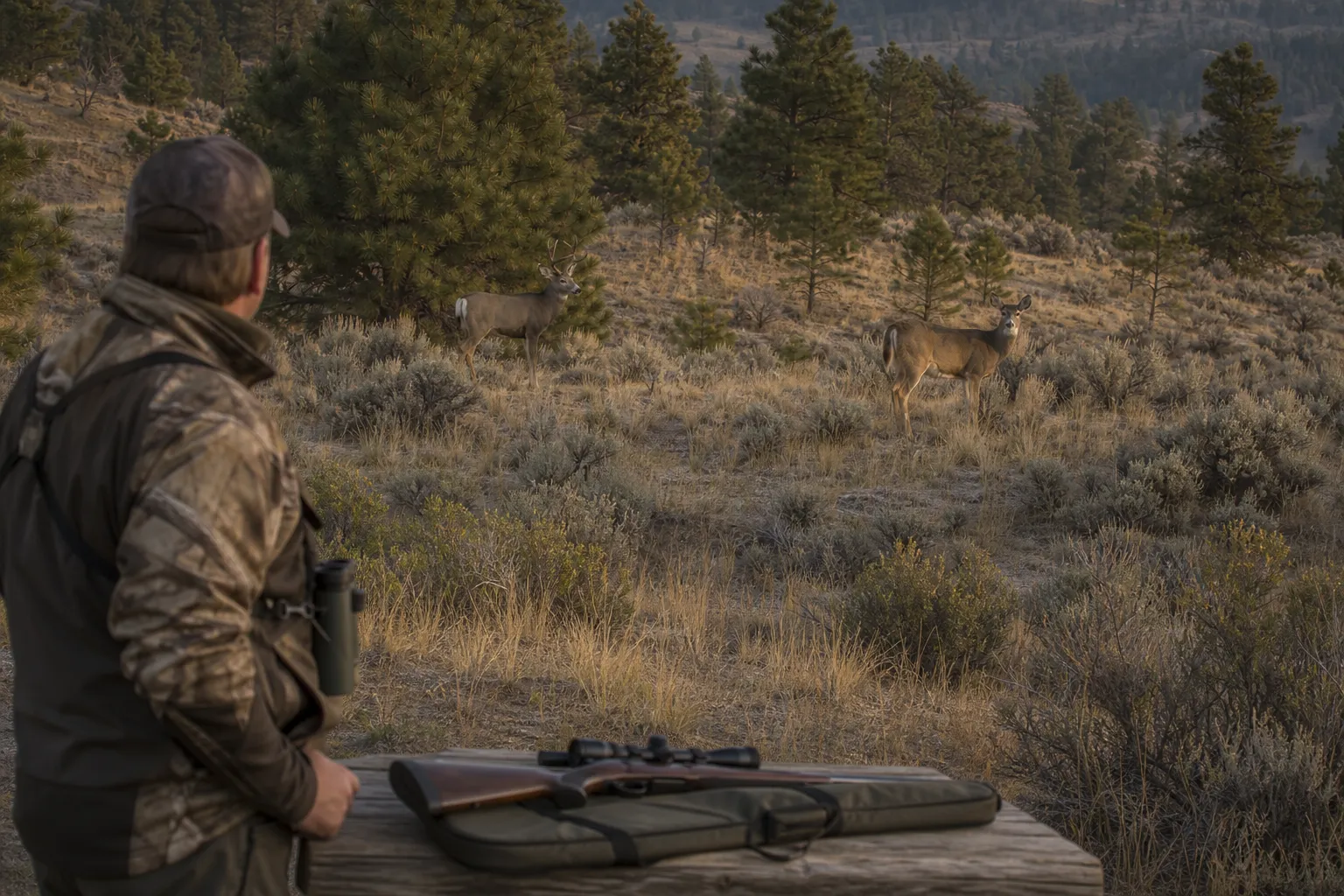
Mule deer and white-tailed deer are easiest to tell apart by the tail first, then the ears, escape gait and antler pattern on older bucks. If the animal runs, Colorado Parks and Wildlife says mule deer bound with a stiff-legged gait and the tail held down, while white-tailed deer move with a graceful lope and hold the broad white tail erect.
For full species profiles, see the ProjectGuns Mule Deer guide and Whitetail Deer guide. This page focuses only on field identification where the two species overlap.
Fast field ID
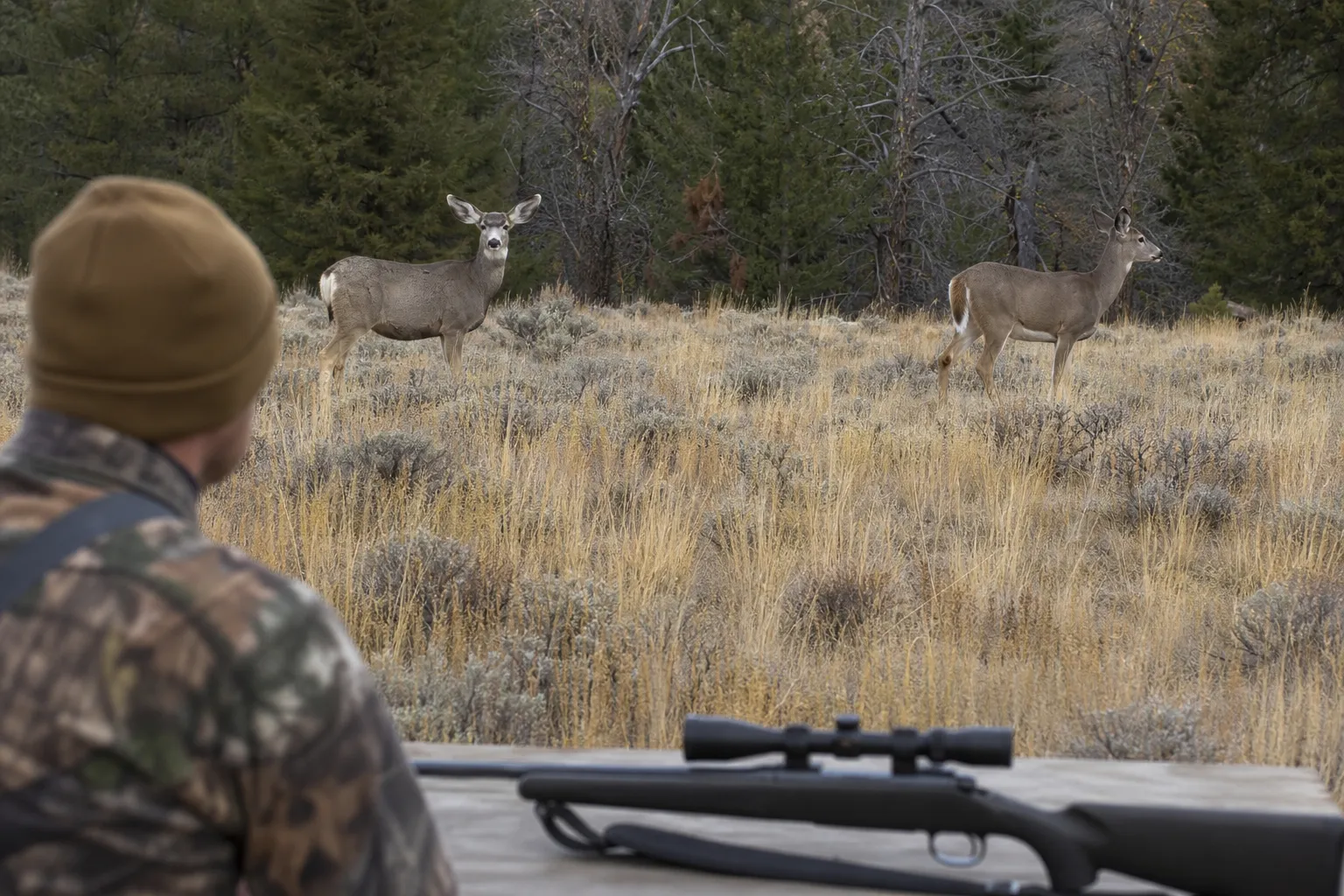
Use several marks together. Tail shape is usually the fastest field clue, but ears, gait and antlers help confirm the identification.
| Trait | Mule deer | White-tailed deer |
|---|---|---|
| Tail | Colorado Parks and Wildlife describes mule deer as having rope-like tails. A USFS-hosted article describes the mule deer tail as cylindrical, hanging like a short piece of white rope, usually white on the back side with a distinctive black tip. | Colorado Parks and Wildlife describes broad white tails. |
| Ears | Colorado Parks and Wildlife calls them large ears. | Colorado Parks and Wildlife describes smaller ears. |
| Antlers on older bucks | Texas A&M AgriLife Extension says mule deer antlers are usually bifurcated, meaning the tines come in forked pairs. | Colorado Parks and Wildlife describes a single main beam bearing smaller tines. |
| Metatarsal glands | A USFS-hosted article says mule deer metatarsal glands sit high on the lower leg and are 4 to 6 inches long. | The same article says whitetail metatarsal glands are at or below the midpoint of the lower leg and are usually less than one inch. |
| Escape gait | Colorado Parks and Wildlife describes a stiff-legged bound with the tail held down. | Colorado Parks and Wildlife says whitetails move with a graceful lope and hold the flag-like tail erect. |
Tail and rump: the best first look
Start with the tail because several wildlife agencies use it as a primary identification mark. Colorado Parks and Wildlife also describes mule deer as having rope-like tails.
A USFS-hosted article by authors including Arizona Game and Fish, Wildlife Genetics International and the U.S. Forest Service describes the mule deer tail as cylindrical, hanging like a short piece of white rope, usually white on the back side with a distinctive black tip.
Whitetails look different from behind. Colorado Parks and Wildlife describes whitetails as having broad white tails.
When a deer leaves, the tail can become even more obvious. Colorado Parks and Wildlife says white-tailed deer hold the flag-like tail erect when moving off. Colorado Parks and Wildlife describes mule deer as bounding with a stiff-legged gait, the tail held down.
Ears and head marks
Mule deer get their common field nickname from their ears. Colorado Parks and Wildlife describes mule deer as having large ears.
Whitetail ears are smaller by comparison. Colorado Parks and Wildlife describes white-tailed deer as having smaller ears.
The USFS-hosted hybrid article gives a useful proportion: whitetail ears are generally about two-thirds the overall head length, from the back of the head to the nose, while mule deer ears are about three-quarters of head length. That difference is easiest to judge when the deer is standing broadside or looking sideways rather than head-on.
Antlers: helpful, but not enough by themselves
Antlers can be useful on older bucks, especially when the view is clear. Texas A&M AgriLife Extension describes mule deer antlers as usually bifurcated, with tines in forked pairs.
Whitetail antlers usually follow a different pattern. Colorado Parks and Wildlife describes whitetail antlers as having a single main beam bearing smaller tines.
Do not make a difficult call on antlers alone. Texas A&M AgriLife Extension cautions that antlers alone are not a great indicator of species because of individual variation. That caution matters most with young bucks, partial views and unusual antlers.
Metatarsal glands: strong evidence, hard to see
Metatarsal glands are on the hind legs, and they can be a strong identification clue when visible.
The USFS-hosted hybrid article gives more detail. It says mule deer metatarsal glands sit high on the lower leg and are 4 to 6 inches long, while whitetail metatarsal glands are at or below the midpoint of the lower leg and are usually less than one inch.
That mark is not always practical in the field. A standing deer in grass, brush, snow or poor light may not show the gland clearly. For a distant animal, tail, rump, ears and gait are usually more useful.
Body size: useful context, not a primary ID mark
Body size can support an identification, but it is not reliable by itself. Texas A&M AgriLife Extension says the average body size of mule deer is usually larger than white-tailed deer, but also says body size is not a great identification tool because the two species are rarely standing next to each other for comparison.
North Dakota Game and Fish shows why size can overlap. For mule deer, North Dakota Game and Fish lists bucks averaging 170 pounds, with a range of 125 to 330 pounds, and does averaging 140 pounds, with a range of 110 to 210 pounds. For white-tailed deer, it lists bucks averaging 170 pounds, with a range of 100 to 330 pounds, and does averaging 130 pounds, with a range of 90 to 210 pounds.
Those North Dakota figures make size a poor single field mark. A large whitetail and a smaller mule deer can overlap in apparent size, especially when distance, age, sex and posture are unknown.
Gait and alarm behavior
Escape style is one of the clearest differences when the animal is moving. Colorado Parks and Wildlife describes mule deer as bounding with a stiff-legged gait and the tail held down.
Whitetails tend to leave differently. Colorado Parks and Wildlife says white-tailed deer move with a graceful lope and hold the flag-like tail erect.
If you only saw the animal after it jumped or ran, combine the gait with the tail. A stiff-legged bound with the tail down points toward mule deer. A loping deer with a raised white flag points toward whitetail.
Range overlap and habitat
The two species overlap across a large part of western North America. A USFS-hosted article states that white-tailed deer and mule deer distributions overlap in a large section of western North America. WAFWA says mule deer and black-tailed deer are distributed through western North America from Alaska and the West Coast to southern Baja Mexico, through the Great Plains and into western Canada.
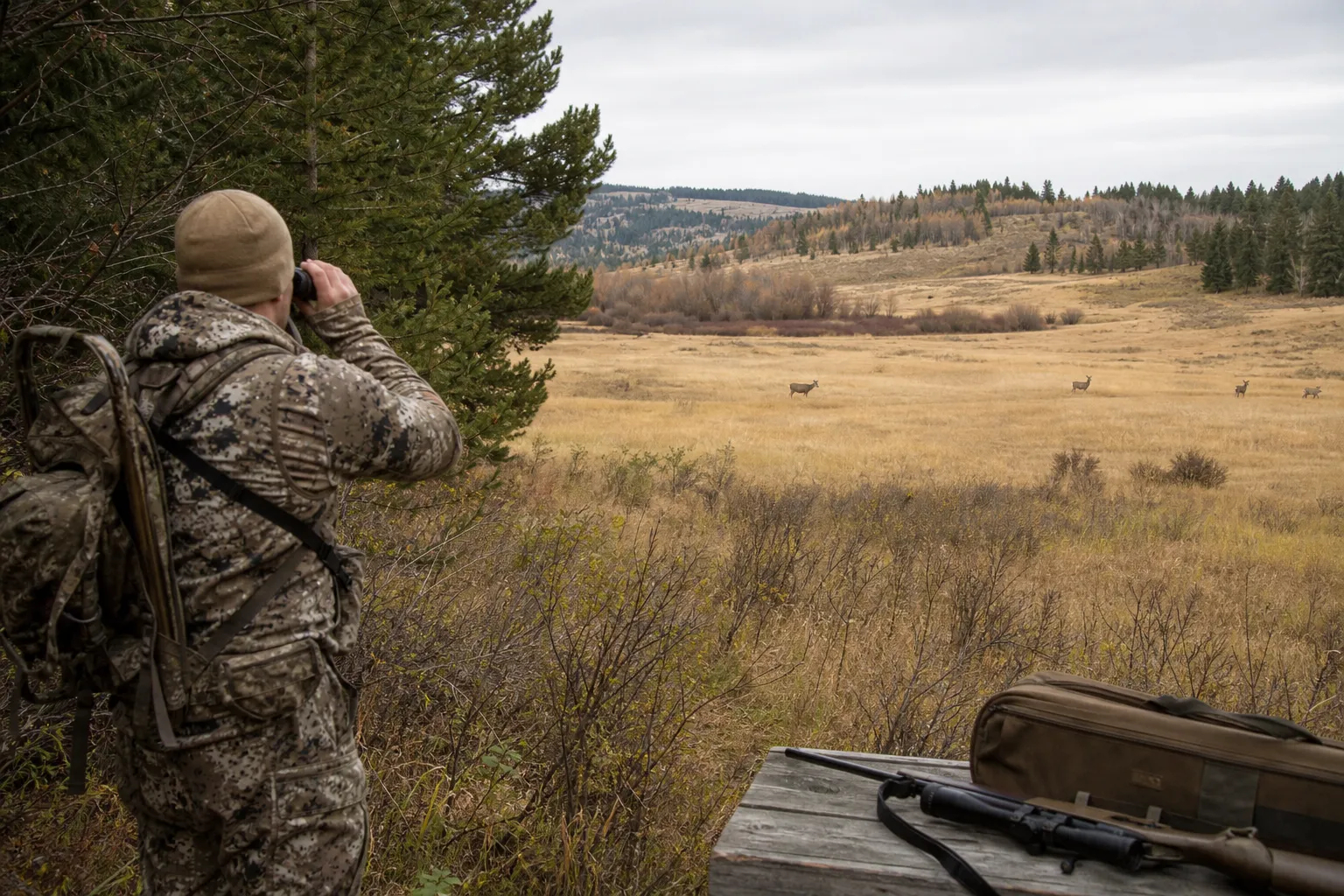
Habitat can give context, but it should not replace visible field marks. The USFS-hosted article says that where both species are found, mule deer typically use higher mountain areas and whitetails use lower valleys and river systems, with a Southwest exception.
State and federal habitat descriptions show how broad the habitats can be. North Dakota Game and Fish says mule deer habitat includes sagebrush plains and shortgrass prairie associated with buttes and rough badlands terrain. NRCS says mule deer inhabit every principal vegetative ecosystem in western North America except tundra, subtropic and extreme desert regions, and lists open grasslands, agricultural land, shrublands, woodlands, mountain forests, semi-deserts and high mountain ecosystems as mule deer habitats.
Whitetails are also adaptable. North Dakota Game and Fish says white-tailed deer live in riparian areas, forests, prairie, agricultural land and suburban areas. Colorado Parks and Wildlife says Colorado whitetails have become increasingly common in streamside woodland and nearby croplands along eastern plains rivers.
Hybrids and tough calls
Hybrids are documented where mule deer and whitetail ranges overlap, but they should not be assumed from one odd-looking feature. The USFS-hosted hybrid article says confirmed whitetail and mule deer hybrids are rare despite documentation in overlap areas.
The same article identifies metatarsal glands as the key physical diagnostic clue for a hybrid specimen. It says hybrid deer have metatarsal glands between 2 and 4 inches, splitting the difference between mule deer and whitetail lengths.
That does not make hybrid identification easy in the field. Metatarsal glands are hard to see at a distance, and Texas A&M AgriLife Extension cautions that antlers alone are not a strong species identification tool because antlers vary. For a difficult identification, rely on multiple visible traits rather than a single feature.
Bottom line for hunters and wildlife watchers
Use a checklist, not one clue. Tail comes first, ears come second, gait is very helpful if the animal moves, and mature buck antlers can support the call. Body size and habitat add context but should not decide the identification by themselves.
If identification affects a hunting decision, check the current materials from the state or provincial wildlife agency for the exact area you are in. Agency identification guides and any current hunt documents should be confirmed before you act in the field.
Frequently asked questions
What is the quickest way to tell a mule deer from a whitetail?
Start with the tail when it is visible. Mule deer are commonly described as having a rope-like tail, while whitetails show a broad white flag when moving off.
Do mule deer and whitetail antlers always look different?
No. Texas A&M AgriLife Extension describes mule deer antlers as usually bifurcated, while Colorado Parks and Wildlife describes whitetail antlers as having a single main beam bearing smaller tines. Texas A&M AgriLife Extension cautions that antlers alone are not a great species ID tool because individual antlers vary.
Which deer has bigger ears?
Mule deer have larger ears in proportion to the head. Colorado Parks and Wildlife describes mule deer as having large ears and whitetails as having smaller ears.
How do they move when startled?
Colorado Parks and Wildlife describes mule deer as bounding with a stiff-legged gait and the tail held down. It says whitetails move with a graceful lope and hold the flag-like tail erect.
Can mule deer and whitetails hybridize?
Yes, hybrids are documented in overlap areas. A USFS-hosted article says confirmed hybrids are rare and identifies intermediate metatarsal glands as the key physical diagnostic clue for a hybrid specimen.
Is body size a reliable way to tell them apart?
No. Texas A&M AgriLife Extension says mule deer are usually larger on average, but body size is not a great field identification tool because both species are rarely standing side by side and size overlaps.
Sources
- Is that a mule deer or white-tailed deer?, Idaho Fish and GameOfficial source. Accessed October 24, 2026.
- Mule Deer, Colorado Parks and WildlifeOfficial source. Accessed October 24, 2026.
- White-Tailed Deer, Colorado Parks and WildlifeOfficial source. Accessed October 24, 2026.
- Arizona Deer Identification, Arizona Game and Fish DepartmentOfficial source. Accessed October 24, 2026.
- Mule Deer, Arizona Game and Fish DepartmentOfficial source. Accessed October 24, 2026.
- White-tailed Deer, Arizona Game and Fish DepartmentOfficial source. Accessed October 24, 2026.
- Mule Deer, North Dakota Game and Fish DepartmentOfficial source. Accessed October 24, 2026.
- White-tailed Deer, North Dakota Game and Fish DepartmentOfficial source. Accessed October 24, 2026.
- Deer of Texas, Texas A&M AgriLife Extension Wildlife & Fisheries. Accessed October 24, 2026.
- Mule Deer, Fish and Wildlife Habitat Management Leaflet Number 28, USDA Natural Resources Conservation Service and Wildlife Habitat CouncilOfficial source. Accessed October 24, 2026.
- Mule Deer Working Group Habitat Guidelines, Western Association of Fish & Wildlife AgenciesOfficial source. Accessed October 24, 2026.
- Keep Trophy Records Honest: Identifying Whitetail/Mule Deer Hybrids, U.S. Forest Service hosted PDF, Fair Chase article with agency and genetics authors. Accessed October 24, 2026.
- Differentiation of Mule Deer and White-Tailed Deer, Nebraska Game and Parks Commission, via University of Nebraska Digital CommonsOfficial source. Accessed October 24, 2026.
- Mule deer, Oregon Department of Fish and WildlifeOfficial source. Accessed October 24, 2026.
- Deer & elk identification, Minnesota Department of Natural ResourcesOfficial source. Accessed October 24, 2026.