Birdshot Sizes Explained: Shot Size Chart for Lead and Steel
Birdshot size numbers run backward: higher numbers are smaller pellets, while B and BB are larger letter sizes. This guide explains #9 through BB, approximate lead pellet counts, and why steel is often chosen one or two sizes larger than lead.
By RaiS. Reviewed by RaiS. Published . 6 min read.
Research and drafting were assisted by AI. RaiS checked the facts against the sources below and approved this page.
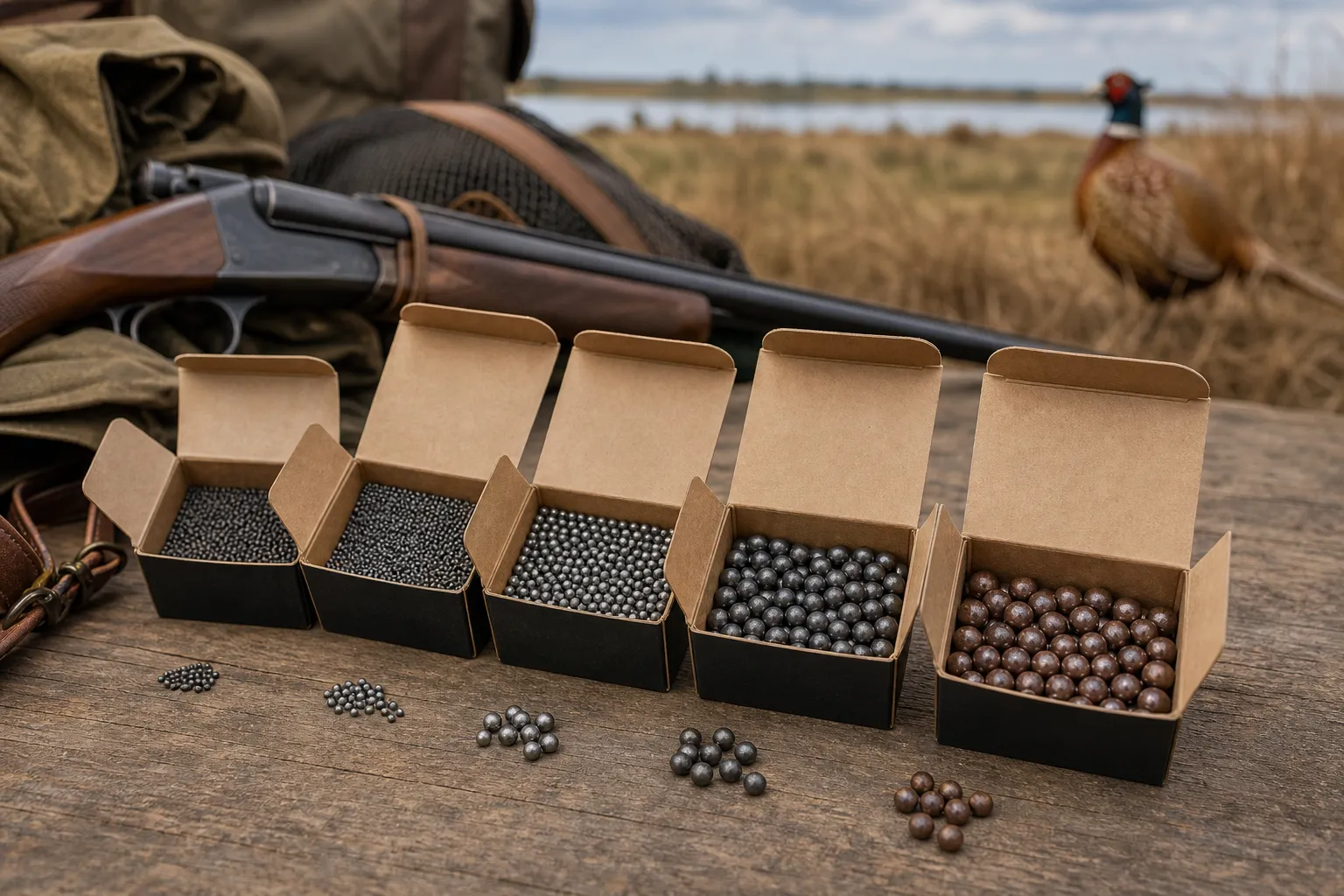
Birdshot size numbers tell you the average pellet diameter. In the common #9 through BB range, higher numbers mean smaller pellets, while lower numbers and letter sizes mean larger pellets. SAAMI defines shot size as a numerical or letter designation for average pellet diameter, and its formula for numbered shot is simple: 17 minus the number designation, divided by 100, gives the average diameter in inches.
What birdshot size numbers mean
For numbered shot, the system runs backward from what many beginners expect. A #9 pellet is smaller than a #8 pellet. A #6 pellet is larger than #8. A #1 pellet is larger still.
SAAMI gives this formula for numbered shot diameter:
(17 minus shot number) divided by 100 = average diameter in inches
SAAMI’s example is #6 shot: 17 minus 6 equals 11, divided by 100, for an average diameter of 0.11 inch.
Winchester’s shot size chart lists the sequence from #9 through #1, followed by letter sizes B and BB, then larger sizes such as BBB and T. This guide focuses on #9 through BB because that is the birdshot range most clay shooters and bird hunters are trying to understand. For pellets larger than BB, see our Buckshot Sizes guide.
Federal’s chart gives useful metric bookends for this range: #9 is 0.08 inch, or 2.03 mm, and BB is 0.18 inch, or 4.57 mm.
Birdshot size chart: lead and steel
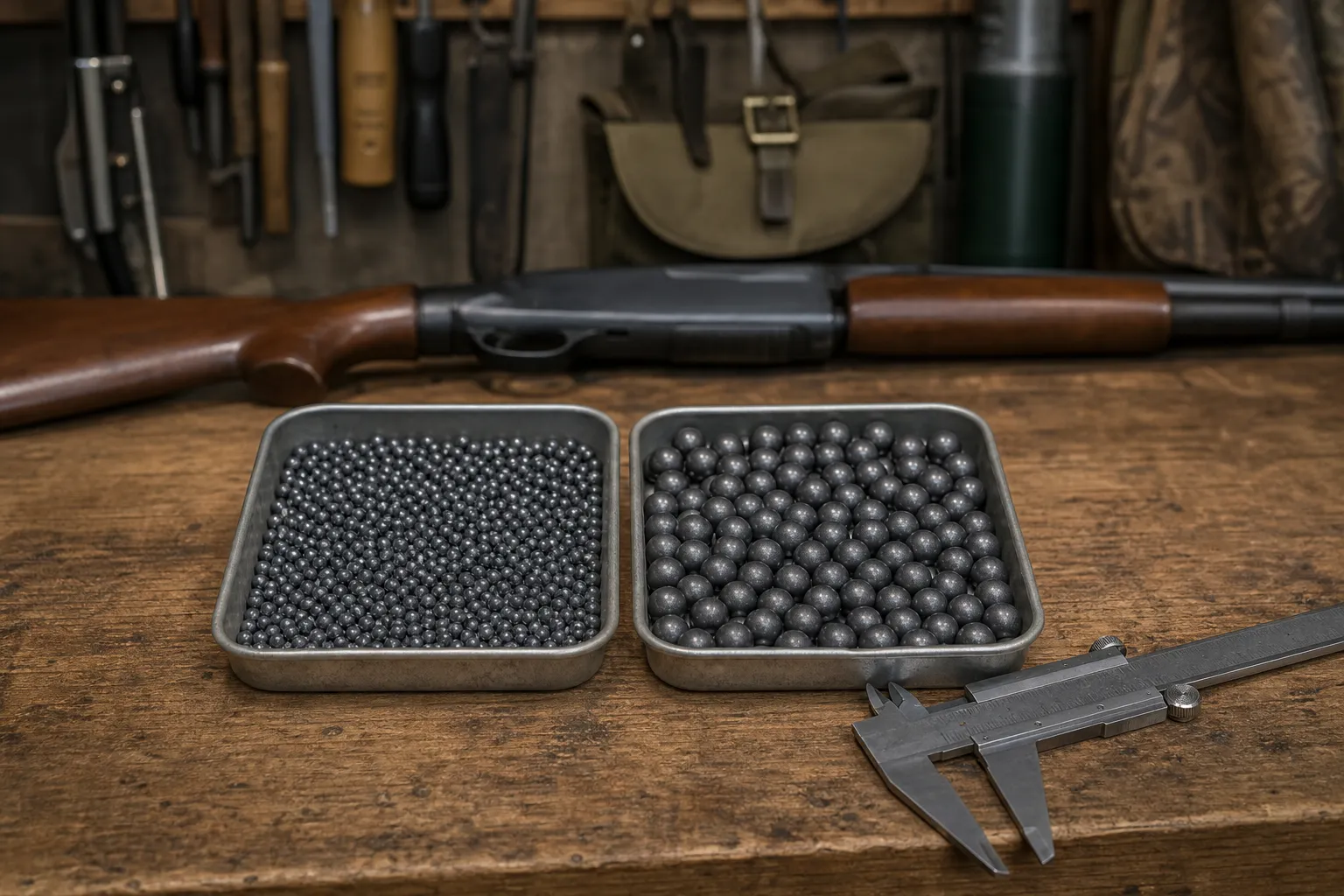
The chart below combines the nominal diameters listed by Winchester with lead pellet counts from Federal’s published shotshell tables. Pellet counts are best read as approximate comparisons, not exact counts for every shell.
| Shot size | Nominal diameter, inches | Approx. lead pellets per oz. |
|---|---|---|
| #9 | 0.08 | 585 |
| #8.5 | 0.085 | 497 |
| #8 | 0.09 | 410 |
| #7.5 | 0.095 | 350 |
| #7 | 0.10 | |
| #6 | 0.11 | 225 |
| #5 | 0.12 | 170 |
| #4 | 0.13 | 135 |
| #2 | 0.15 | 87 |
| B | 0.17 | |
| BB | 0.18 | 50 |
The main lesson from the chart is that pellet count changes quickly as pellet diameter changes. Federal’s lead table lists about 585 #9 lead pellets per ounce, compared with about 50 BB lead pellets per ounce.
That does not mean one size is automatically better than another. Shot size is always a tradeoff among pellet count, pattern density, pellet size, and the way a particular load patterns from a particular shotgun.
Pellet count, pattern density, and pellet energy
Smaller shot gives more pellets per ounce. Larger shot gives fewer pellets per ounce, but each pellet is larger. Federal describes the broad rule this way: small game calls for dense patterns with small shot, while larger game needs bigger pellets with a less dense pattern.
Winchester describes how a shotgun pattern changes in flight: a small, dense pattern close to the muzzle becomes wider and thinner downrange. That is why pellet count matters. More pellets can help fill the pattern, but only if the pattern is even enough from the gun, choke, and load being used.
Federal says patterning should show whether the pattern is dense enough for the intended game.
In plain terms:
- Smaller pellets usually mean more pellets in the payload and a denser pattern.
- Larger pellets usually mean fewer pellets in the payload.
- A pattern spreads and thins as distance increases.
- The only way to see what your shotgun is actually doing is to pattern the load and choke combination.
For more on how constriction affects patterns, see our Shotgun Chokes guide.
Why steel is often one or two sizes larger than lead
Steel and lead pellets of the same diameter are not the same weight. Alaska Department of Fish and Game states that steel is lighter and harder than lead, and that steel pellets weigh about one third less than lead pellets of the same size.
That weight difference is the reason many steel shot discussions tell hunters to go larger than the lead size they used before. Alaska Department of Fish and Game advises using steel shot one or two sizes larger than the usual lead load to compensate for weight differences and improve downrange energy.
There is still a tradeoff. Alaska Department of Fish and Game also warns that selecting overly large steel shot can create problems in hitting birds because pellet count is still needed. You gain pellet size, but you lose pellet count.
A simple way to think about the tradeoff is this: a steel pellet of the same diameter weighs less than a lead pellet. Moving to a larger steel size can help individual pellet energy, but it also lowers pellet count.
Federal notes that lead, steel, bismuth, and tungsten pattern differently through chokes, so shooters should pattern different loads at different distances. That matters more than choosing by chart alone.
Other nontoxic shot materials: bismuth and TSS
Steel is not the only nontoxic shot material. Federal lists bismuth pellets as almost as dense as lead at 9.6 g/cc.
Federal states that tungsten super shot, often called TSS, is a tungsten alloy that is 56 percent denser than lead. Federal says that density allows smaller shot without sacrificing downrange energy, while increasing pellet counts and pattern density.
Those material differences are why the same shot number does not tell the whole story. A #6 lead pellet, a #6 steel pellet, a #6 bismuth pellet, and a #6 TSS pellet share a nominal diameter, but the material changes pellet weight and pattern behavior.
Nontoxic shot rules in the United States and Canada
Legal requirements depend on species, location, season, and agency rules. The U.S. Fish and Wildlife Service states that the lead shot ban for hunting waterfowl became nationwide in 1991. The agency lists bismuth tin and iron, or steel, among approved nontoxic shot types for waterfowl hunting in the United States.
Canada’s Migratory Birds Regulations, 2022 state that a person must not hunt a migratory game bird while possessing or using shot other than nontoxic shot, subject to listed exceptions. The regulations define nontoxic shot to include iron, tungsten, tin, or bismuth within stated composition limits.
Always confirm current requirements with the wildlife agency for the place and species you plan to hunt. A shot material that appears in a general chart still has to match the rules for that hunt.
Where birdshot ends and buckshot begins
This guide stops at BB because BB is still part of the common birdshot chart range shown by Winchester. Winchester’s chart continues beyond BB to BBB and T, and shotgun pellet discussions eventually move into buckshot sizes.
If you are comparing larger pellets for defensive, law enforcement, or big game contexts, use the Buckshot Sizes guide instead. Birdshot charts and buckshot charts use different naming conventions, so it is better to keep them separate.
How to use a shot size chart
Use the diameter column to understand size. Use the pellet count columns to understand the pattern density tradeoff. Use the material information to understand why lead, steel, bismuth, and TSS are not interchangeable just because the number on the box is the same.
Then confirm two things before hunting or competition:
- Pattern your actual shotgun, choke, and load. Federal says to determine whether the pattern is dense enough for the game, and it notes that different shot materials pattern differently through chokes.
- Check the current regulations from the responsible wildlife agency. Nontoxic shot rules vary by jurisdiction and hunting context, and official rules control what may be used.
Frequently asked questions
Is a bigger birdshot number a bigger pellet?
No. For numbered birdshot, higher numbers are smaller pellets. SAAMI’s formula is 17 minus the shot number, divided by 100, for average diameter in inches.
How big is #6 shot?
SAAMI gives #6 shot as 0.11 inch average diameter, using the formula 17 minus 6, divided by 100.
How many pellets are in an ounce of #8 lead shot?
Federal’s lead pellet count table lists about 410 #8 lead pellets per ounce.
Why do hunters often choose larger steel shot than lead?
Alaska Department of Fish and Game states that steel pellets weigh about one third less than lead pellets of the same size, and advises using steel one or two sizes larger than the usual lead load to help compensate for weight differences.
Is bismuth closer to lead or steel by density?
Federal lists bismuth pellets as almost as dense as lead at 9.6 g/cc.
Does shot size alone tell me what pattern I will get?
No. Federal states that lead, steel, bismuth, and tungsten pattern differently through chokes, so shooters should pattern different loads at different distances.
Sources
- SHOT SIZE, Sporting Arms and Ammunition Manufacturers' InstituteOfficial source. Accessed October 26, 2026.
- AMMO101: SHOTSHELL, Olin Winchester, LLC. Accessed October 26, 2026.
- Shotshell Science, Federal Premium. Accessed October 26, 2026.
- Ammo Basics: Shotshell, Federal Premium. Accessed October 26, 2026.
- What's on a Box of Shells, Winchester Ammunition. Accessed October 26, 2026.
- Non-Toxic Shot, Alaska Department of Fish and GameOfficial source. Accessed October 26, 2026.
- Nontoxic Shot Regulations For Hunting Waterfowl and Coots in the U.S., U.S. Fish and Wildlife ServiceOfficial source. Accessed October 26, 2026.
- Migratory Birds Regulations, 2022, Section 38, Government of Canada, Justice Laws WebsiteOfficial source. Accessed October 26, 2026.
- Migratory game bird hunting regulations: frequently asked questions, Environment and Climate Change CanadaOfficial source. Accessed October 26, 2026.
- Nontoxic Shot and Shot Size, Missouri Department of ConservationOfficial source. Accessed October 26, 2026.
- Handbook of Firearms and Ballistics, Brian J. Heard, via Probelab Forensic Science Consulting. Accessed October 26, 2026.