Free-Floating Barrels Explained: What They Are and Why Rifles Use Them
A free-floating barrel does not touch the stock or fore-end forward of the action. Rifle makers use the design to reduce changing pressure on the barrel so its vibration during firing is more repeatable.
By RaiS. Reviewed by RaiS. Published . 7 min read.
Research and drafting were assisted by AI. RaiS checked the facts against the sources below and approved this page.
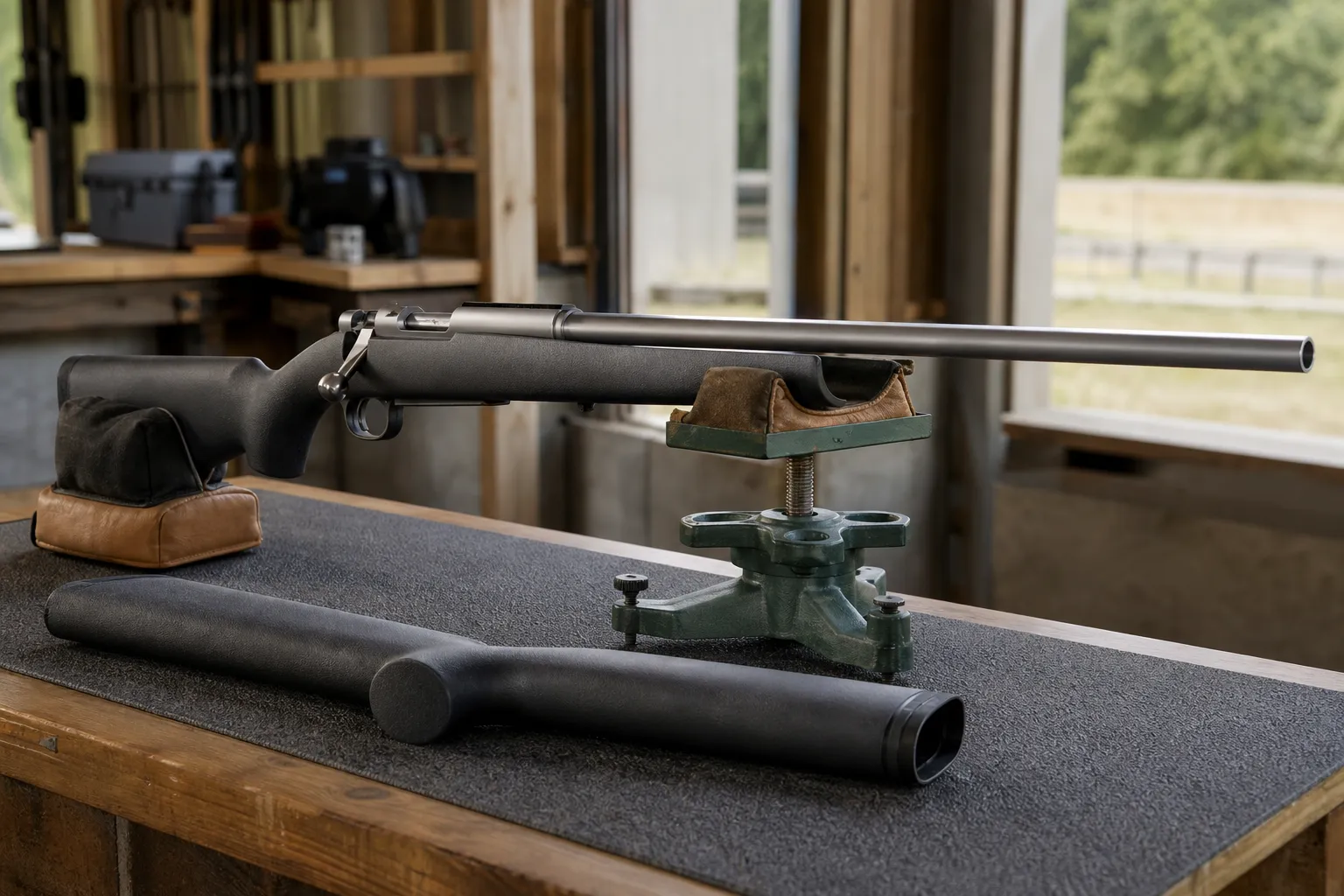
A free-floating rifle barrel is a barrel that does not touch the stock or fore-end forward of the action or receiver. Rifle makers use this layout because a barrel vibrates during firing, and changing pressure from the stock, fore-end, handguard, sling, bipod, or other contact can change how repeatable that vibration is.
What “free-floating barrel” means
Bergara describes a free-floating barrel as one that does not touch the stock at any point along its length from the action or receiver to the muzzle. Winchester gives the same basic idea for the Model 70, describing free-floating as a condition where no part of the forearm area touches the barrel.
In plain English, the barrel is attached at the receiver or action, but the stock or fore-end is not supposed to press against the barrel ahead of that point. If you are learning the parts of a rifle, the key distinction is between the action or receiver, which must be solidly supported, and the barrel, which is often left clear of the stock.
The term is most often heard with bolt-action hunting and precision rifles, but it also appears in AR-style rifles. In a bolt-action rifle, “free-floating barrel” usually refers to the barrel clearing the stock or fore-end. In an AR-style rifle, a “free-float handguard” or “free-float rail” means the handguard mounts to the upper receiver and does not touch the barrel, as Daniel Defense describes its free-float rail system.
Why barrel contact can affect point of impact
A rifle barrel is not motionless when a shot is fired. Winchester states that the XPR’s fully free-floating barrel is allowed to vibrate at its own frequency while the bullet travels through it. Sako’s bedding article also says the barreled action moves and vibrates in the stock during each shot.
That matters because the bullet leaves from the muzzle.
The practical idea is repeatability. If the muzzle is in the same position and orientation shot after shot, the rifle has a better chance of placing shots consistently. If pressure on the barrel changes from shot to shot, the vibration pattern can change too.
That pressure can come from several places. The manufacturer descriptions support the general concern with fore-end, stock, handguard, and other contact. Winchester specifically says forearm pressure can hurt accuracy. Daniel Defense says a rail that does not touch the barrel avoids interference with barrel harmonics, which can affect accuracy.
For a shooter, this is why the phrase “free-floating” is usually tied to consistency. It is not magic, and it is not the only thing that affects accuracy. It is one way rifle designers try to keep the barrel’s movement from being influenced by changing pressure along the fore-end.
Barrel harmonics in simple terms
“Harmonics” is the common shooting term for the way a barrel vibrates during firing. Winchester uses the idea directly when it says a free-floating barrel can vibrate at its own frequency during bullet travel. Daniel Defense also connects barrel contact with interference in barrel harmonics.
A smallbore target rifle reference describes the theory of fully floating barrels as allowing the barrel to vibrate and recoil freely.
For new precision shooters, the important point is not to imagine the barrel as a rigid pipe that stays perfectly still. It moves. Rifle makers try to make that movement consistent.
Free-floating barrels on factory bolt-action rifles
Many modern factory rifles advertise free-floating barrels as part of an accuracy-focused design. This is common on hunting rifles, target rifles, and chassis rifles.
Examples from manufacturer descriptions include:
| Manufacturer or rifle line | How the maker describes the design |
|---|---|
| Winchester Model 70 | Winchester describes free-floating as no part of the forearm touching the barrel, and says forearm pressure can hurt accuracy. |
| Winchester XPR | Winchester says the fully free-floating barrel reduces stock pressure points and lets the barrel vibrate at its own frequency during bullet travel. |
| Browning X-Bolt | Browning describes the action as bedded at the front and rear action screws and recoil lug to produce a true free-floating barrel. |
| Ruger American Rifle | Ruger describes its Power Bedding system as locating the receiver while free-floating the barrel. |
| Savage Model 334 | Savage describes the rifle as having a free-floating, button-rifled carbon steel barrel designed for consistent accuracy. |
| Sako TRG M10 | Sako’s manual attributes the rifle’s accuracy partly to a free-floating barrel and solid mounting of the main components. |
| Sako Finnfire | Sako describes the rimfire line as using free-floating, cold hammer-forged match-grade barrels for accuracy. |
| Tikka rifles | A Tikka catalog states that some models use a free-floating barrel fastened to the receiver by a threaded joint for safety and accuracy. |
These examples show a pattern. Manufacturers often pair a free-floating barrel with a supported action, a bedding system, or a rigid main structure. Browning describes bedding the X-Bolt at the action screws and recoil lug. Ruger describes a bedding block system that locates the receiver and free-floats the barrel. Sako links a free-floating barrel with solid mounting of the main components.
That design split is central to the idea. The action or receiver needs stable support. The barrel, in many factory designs, is kept clear so the fore-end does not add pressure points.
Free-floating handguards on AR-style rifles
On an AR-style rifle, the wording is a little different. The barrel can still be described as free-floating, but the part most shooters notice is the free-float handguard or rail.
Daniel Defense defines a free-float rail as one that mounts directly to the upper receiver and, unlike a drop-in rail, does not touch the barrel. Daniel Defense also says this avoids interference with barrel harmonics, and its catalog connects free-floating barrel design with increased accuracy.
That distinction matters because the handguard is where the shooter may hold the rifle and where accessories are often mounted. If the handguard does not contact the barrel, forces applied to the handguard are separated from direct barrel contact by design.
This is different from simply saying “the rifle has a long handguard.” The defining point in the manufacturer description is that the handguard or rail mounts to the receiver and does not touch the barrel.
Bedding, stocks, chassis, and the design tradeoff
Free-floating does not mean the entire barreled action is unsupported. It means the barrel is not contacting the stock or fore-end forward of the action or receiver.
Factory designs often combine a clear barrel channel with a supported receiver or action. Browning describes action bedding at the action screws and recoil lug. Ruger describes an integral bedding block that locates the receiver. Sako’s TRG M10 manual connects free-floating barrel accuracy with solid mounting of major components.
This is the tradeoff: support the action solidly, while leaving the barrel clear where the designer wants it clear. In many modern rifle descriptions, that combination is presented as an accuracy feature.
Chassis rifles follow the same broad concept when the barrel is free-floating and the main components are mounted solidly. Ruger describes Ruger Precision Rifle models as using both a free-float barrel and a free-float handguard. Sako’s TRG M10 manual uses similar language about a free-floating barrel and solid mounting.
Free-floating is not the only factory approach
Not every rifle system is built around a completely free barrel. The fact that many manufacturers advertise free-floating barrels does not mean every intentional contact point is automatically a defect.
Magpul’s instructions for its 10/22 Takedown forend show a different design idea: adjustable shims are included for setting barrel preload for harmonic tuning. That example is important because it shows that some systems deliberately use controlled pressure or preload rather than simply clearing the barrel everywhere.
So, “free-floating” is best understood as one common design approach, not a universal rule for every rifle. If a factory design includes pressure, preload, or another bedding feature, the correct standard is the maker’s information for that rifle.
What free-floating can and cannot tell you
The phrase “free-floating barrel” tells you something useful about the rifle’s design. It suggests the maker intended the barrel to avoid fore-end or handguard contact so the barrel can vibrate more consistently.
It does not, by itself, prove that one rifle will outshoot another. The manufacturer descriptions connect free-floating with accuracy, consistency, or reduced pressure points, but those descriptions are part of a larger rifle design. Barrel quality, action support, mounting of major components, ammunition, optics, and shooter technique can all matter, but those details are outside the free-floating definition covered here.
For a new precision shooter, the best takeaway is simple: free-floating is about reducing unwanted and changing contact with the barrel. The goal is not to stop vibration. The goal is to make the barrel’s vibration more repeatable.
Cautions before changing anything
Do not treat “free-floating” as a diagnosis or modification plan. Stock fit, bedding, receiver support, and barrel clearance are part of how a rifle is designed to function.
If you think your rifle has a stock, bedding, barrel, or handguard problem, use the manufacturer’s manual and support information for that exact model, or ask a qualified gunsmith. This is especially important when a rifle may have intentional pressure, preload, bedding, or chassis features.
What to check with official information
Before assuming a rifle should be free-floated, check the maker’s description for that exact model. Look for the manufacturer’s language about the barrel, stock, bedding, chassis, or handguard. If the rifle uses a special bedding system, pressure feature, adjustable preload, or free-float rail, follow the manufacturer’s information and consult a qualified gunsmith before any repair or alteration.
Frequently asked questions
What is a free-floating barrel?
A free-floating barrel is generally described as a barrel that does not touch the stock or fore-end forward of the action or receiver. Bergara describes it as not touching the stock from the action or receiver to the muzzle.
Why do rifles use free-floating barrels?
Manufacturers describe free-floating barrels as a way to reduce stock or fore-end pressure on the barrel. Winchester says its XPR barrel can vibrate at its own frequency during bullet travel, and Daniel Defense says avoiding barrel contact helps avoid interference with barrel harmonics.
Are barrel harmonics real?
Yes. Winchester and Daniel Defense both use the concept in manufacturer explanations.
Is a free-float handguard the same thing as a free-floating barrel?
They are related but not identical terms. Daniel Defense defines an AR-style free-float rail as a rail that mounts to the upper receiver and does not touch the barrel, while a free-floating barrel on a bolt-action rifle usually refers to the barrel clearing the stock or fore-end.
Do all accurate rifles need a fully free-floating barrel?
No. Many factory rifles use free-floating barrels, but some designs deliberately use controlled pressure or preload. Magpul’s 10/22 Takedown forend instructions, for example, include adjustable shims for setting barrel preload for harmonic tuning.
Should I modify my rifle to free-float the barrel?
Use the manufacturer’s information for your exact rifle or consult a qualified gunsmith. Some rifles use intentional bedding, pressure, or preload features.
Sources
- The secrets of a Free Floating Barrel, Bergara Rifles InternationalOfficial source. Accessed November 21, 2026.
- Model 70 Intro, Winchester Repeating ArmsOfficial source. Accessed November 21, 2026.
- XPR Episode 2, Inside the XPR: Fire in the Hole, Winchester Repeating ArmsOfficial source. Accessed November 21, 2026.
- X-Bolt Rifle Overview, BrowningOfficial source. Accessed November 21, 2026.
- Ruger American Rimfire Line Now Includes Threaded Barrel Models In Three Calibers, Sturm, Ruger & Co.Official source. Accessed November 21, 2026.
- Ruger Precision Rifle Now Chambered in .300 PRC and 6.5 PRC, Sturm, Ruger & Co.Official source. Accessed November 21, 2026.
- Savage Arms Expands Model 334 Rifle Lineup, Savage ArmsOfficial source. Accessed November 21, 2026.
- 2018 Bolt Action Rifle Comparison Matrix, Christensen ArmsOfficial source. Accessed November 21, 2026.
- Picking the Right Rail for You, Daniel DefenseOfficial source. Accessed November 21, 2026.
- The DDM4 V7 vs DD4 RIII, Daniel DefenseOfficial source. Accessed November 21, 2026.
- Daniel Defense Catalog 2023, Daniel DefenseOfficial source. Accessed November 21, 2026.
- Sako TRG M10 Instruction Manual, SakoOfficial source. Accessed November 21, 2026.
- Finnfire, SakoOfficial source. Accessed November 21, 2026.
- Tikka M590, M690, M595, M695 Manual, Tikka, SakoOfficial source. Accessed November 21, 2026.
- Tikka Rifles 2015 Catalog, Tikka, SakoOfficial source. Accessed November 21, 2026.
- Fine-tuned Bedding, Sako, TikkaOfficial source. Accessed November 21, 2026.
- Analysis of the Dynamic Behaviour of the Barrel During a Gunshot Using Modal Analysis, MDPI Technologies. Accessed November 21, 2026.
- Barrel vibrations in small arms using combined experimental/computational methods, University of Canterbury Research Repository. Accessed November 21, 2026.
- Experimental Study of Rifle Barrel Bending Vibrations With Muzzle Devices, Revista Academiei Forțelor Terestre. Accessed November 21, 2026.
- Prone to Win, Chapter 24: Bedding and Vibrations, Chris Fordham, hosted by SERC. Accessed November 21, 2026.
- MAG1065 Takedown Forend Insert Instructions, MagpulOfficial source. Accessed November 21, 2026.
- Instruction Manual for Ruger AR-556 Rifles, Sturm, Ruger & Co.Official source. Accessed November 21, 2026.