Parts of a Revolver: Frame, Cylinder, Crane, Barrel and Lockwork
A revolver is a handgun built around a rotating cylinder with multiple chambers. This guide names the main external and internal parts and explains, at a beginner level, how they relate to single action and double action operation.
By RaiS. Reviewed by RaiS. Published . 8 min read.
Research and drafting were assisted by AI. RaiS checked the facts against the sources below and approved this page.
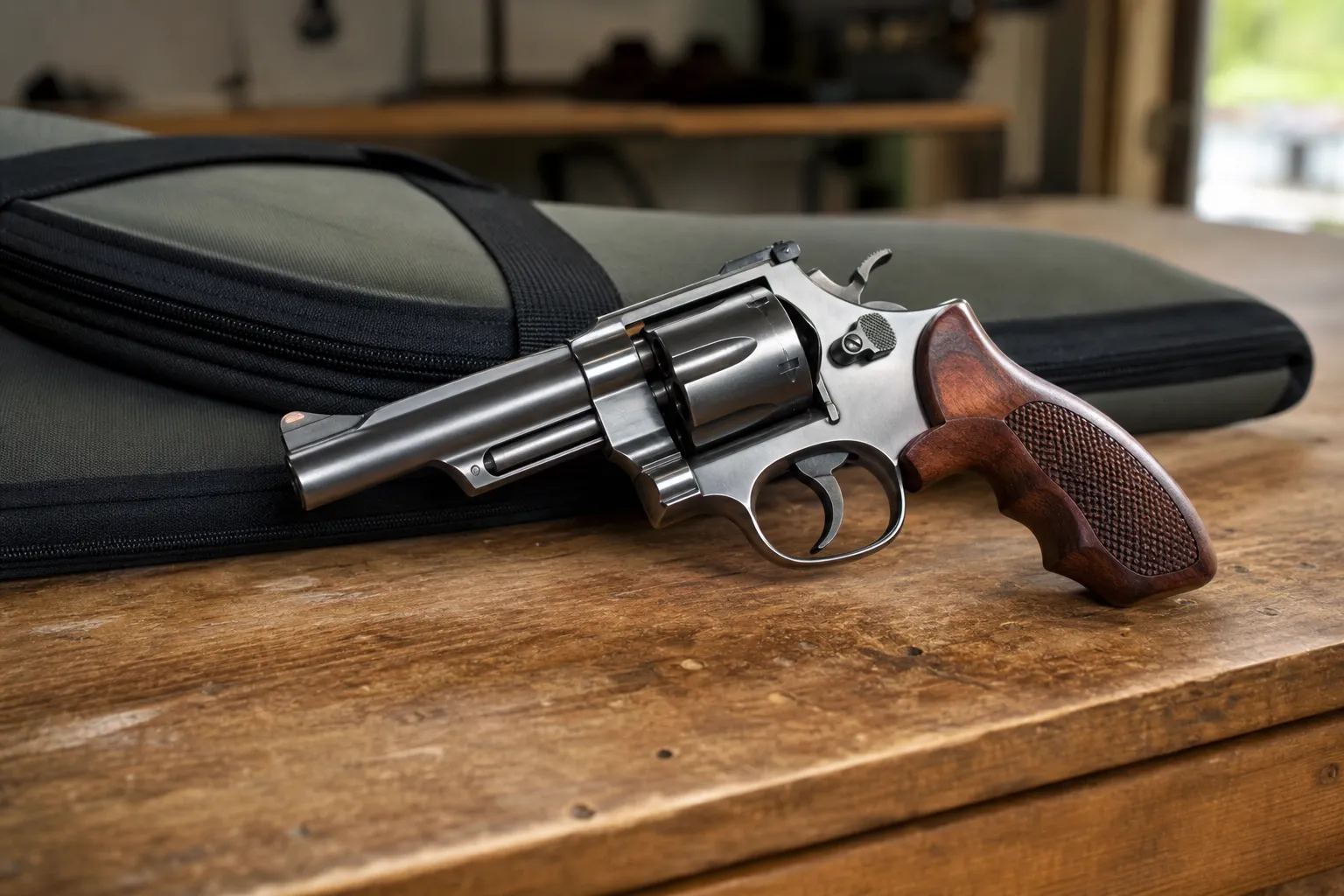
A revolver is a handgun with a rotating, chambered cylinder. ATF describes the cylinder as bringing the next cartridge into line with the barrel, and the National Institute of Justice describes revolvers as having a cylinder with several chambers. For a new owner or safety student, the most important parts to recognize are the frame, barrel, cylinder, chambers, crane or yoke, ejector rod, hammer, trigger, sights and grip.
What makes a revolver a revolver
The central feature of a revolver is its cylinder. ATF describes a revolver around a breechloading chambered cylinder, and says the cylinder brings the next cartridge in line with the barrel for firing. The National Institute of Justice uses similar language, describing a revolver as having a cylinder containing several chambers.
Those chambers are the individual openings in the cylinder. Smith & Wesson uses the linked terms “charge holes” and “chambers” for those holes in its revolver manual.
Revolvers are commonly discussed by action type. The National Institute of Justice lists the two common revolver action categories as single action and double action. Those terms describe how the hammer, trigger and cylinder work together when the revolver is fired.
Major external parts you can see
Manufacturer manuals use slightly different names, but the same basic parts appear across many typical revolvers. Smith & Wesson labels visible revolver features such as the frame, cylinder and rear sight. Ruger labels visible parts on the GP100 including the front sight, muzzle, cylinder and ejector rod.
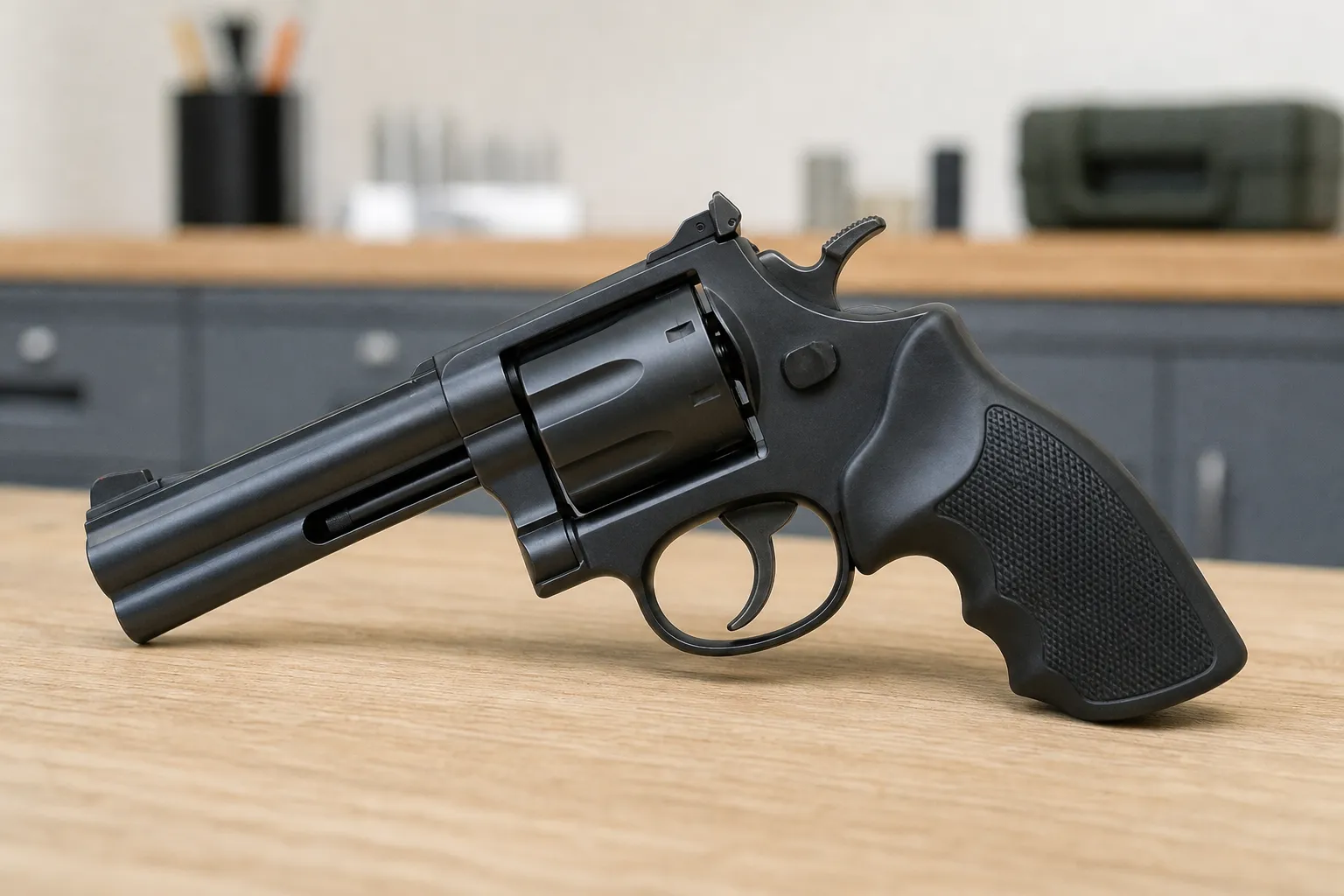
| Part | What the term means in beginner language |
|---|---|
| Frame or cylinder frame | The main named body of the revolver in manufacturer diagrams. Ruger describes the GP100 crane and cylinder assembly as locking into the frame, and Ruger labels the Vaquero with a cylinder frame and frame. |
| Barrel | The part the cylinder aligns with for firing. ATF describes the cylinder as bringing the next cartridge in line with the barrel. Ruger labels the barrel on the Vaquero and the muzzle on the GP100. |
| Muzzle | Ruger labels the muzzle as a visible part on the GP100. |
| Cylinder | The rotating chambered part. ATF says it brings the next cartridge into line with the barrel, and the National Institute of Justice says it contains several chambers. |
| Chambers or charge holes | The individual openings in the cylinder. Smith & Wesson uses the terms “charge holes” and “chambers” together. |
| Crane or yoke | Manufacturer terms for the support area associated with a swing-out cylinder assembly. Ruger uses “crane” in the GP100 manual. Smith & Wesson uses “yoke” in its revolver manual. |
| Ejector rod or extractor rod | Ruger labels the GP100 ejector rod as a visible part, and states that on the GP100 the ejector rod serves only as an ejector and does not rotate with the cylinder. |
| Hammer | The part involved in single action and double action firing. The National Institute of Justice says a single action revolver requires manual cocking of the hammer before firing, and describes double action operation as cocking and releasing the hammer with one trigger pull. |
| Trigger | The control that releases the hammer in single action operation, and in double action operation performs the cocking and release cycle described by the National Institute of Justice. Ruger states that the GP100 transfer bar is connected directly to the trigger. |
| Sights | Aiming references named in manufacturer diagrams and product descriptions. Smith & Wesson labels a rear sight. Ruger labels a front sight on the GP100 and describes the Vaquero as having blade front and integral notch rear sights. |
| Grip | The hand contact area named by the manufacturer. Ruger describes the Vaquero grip style as hand filling. |
Frame, barrel and muzzle
The frame is the main named structure shown in revolver manuals. Smith & Wesson lists the frame among its major revolver features. Ruger labels both “cylinder frame” and “frame” on the Vaquero, and describes the GP100 crane and cylinder assembly as locking directly into the frame.
The barrel is the part aligned with the chamber that is ready to fire. ATF’s description is the key beginner idea: the revolver cylinder brings the next cartridge in line with the barrel. Ruger labels the barrel on the Vaquero and labels the muzzle on the GP100.
For identification, “muzzle” is the manufacturer label Ruger uses for the front end of the GP100 barrel in its nomenclature figure. A new owner should learn the model’s exact labels from the manual for that firearm.
Cylinder, chambers and charge holes
The cylinder is the rotating part that gives the revolver its name. The National Institute of Justice describes revolvers as having a cylinder with several chambers, and ATF says the cylinder brings the next cartridge in line with the barrel.
Each chamber is one of the openings in the cylinder. Smith & Wesson uses “charge holes” and “chambers” as linked terms, which is useful because both terms may appear in manuals or training material.
On swing-out cylinder revolvers, the cylinder opens to the side for inspection and handling as described by the manufacturer. Smith & Wesson instructs users to press the thumbpiece and move the cylinder to the left when inspecting a swing-out cylinder revolver.
Crane, yoke and cylinder support
“Crane” and “yoke” are manufacturer terms, and the correct word can depend on the brand. Ruger uses “crane” in the GP100 manual. Smith & Wesson uses “yoke” in its revolver manual, including when describing where the internal serial number and model number appear when the cylinder is open.
In beginner terms, this is the named support area associated with the swing-out cylinder assembly. Ruger describes the GP100 crane and cylinder assembly as locking directly into the frame. Smith & Wesson’s revolver manual uses the yoke area as a point of reference when the cylinder is open.
Because these terms vary by maker, do not worry if two manuals use different words for similar areas. Learn the term your own manufacturer uses.
Ejector rod or extractor rod
Ruger labels the GP100 ejector rod as a visible part. In the GP100 manual, Ruger states that the ejector rod serves only as an ejector and does not rotate with the cylinder.
This is another place where manufacturer language matters. Some training material may use ejector or extractor language, while a specific manual may use one preferred term. For the GP100, Ruger’s manual specifically uses “ejector rod.”
Hammer, trigger and basic lockwork
The hammer and trigger are the external controls most closely tied to the revolver’s internal lockwork. The National Institute of Justice explains that a single action revolver requires manual cocking of the hammer before firing. Smith & Wesson also describes single action operation as starting when the hammer is first cocked.
Inside the revolver, the National Institute of Justice identifies the hand or pawl as the part that rotates the cylinder during cocking on a single action revolver. That is the beginner level idea behind cylinder indexing: the lockwork moves the cylinder so the next chamber can align with the barrel.
Some Ruger manuals also describe transfer bar parts. Ruger states that the GP100 transfer bar is connected directly to the trigger. For the Vaquero, Ruger explains that the transfer bar is raised into firing position as the trigger is pulled.
This guide does not give internal disassembly steps. Internal lockwork differs by design, and manufacturer manuals should be followed for owner level handling only.
Single action revolver operation
In single action operation, the hammer is cocked first, then the trigger releases it. The National Institute of Justice says a single action revolver requires manual cocking of the hammer before firing, and Smith & Wesson gives the same basic sequence by stating that the hammer is first cocked before trigger release.
On a typical single action revolver, cocking the hammer is also part of cylinder rotation. The National Institute of Justice identifies the internal hand or pawl as the part that rotates the cylinder during cocking on a single action revolver.
Ruger identifies the Vaquero as a single action revolver. Ruger says the Vaquero hammer must first be manually cocked before firing. Ruger also labels the Vaquero’s cylinder frame, loading gate and chamber as key parts, and says opening the loading gate unlatches the cylinder for loading or ejection.
Double action revolver operation
In double action operation, one trigger pull performs more of the cycle. The National Institute of Justice describes double action revolver operation as cocking and releasing the hammer with a single pull of the trigger. Smith & Wesson says double action trigger operation cycles the hammer rearward before release.
Ruger labels the GP100 as a double action firearm. Ruger also states that the GP100 transfer bar is connected directly to the trigger, which is one example of how a manufacturer describes the relationship between the trigger and internal firing parts.
A beginner does not need armorer level detail to understand the basic difference. In single action operation, the hammer is manually cocked before the trigger releases it. In double action operation, the trigger pull cocks and releases the hammer in one continuous cycle.
Sights and grip
Sights are the named aiming references shown in manufacturer materials. Smith & Wesson labels a rear sight in its revolver features figure. Ruger labels a front sight on the GP100, and describes the Vaquero line as having blade front and integral notch rear sights.
The grip is the part named by the manufacturer for the hand contact area. Ruger describes the Vaquero grip style as hand filling. Grip shape and sight style vary by model, so use the manual and manufacturer description for the revolver in front of you.
Safe handling and maintenance boundaries
For routine owner handling, stay at the level described in the manual for the exact model. Smith & Wesson gives a specific inspection sequence for its swing-out cylinder revolvers: press the thumbpiece and move the cylinder to the left. Ruger gives different model specific descriptions for the GP100 and the Vaquero.
Manufacturer manuals also contain model specific warnings and handling procedures, including warnings related to the barrel and cylinder gap. Do not use a terminology guide as a substitute for those instructions.
If a revolver does not operate as the manual describes, stop and consult the manufacturer’s instructions or a qualified service professional. For safety, identification and maintenance, check the current owner’s manual for the exact make and model before relying on any general revolver terminology guide.
Frequently asked questions
What is the most important part that makes a revolver different?
The cylinder is the defining part. ATF describes a revolver around a chambered cylinder, and says that cylinder brings the next cartridge in line with the barrel.
Are chambers and charge holes the same thing?
In Smith & Wesson’s revolver manual, the terms are linked as “charge holes” and “chambers.” Both refer to the individual openings in the cylinder.
What is the difference between a crane and a yoke?
The term depends on the manufacturer. Ruger uses “crane” in the GP100 manual, while Smith & Wesson uses “yoke” in its revolver manual.
What happens in single action operation?
The hammer is manually cocked before firing, then the trigger releases it. The National Institute of Justice identifies the hand or pawl as the internal part that rotates the cylinder during cocking on a single action revolver.
What happens in double action operation?
The trigger pull cocks and releases the hammer. The National Institute of Justice describes double action revolver operation as cocking and releasing the hammer with a single pull of the trigger.
Does the GP100 ejector rod rotate with the cylinder?
Ruger states that the GP100 ejector rod serves only as an ejector and does not rotate with the cylinder.
Sources
- ATF Guidebook, Importation and Verification of Firearms, Ammunition, and Implements of War, Bureau of Alcohol, Tobacco, Firearms and Explosives, via GovInfoOfficial source. Accessed October 29, 2026.
- Firearms Examiner Training, Module 08, Handguns, National Institute of JusticeOfficial source. Accessed October 29, 2026.
- Safety and Instruction Manual, Smith & Wesson J, K, L and N Frame Revolvers, Smith & WessonOfficial source. Accessed October 29, 2026.
- Instruction Manual for Ruger GP100 Revolver, Sturm, Ruger & Co.Official source. Accessed October 29, 2026.
- Instruction Manual for Ruger Vaquero and Bisley Ruger Vaquero Single Action Revolvers, Sturm, Ruger & Co.Official source. Accessed October 29, 2026.
- Ruger Vaquero Product Overview, Sturm, Ruger & Co.Official source. Accessed October 29, 2026.