Snub-Nose Revolvers Explained: Barrel Length, Sight Radius and Tradeoffs
A snub nose revolver is an informal category, not a fixed industry standard. Most examples use barrels around 1.875 inches or 2 inches, while some collector usage includes 3 inch revolvers.
By RaiS. Reviewed by RaiS. Published . 6 min read.
Research and drafting were assisted by AI. RaiS checked the facts against the sources below and approved this page.
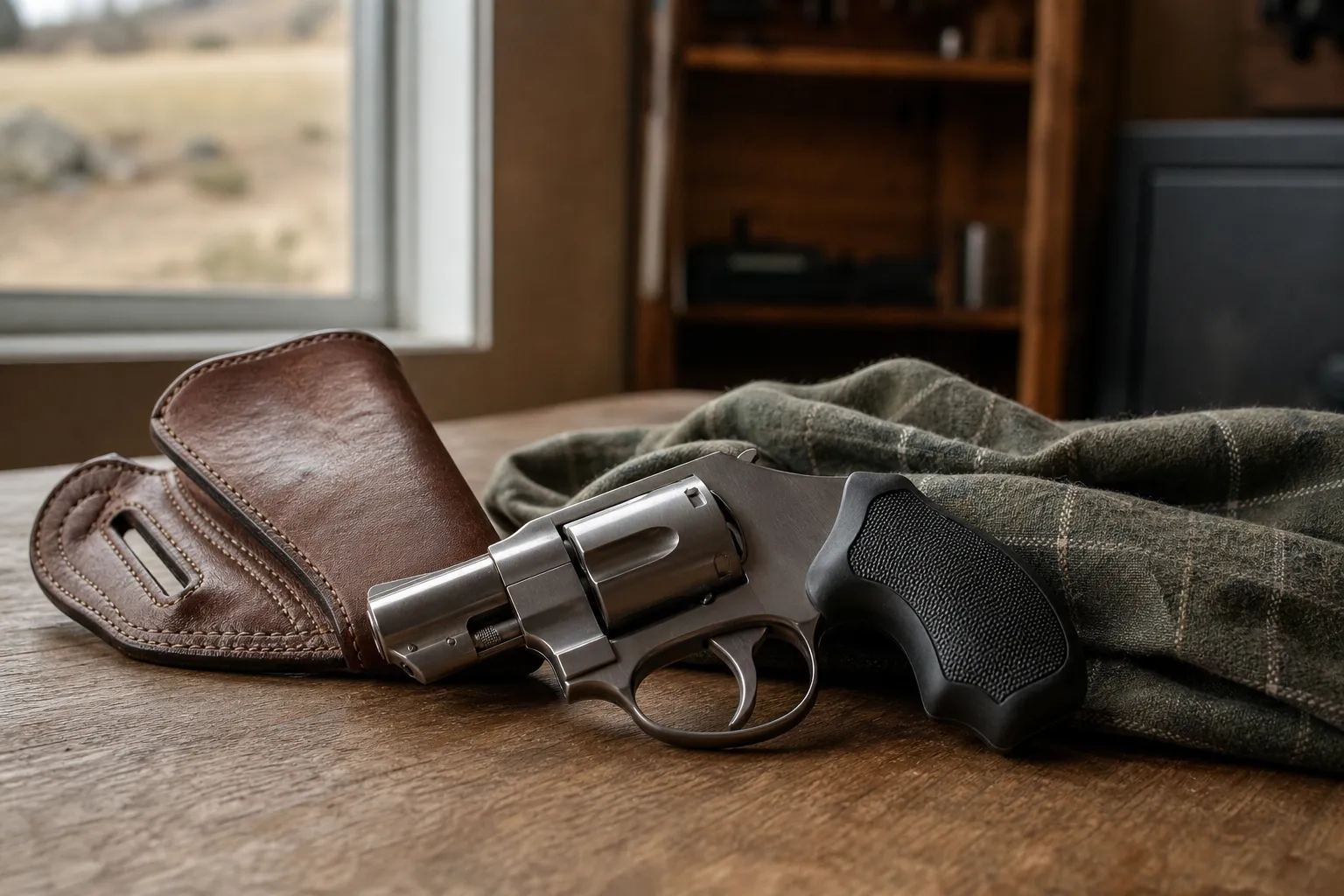
A snub nose revolver is usually a compact revolver with a very short barrel, most often around 1.875 inches or 2 inches. The term is informal rather than a fixed industry standard. Some references use 2 inches or shorter as the cutoff, while broader collector usage may include revolvers with barrels of 3 inches or less.
What “snub-nose” means
“Snub nose” describes the shape and size of a revolver more than a formal specification. If you are new to the basic mechanism, see how a revolver works.
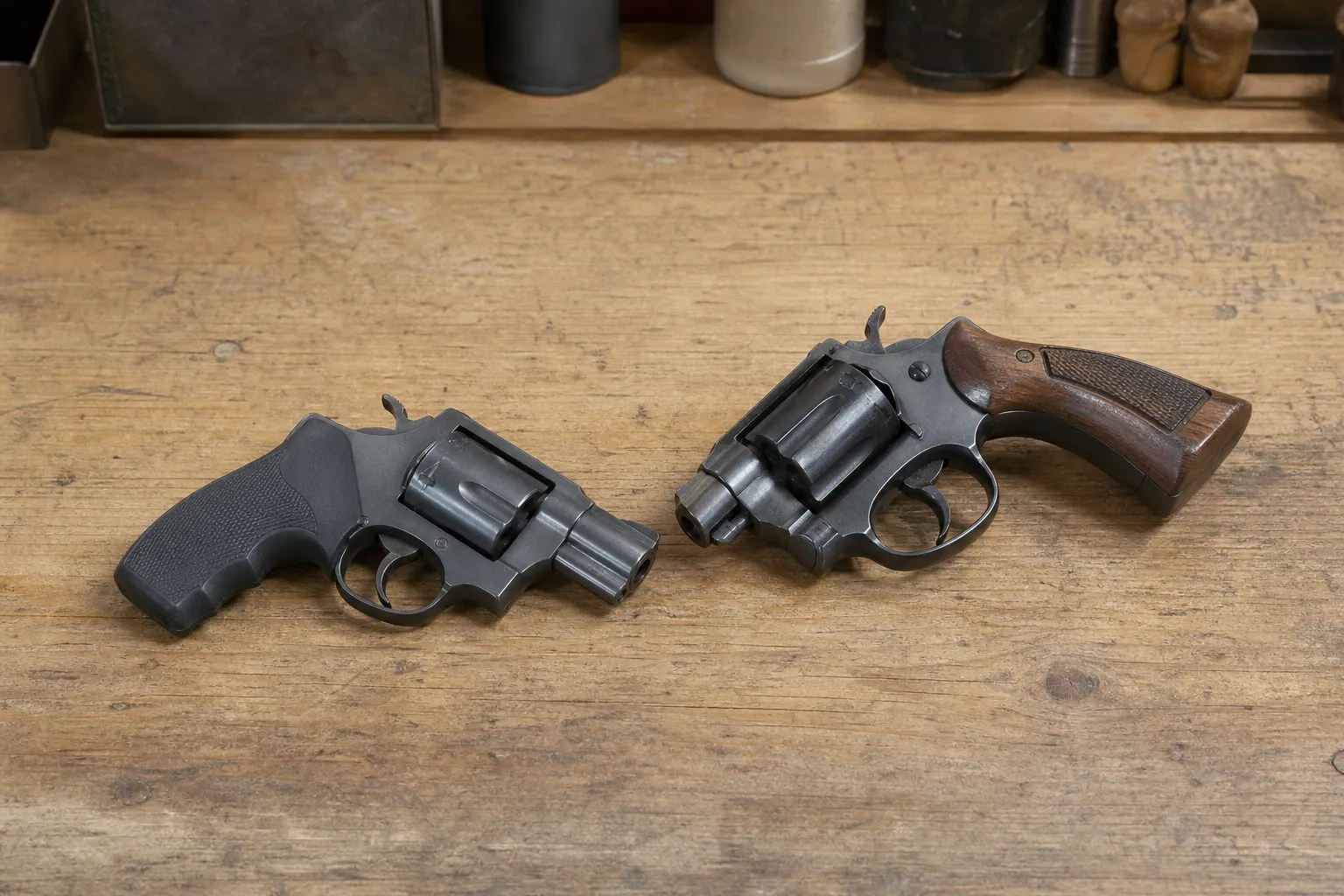
The “snub” part refers to the short barrel. NRA Shooting Illustrated and Rock Island Auction use different cutoffs. An NRA Shooting Illustrated article uses 2 inches or shorter as the author’s cutoff. Rock Island Auction uses a broader collector description, stating that the term generally refers to a revolver with a barrel length of 3 inches or less.
That is why the term can be a little fuzzy. A 1 7/8 inch compact revolver fits comfortably within common usage. A 2 inch Colt Cobra also fits the classic idea. A 3 inch revolver is more borderline: some people include it, while others reserve “snub nose” for shorter barrels.
Typical barrel lengths and real examples
The most common examples cluster around 1.875 inches and 2 inches. Three inch revolvers appear in some broader discussions, but they are better understood as the long end of the snub nose category rather than the center of it.
| Revolver example | Listed chambering | Capacity | Barrel length | Listed weight | Listed overall length |
|---|---|---|---|---|---|
| Colt Cobra, modern manual | .38 Special and .38 Special +P | 6 shot | 2 in | ||
| Ruger LCRx model 5431 | .38 Special +P | 5 | 3 in | 15.7 oz | 7.50 in |
Smith & Wesson’s Model 642 is listed with an integral front sight, a fixed rear sight, a 14.5 ounce weight, and a 6.31 inch overall length.
Colt’s modern Cobra manual describes the Cobra as a compact stainless steel single and double action revolver. The same manual lists it as a six shot .38 Special and .38 Special +P revolver with a 2 inch barrel. Colt’s 2017 Cobra announcement also lists the new Cobra with a 2 inch barrel.38 Special chambering, six round capacity, and stainless steel construction.
Sight radius: why a short barrel changes the aiming picture
Sight radius is the distance between the front and rear sights. NRA Family explains the basic rule: the longer the distance between the front and rear sights, the smaller the effect of front sight error.
That matters because snub nose revolvers place the front sight on a very short barrel. A revolver with a 1.875 inch or 2 inch barrel has less room between the front and rear sights than a longer barreled handgun of the same general sight layout.
This is not about tactics. It is simple geometry. If the front sight is slightly misaligned, a short sight radius gives that small misalignment more effect at the target. NRA Family’s handgun example table shows the same 1/16 inch sight error at 30 yards producing larger target error as sight radius gets shorter. In that table, a 5.39 inch sight radius corresponds to 12.52 inches of target error, while a 7.55 inch sight radius corresponds to 8.94 inches.
Snub nose revolvers often use simple fixed sights. Smith & Wesson’s Model 642 is listed with an integral front sight and fixed rear sight. Ruger’s LCR materials list ramp front and integral rear sights. For a plain language overview of sight types, see iron sights explained.
Velocity: what shorter barrels can do
Shorter barrels can record lower velocity in comparable barrel length tests. Ballistics by the Inch data for .38 Special provides the clearest example below.
For .38 Special Cor Bon 110 grain JHP, the table records 675 feet per second from a 2 inch barrel and 1,013 feet per second from a 4 inch barrel. For .38 Special Speer 135 grain Gold Dot HP, the table records 756 feet per second from a 2 inch barrel and 1,027 feet per second from a 4 inch barrel.
| .38 Special load | 2 inch velocity | 4 inch velocity |
|---|---|---|
| Cor Bon 110 gr. JHP | 675 fps | 1,013 fps |
| Speer 135 gr. Gold Dot HP | 756 fps | 1,027 fps |
These examples do not create a universal number for every revolver or every load. They do show the kind of measured difference that can appear when the same cartridge is compared across barrel lengths. For more background on what velocity means, see muzzle velocity explained.
Many classic snub nose revolvers are chambered in .38 Special. Some modern examples are marked for .38 Special +P. If you see “+P” in a model name or manual, read the maker’s manual for that exact firearm and see the site glossary entry on +P ammunition.
Weight and size tradeoffs
The short barrel is only one part of the snub nose formula. Small frames, compact grips, aluminum alloy frames, polymer fire control housings, and other design choices also affect weight and overall size.
Ruger announced the LCR in 2009 as a 13.5 ounce, small frame, five shot revolver with three main components: a polymer fire control housing, an aircraft quality aluminum monolithic frame, and an extensively fluted stainless steel cylinder. The same announcement stated that the LCR barrel was 1 7/8 inches long.
Ruger’s later catalog gives a useful example of a 3 inch LCRx. The 3 inch .38 Special +P LCRx model 5431 is listed at 7.50 inches overall length and 15.7 ounces.
Smith & Wesson’s Model 642 is another compact example. Its spec sheet lists 14.5 ounces and 6.31 inches overall length.
This is the central tradeoff. The short barrel and compact frame reduce length and can reduce weight. The same short barrel also shortens sight radius, and measured .38 Special examples show lower recorded velocity at 2 inches than at 4 inches for the listed loads.
Why snub-nose revolvers became popular
The snub nose idea became recognizable because several compact revolvers combined short barrels with small frames and service handgun cartridges. Rock Island Auction identifies the Fitz Special as a 1920s snub nosed concept and says it became the prototype for what would eventually be called the Colt Detective Special in 1927.
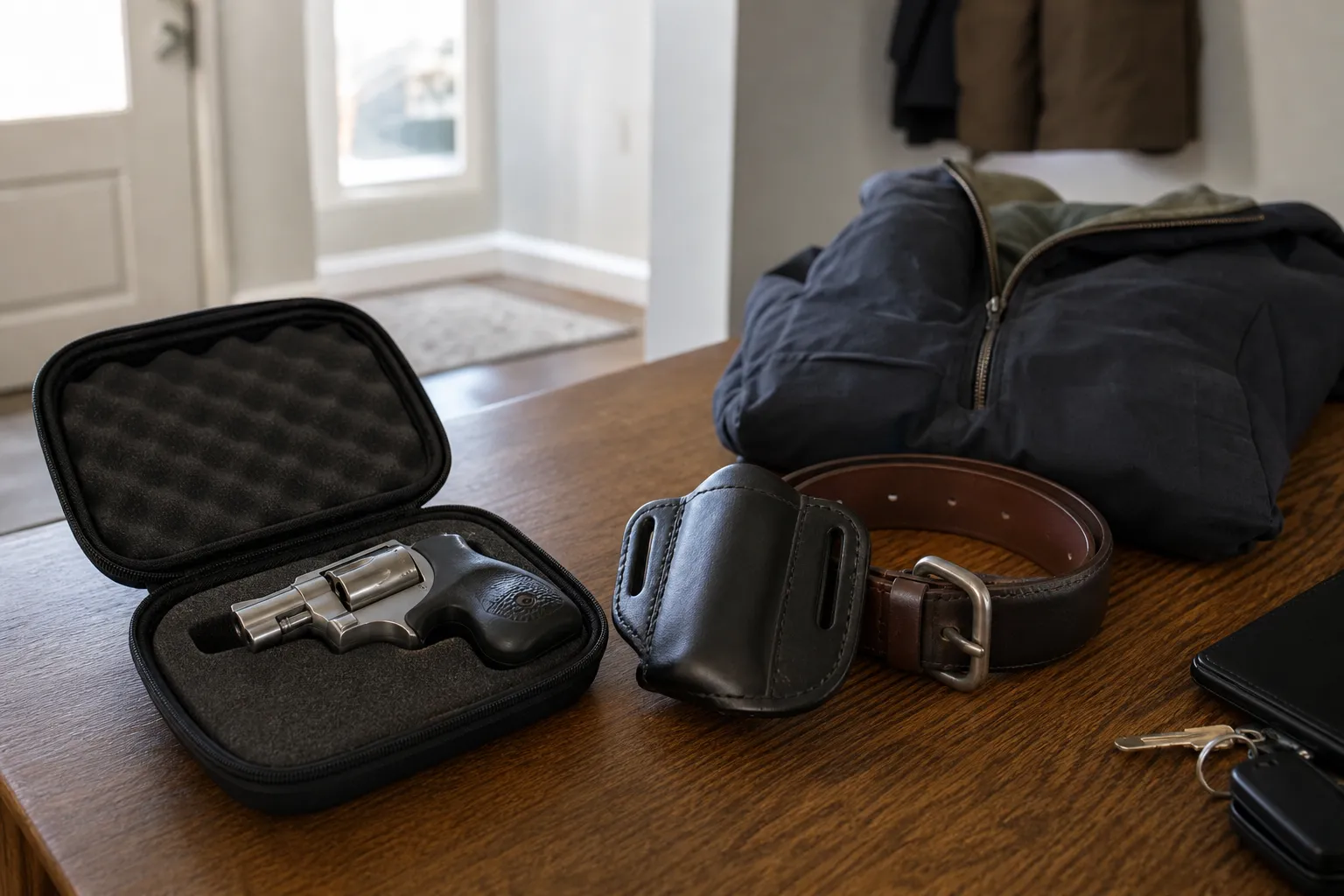
Rock Island Auction describes the Colt Detective Special as one of the most famous early modern factory production snub nose revolvers. It also describes the Detective Special as a double action revolver that could function as single action, used a swing out frame, and was specifically designed for .38 Special. For a basic explanation of those trigger terms, see single action vs double action.
Smith & Wesson’s Chief’s Special is another landmark. American Rifleman describes it as a compact five shot revolver with a 1 7/8 inch barrel and identifies it as the first Smith & Wesson J frame series revolver. American Rifleman also reports that it was unveiled in October 1950 at the International Association of Chiefs of Police conference and became the Model 36 in 1957. Rock Island Auction similarly states that the Chief’s Special, later the Model 36, was a five shot double action revolver on the Smith & Wesson J frame introduced in 1950.
Those examples show why the snub nose revolver became a lasting category: short barrel, compact frame, reduced overall length, and familiar revolver operation. The phrase is casual, but the pattern is easy to recognize.
What to check before relying on any specification
Model names, chamber markings, +P ratings, sights, weights, and dimensions can vary by exact version and production period. Check the current manufacturer manual and spec sheet for the exact revolver in question. For ownership, transport, and carry rules, confirm current requirements with the appropriate official federal, state, provincial, territorial, or local authority.
Frequently asked questions
Is “snub-nose revolver” an official technical category?
No. The term is informal. One NRA Shooting Illustrated article uses 2 inches or shorter as the author’s cutoff, while Rock Island Auction uses the broader description of 3 inches or less.
What barrel length is typical for a snub-nose revolver?
Many examples use 1 7/8 inch or 2 inch barrels. Examples include Ruger’s original LCR at 1 7/8 inches, the Smith & Wesson Chief’s Special at 1 7/8 inches, and the modern Colt Cobra at 2 inches.
Can a 3 inch revolver be called a snub nose?
Some collector usage includes revolvers with barrels of 3 inches or less. Other writers reserve the term for 2 inches or shorter, so a 3 inch revolver is best treated as a borderline or extended snub nose example.
Why does sight radius matter on a snub-nose revolver?
Sight radius is the distance between the front and rear sights. NRA Family explains that a longer sight radius reduces the effect of front sight error, so a very short handgun gives the shooter less sight radius to work with.
Do short barrels reduce velocity?
In the .38 Special data below, yes for the listed loads. Ballistics by the Inch data records lower velocities at 2 inches than at 4 inches for the Cor Bon 110 grain JHP and Speer 135 grain Gold Dot HP examples.
Why did snub-nose revolvers become well known?
Historic examples such as the Colt Detective Special and Smith & Wesson Chief’s Special helped make compact revolvers well known. American Rifleman reports that the Chief’s Special was unveiled at the International Association of Chiefs of Police conference in 1950.
Sources
- Smith & Wesson Holding Corporation annual report, revolvers section, Smith & Wesson Holding CorporationOfficial source. Accessed November 17, 2026.
- Smith & Wesson Performance Center Model 642 spec sheet, Smith & WessonOfficial source. Accessed November 17, 2026.
- Ruger International Catalog, LCR specifications, Sturm, Ruger & Co.Official source. Accessed November 17, 2026.
- Introducing the Ruger LCR: an Evolutionary Revolver Design, Sturm, Ruger & Co.Official source. Accessed November 17, 2026.
- Colt Cobra Revolver operator’s manual, Colt’s Manufacturing Company LLCOfficial source. Accessed November 17, 2026.
- Colt double action revolver manual, Detective Special, Commando Special, Diamondback, Police Positive, Agent, Cobra, Viper, Colt’s Manufacturing Company LLCOfficial source. Accessed November 17, 2026.
- Colt Announces the New Cobra Double Action Revolver, Colt’s Manufacturing Company LLCOfficial source. Accessed November 17, 2026.
- FM 23-35, Pistols and Revolvers, Colt Detective Special section, United States Army, hosted by 90th Infantry Division Preservation Group. Accessed November 17, 2026.
- Again With the Front Sight, NRA Family. Accessed November 17, 2026.
- Snub Nosed Revolvers, Shooting Illustrated. Accessed November 17, 2026.
- Smith & Wesson Model 36, Chief’s Special, American Rifleman. Accessed November 17, 2026.
- Snub Nose Revolvers: Evolution and Models, Rock Island Auction Company. Accessed November 17, 2026.
- .38 Special: history, loads and ballistics, 2A Ledger. Accessed November 17, 2026.
- Ruger Expands the Popular Line of Lightweight Compact Revolvers with the Addition of the LCRx with 3-inch barrel. Accessed November 17, 2026.