How a Revolver Works: Cylinder Rotation, Lockup and Firing Cycle
A revolver works by rotating a chambered cylinder so one chamber lines up with the barrel and firing pin before each shot. The hand turns the cylinder, the cylinder stop or latch locks it in alignment, the hammer and firing pin fire the cartridge, and the ejector rod helps remove cartridges or fired cases.
By RaiS. Reviewed by RaiS. Published . 8 min read.
Research and drafting were assisted by AI. RaiS checked the facts against the sources below and approved this page.
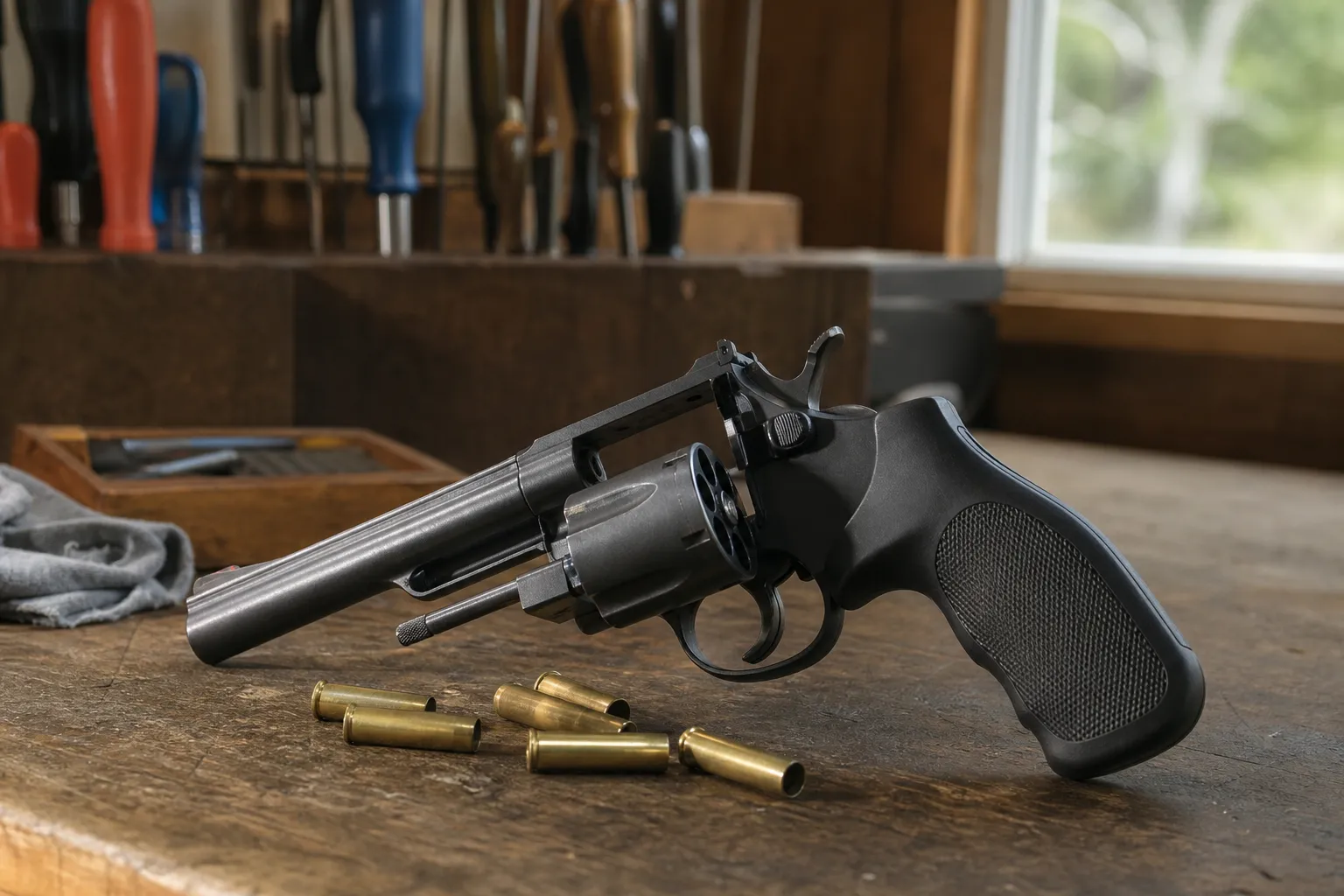
A revolver works by rotating a cylinder that contains multiple cartridge chambers. ATF describes a revolver as a pistol type firearm with a breechloading chambered cylinder, arranged so cocking the hammer or moving the trigger rotates the cylinder and brings the next cartridge in line with the barrel for firing. In plain terms, each trigger press or hammer cocking cycle indexes the cylinder, locks the next chamber in place, fires the cartridge, and then leaves the shooter to reset the trigger and unload the cases manually.
For a broader comparison with magazine-fed handguns, see Revolver vs Pistol. This guide stays focused on the internal cycle of a typical revolver, using manufacturer manuals and SAAMI terminology.
The main parts in the cycle
SAAMI defines the cylinder as the rotating part of a revolver that contains the cartridge chambers. SAAMI also defines those revolver chambers as the holes in the cylinder formed to accept a cartridge.
Here are the parts and terms a new shooter will hear most often:
| Term | What it means |
|---|---|
| Cylinder | SAAMI defines it as the rotating part that contains the cartridge chambers. |
| Chamber | SAAMI defines revolver chambers as the holes in the cylinder formed to accept a cartridge. |
| Hand | Colt identifies the hand as the part that rotates the cylinder to align the chamber with the barrel and firing pin. |
| Cylinder stop, cylinder latch, cylinder bolt, or bolt | SAAMI defines the cylinder stop as the device that stops cylinder rotation in proper alignment with the barrel. SAAMI notes that it may also be called a cylinder latch or cylinder bolt. |
| Cylinder stop notch | SAAMI defines this as a machined groove on the cylinder that is engaged by the cylinder stop to assure barrel and chamber alignment. |
| Cylinder gap | SAAMI defines the cylinder gap as the space between the cylinder and the barrel, measured with the cylinder in the rearmost position. |
| Ejector rod | Colt identifies the ejector rod and ratchet as providing a means to eject fired or unfired cartridges from the cylinder. |
The names can vary by maker. Colt uses the term bolt in its Anaconda manual when describing the part that drops into the cylinder notch. Ruger uses cylinder latch in its GP100 manual. SAAMI treats cylinder stop, cylinder latch, cylinder bolt, and bolt as related terminology for the part that stops cylinder rotation in alignment.
Single action and double action
Colt states that most revolver models can be fired in single action by cocking the hammer manually and then squeezing the trigger, or in double action by squeezing the trigger to rotate the cylinder, cock the hammer, and fire. Ruger describes the GP100 the same way: double action means pulling the trigger through its complete arc for each shot, while single action means cocking the hammer and then pulling the trigger.
Smith & Wesson describes double action as pulling and holding the trigger to the rear, causing the hammer to cycle rearward and then release. Smith & Wesson describes single action as cocking the hammer first and then pulling the trigger.
For a plain language comparison of those trigger systems, see Single Action vs Double Action.
What changes between the two modes?
The basic cylinder cycle is similar, but the shooter starts it differently.
In double action, the trigger press does several jobs. It rotates the cylinder, cocks the hammer, and releases the hammer. Colt describes this sequence as the trigger rotating the cylinder, cocking the hammer, and then firing the revolver.
In single action, the shooter manually cocks the hammer first. That hammer movement begins the mechanical cycle. The trigger press that follows releases the cocked hammer.
Smith & Wesson and Ruger both state that, after firing in double action, the trigger must move fully forward before another shot can be fired. Ruger identifies this full trigger release as a characteristic of modern double action revolvers and double action only pistols.
Step by step: the firing cycle
A revolver’s firing cycle is a coordinated sequence. The details vary by model, but the manuals from Colt, Smith & Wesson, and Ruger describe the same broad idea: movement of the trigger or hammer rotates the cylinder, aligns the chamber, locks the cylinder, and releases the hammer to fire.
1. The trigger or hammer begins rearward movement
In the Colt Anaconda manual, Colt states that when the trigger or hammer rotates rearward, the trigger unlocks the bolt from the cylinder. At the same time, Colt says the trigger lifts the hand to rotate the cylinder clockwise and moves the transfer bar up behind the firing pin.
This is the start of indexing. SAAMI defines cylinder indexing as the rotational movement of the cylinder to bring the next chamber into alignment with the bore.
2. The hand rotates the cylinder
Colt identifies the hand as the part that rotates the cylinder to align the chamber with the barrel and firing pin.
As the hand moves, the cylinder turns toward the next chamber. That chamber must end up aligned with the bore. SAAMI defines cylinder alignment as the relationship of the chamber axis in the revolver cylinder to the bore axis.
3. The cylinder stop or bolt locks the cylinder
The cylinder cannot simply keep spinning. It has to stop at the correct point.
SAAMI defines the cylinder stop as the device that stops cylinder rotation in proper alignment with the barrel. SAAMI defines the cylinder stop notch as a machined groove on the cylinder that is engaged by the cylinder stop to assure barrel and chamber alignment.
Colt describes this moment in its Anaconda manual: the cylinder continues rotating until the bolt drops into the next cylinder notch, assuring proper alignment of the chamber, barrel, and firing pin before the hammer is released.
Ruger describes the same job in GP100 terms. Ruger states that the revolver has a cylinder latch that locks cylinder rotation before a shot is fired, and that the latch rides on the outside circumference of the cylinder where the stop notches are cut.
What lockup means
Lockup is the condition where the cylinder is closed, rotation has been stopped, and the chamber is held in alignment with the barrel and firing pin before firing. The term is often used informally by shooters, but the important pieces are the SAAMI terms: cylinder indexing, cylinder alignment, cylinder stop, and cylinder stop notch.
Ruger states that, when correctly operated, the GP100 cylinder cannot be opened when the hammer is cocked, and the hammer/trigger mechanism cannot operate until the cylinder is locked shut. Ruger also states that the GP100 crane and cylinder assembly locks directly into the frame at the rear of the cylinder and at the front of the crane.
Do not treat lockup or timing as a home adjustment topic. Ruger warns that barrels, cylinders, cylinder/crane assemblies, and a number of other GP100 component parts must be fitted at the factory, and that improper fitting may cause dangerous malfunction and serious injury. If cylinder alignment, cylinder rotation, trigger reset, or lockup seems different than normal, use the manufacturer’s manual and contact the manufacturer or a qualified gunsmith.
Firing: hammer, transfer bar, firing pin, and primer
Once the cylinder is aligned and locked, the hammer can fall. Colt states that, once the hammer is released from the trigger, it rotates forward, strikes the transfer bar, and transfers energy to the firing pin to ignite the cartridge in the chamber.
Ruger describes the GP100 transfer bar safety system as a design in which the hammer blow can be transmitted to the firing pin only when the trigger is pulled all the way to the rear. Colt describes a related sequence in the Anaconda: when the trigger is released, the transfer bar moves down from behind the firing pin, leaving a gap between the firing pin and hammer.
Not every revolver uses identical internal parts, but the firing concept is simple for a beginner: the mechanism must align the chamber, lock the cylinder, and let the hammer and firing pin system strike the cartridge primer directly or through a transfer bar, depending on the design.
The forcing cone and cylinder gap
After ignition, the bullet leaves the chamber, crosses the gap between the cylinder and barrel, and enters the rear of the barrel. SAAMI defines the cylinder gap as the space between the cylinder and barrel.
The cylinder gap is also a safety issue. Ruger warns that all revolvers discharge hot gas and particles of lead, powder grains, or lubricant through the clearance gap between the cylinder and the rear of the barrel at high speed.
That is why hands, fingers, and support hand techniques matter around revolvers. Do not place fingers near the barrel/cylinder gap, and do not hold a revolver by the barrel or cylinder while firing. For more detail on this specific feature, see Revolver Cylinder Gap Explained.
Extraction and unloading
On many swing-out double action revolvers, the shooter opens the cylinder and uses the ejector rod to lift cartridges or fired cases from the chambers.
Colt identifies the ejector rod and ratchet as providing a means to eject fired or unfired cartridges from the cylinder. Ruger states that pressing the ejector rod head rearward until it stops extracts cartridges or fired cases.
A safe unloading check does not end with pressing the ejector rod. Visually and physically check every chamber. Because each chamber is separate, a beginner should confirm the status of each chamber rather than assuming the cylinder is empty. For general handling rules, see The Basic Rules of Firearm Safety.
Beginner safety notes for revolvers
A revolver’s open cylinder gap and rotating cylinder make its safety concerns a little different from a self-loading pistol.
Keep these manufacturer based points in mind:
- Ruger warns that all revolvers discharge hot gas and particles through the cylinder gap at high speed.
- Ruger states that, when correctly operated, the cylinder cannot be opened when the hammer is cocked.
- Ruger states that the hammer/trigger mechanism cannot operate until the cylinder is locked shut.
- Smith & Wesson and Ruger both state that the trigger must move fully forward after firing before another double action shot can be fired.
- Ruger warns that certain parts, including barrels, cylinders, and cylinder/crane assemblies, must be factory fitted.
Those points support a simple beginner rule: if the revolver does not rotate, lock, reset, open, close, or unload normally, stop using it and follow the manufacturer’s manual. Do not attempt timing, fitting, or action repair based on a general guide.
What to check in the manual for your revolver
Revolver designs share common ideas, but the exact safety system and part names vary by manufacturer and model. Colt’s manual describes a transfer bar moving behind the firing pin. Ruger’s GP100 manual describes a transfer bar safety system connected to the trigger. Ruger’s manual also describes the GP100 ejector rod as serving only as an ejector and not rotating with the cylinder.
Before handling, loading, unloading, dry firing, or diagnosing a function concern, check the manual for your exact revolver model. Confirm how that model opens, unloads, resets, locks, and uses its safety system. If anything about cylinder alignment, lockup, trigger reset, or extraction seems wrong, contact the manufacturer or a qualified gunsmith rather than trying to adjust the action yourself.
Frequently asked questions
What makes a revolver different from other handguns?
ATF describes a revolver as a pistol type firearm with a breechloading chambered cylinder that rotates to bring the next cartridge in line with the barrel. SAAMI defines the cylinder as the rotating part that contains the cartridge chambers.
What part turns the cylinder on a revolver?
Colt identifies the hand as the part that rotates the cylinder to align the chamber with the barrel and firing pin.
What is revolver lockup?
Lockup is the condition where the cylinder is closed, rotation is stopped, and the chamber is held in alignment with the barrel and firing pin. SAAMI terms tied to this idea include cylinder indexing, cylinder alignment, cylinder stop, and cylinder stop notch.
What is the cylinder stop?
SAAMI defines the cylinder stop as the device that stops cylinder rotation in proper alignment with the barrel. SAAMI notes that it may also be called a cylinder latch or cylinder bolt.
Why is the barrel/cylinder gap important?
SAAMI defines the cylinder gap as the space between the cylinder and barrel. Ruger warns that all revolvers discharge hot gas and particles through that clearance gap at high speed, so fingers and hands should be kept away from it when firing.
How are fired cases removed from a revolver?
On many swing out double action revolvers, the shooter opens the cylinder and uses the ejector rod to lift cartridges or fired cases from the chambers. Ruger states that pressing the ejector rod head rearward extracts cartridges or fired cases.
Sources
- ATF Guidebook: Importation & Verification of Firearms, Ammunition, and Implements of War, Bureau of Alcohol, Tobacco, Firearms and Explosives via GovInfoOfficial source. Accessed November 2, 2026.
- SAAMI Glossary, Letter C, Sporting Arms and Ammunition Manufacturers' InstituteOfficial source. Accessed November 2, 2026.
- Operator’s Manual for Colt Anaconda Revolver, Colt’s Manufacturing Company LLCOfficial source. Accessed November 2, 2026.
- Smith & Wesson Safety & Instruction Manual, J, K, L, and N Frame Revolvers, Smith & WessonOfficial source. Accessed November 2, 2026.
- Instruction Manual for Ruger GP100 Double-Action Revolver, Sturm, Ruger & Co., Inc.Official source. Accessed November 2, 2026.