Revolver vs Pistol: Key Differences in Operation, Capacity and Use
A revolver stores cartridges in a rotating cylinder, while a semi-automatic pistol feeds cartridges from a magazine into a chamber at the rear of the barrel. The biggest beginner differences are how each handgun stores ammunition, cycles after firing, extracts cases, and gets reloaded.
By RaiS. Reviewed by RaiS. Published . 6 min read.
Research and drafting were assisted by AI. RaiS checked the facts against the sources below and approved this page.
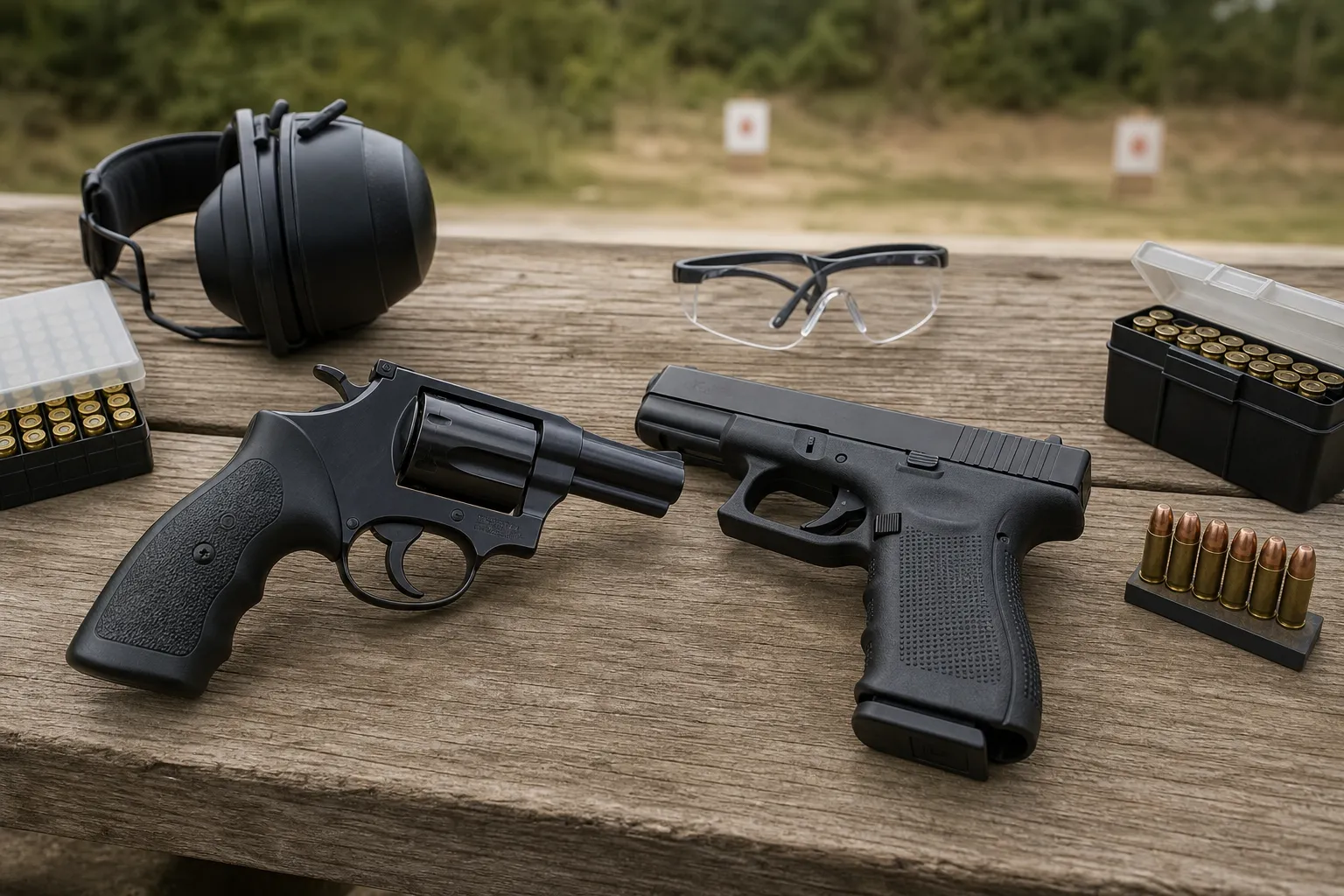
A revolver and a semi-automatic pistol are both handguns, but they handle ammunition in very different ways. A revolver uses a rotating, chambered cylinder. A semi-automatic pistol uses a magazine and a chamber at the rear of the barrel, with the slide cycling to extract, eject, and feed cartridges.
Basic definitions
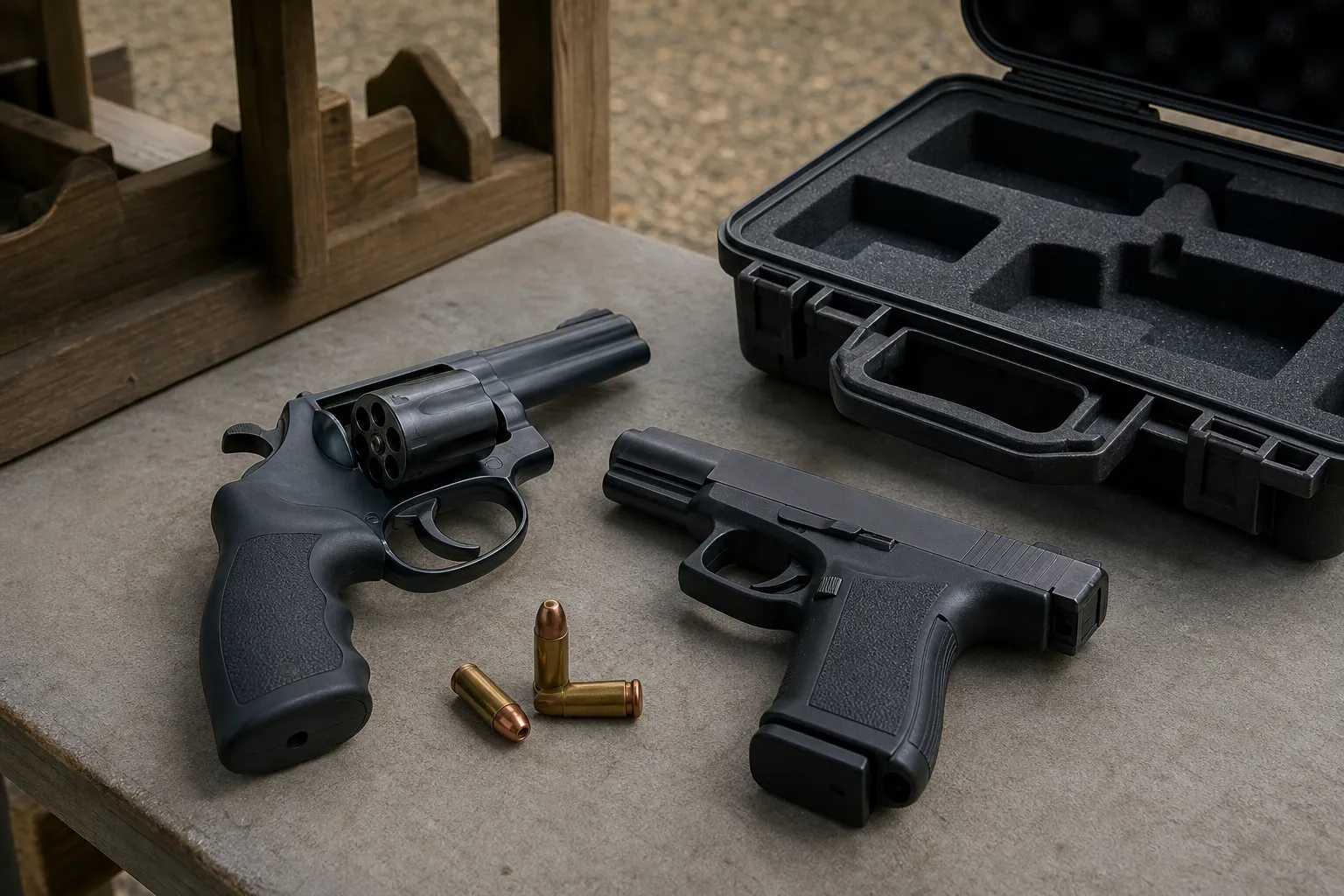
SAAMI describes a distinction by chamber location. In a pistol, SAAMI says the chamber is at the rear of the barrel. In a revolver, SAAMI says the chambers are holes in the cylinder.
The National Institute of Justice firearms examiner training material describes the two general handgun types as revolvers and pistols. In everyday conversation, people often use the word “pistol” to mean a semi-automatic handgun, but the important mechanical difference is the ammunition system: magazine and barrel chamber for the semi-automatic pistol, rotating cylinder for the revolver.
SAAMI also cautions that “automatic pistol” is commonly but improperly used for many modern autoloading pistols, because most are semiautomatic. SAAMI defines semiautomatic action as self-loading and magazine-fed, with each trigger pull producing one complete firing cycle.
The short comparison
| Feature | Revolver | Semi-automatic pistol |
|---|---|---|
| Ammunition storage | Revolving cylinder | Magazine |
| Chamber location | Chambers are holes in the cylinder, according to SAAMI | Chamber is at the rear of the barrel, according to SAAMI |
| Feeding cycle | Cylinder rotates to align a chamber with the barrel | Slide movement feeds the next cartridge from the magazine into the chamber |
| Fired case handling | Fired cases remain in the cylinder until manually extracted | Fired case is extracted and ejected during slide movement |
| Common capacity examples | NIJ says revolver cylinders commonly have five to nine chambers, typically six | Beretta lists 10, 15, 17, or 18 round standard magazine capacities for certain full-size and Centurion 9 mm Beretta 92 pistols, depending on state law |
| Common terms | Cylinder, chamber, ejector rod, single action, double action | Magazine, chamber, slide, extractor, ejector, slide lock |
How a revolver loads and fires
A revolver stores cartridges in separate chambers in a rotating cylinder.
NIJ training material says double-action revolvers can cock and release the hammer with a single pull of the trigger.
Ruger’s GP100 manual describes loading by inserting cartridges and gently closing the cylinder while making sure it is latched.
For firing, Ruger’s GP100 manual says the revolver can be fired in double action by pulling the trigger through its full arc. It can also be fired in single action by cocking the hammer and then pulling the trigger.
This does not mean every revolver is identical. The useful beginner point is that the cylinder is both the ammunition reservoir and the set of chambers. When the action rotates the cylinder, a loaded chamber is brought into line with the barrel.
How a semi-automatic pistol loads and fires
A semi-automatic pistol stores ammunition in a magazine and feeds cartridges into a chamber at the rear of the barrel. SAAMI defines semiautomatic action as self-loading and magazine-fed, with one complete firing cycle for each trigger pull.
GLOCK’s owner manual describes the slide moving forward under recoil spring force and stripping the next cartridge from the magazine into the chamber. Beretta’s 92XI manual describes a semi-automatic firing cycle in which the slide ejects the spent cartridge and then feeds the next cartridge from the magazine into the chamber.
NIJ training material states that pistols do not have rotating cylinders. That is the key visual and mechanical difference from a revolver. Instead of multiple chambers rotating into place, the semi-automatic pistol repeatedly uses the same chamber while cartridges are fed from the magazine.
GLOCK’s manual also warns that a chambered cartridge can discharge when the trigger is pulled whether or not a magazine is in the pistol. For a beginner, that is an important terminology point: removing the magazine and emptying the chamber are not the same thing.
Extraction, ejection, and reloading
The biggest difference after a shot is what happens to the fired case. In a revolver, the fired case stays in its cylinder chamber until the cylinder is opened and the cases are extracted. In a semi-automatic pistol, the cycling slide normally removes and ejects the fired case as part of the firing cycle.
Ruger’s GP100 manual says pushing the ejector rod toward the rear of the cylinder extracts cartridges or fired cases. That describes a common revolver unloading method: the cylinder is opened, then the ejector rod moves the cases out of the chambers.
GLOCK’s manual describes the semi-automatic sequence differently. It says the fired case is pulled from the chamber by the extractor and thrown out by the ejector. The recoil spring then brings the slide forward, and the next cartridge is stripped from the magazine and placed in the chamber.
Beretta’s 92XI manual gives the same broad concept: the slide ejects the spent cartridge and feeds the next cartridge from the magazine into the chamber.
Many semi-automatic pistol users also hear the term “slide lock.” GLOCK’s manual says the slide remains locked open after the last round in the pistol has been fired, if firing with a magazine inserted. This is a model-supported example of a common semi-automatic pistol concept: the open slide can indicate that the firing cycle reached the end of the magazine.
Capacity and ammunition storage
For revolvers, NIJ says cylinders commonly have between five and nine chambers, typically six. Ruger’s GP100 manual gives model-specific examples, including 5-shot .44 Special, 7-shot .357 Magnum, and 10-shot .22 LR cylinder variants.
For semi-automatic pistols, capacity is tied to the magazine and model. Beretta’s 92XI manual lists standard magazine capacities for full-size and Centurion 9 mm Beretta 92 pistols as 10, 15, 17, or 18 rounds, depending on state law.
Those examples should not be read as universal limits. They show the general pattern: revolvers store cartridges in cylinder chambers, while semi-automatic pistols store cartridges in magazines and feed them into one barrel chamber.
Malfunction terms beginners should know
AFTE defines a malfunction as the failure of a firearm to function properly. That broad term can apply to different firearm types, but the named malfunction terms often describe semi-automatic feeding and ejection issues.
SAAMI defines a misfeed as a feed-cycle malfunction where a cartridge or shell fails to enter the chamber completely. AFTE defines a stovepipe as a failure to eject where the cartridge case is caught in the ejection port by the bolt or slide moving forward.
GLOCK’s manual says autoloading pistols may occasionally have ammunition-feeding malfunctions and warns not to force a jammed cartridge into the chamber. That is the level of concept a beginner should take from the term “malfunction” here: recognize that the firearm did not function properly, keep the muzzle controlled, and follow the manufacturer’s instructions rather than forcing parts or cartridges.
Revolvers have different mechanical issues and different safety concerns.
Common terminology, translated
Revolver terms
Cylinder: The rotating part with multiple chambers. SAAMI describes revolver chambers as holes in the cylinder.
Chamber: In a revolver, each chamber is a hole in the cylinder. In a pistol, SAAMI says the chamber is at the rear of the barrel.
Ejector rod: Ruger’s GP100 manual says pushing the ejector rod toward the rear of the cylinder extracts cartridges or fired cases.
Single action and double action: Ruger’s GP100 manual describes double action as pulling the trigger through its full arc. It describes single action as cocking the hammer and then pulling the trigger.
Semi-automatic pistol terms
Magazine: The ammunition reservoir for a semiautomatic, magazine-fed firearm, as reflected in SAAMI’s definition of semiautomatic action.
Slide: The moving upper assembly described in GLOCK and Beretta manuals as part of the extraction, ejection, and feeding cycle.
Extractor: GLOCK’s manual says the extractor pulls the fired case from the chamber.
Ejector: GLOCK’s manual says the ejector throws the fired case out.
Slide locked open: GLOCK’s manual says the slide remains locked open after the last round has been fired, if firing with a magazine inserted.
Practical takeaway
A revolver is built around a rotating cylinder that stores cartridges in its chambers and brings them into line with the barrel. A semi-automatic pistol is built around a magazine-fed action that uses slide movement to extract, eject, and feed cartridges into a chamber at the rear of the barrel.
For ownership, training, or range use, check the exact manufacturer’s manual for the model in question. For legal questions, magazine capacity limits, and possession rules, confirm current requirements with the relevant federal, state, provincial, or local authority.
Frequently asked questions
Is a revolver a pistol?
NIJ training material describes the two general handgun types as revolvers and pistols. In everyday conversation, people often use the word “pistol” to mean a semi-automatic handgun.
What is the main mechanical difference between a revolver and a semi-automatic pistol?
A revolver stores cartridges in a rotating cylinder. A semi-automatic pistol feeds cartridges from a magazine into a chamber at the rear of the barrel and uses slide movement to extract, eject, and feed.
How many rounds does a revolver usually hold?
NIJ says revolver cylinders commonly have between five and nine chambers, typically six. Ruger’s GP100 manual also lists model variants with 5-shot, 7-shot, and 10-shot cylinders.
What happens to the fired case after a shot?
In a revolver, fired cases remain in the cylinder until extracted, and Ruger describes using the ejector rod to extract cartridges or fired cases. In a semi-automatic pistol, GLOCK describes the extractor pulling the fired case from the chamber and the ejector throwing it out.
What does stovepipe mean?
AFTE defines a stovepipe as a failure to eject where the cartridge case is caught in the ejection port by the bolt or slide moving forward.
Is “automatic pistol” the same as “semi-automatic pistol”?
SAAMI cautions that “automatic pistol” is commonly but improperly used for many modern autoloading pistols, because most are semiautomatic. SAAMI defines semiautomatic action as self-loading and magazine-fed, with each trigger pull producing one complete firing cycle.
Sources
- Properly Identify a Firearm for the Purpose of Tracing, Bureau of Alcohol, Tobacco, Firearms and ExplosivesOfficial source. Accessed October 23, 2026.
- ATF Firearms Verification Guidebook, Bureau of Alcohol, Tobacco, Firearms and ExplosivesOfficial source. Accessed October 23, 2026.
- SAAMI Glossary, Sporting Arms and Ammunition Manufacturers' InstituteOfficial source. Accessed October 23, 2026.
- SAAMI Glossary, Chamber, Sporting Arms and Ammunition Manufacturers' InstituteOfficial source. Accessed October 23, 2026.
- SAAMI Glossary, Semiautomatic Action, Sporting Arms and Ammunition Manufacturers' InstituteOfficial source. Accessed October 23, 2026.
- SAAMI Glossary, Misfeed, Sporting Arms and Ammunition Manufacturers' InstituteOfficial source. Accessed October 23, 2026.
- Firearms Examiner Training, Handguns, National Institute of JusticeOfficial source. Accessed October 23, 2026.
- Instruction Manual for Ruger GP100 Double-Action Revolvers, Sturm, Ruger & Co., Inc.Official source. Accessed October 23, 2026.
- GLOCK Safe Action Pistols Instructions for Use, 06-26, GLOCK, Inc.Official source. Accessed October 23, 2026.
- Beretta 92XI DA/SA User Manual, Beretta U.S.A.Official source. Accessed October 23, 2026.
- Malfunction, Association of Firearm and Tool Mark Examiners. Accessed October 23, 2026.
- Stove-Pipe, Association of Firearm and Tool Mark Examiners. Accessed October 23, 2026.