The 1911 Pistol
The M1911 is John Moses Browning’s single action, short recoil .45 service pistol. Its M1911A1 update, long military service, and continued production by modern makers keep it one of the best known handgun designs in American firearms history.
By RaiS. Reviewed by RaiS. Published . 5 min read.
Research and drafting were assisted by AI. RaiS checked the facts against the sources below and approved this page.
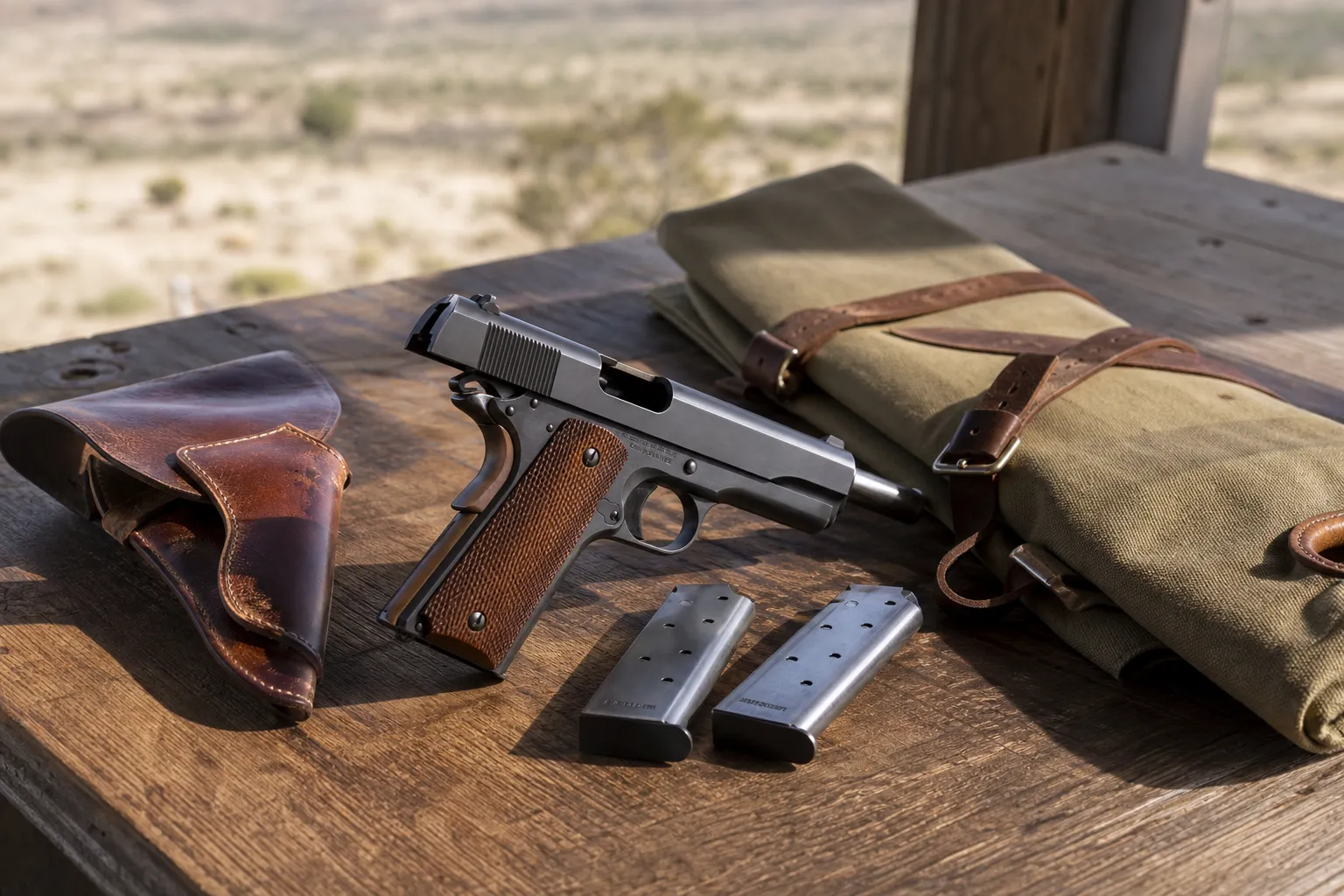
The 1911 pistol is best understood as the U.S. military service pistol designed by John Moses Browning. Browning describes the design as a magazine fed, single action, semi automatic pistol with manual and grip safeties, based on the short recoil principle of operation. The M1911 and its later M1911A1 form remained the standard U.S. sidearm until 1985, according to the National Firearms Museum.
Origins and U.S. Army adoption
Browning gives the formal adoption date as March 29, 1911, when the Browning designed pistol became known officially as the Model 1911.
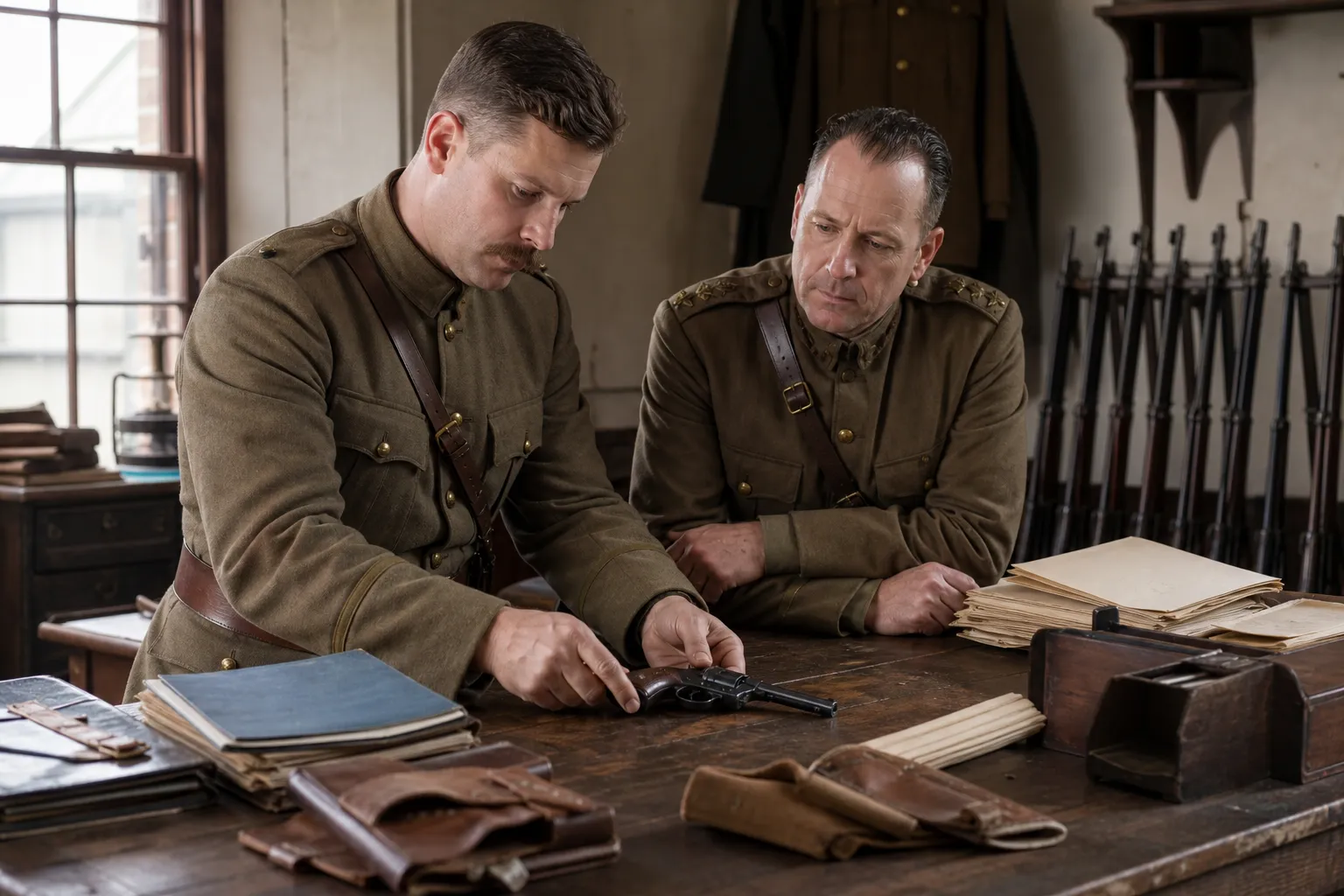
Colt’s company history says the Colt Model 1911, designed by John Browning, was officially adopted as the standard sidearm of the United States Armed Forces, replacing the .38 caliber Colt revolver.
Browning’s historical account states that the Colt pistol submitted for U.S. military tests was designed by John M. Browning. That is why the pistol is often discussed through both Colt history and Browning design history: Colt was the maker tied to Army adoption, while Browning was the designer of the pistol submitted for the trials.
Early service and production
Browning says the U.S. Navy and U.S. Marine Corps adopted the Browning designed pistol in 1913. Springfield Armory National Historic Site says Springfield Armory made U.S. M1911 pistols between 1913 and 1917.
World War I quickly increased demand. The National Firearms Museum says approximately 70,000 M1911 pistols were available for issue to U.S. troops when Congress declared war against the Central Powers on April 6, 1917. It also says the Army’s Ordnance Department soon ordered an additional 500,000 pistols from Colt.
The National Firearms Museum notes that Remington U.M.C. and Winchester both received contracts for 500,000 M1911 pistols late in World War I. Colt remained central to production history. The National Firearms Museum says Colt manufactured the M1911 and M1911A1 continuously from the original Army adoption through World War II, and was the sole producer between 1919 and 1940.
The M1911A1 update
The M1911A1 was not a new operating system. It was an improved postwar version of the M1911. The National Firearms Museum says the improved pistol was adopted by the Army in 1923 as the M1911M1, later changed to M1911A1.
The National Firearms Museum describes the changes as modifications incorporated into the frame, trigger, grip safety, and hammer of the original M1911 design. Browning lists 1924 refinements that led to the Model 1911A1, including improved sights, an arched mainspring housing, a shorter trigger, a longer grip safety spur, and other ergonomic improvements.
For a new reader, the important point is that the M1911A1 kept the basic Browning short recoil, single action pistol concept, while changing several handling and fit details.
World War II and service until 1985
The National Firearms Museum says approximately two million M1911A1 pistols were manufactured during the Second World War. It identifies Remington Rand as the largest M1911A1 producer, with its Syracuse, New York plant making more than one million .45 semi auto pistols and more than 50 percent of total wartime M1911A1 production.
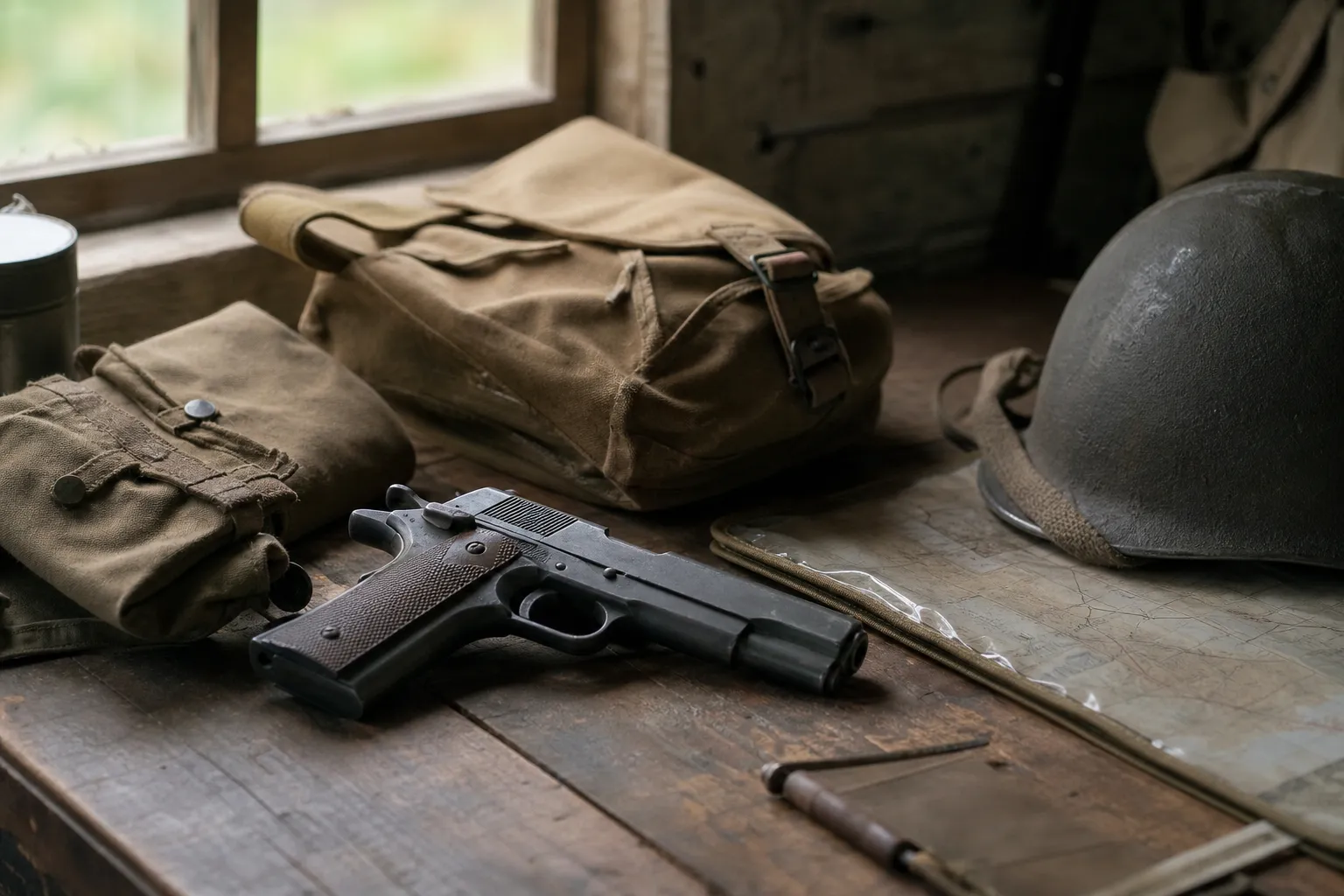
The same museum account says the M1911 and M1911A1 remained the standard sidearm for U.S. forces until 1985. The Army Historical Foundation says the Army officially retired the Colt .45 in 1985 in exchange for the Italian made 9 mm Beretta.
That long service life is a major reason the 1911 has such a strong place in U.S. handgun history. Its story runs from before World War I adoption, through two world wars, and into the late Cold War period.
How the 1911 action works
Browning identifies the original design as a short recoil pistol. Ruger’s SR1911 manual describes the modern SR1911 action as a U.S. M1911 type tilting barrel design, which is a useful plain English way to understand the system.
At the moment of firing, Ruger explains that the barrel and slide are locked together. After firing, the barrel and slide recoil rearward a short distance while still locked together.
After that short movement, Ruger says the barrel is cammed downward from its locked position. That downward movement allows full recoil of the slide, along with extraction and ejection of the spent cartridge case.
Ruger then explains that the recoil spring returns the slide forward, and the barrel is cammed back upward into its locked position in the slide. In simple terms, the barrel and slide begin together, separate as the barrel tips down, and then return to lockup as the slide moves forward.
The 1911 is also a single action pistol. Browning describes the design as single action, and Ruger explains that subsequent shots are fired single action until the magazine is empty, with the hammer cocked by the slide as it recoils from each shot. For the reader, that means the slide’s movement prepares the hammer for the next shot in the firing cycle.
Features often associated with the 1911 pattern
Browning describes the military trial pistol as magazine fed, semi automatic, and equipped with both manual and grip safeties. Those points are part of the historic 1911 identity.
The design’s reputation is also tied to its operating system: a short recoil, tilting barrel action. Ruger’s modern SR1911 manual uses the same broad M1911 type description for its current pistol line, showing that the basic operating idea remains recognizable in modern 1911 pattern pistols.
This guide does not cover disassembly, adjustment, parts fitting, or gunsmithing. For any individual pistol, the safe reference is the manufacturer’s current manual for that exact model.
Modern 1911 makers and chamberings
Many modern pistols use the 1911 pattern.
The original U.S. service identity of the M1911 is strongly tied to .45 caliber service use.
Safe handling basics
Safe handling rules and legal requirements should be reviewed before any firearm is handled, stored, transported, or transferred.
For Canadian readers, the RCMP says the Canadian Firearms Program oversees firearms licences and registration, maintains national firearm safety training standards, and assists law enforcement agencies. The RCMP says firearms in Canada are regulated by the Firearms Act and Part III of the Criminal Code, and fall into nonrestricted, restricted, and prohibited classes.
The RCMP also says it is important to store, transport, and display firearms safely to prevent accidents and deter loss or theft.
What to verify before relying on any rule
The 1911 is both a historic service pistol and a current commercial handgun pattern. If you are studying one for history, focus on the adoption period, the M1911A1 update, and the production record described above.
If you own, transport, inherit, or handle any firearm, check the current manufacturer’s manual for that exact pistol and confirm current laws with the proper authority. U.S. readers should confirm federal, state, and local requirements with the appropriate government authority. Canadian readers should confirm licensing, registration, classification, storage, and transport requirements with the Canadian Firearms Program and other relevant authorities.
Frequently asked questions
Who designed the 1911 pistol?
Browning says the Colt pistol submitted for U.S. military tests was designed by John M. Browning. Colt also identifies the Colt Model 1911 as designed by John Browning.
When did the U.S. Army adopt the M1911?
Browning gives the formal adoption date as March 29, 1911.
What changed with the M1911A1?
The National Firearms Museum says the M1911A1 changes were incorporated into the frame, trigger, grip safety, and hammer. Browning lists refinements including improved sights, an arched mainspring housing, a shorter trigger, and a longer grip safety spur.
How long did the M1911 and M1911A1 serve as standard U.S. sidearms?
The National Firearms Museum says the M1911 and M1911A1 remained the standard sidearm for U.S. forces until 1985. The Army Historical Foundation says the Army officially retired the Colt .45 in 1985 in exchange for the Italian made 9 mm Beretta.
How does the 1911’s short recoil action work?
Ruger describes the SR1911 as a U.S. M1911 type tilting barrel design. The barrel and slide begin locked together, recoil rearward briefly, then the barrel cams downward so the slide can extract and eject. The recoil spring returns the slide forward and cams the barrel back up into lockup.
Sources
- Firearms, Royal Canadian Mounted PoliceOfficial source. Accessed October 23, 2026.
- History of the 1911 Pistol, Browning. Accessed October 23, 2026.
- Arming the Army, John M. Browning, The United States ArmyOfficial source. Accessed October 23, 2026.
- The Colt Story, Timeline, Colt’s Manufacturing Company LLCOfficial source. Accessed October 23, 2026.
- How to Make a Gun, Springfield Armory National Historic Site, U.S. National Park ServiceOfficial source. Accessed October 23, 2026.
- The National Matches, Springfield Armory National Historic Site, U.S. National Park ServiceOfficial source. Accessed October 23, 2026.
- Springfield Armory National Historic Site, U.S. National Park ServiceOfficial source. Accessed October 23, 2026.
- U.S. Small Arms of World War II, Springfield Armory National Historic Site, U.S. National Park ServiceOfficial source. Accessed October 23, 2026.
- U.S. Colt Model 1911 Semi-Automatic Pistol, NRA National Firearms Museum. Accessed October 23, 2026.
- U.S. Colt Model 1911A1 Semi-Automatic Pistol, NRA National Firearms Museum. Accessed October 23, 2026.
- M1911 .45 Caliber Pistol, The Army Historical Foundation. Accessed October 23, 2026.
- Ruger SR1911 Instruction Manual, Sturm, Ruger & Co., Inc.Official source. Accessed October 23, 2026.
- 1911 Series Handguns, Springfield ArmoryOfficial source. Accessed October 23, 2026.
- SR1911, Sturm, Ruger & Co., Inc.Official source. Accessed October 23, 2026.
- 2025 Colt Catalog Update, ColtOfficial source. Accessed October 23, 2026.
- Kimber 1911 Manual, Kimber AmericaOfficial source. Accessed October 23, 2026.
- Learn About Firearms Safety and Security, Bureau of Alcohol, Tobacco, Firearms and ExplosivesOfficial source. Accessed October 23, 2026.
- State Laws and Published Ordinances, Firearms, 36th Edition, Bureau of Alcohol, Tobacco, Firearms and ExplosivesOfficial source. Accessed October 23, 2026.
- Storing, transporting and displaying firearms, Royal Canadian Mounted PoliceOfficial source. Accessed October 23, 2026.