The Heckler & Koch MP5: History and Design
The Heckler & Koch MP5 is a 9 x 19 mm submachine gun that grew out of HK’s G3 roller-delayed design family in the 1960s. Its full-size, SD and K variant families became closely associated with police and special-unit use before newer PDWs and short rifle-caliber carbines took over some of its roles.
By RaiS. Reviewed by RaiS. Published . 6 min read.
Research and drafting were assisted by AI. RaiS checked the facts against the sources below and approved this page.
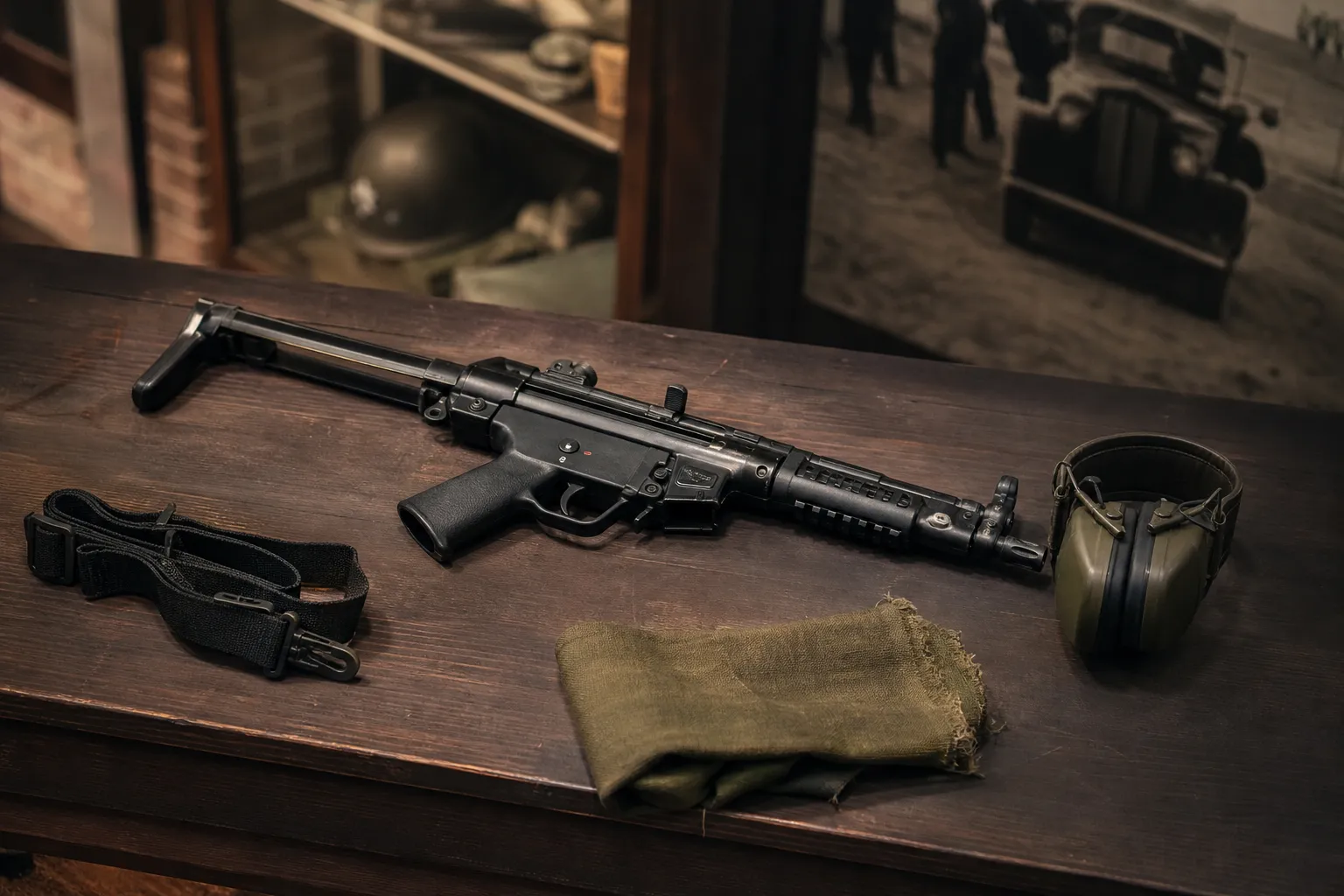
The Heckler & Koch MP5 is best understood as a compact 9 x 19 mm member of the same design family that produced the G3 rifle. Heckler & Koch describes the MP5 as a roller-delayed blowback submachine gun, and HK’s own 50th anniversary catalog says it began as the 9 mm HK54, adapted from the basic G3 design and operating system. Its reputation came from a mix of mechanical refinement and wide use by police and special units.
Origins at Heckler & Koch
Heckler & Koch traces its origin to Oberndorf, Germany, after World War II. HK Defense says Edmund Heckler, Theodor Koch and Alex Seidel were former Mauser engineers who salvaged equipment after the French dismantled the former Mauser works. HK Defense states that Heckler & Koch GmbH was registered in December 1949 and opened for business in 1950 in Oberndorf.
HK’s first major firearm breakthrough was the G3. HK Defense says the G3 became the Bundeswehr standard rifle by 1959, and describes it as using a delayed roller locked bolt system. That system became central to HK’s later firearms identity.
The MP5 followed from that lineage. HK’s 50th anniversary catalog states that Heckler & Koch adapted the basic G3 design and operating system into other calibers, with the most famous being the 9 mm HK54, better known as the MP5. HK Defense says that, in the mid-1960s, the company gained international prominence with the 9 mm Maschinenpistole 5, or MP5.
The MP5 emerged in the 1960s from HK’s G3-based roller-delayed family. A 2000 article by Jim Schatz, identified there as working in HK Federal Operations, says HK had been producing and improving the MP5 since 1964.
The roller-delayed design lineage
HK’s current MP5 product page lists the MP5 as a 9 mm x 19 firearm with a roller-delayed blowback bolt system.
In broad terms, roller-delayed blowback uses mechanical delay to slow the opening of the breech after firing. The important historical point is not how to build or alter the system, but why it mattered: HK carried a G3-family operating idea into a smaller 9 mm submachine gun.
HK’s modern MP5 page lists a 30-cartridge magazine capacity for the 9 mm x 19 MP5. The FBI’s archived SWAT equipment guide also identifies a 30-round magazine for the FBI SWAT MP5 described there, although that archived FBI example is listed as a 10 mm weapon.
Main MP5 variant families
HK groups the modern MP5 product family into three main variants: MP5, MP5SD and MP5K. Those names represent the core shape of the family: a full-size gun, an integrated-suppressed model, and a very compact model.
| Variant family | How HK describes it | Historical notes |
|---|---|---|
| MP5 | HK says the MP5 is primarily aimed at police units and first response forces engaging area targets. | Jim Schatz’s 2000 article identifies the standard full-size A2/A3 model as one of the broad MP5 developments from the mid-1960s. |
| MP5SD | HK says the MP5SD is intended for specialized forces and selected special units. | Schatz identifies the SD as an integrally sound-suppressed model created in 1971. HK distinguishes it by a special barrel and integrated silencer. |
| MP5K | HK says the MP5K is the most compact MP5 family member, designed primarily for special forces and bodyguards. | Schatz identifies the micro-sized K as a 1978 development. |
MP5: the full-size family
The standard MP5 family is the version most readers picture first. HK describes the MP5 as primarily aimed at police units and first response forces.
HK USA’s law-enforcement brochure lists several MP5-related models in its technical data table, including MP5, MP5N, MP5K, MP5K-PDW and MP5SD. The brochure shows how the MP5 name grew into a family rather than a single fixed pattern.
MP5SD: the suppressed branch
HK describes the MP5SD as intended for specialized forces and selected special units. It distinguishes the MP5SD by a special weapon barrel with an integrated silencer. HK also says that where other submachine guns have to use special subsonic ammunition for silenced use, the MP5SD fires supersonic ammunition in the subsonic range.
That description is included here only as historical and technical context. It is not guidance on suppressor construction, alteration, ammunition selection or legal use. Readers should treat the MP5SD as an institutional, specialized branch of the MP5 family.
MP5K: the compact branch
HK describes the MP5K as the most compact submachine gun in the MP5 family, designed primarily for special forces and bodyguards. In Schatz’s model history, the K appeared after the full-size and SD branches.
The K’s importance is easy to understand in context. The broader MP5 family was already associated with police and special units, and the MP5K took that design identity into a smaller package for roles where compactness was central.
Adoption and reputation
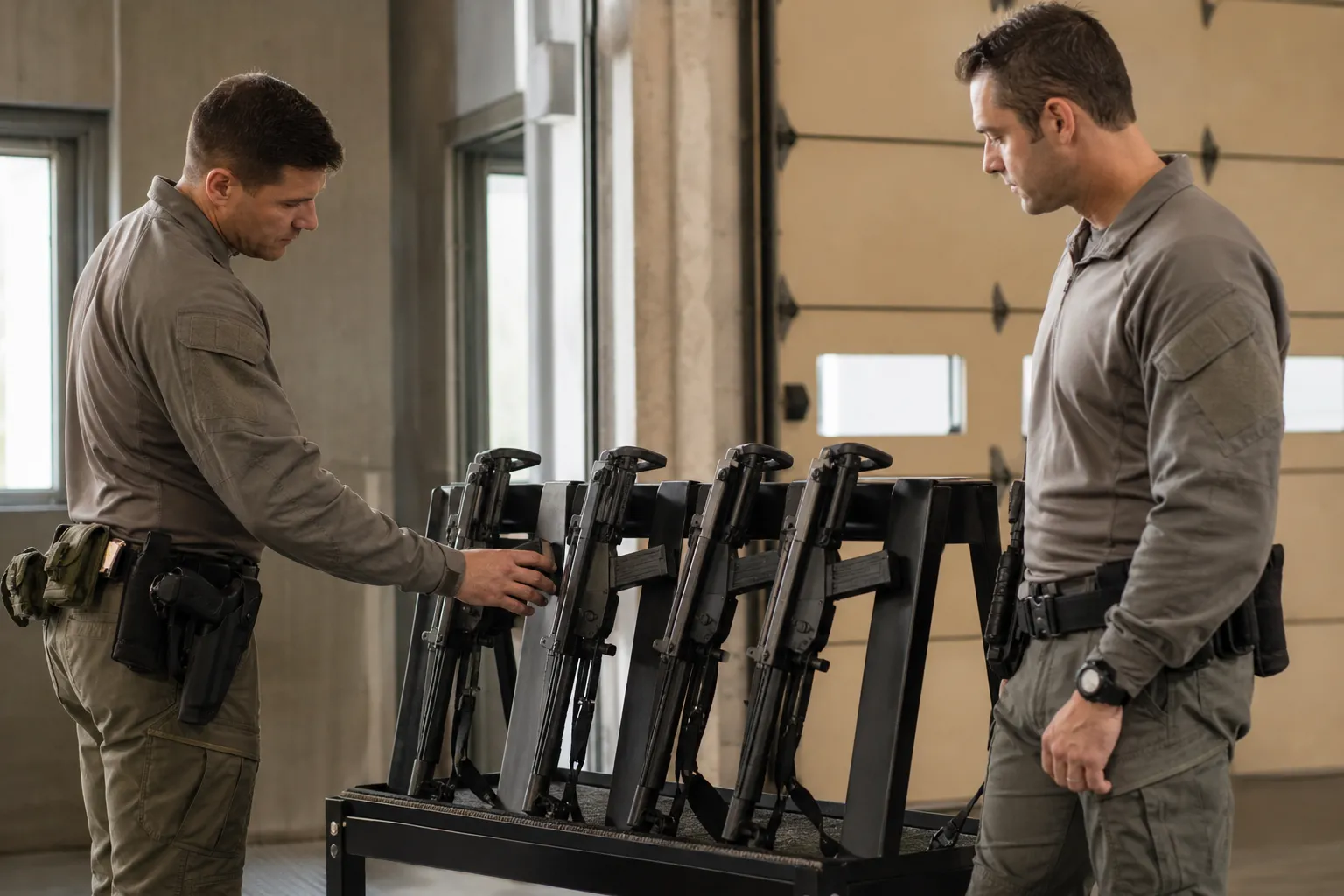
The FBI archive gives a documented U.S. law-enforcement example. Its archived SWAT equipment guide identifies an H&K MP5 submachine gun with collapsible stock as an FBI SWAT assaulter primary weapon. The same FBI page specifies that the described FBI SWAT MP5 fired a 10 mm bullet and held a 30-round magazine.
The French Gendarmerie example shows that MP5 demand continued well after the design’s 1960s origin. Schatz’s 2000 article says the MP5F was developed after a 1998 French Gendarmerie requirement for a 9 mm submachine gun for general police issue. The article states that the French Gendarmerie purchase under consideration was up to 35,000 MP5s, with some to be assembled and produced in France under license.
Taken together, those examples explain the MP5’s reputation without relying on legend. The FBI archive records it in a U.S. SWAT equipment context. The French Gendarmerie requirement shows late institutional interest in a refined MP5 version.
Why later PDWs and carbines displaced it in some roles
The MP5 did not disappear, but later weapons challenged the role that pistol-caliber submachine guns once filled. Three major pressures were lower-cost submachine gun alternatives, compact personal defense weapons, and short rifle-caliber carbines.
HK’s own UMP information sheet places one pressure inside HK’s catalog. It describes the UMP as a lightweight, cost-effective submachine gun option for law-enforcement duty ammunition. HK USA says the UMP was designed in the 1990s and entered production in 2000. That does not make the UMP a direct replacement in every agency, but it shows that HK itself offered a newer submachine gun concept after decades of MP5 production.
The PDW pressure is clearer in HK’s MP7A1 brochure. HK says the MP7 was developed according to NATO’s profile for a new personal defence weapon. The same brochure says the MP7 represents a new generation of very compact and performance-improved submachine guns that, unlike former conventional submachine guns, can engage protected targets at short and medium ranges. HK explicitly contrasts this with conventional 9 mm x 19 submachine guns and police pistol ammunition, saying those ammunition types are ineffective against bulletproof vests.
Short rifle-caliber carbines were another pressure. Police Magazine links the U.S. law-enforcement shift toward M16, AR-15 and M4 patrol rifles to the 1997 North Hollywood Shootout in Los Angeles, where armor stopped pistol rounds. The same article says many tactical operators later favored the M4 for rifle-caliber power and combat-proven performance in Iraq and Afghanistan, while short-barreled M4 variants answered the desire for compact entry weapons.
That combination explains why the MP5’s original strengths did not guarantee permanent dominance. A 9 mm roller-delayed submachine gun could still be valued for specialized roles, but agencies facing armor concerns, longer standoff distances, or budget and procurement pressures had reasons to consider PDWs, newer submachine guns, and compact rifle-caliber carbines.
What to check now
Readers considering a specific agency, military unit, or current model should use the latest manufacturer literature and the agency’s current equipment information. For current legal status, procurement rules, suppressor rules, or official issue policies, use information from the responsible government agency, not historical summaries or collector discussions.
Frequently asked questions
What was the MP5 originally based on?
HK’s 50th anniversary catalog says the MP5 began as the 9 mm HK54, adapted from the basic G3 design and operating system.
What operating system does the MP5 use?
Heckler & Koch lists the MP5 bolt system as roller-delayed blowback.
What are the main MP5 variant families?
Heckler & Koch groups the modern MP5 family into MP5, MP5SD and MP5K main variants.
Who used the MP5?
The FBI archive identifies an H&K MP5 as an FBI SWAT assaulter primary weapon in its archived equipment guide. Jim Schatz’s 2000 article also discusses a French Gendarmerie requirement for an MP5 variant.
Why did some agencies move away from 9 mm submachine guns like the MP5?
HK’s MP7A1 brochure says conventional 9 mm x 19 submachine guns and police pistol ammunition are ineffective against bulletproof vests. Police Magazine also links U.S. law-enforcement adoption of M16, AR-15 and M4 patrol rifles to the 1997 North Hollywood Shootout, where armor stopped pistol rounds.
Sources
- MP5, Heckler & KochOfficial source. Accessed October 23, 2026.
- MP5 Sub-Machine Gun (SMG) / 9 x 19mm, Heckler & Koch USAOfficial source. Accessed October 23, 2026.
- Heckler & Koch: A Company History, Heckler & Koch Defense Inc.Official source. Accessed October 23, 2026.
- Heckler & Koch 50 Year Anniversary Catalog 2000, Heckler & KochOfficial source. Accessed October 23, 2026.
- MP5 9mm, Australian ArmyOfficial source. Accessed October 23, 2026.
- Tools of the Trade: FBI SWAT (Text Version), Federal Bureau of Investigation archiveOfficial source. Accessed October 23, 2026.
- The New HK MP5F Submachine Gun, Small Arms Review. Accessed October 23, 2026.
- Universal Machine Pistol (UMP) 9 mm x 19, Heckler & Koch USAOfficial source. Accessed October 23, 2026.
- MP7 A1 Technical Data, Heckler & KochOfficial source. Accessed October 23, 2026.
- Select Fire Carbines vs. Submachine Guns, Police Magazine. Accessed October 23, 2026.
- MP5 | Heckler & Koch. Accessed November 25, 2026.