.40 S&W: History, Dimensions and Use in Service Pistols
.40 S&W is a 1990 centerfire pistol cartridge jointly developed by Smith & Wesson and Winchester/Olin. It became widely used in police service pistols, and later comparisons can include magazine capacity differences among similar size pistols.
By RaiS. Reviewed by RaiS. Published . 4 min read.
Research and drafting were assisted by AI. RaiS checked the facts against the sources below and approved this page.
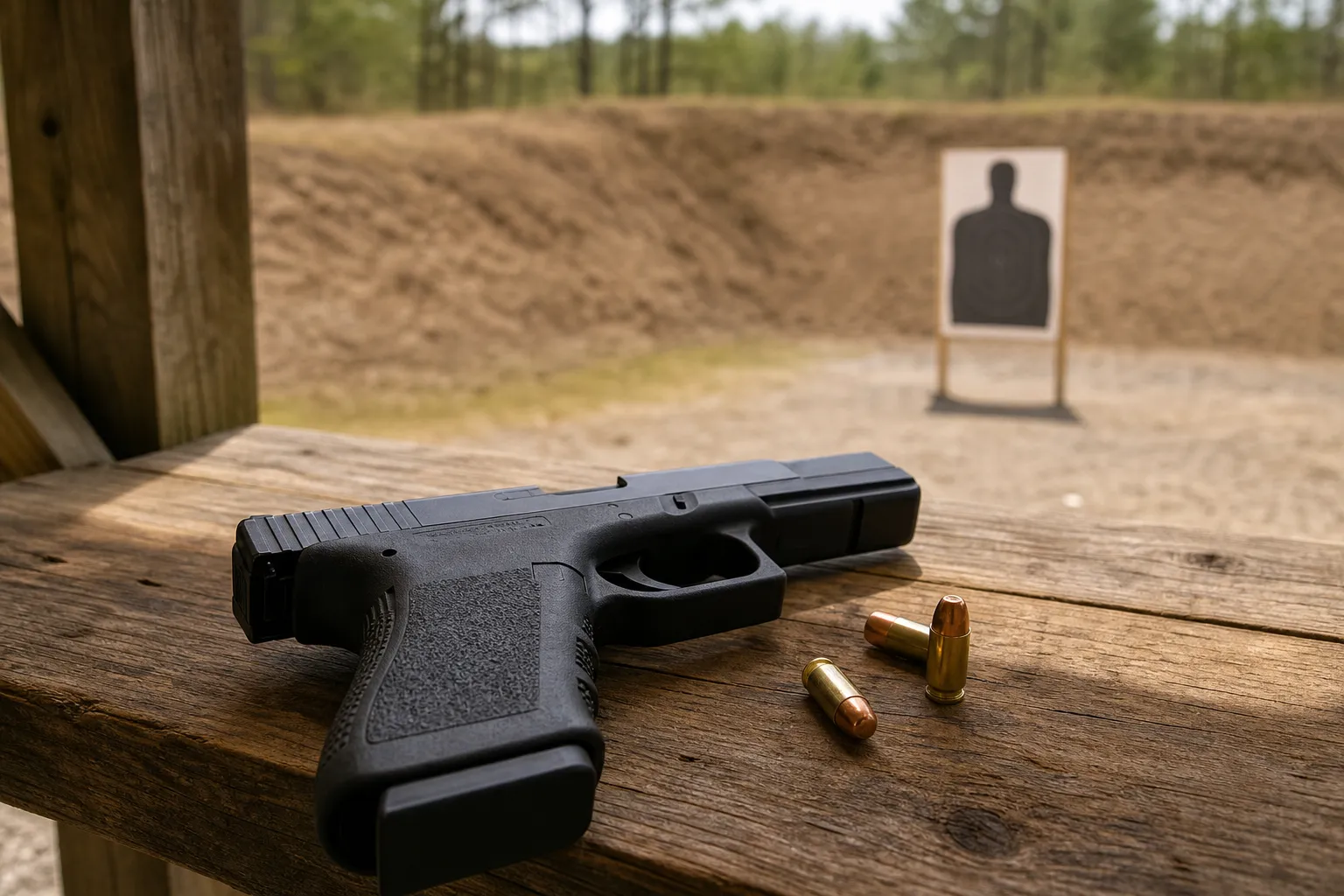
.40 S&W is a centerfire pistol cartridge introduced in 1990 and jointly developed by Smith & Wesson and Winchester/Olin. In police service pistols, it became widely used through the 2000s and early 2010s, while later comparisons can include standard magazine capacity differences among similar size pistols.
The law enforcement background before .40 S&W
The FBI’s April 11, 1986 Miami firefight is the usual historical starting point for modern discussion of .40 S&W. FBI history describes that incident as one of the Bureau’s deadliest shootouts, with two agents killed and five others injured.
The cartridge itself did not appear in 1986. Later law enforcement interest in semiautomatic service pistols became part of the setting in which .40 S&W emerged.
From 10mm Auto testing to the .40 S&W
For more background on 10mm Auto, see our guide to 10mm Auto.
The Smith & Wesson Model 4006 was introduced in 1990 for the newly designed .40 S&W cartridge, which was jointly developed with Winchester/Olin.
The pairing of a service pistol and a new cartridge helped place .40 S&W in the law enforcement market.
SAAMI dimensions and pressure
SAAMI standards are used as dimensional references for cartridges. The specific figures should be read from the current standard rather than from general history notes.
These are cartridge and chamber standard figures, not a guarantee that every commercial load will have the same velocity or energy. Ammunition companies publish their own load data, often with a stated test barrel length.
Common bullet weights and published load examples
Ammunition and law enforcement catalogs show that .40 S&W loads can vary by bullet weight, velocity, energy, and test barrel length.
Hornady Law Enforcement lists a .40 S&W 175 grain FlexLock Critical Duty load, item 91375. Hornady lists that 175 grain load at 1,010 feet per second and 396 foot pounds at the muzzle from a 4 inch factory test barrel. Hornady also states that the FBI chose Hornady Critical Duty .40 S&W as contracted service ammunition after an evaluation process.
Many .40 S&W examples discussed in law enforcement history use hollow point bullets. For a plain language explanation of that bullet type compared with full metal jacket bullets, see FMJ vs hollow point bullets.
Why .40 S&W became a major police cartridge
Federal survey data shows how widely .40 caliber service pistols were used. The Bureau of Justice Statistics reported that in 2003 the .40 caliber semiautomatic was the most commonly authorized sidearm among local police departments.
BJS also reported that in 2003.40 caliber semiautomatics were authorized by 62 percent of departments, employing 55 percent of officers. A 2009 BJA/PERF body armor survey reported that 72.9 percent of agencies issued or authorized .40 caliber firearms as the primary sidearm.
The pattern continued into the early 2010s. A 2013 PERF service weapon survey found that .40 caliber handguns were the most common type purchased by responding agencies from 2008 through 2012. The same PERF survey said the most common magazine capacity among handgun purchases was 15 rounds.
Those figures explain why .40 S&W is often remembered as a once dominant law enforcement cartridge. It was not just available in service pistols. It was broadly authorized, issued, and purchased by police agencies during the period covered by those surveys.
Recoil and capacity tradeoffs
Manufacturer specifications give a simple example of the capacity side of that comparison. Glock lists the .40 S&W G22 Gen5 MOS with a standard magazine capacity of 15 rounds and a 4.49 inch barrel. Glock lists the 9x19 mm G17 Gen5 with a standard magazine capacity of 17 rounds and the same 4.49 inch barrel. For more on how pistol magazines are described, see pistol magazines explained. For more background on the 9mm cartridge, see 9mm Luger.
The key point is not that one cartridge is best for every reader. The example shown here is that .40 S&W became popular in service pistols, while similar size 9mm and .40 S&W pistols can have different standard magazine capacities.
How to read .40 S&W data responsibly
Keep three kinds of information separate.
First, cartridge standards describe the cartridge. They are the best place to start for bullet diameter, case length, chamber and barrel drawings, and maximum average pressure.
Second, ammunition catalogs describe specific loads. The Hornady example shows how bullet weight, velocity, energy, and test barrel length are tied to a particular product listing.
Third, agency surveys describe what police departments authorized, issued, or purchased during a specific period. BJS, BJA/PERF, and PERF figures are useful for history, but they do not say what every agency uses now.
For current information, check the latest cartridge standard, ammunition manufacturers for current load data, and the relevant agency or department for any present service pistol or ammunition policy.
Frequently asked questions
When was .40 S&W introduced?
.40 S&W was introduced in 1990. The cartridge was jointly developed by Smith & Wesson and Winchester/Olin.
Was .40 S&W widely used by police?
Yes. The Bureau of Justice Statistics reported that in 2003 the .40 caliber semiautomatic was the most commonly authorized sidearm among local police departments. A 2009 BJA/PERF survey reported that 72.9 percent of agencies issued or authorized .40 caliber firearms as the primary sidearm.
How does .40 S&W compare with 9mm for capacity?
One manufacturer example shows the capacity side of the comparison. Glock lists the .40 S&W G22 Gen5 MOS at 15 rounds and the 9x19 mm G17 Gen5 at 17 rounds, both with 4.49 inch barrels.
Sources
- Fatal Firefight in Miami, Federal Bureau of InvestigationOfficial source. Accessed November 12, 2026.
- FBI Law Enforcement Bulletin, November 1989, The FBI’s 10mm Pistol, Federal Bureau of InvestigationOfficial source. Accessed November 12, 2026.
- Smith & Wesson Holding Corp. SEC filing with History of S&W section, Smith & Wesson Holding Corp. / SEC filing archiveOfficial source. Accessed November 12, 2026.
- SAAMI Z299.3-2022, Voluntary Performance Standards for Centerfire Pistol and Revolver Ammunition, Sporting Arms and Ammunition Manufacturers’ InstituteOfficial source. Accessed November 12, 2026.
- Federal Premium 2020 Catalog, Handgun Ballistics, Federal Premium AmmunitionOfficial source. Accessed November 12, 2026.
- 40 S&W 175 gr FlexLock, Hornady Law EnforcementOfficial source. Accessed November 12, 2026.
- Local Police Departments, 2003, Bureau of Justice Statistics, Office of Justice Programs, U.S. Department of JusticeOfficial source. Accessed November 12, 2026.
- The BJA/PERF Body Armor National Survey, 2009, Bureau of Justice Assistance and Police Executive Research ForumOfficial source. Accessed November 12, 2026.
- Police Department Service Weapon Survey, 2013, Police Executive Research Forum. Accessed November 12, 2026.
- GLOCK 22 Gen5 MOS, GLOCK, Inc.Official source. Accessed November 12, 2026.
- GLOCK 17 Gen5, GLOCK, Inc.Official source. Accessed November 12, 2026.
- FBI Training Division, Executive Summary of Justification for Law Enforcement Partners, FBI Training Division document copy hosted by Gun Nuts Media. Accessed November 12, 2026.
- Company | Smith & Wesson. Accessed November 25, 2026.