Axis Deer Guide for Texas and Hawaiʻi
Axis deer are deer established in parts of Texas and Hawaiʻi. Introduced populations can create management concerns where they affect agriculture, habitats, roads, and other wildlife.
By RaiS. Reviewed by RaiS. Published . 6 min read.
Research and drafting were assisted by AI. RaiS checked the facts against the sources below and approved this page.

Axis deer are not native to Texas and Hawaiʻi. For hunters and wildlife readers, the big picture is simple: axis deer are attractive and highly recognizable animals, but introduced populations can create serious local management problems.
What axis deer are
Texas Parks and Wildlife Department includes axis deer among examples of exotic ungulates that are not indigenous or native to Texas. In Hawaiʻi, the Hawaiʻi Invasive Species Council says axis deer are not native to Hawaiʻi and are known pests of agriculture, native plants, and culturally significant plants.
Identification in the field
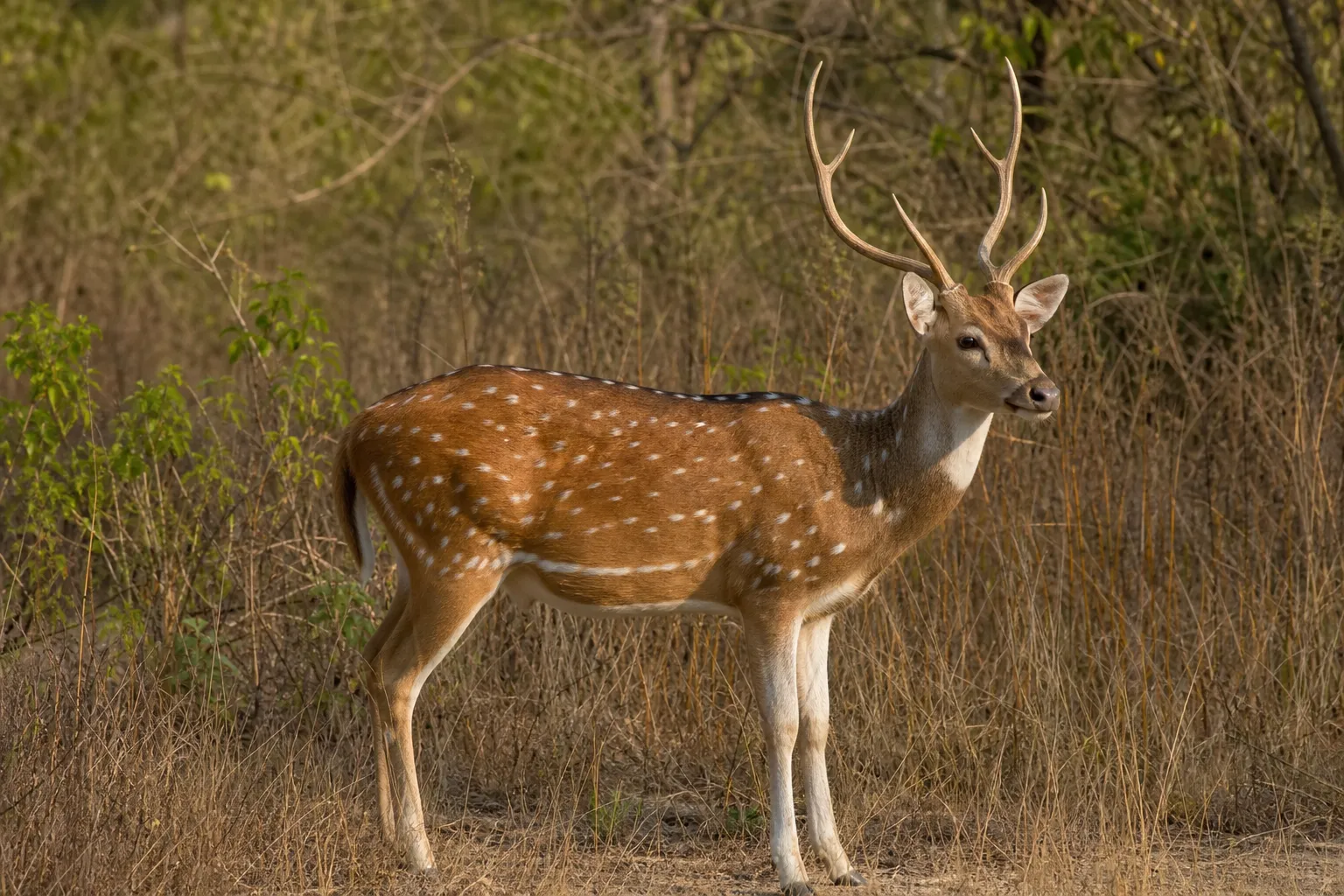
Males grow antlers. Texas Parks and Wildlife describes adult male antlers as usually 30 to 36 inches long, with a beam that curves backward and outward in a lyre shaped form.
Texas profile
In Texas, axis deer are an introduced exotic ungulate. Texas Parks and Wildlife includes axis deer in its examples of exotic ungulates that are not indigenous or native to Texas.

Texas A&M AgriLife says axis deer may be the most abundant and widespread exotic species in Texas and were first introduced there in 1932. Texas Tech’s Mammals of Texas account also places the Texas introduction at about 1932 and says the species now occurs in a number of central and southern Texas counties.
Their modern Texas distribution is especially important for Hill Country and South Texas readers. Texas A&M AgriLife says early introductions were on high fenced game ranches, while many free ranging populations now occur in the Edwards Plateau and northern South Texas Plains ecoregions. Texas Tech says axis deer are very common through much of the Hill Country region.
Habitat and water help explain where people see them. Texas Tech describes axis deer habitat as secondary forest land broken by glades, with grasses, forbs, tender shoots, drinking water, and shade, and says they tend to avoid rugged terrain. Texas A&M AgriLife says axis deer select grassland near water and woody brush or trees, which they use for security cover or shade.
Diet is another practical point. Texas A&M AgriLife describes axis deer as primarily grazers that forage on grasses year round, but with a broad diet that includes browse, mast, and forbs. The same Texas A&M AgriLife fact sheet says axis deer may drink standing water daily in hot weather.
Hawaiʻi profile
Axis deer have a long introduction history in Hawaiʻi. Hawaiʻi Department of Land and Natural Resources says axis deer first came to Hawaiʻi in the 1860s as a gift to King Kamehameha V, were first taken to Molokaʻi, and later went to Maui and Lānaʻi.
USGS gives a more specific sequence: axis deer were brought to the Hawaiian Islands from India in late 1867 as a gift to King Kamehameha V and released on Molokaʻi in 1868. USGS says some were moved to Lānaʻi in 1920 and released on Maui in 1959.
Hawaiʻi DLNR lists axis deer as occurring on Maui, Molokaʻi, and Lānaʻi. In a 2026 DLNR statement, the agency said the abundance of axis deer on Maui Nui continued to cause environmental, safety, and economic challenges for residents. DLNR also said it estimated 26,000 axis deer on Maui Nui in 2025, with 2026 surveys underway, and noted that some deer occupy public lands but most are on private land.
The Hawaiʻi Invasive Species Council says numbers on Maui reached an estimated 7,500 to 11,000 animals by 2013 after nine deer were introduced in 1959 and 1960. USGS modeling also used the history of only nine deer introduced in 1959 and recent estimates of fewer than 10,000 deer for Maui management scenarios.
Behavior and reproduction
Axis deer are social animals. Texas Tech says they are gregarious and usually found in herds ranging from a few animals to more than 100, with the leader usually an old, experienced doe.
Their breeding pattern is one reason introduced populations can be hard to manage. Texas Tech says bucks with hardened antlers and in rutting condition may be found throughout the year. It also says females experience estrous cycles throughout the year and that pregnant females may be found throughout the year.
The Hawaiʻi Invasive Species Council describes axis deer as having high reproductive rates, with at least 95 percent of does bearing fawns after reaching maturity as early as six to ten months.
Impacts in Texas
Texas management concerns often focus on overlap with native wildlife, especially white tailed deer. Texas A&M AgriLife says axis deer can affect and compete with native wildlife species, especially white tailed deer, because the two species use similar habitat characteristics.
Forage competition can become more important when conditions are dry. Texas A&M AgriLife says axis deer compete directly with white tailed deer for forage, especially during drought. The agency notes that axis deer eat browse, mast, and forbs like white tailed deer, but can also thrive on grass, while white tailed deer cannot.
Texas Tech reports that research at Kerr Wildlife Management Area suggests axis deer can outcompete white tailed deer when resources are limited. Texas A&M AgriLife also says axis deer can damage rangelands and riparian areas through overuse.
For a Texas landowner, hunter, or wildlife observer, the practical takeaway is that axis deer are not just another deer on the landscape. Their grazing habits, herd behavior, use of water and cover, and overlap with white tailed deer make them part of broader rangeland and wildlife management decisions.
Impacts in Hawaiʻi
In Hawaiʻi, official descriptions emphasize damage to agriculture, forests, watersheds, roads, and native plant communities. Hawaiʻi DLNR says axis deer on Maui and Molokaʻi continue to devastate private agricultural land and move higher into forested lands.
DLNR also says axis deer trample and eat plants, spread invasive weeds, and can turn forests into bare ground that erodes into beaches and coral reefs. The Hawaiʻi Invasive Species Council says axis deer are pests of agriculture, native plants, and culturally significant plants, many of which are already endangered.
USGS describes several impacts in one place: axis deer in the Hawaiian Islands damage agricultural crops and native and ornamental vegetation through browse and bark stripping, cause erosion, are frequently hit by vehicles, and may carry diseases that can infect humans. USGS also says that with no predators in Hawaiʻi, deer numbers can increase rapidly.
Disease surveillance is part of the Hawaiʻi management context, especially on Molokaʻi. USDA APHIS reported in an August 2025 program review that three bovine tuberculosis positive axis deer had been detected from western Molokaʻi since 2022 through opportunistic hunter harvested deer sampling and FSIS slaughter inspection. USDA APHIS also said axis deer surveillance had improved, while surveillance for other wildlife species remained limited or absent at that time.
Key differences for Texas and Hawaiʻi readers
Axis deer are the same species in both places, but the management context differs.
In Texas, Texas Parks and Wildlife frames axis deer as exotic ungulates that are not native to the state. Texas A&M AgriLife and Texas Tech emphasize their establishment in central and southern Texas, especially the Edwards Plateau, northern South Texas Plains, and Hill Country, along with competition concerns involving white tailed deer.
In Hawaiʻi, Hawaiʻi DLNR, the Hawaiʻi Invasive Species Council, and USGS emphasize impacts on agriculture, native forests, watersheds, erosion, roads, and disease surveillance. DLNR’s 2026 statement also describes axis deer abundance on Maui Nui as an ongoing environmental, safety, and economic challenge.
Before planning any hunt, land access, control work, transport, or meat handling activity, readers should check the current official information from the relevant state agency, county or land manager, and any disease surveillance advisories. This guide does not summarize hunting regulations.
Frequently asked questions
Are axis deer native to Texas or Hawaiʻi?
No. Texas Parks and Wildlife describes axis deer as exotic ungulates that are not indigenous or native to Texas. Hawaiʻi agencies describe axis deer as not native in Hawaiʻi.
Where are axis deer found in Texas?
Texas A&M AgriLife says many free ranging populations occur in the Edwards Plateau and northern South Texas Plains ecoregions. Texas Tech says axis deer are very common through much of the Hill Country region.
Where are axis deer found in Hawaiʻi?
Hawaiʻi DLNR lists axis deer as occurring on Maui, Molokaʻi, and Lānaʻi.
Do axis deer breed year round?
They can. Texas Tech says rutting bucks, estrous females, and pregnant females may be found throughout the year.
Why are axis deer a concern in Hawaiʻi?
Hawaiʻi DLNR, the Hawaiʻi Invasive Species Council, and USGS describe impacts including damage to agriculture, native plants, forests, watersheds, erosion, road collisions, and disease surveillance concerns.
Sources
- Axis axis (Artiodactyla: Cervidae), Mammalian Species, Oxford Academic. Accessed October 23, 2026.
- Exotics in Texas, Texas Parks and Wildlife DepartmentOfficial source. Accessed October 23, 2026.
- Exotic and Fur-bearing Species, Texas Parks and Wildlife DepartmentOfficial source. Accessed October 23, 2026.
- Axis Deer / Chital (Axis axis), Texas A&M AgriLife Extension and Texas A&M Natural Resources InstituteOfficial source. Accessed October 23, 2026.
- Species account of the Axis Deer, Natural Science Research Laboratory, Texas Tech University. Accessed October 23, 2026.
- Hawaii Wildlife Conservation Stamp Contest 2016-17 Announcement, Hawaiʻi Department of Land and Natural Resources, Division of Forestry and WildlifeOfficial source. Accessed October 23, 2026.
- Axis Deer Impact Survey for Maui, Molokaʻi, Lānaʻi, Hawaiʻi Department of Land and Natural ResourcesOfficial source. Accessed October 23, 2026.
- Aerial Assessment of Molokaʻi Axis Deer Illustrates the Extent of Overpopulation on Maui Nui, Hawaiʻi Department of Land and Natural ResourcesOfficial source. Accessed October 23, 2026.
- First axis deer removed from Hawaii Island, Hawaiʻi Invasive Species Council, Hawaiʻi Department of Land and Natural ResourcesOfficial source. Accessed October 23, 2026.
- FY18 Funded Projects, Hawaiʻi Invasive Species Council, Hawaiʻi Department of Land and Natural ResourcesOfficial source. Accessed October 23, 2026.
- Introduced Deer in the Hawaiian Islands, U.S. Geological SurveyOfficial source. Accessed October 23, 2026.
- Maui Island Modeling Scenarios for the Management of Axis Deer 1959-2014, U.S. Geological SurveyOfficial source. Accessed October 23, 2026.
- Hawaii Bovine Tuberculosis Program Review, August 2025, USDA Animal and Plant Health Inspection ServiceOfficial source. Accessed October 23, 2026.