Black-Tailed Deer: Columbian and Sitka Blacktails
Black-tailed deer are the coastal blacktail group within Odocoileus hemionus, with Columbian black-tailed deer from northern California to British Columbia and Sitka black-tailed deer in Southeast Alaska and the north British Columbia coast. This guide covers identification, range, habitat, diet, rut timing, and behavior for hunters and wildlife watchers.
By RaiS. Reviewed by RaiS. Published . 9 min read.
Research and drafting were assisted by AI. RaiS checked the facts against the sources below and approved this page.
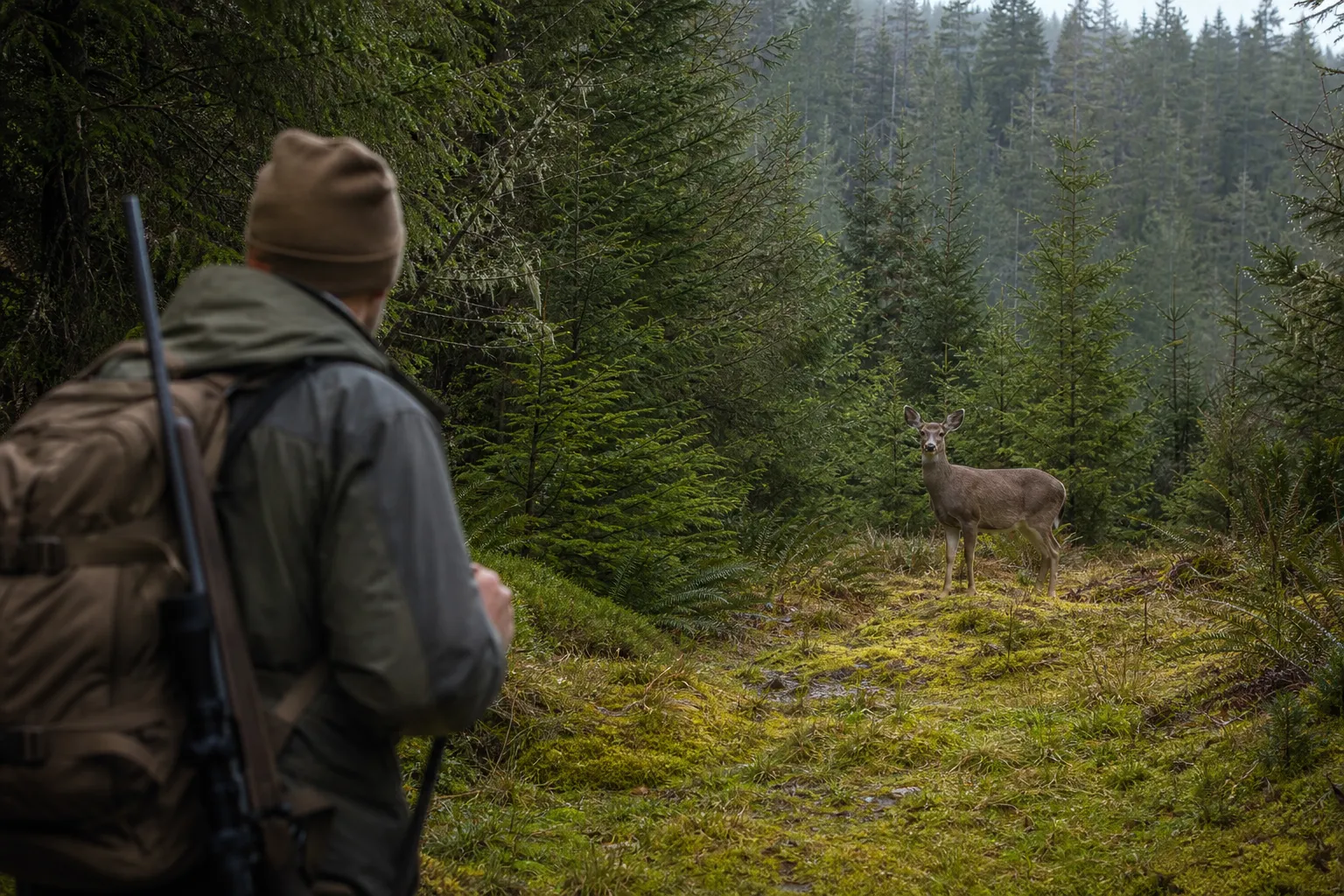
Black-tailed deer are the coastal blacktail group within Odocoileus hemionus, the same species group that includes mule deer. Wildlife agencies and references commonly treat blacktails as mule deer subspecies, but they are smaller, darker, and strongly tied to coastal forest habitats. The two blacktail deer subspecies are the Columbian black-tailed deer and the Sitka black-tailed deer.
What black-tailed deer are
The Western Association of Fish and Wildlife Agencies lists two black-tailed deer subspecies: Columbian black-tailed deer (Odocoileus hemionus columbianus) and Sitka black-tailed deer (O. h. sitkensis). The USDA Forest Service Fire Effects Information System also separates Odocoileus hemionus into a mule deer group and a black-tailed deer group, with Columbian and Sitka deer in the black-tailed group.
That relationship matters in the field. Blacktails are not white-tailed deer. They are closely tied to the mule deer side of North American deer classification. The Western Association of Fish and Wildlife Agencies says black-tailed deer are subspecies of mule deer, while also being physically and genetically different from mule deer and from each other. The British Columbia Ministry of Environment, Lands and Parks similarly describes mule deer and black-tailed deer as members of the same species, Odocoileus hemionus.
For a broader look at the larger species group, see our queued Mule Deer guide.
Columbian vs. Sitka blacktails
Columbian black-tailed deer are the familiar blacktails of much of the Pacific Northwest. Oregon Department of Fish and Wildlife says Oregon’s black-tailed deer occur throughout the state west of the Cascade Range, and Washington Department of Fish and Wildlife says Columbian black-tailed deer occur from the Cascade crest west to the ocean. The National Park Service gives the Columbian black-tailed deer range as northern California to British Columbia. California Department of Fish and Wildlife identifies California black-tailed deer as Odocoileus hemionus columbianus.
Sitka black-tailed deer are the northern coastal form. Alaska Department of Fish and Game says Sitka blacktails are native to the wet coastal rain forests of Southeast Alaska and north coastal British Columbia. The agency also says established translocated populations occur near Yakutat, in Prince William Sound, and on Kodiak and Afognak Islands.
The two blacktails are not identical. Alaska Department of Fish and Game describes Sitka black-tailed deer as smaller, stockier, and shorter-faced than other members of the black-tailed group. The British Columbia Ministry of Environment, Lands and Parks says Sitka blacktails tend to be smaller and darker than Columbian blacktails. E-Fauna BC also says Sitka black-tailed deer have a darker coat than Columbian black-tailed deer and have two white spots on the throat.
How to identify a black-tailed deer
The most useful field marks are the tail, rump patch, body size, coat color, and antler pattern. These marks are especially important in places where black-tailed deer and mule deer meet or interbreed. E-Fauna BC says that where Columbian blacktails and Rocky Mountain mule deer overlap on the east side of the Coast Mountains, hybrids occur, and the tail is probably the most useful distinguishing feature.
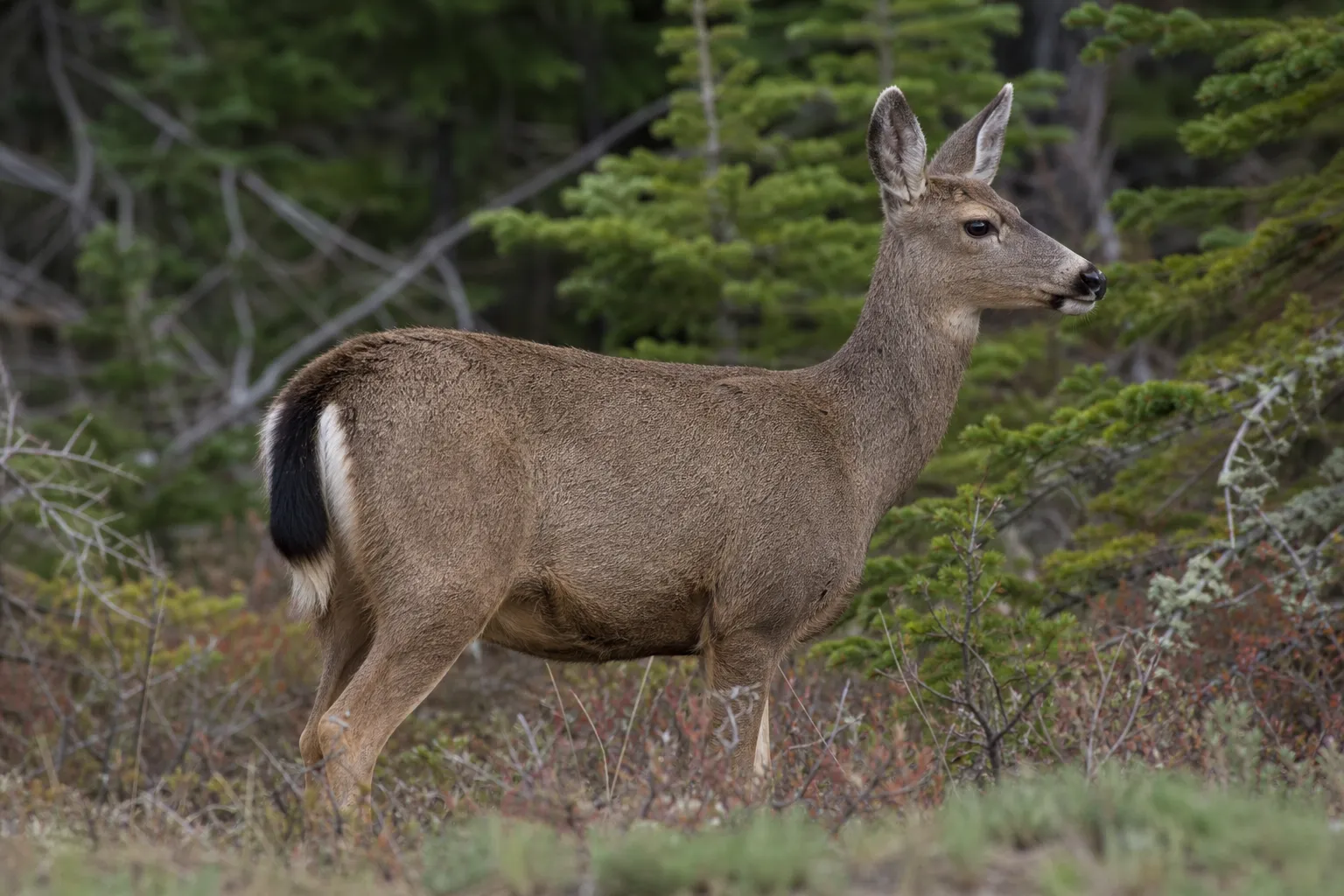
Tail and rump patch
Oregon Department of Fish and Wildlife describes the blacktail tail as wide and triangular, with a dark brown or black top and a white underside. The agency also says the black-tailed deer’s tail is much larger than a mule deer’s tail, but not as long or wide as a white-tailed deer’s tail.
Washington Department of Fish and Wildlife contrasts mule deer and blacktail tails this way: the mule deer tail is white except for a black tip, while the blacktail tail is broader and the backside of the tail is covered with dark brown hair that grades to black near the tip. The British Columbia Ministry of Environment, Lands and Parks says blacktails have a small rump patch and a tail that is dark brown or black for most of its length. E-Fauna BC says the Columbian blacktail’s rump patch is smaller than a mule deer’s and the upper tail surface is black for about the last three quarters of its length.
Size and color
Oregon Department of Fish and Wildlife describes black-tailed deer as smaller and darker than mule deer. The British Columbia Ministry of Environment, Lands and Parks also says blacktails are smaller and slightly darker than mule deer.
Washington Department of Fish and Wildlife lists adult black-tailed bucks at 140 to 200 pounds and adult does at 90 to 130 pounds. Alaska Department of Fish and Game gives typical October adult Sitka weights as about 80 pounds for does and 120 pounds for bucks, with some bucks over 200 pounds reported.
Coat color shifts with season in Sitka deer. Alaska Department of Fish and Game says the Sitka summer coat is reddish brown and the winter coat is dark brownish gray.
Antlers
Antlers can help separate blacktails and mule deer from white-tailed deer. The National Park Service says Columbian black-tailed deer tend to have evenly forked antlers, unlike white-tailed deer, which have tines extending off single beams. E-Fauna BC gives the same basic distinction, noting that mule deer and black-tailed deer have forked tines from the main beam, unlike white-tailed deer.
Alaska Department of Fish and Game says Sitka buck antlers are dark brown, have typical black-tailed branching, and are relatively small.
Range by region
Black-tailed deer are coastal deer. Their range follows the wet, forested side of western North America more than the open interior ranges associated with mule deer.
In Oregon, Oregon Department of Fish and Wildlife says black-tailed deer occur west of the Cascade Range. In Washington, Washington Department of Fish and Wildlife says Columbian black-tailed deer occur from the Cascade crest west to the ocean. The National Park Service describes the broader Columbian range as northern California to British Columbia.
In British Columbia, the Ministry of Environment, Lands and Parks says black-tailed deer occur along the entire coast, west of the summit of the Coast and Cascade ranges, and on most coastal islands. The same ministry says the Coast Range largely separates black-tailed deer and mule deer in British Columbia, especially in winter, and that the two subspecies interbreed where their ranges meet.
In Alaska, Alaska Department of Fish and Game says Sitka black-tailed deer are native to Southeast Alaska and north coastal British Columbia. The agency says deer swim well and are found on all Southeast Alaska islands except remote Forrester Island.
Habitat: cover, edges, and forest age
Black-tailed deer are strongly associated with forest cover, but the best habitat is not just unbroken timber. Oregon Department of Fish and Wildlife says black-tailed deer make their home in the timber and heavy brush of western Oregon, and that recently disturbed habitats such as clearcuts or burns can support healthy deer populations.
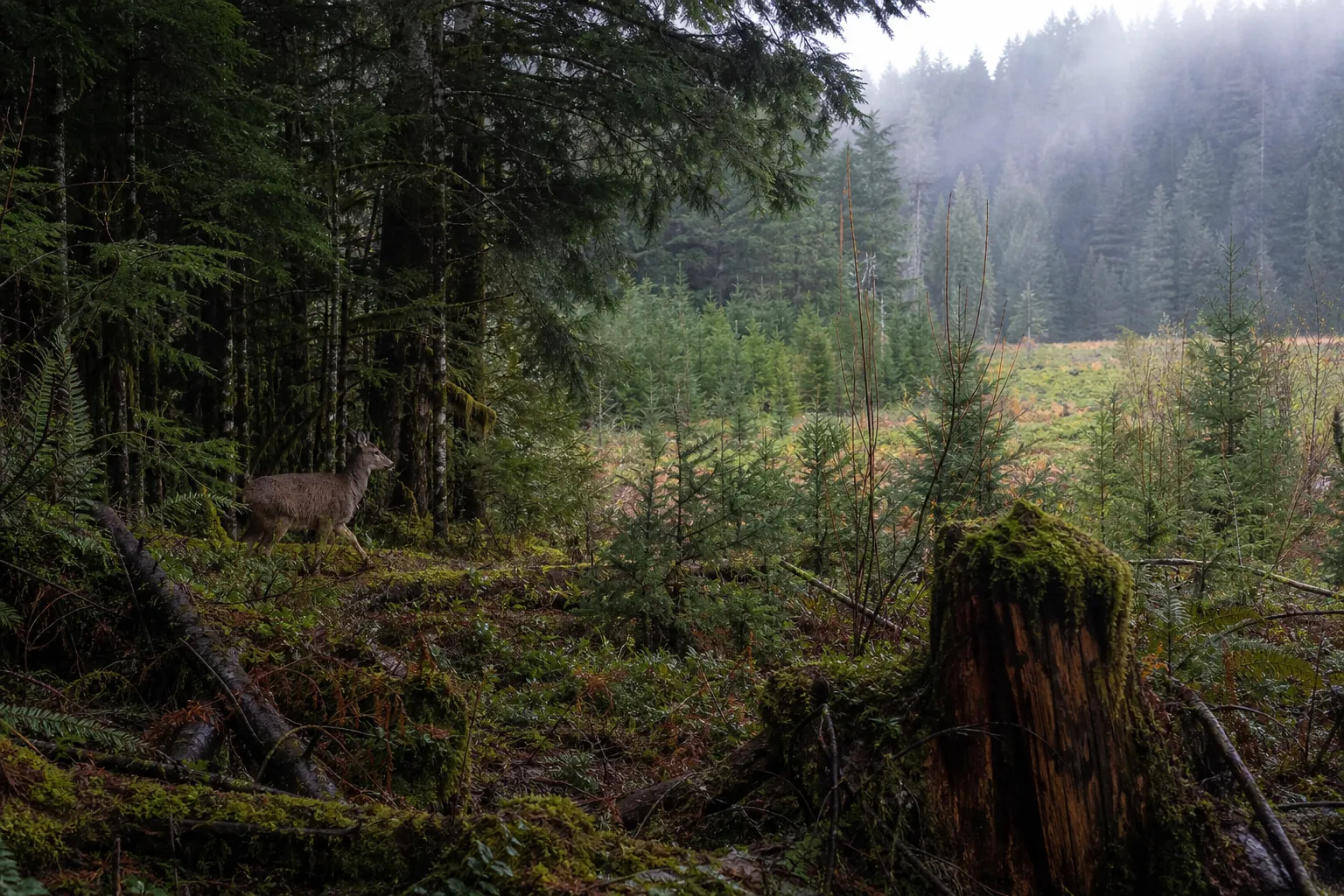
ODFW describes blacktails as edge-adapted deer. They use dense forest cover to hide during the day, then feed more openly in early successional forest at dawn and dusk. The agency says places with a mix of forest age classes offer the best black-tailed deer habitat.
That pattern helps explain why hunters and wildlife watchers often focus on transitions: timber to brush, brush to opening, burn to cover, or clearcut to older forest. The official biology pages describe the same basic need: food in openings and younger plant communities, with nearby cover that lets deer disappear quickly.
E-Fauna BC describes the escape behavior plainly: where thick cover is available, black-tailed deer prefer to sneak away from predators. That secretive behavior is part of what makes blacktails difficult to see even where they are common.
Sitka deer habitat and winter cover
Sitka black-tailed deer live in a colder, wetter coastal setting than Columbian blacktails. Alaska Department of Fish and Game says migratory Sitka deer move to high elevation alpine and subalpine habitats in summer, while resident deer remain in lower elevation forest. The agency lists Sitka seasonal home ranges from 30 to 1,200 acres, with radio-collared deer on Admiralty Island averaging about 200 acres.
Winter cover is especially important on the northern coast. The British Columbia Ministry of Environment, Lands and Parks says old-growth forest is a key part of the winter range for coastal black-tailed deer in British Columbia because it shelters deer, intercepts snow, and provides forage.
Alaska Department of Fish and Game says Sitka deer feed on herbaceous vegetation and shrub leaves in summer. In winter, the agency says they are restricted to evergreen forbs and woody browse, and during deep snow they eat woody browse and arboreal lichens.
Diet through the year
Black-tailed deer are browsers. Alaska Department of Fish and Game says Sitka deer eat the leaves and stems of woody plants and shrubs, as well as forbs, and that they very rarely eat grass. The agency notes one seasonal exception: they may graze emerging sedges on beaches for a short window in spring.
The National Park Service says Columbian black-tailed deer at Oregon Caves are usually found at dusk and dawn feeding on young trees, berries, lichen, fungi, and leafy plants.
British Columbia’s coastal blacktail food list changes by season. The British Columbia Ministry of Environment, Lands and Parks says winter and early spring foods include Douglas-fir, western redcedar, red huckleberry, salal, deer fern, and tree lichens. From late spring to fall, the ministry says blacktails eat a wider variety of plants, including grasses, trailing blackberry, fireweed, pearly everlasting, many other forbs, and leaves of willows and salmonberry.
For field observation, the key point is simple: blacktails need edible new growth, shrubs, forbs, lichens, and cover close together. Productive spots often combine browse and security cover rather than one or the other.
Rut, fawns, and antlers
The British Columbia Ministry of Environment, Lands and Parks says the rut occurs in November and early December, when mature bucks of equal size may fight head to head. Alaska Department of Fish and Game says Sitka black-tail fawns are born in late spring after a late November breeding season.
In British Columbia, the Ministry of Environment, Lands and Parks says fawns are born from late May through June after a six to seven month gestation. The same ministry says bucks drop their antlers from January to March in British Columbia and regrow them from April through August.
Those dates are useful for understanding behavior and what you are seeing on the landscape. Late spring and early summer are fawning periods. Late fall is the rut period described by British Columbia and Alaska agencies. Winter is a time when cover, snow interception, and accessible browse become especially important in northern coastal habitats.
Practical watching and scouting notes
For hunters and wildlife watchers, the official biology points lead to a few practical takeaways.
Look for edges. Oregon Department of Fish and Wildlife describes blacktails as edge-adapted deer that hide in dense forest by day and feed more openly at dawn and dusk. Forest edges, young growth, burns, clearcuts, and brushy openings near cover fit that pattern.
Use the tail first when identification is uncertain. Multiple British Columbia and Pacific Northwest references point to the black, broad, mostly dark tail and smaller rump patch as key marks, especially where blacktails and mule deer meet.
Expect secrecy in cover. E-Fauna BC says black-tailed deer often sneak away through thick cover rather than relying on open flight. Slow observation at dawn and dusk fits the behavior described by Oregon Department of Fish and Wildlife and the National Park Service.
In Southeast Alaska and coastal British Columbia, think about snow and winter cover. Alaska Department of Fish and Game describes seasonal shifts in Sitka deer food, and British Columbia’s ministry identifies old-growth winter range as important because it shelters deer, intercepts snow, and provides forage.
This guide covers biology and identification, not seasons, tags, or hunting regulations. Before hunting blacktail deer, confirm current rules directly with the state, provincial, territorial, or federal agency for the exact place and date you plan to hunt.
Frequently asked questions
Are black-tailed deer the same as mule deer?
They are closely related. The Western Association of Fish and Wildlife Agencies says black-tailed deer are subspecies of mule deer, while also being physically and genetically different from mule deer and from each other.
What are the two kinds of black-tailed deer?
The two black-tailed deer subspecies are the Columbian black-tailed deer and the Sitka black-tailed deer, according to the Western Association of Fish and Wildlife Agencies.
How do I tell a blacktail from a mule deer?
Use the tail, rump patch, size, and color. Oregon Department of Fish and Wildlife describes blacktails as smaller and darker than mule deer, with a wide triangular tail that is dark brown or black above and white underneath. British Columbia references also note the smaller rump patch and mostly dark tail.
Where do Columbian black-tailed deer live?
Agency descriptions place Columbian black-tailed deer along the coastal side of the Pacific Northwest. Oregon lists them west of the Cascade Range, Washington lists them from the Cascade crest west to the ocean, and the National Park Service gives the broader range as northern California to British Columbia.
Where do Sitka black-tailed deer live?
Alaska Department of Fish and Game says Sitka black-tailed deer are native to Southeast Alaska and north coastal British Columbia, with established translocated populations near Yakutat, in Prince William Sound, and on Kodiak and Afognak Islands.
When is the blacktail rut?
The British Columbia Ministry of Environment, Lands and Parks says the rut is in November and early December. Alaska Department of Fish and Game describes Sitka fawns as being born in late spring after a late November breeding season.
Sources
- Fact Sheet 46: Black-tailed Deer, Western Association of Fish and Wildlife Agencies, Mule Deer Working Group. Accessed October 23, 2026.
- Odocoileus hemionus, mule deer, U.S. Department of Agriculture, Forest Service, Fire Effects Information SystemOfficial source. Accessed October 23, 2026.
- Columbian black-tailed deer, Oregon Department of Fish and WildlifeOfficial source. Accessed October 23, 2026.
- Black-tailed deer, Oregon Department of Fish and WildlifeOfficial source. Accessed October 23, 2026.
- Living with wildlife: Deer, Washington Department of Fish and WildlifeOfficial source. Accessed October 23, 2026.
- Columbian Black-tailed Deer, National Park Service, Oregon Caves National Monument and PreserveOfficial source. Accessed October 23, 2026.
- Sitka Black-tailed Deer Species Profile, Alaska Department of Fish and GameOfficial source. Accessed October 23, 2026.
- Mule and Black-tailed Deer in British Columbia, British Columbia Ministry of Environment, Lands and ParksOfficial source. Accessed October 23, 2026.
- E-Fauna BC Atlas Page: Odocoileus hemionus, University of British Columbia, E-Fauna BC. Accessed October 23, 2026.
- Deer, California Department of Fish and WildlifeOfficial source. Accessed October 23, 2026.