Bighorn Sheep: Subspecies, Horns and Habitat
Bighorn sheep are North American wild sheep known for permanent horns, steep escape terrain and a conservation history shaped by disease, translocations and habitat management. This guide explains the Rocky Mountain, Sierra Nevada and desert forms, plus how bighorns differ from Dall sheep, Stone sheep and mountain goats.
By RaiS. Reviewed by RaiS. Published . 6 min read.
Research and drafting were assisted by AI. RaiS checked the facts against the sources below and approved this page.
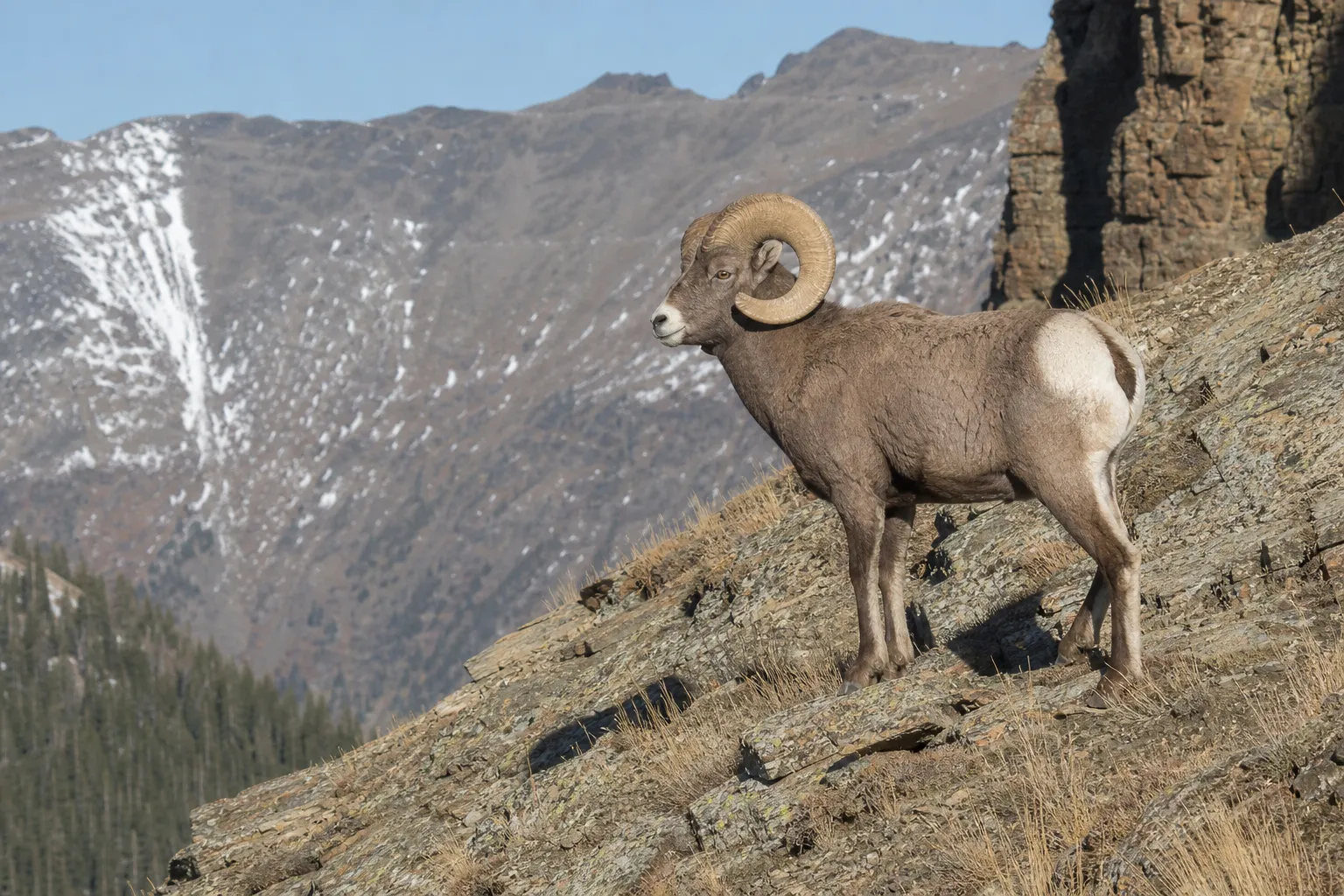
Bighorn sheep are Ovis canadensis, hoofed ruminants in the family Bovidae, according to the California Department of Fish and Wildlife. For hunters and wildlife watchers, the essentials are simple: bighorns are mountain and desert animals tied to steep escape terrain, both rams and ewes carry permanent horns, and the Rocky Mountain, Sierra Nevada and desert forms differ in range, body form and horn shape.
Bighorn sheep basics
The California Department of Fish and Wildlife describes bighorn sheep as animals named for their large horns. The three forms covered here are Rocky Mountain bighorn sheep, desert bighorn sheep and Sierra Nevada bighorn sheep.
Nevada Department of Wildlife identifies Rocky Mountain bighorn sheep as Ovis canadensis canadensis. Nevada also describes them as bulkier and stockier in body size than the other bighorn subspecies found in that state.
The California Department of Fish and Wildlife lists desert bighorn sheep as Ovis canadensis nelsoni. CDFW describes them as adapted to desert regions of California, Nevada, Arizona, New Mexico, Utah, Colorado, Texas and Baja California.
The U.S. Fish and Wildlife Service identifies the Sierra Nevada bighorn sheep as Ovis canadensis sierrae.
For a field observer, the safest starting point is not a single color or size cue. Look at the whole setting: steep rock, open views, group behavior and horn form. In the Sierra Nevada, CDFW says the clearest physical difference between Sierra Nevada bighorn and other bighorn subspecies is the shape of ram horns.
Horns, age and rut behavior
Both rams and ewes have horns. CDFW describes bighorn horns as permanent structures made of a keratin sheath over a bony core. The horns of rams are much larger and more curved than ewe horns.
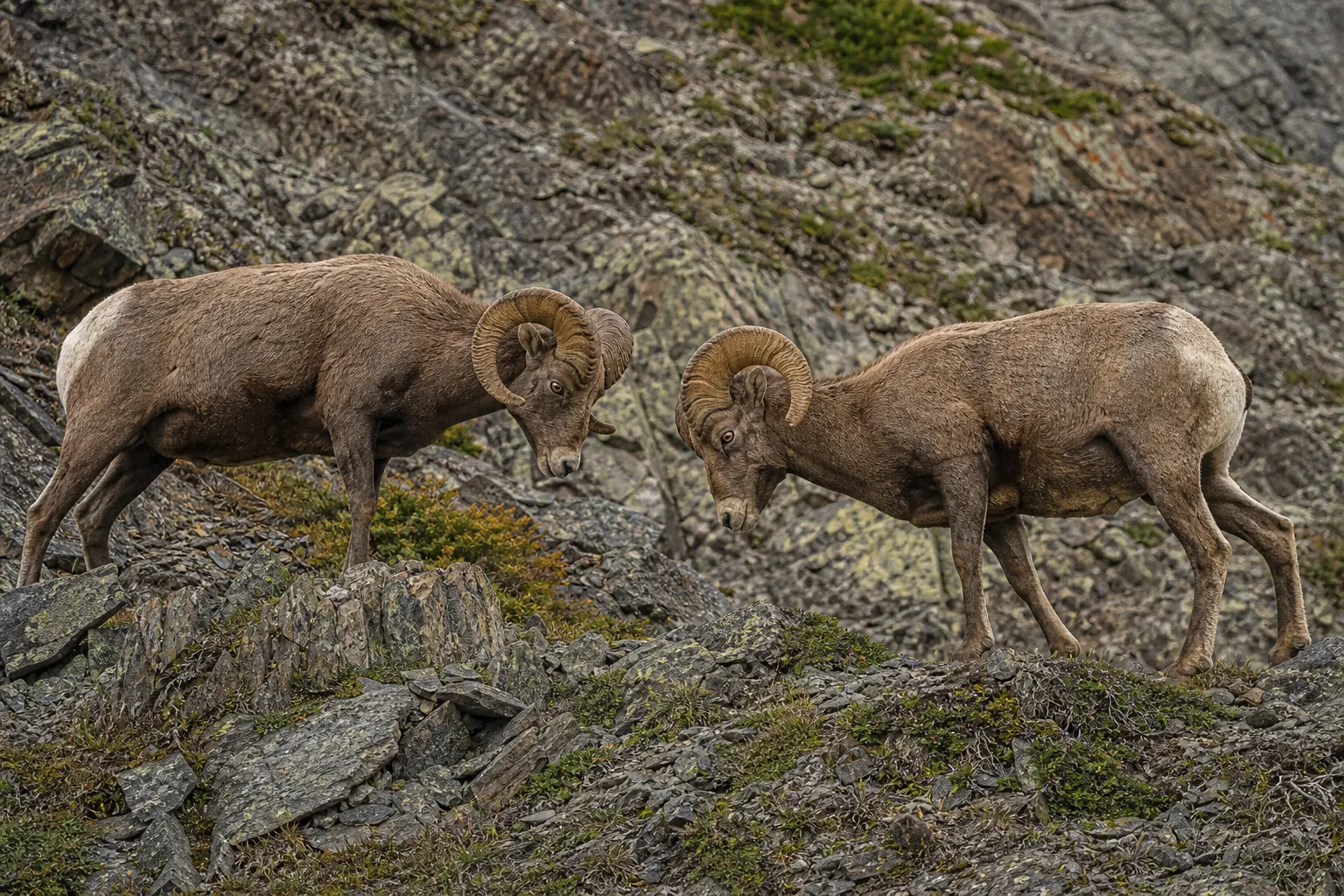
Grand Teton National Park reports that bighorn sheep develop horns soon after birth and that horn growth continues throughout life. The park also states that annual growth rings indicate age. That is why horn rings are one of the classic features people notice when they study mature sheep.
Ram horns can become very large. Grand Teton National Park reports that the curling horns of older rams may weigh more than 30 pounds and measure over 3 feet. The same National Park Service report says ewe horns are much smaller and lighter and do not tend to curl.
Horn shape also helps distinguish some bighorn forms. CDFW contrasts desert bighorn rams with Sierra Nevada bighorn rams this way: desert rams have a tight, narrow curl, while Sierra Nevada rams have a more splayed horn shape with a less pronounced curl.
Rut timing varies by population and place. The National Park Service says Sierra Nevada bighorn rams and ewes flock together only during the November and December mating season and are mostly apart the rest of the year. At Colorado National Monument, the National Park Service says the desert bighorn rut takes place from August through early fall.
During the rut, ram competition can be dramatic. The National Park Service describes dominance behavior as including kicking, biting, neck wrestling and horn clashes, with competitors facing each other, rearing up and pitching forward at rapid speeds.
Habitat, movement, diet and water
The National Park Service states that the defining feature of bighorn sheep habitat is closeness to rugged, steep terrain where sheep can escape predators. The same agency says cliffs, rim rocks and ledges are commonly used for bedding and resting.
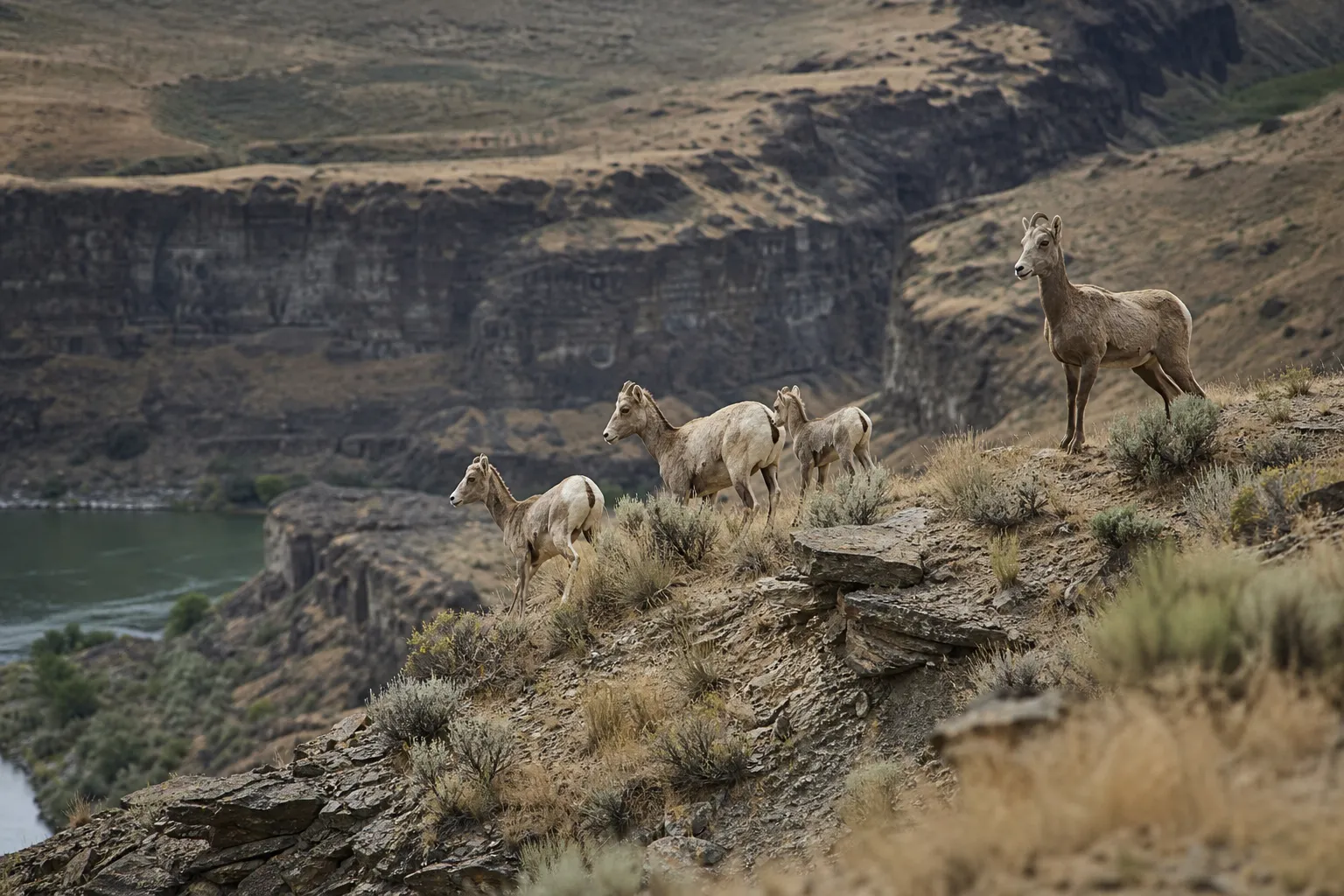
Bighorns also depend on visibility. The National Park Service says bighorn sheep generally use open country with long views of the surrounding area so they can see predators from a distance, and that they generally avoid tall vegetation that blocks their view.
Rocky Mountain bighorns often move among seasonal habitats. The National Park Service says alpine or subalpine areas provide classic summer ranges for bighorn sheep in the Rocky Mountains. In many cases, animals move to lower elevation valleys or foothills where snow is shallower during winter.
Desert bighorns use a different setting but still show the same connection to rock and escape terrain. The National Park Service says desert bighorn sheep prefer steep, rocky habitats in desert mountain ranges. It also says they can travel great distances across valleys to reach distant habitat, as long as barriers do not block movement.
Their diet is broad. The National Park Service lists grasses, sedges, forbs and shrubs as important food types for bighorn sheep. At Colorado National Monument, the National Park Service says desert bighorns eat shrubs, grasses, brome, fescue, clover phlox and cinquefoil, and that this diet supplies a good portion of their water needs.
For hunters and wildlife watchers, the habitat lesson is practical. In mountain country, look near steep open slopes, cliffs and ledges, especially where seasonal ranges match the time of year. In desert country, focus on steep, rocky mountain ranges and the connected valleys that may let sheep move between habitat patches.
Collapse and recovery
The modern bighorn story includes severe decline and long recovery work. In the Sierra Nevada, the National Park Service says bighorns declined because of diseases contracted from domestic sheep and unregulated hunting.
CDFW gives a detailed picture of the Sierra Nevada decline. The agency states that Sierra Nevada bighorn sheep probably exceeded 1,000 animals, declined to 9 known herds by the beginning of the 20th century, to 5 herds by 1948, to only 2 areas in the Sierra Nevada by the 1970s, and to about 100 animals by 1995.
The National Park Service says that after the Sierra Nevada bighorn population dropped to around 100 animals in 1995, this unique subspecies was listed as endangered. The National Park Service also identifies diseases from domestic sheep as the single largest threat to the existence of Sierra Nevada bighorn sheep.
Respiratory disease remains a major conservation issue for bighorns more broadly. The U.S. Geological Survey identifies respiratory disease as the biggest impediment to sustaining bighorn sheep populations and names Mycoplasma ovipneumoniae, also called M. ovi, as a primary causative agent driving epidemic respiratory disease in bighorn sheep.
Recovery work uses several tools. CDFW lists Sierra Nevada bighorn recovery actions as management of disease risk from domestic sheep, translocations to increase bighorn numbers and geographic distribution, predator management to limit predation on bighorn sheep, and monitoring and management of genetic variation.
Translocation has a long history in wild sheep restoration. The Wild Sheep Foundation says use of translocations for restoring wild sheep began in 1922, when 20 bighorns were captured in Alberta, Canada, with 12 released in Montana and 8 released at Custer State Park, South Dakota. The organization says that by 2015, at least 1,460 projects had translocated more than 21,500 bighorn sheep in the United States and Canada combined.
The Wild Sheep Foundation also says its funding has supported wild sheep transplants, telemetry studies, research, habitat enhancements, disease surveillance and response strategies, predator management, education and related programs.
Bighorns, Dall sheep, Stone sheep and mountain goats
Bighorn sheep are not the only mountain sheep that North American hunters and wildlife watchers may read about. British Columbia describes bighorn sheep and thinhorn sheep as two mountain sheep species in the province. Under bighorn sheep, the province lists Rocky Mountain bighorn sheep and California bighorn sheep. Under thinhorn sheep, it lists Stone’s sheep and Dall’s sheep.
The Alaska Department of Fish and Game identifies Dall sheep as Ovis dalli dalli. It says Dall sheep inhabit Alaska mountain ranges and are notable for their white appearance and the males’ massive curled horns.
British Columbia identifies Stone’s sheep as Ovis dalli stonei. The province states that, except for about 100 sheep in the extreme southern Yukon, this taxon is entirely restricted to northcentral and northeastern mountainous British Columbia.
Mountain goats are a separate species from bighorn and thinhorn sheep. British Columbia identifies the mountain goat as Oreamnos americanus. The National Park Service contrasts bighorn sheep and mountain goats at Glacier by describing bighorns as “head bangers” with huge curved horns, while mountain goats are “cliff hangers” with split hooves and rough concave pads that help them grip steep cliffs.
What to check before a trip
For wildlife watching, check the current guidance from the park, state or provincial wildlife agency that manages the area you plan to visit. For hunting, check the current official regulations from the responsible state or provincial wildlife agency, and confirm any land manager rules for the exact unit, season and access point. Disease guidance, closures and access rules can change, so use the agency’s current materials before making plans.
Frequently asked questions
What species is a bighorn sheep?
The California Department of Fish and Wildlife identifies bighorn sheep as Ovis canadensis, hoofed ruminants in the family Bovidae.
Do both male and female bighorn sheep have horns?
Yes. CDFW says both rams and ewes have horns, although ram horns are much larger and more curved. The horns are permanent keratin sheaths over bony cores.
Can horn rings show a bighorn sheep’s age?
Grand Teton National Park reports that bighorn horn growth continues throughout life and that annual growth rings indicate age.
When is the bighorn sheep rut?
Rut timing depends on the population. The National Park Service says Sierra Nevada bighorn sheep mate in November and December, while desert bighorns at Colorado National Monument rut from August through early fall.
What caused major bighorn sheep declines?
For Sierra Nevada bighorn sheep, the National Park Service cites diseases from domestic sheep and unregulated hunting. The U.S. Geological Survey identifies respiratory disease as the biggest impediment to sustaining bighorn sheep populations.
Are mountain goats the same as bighorn sheep?
No. British Columbia identifies the mountain goat as Oreamnos americanus, a separate species from bighorn and thinhorn sheep. The National Park Service contrasts bighorns as animals with huge curved horns and mountain goats as cliff gripping animals with split hooves and rough concave pads.
Sources
- Natural History, California Department of Fish and WildlifeOfficial source. Accessed October 24, 2026.
- Rocky Mountain Bighorn Sheep, Nevada Department of WildlifeOfficial source. Accessed October 24, 2026.
- Sierra Nevada Bighorn Sheep (Ovis canadensis sierrae), U.S. Fish & Wildlife ServiceOfficial source. Accessed October 24, 2026.
- Sierra Nevada Bighorn Sheep Facts, California Department of Fish and WildlifeOfficial source. Accessed October 24, 2026.
- Science and Resource Management, 2018 Vital Signs, National Park Service, Grand Teton National ParkOfficial source. Accessed October 24, 2026.
- Sierra Nevada Bighorn Sheep Description and Biology, National Park Service, Yosemite National ParkOfficial source. Accessed October 24, 2026.
- Desert Bighorn Sheep, National Park Service, Colorado National MonumentOfficial source. Accessed October 24, 2026.
- Mountain Ungulates: A Contrast in Management Histories, National Park Service, Yellowstone National ParkOfficial source. Accessed October 24, 2026.
- Desert Bighorn Sheep: Connecting a Desert Landscape, National Park ServiceOfficial source. Accessed October 24, 2026.
- Bighorn Sheep (Ovis canadensis), National Park Service, Jewel Cave National MonumentOfficial source. Accessed October 24, 2026.
- Sierra Nevada Bighorn Sheep in Yosemite National Park, National Park Service, Yosemite National ParkOfficial source. Accessed October 24, 2026.
- Sierra Nevada Bighorn Sheep, Disease, National Park Service, Yosemite National ParkOfficial source. Accessed October 24, 2026.
- Bighorn Sheep Pneumonia, National Park ServiceOfficial source. Accessed October 24, 2026.
- Ecology and Conservation of Desert Bighorn Sheep, U.S. Geological SurveyOfficial source. Accessed October 24, 2026.
- Trap & Transplant, Wild Sheep Foundation. Accessed October 24, 2026.
- About WSF, Wild Sheep Foundation. Accessed October 24, 2026.
- Wild Sheep and Mountain Goat, Province of British ColumbiaOfficial source. Accessed October 24, 2026.
- Dall Sheep Species Profile, Alaska Department of Fish and GameOfficial source. Accessed October 24, 2026.
- Species Summary: Ovis dalli stonei, Province of British ColumbiaOfficial source. Accessed October 24, 2026.
- Sheep and Goat Superpowers Exhibit, National Park Service, Glacier National ParkOfficial source. Accessed October 24, 2026.
- Bighorn Sheep (U.S. National Park Service). Accessed October 24, 2026.
- Bighorn and Big Rail Can Be Friends (U.S. National Park Service). Accessed October 24, 2026.
- Dall Sheep Species Profile, Alaska Department of Fish and Game. Accessed October 24, 2026.