Does Bear Spray Work?
Bear spray can work as a last line of defense when it is EPA registered, carried where you can reach it quickly, and used as an airborne cloud at close range. Field research and agency guidance also warn that wind, product condition, and bear response can affect results.
By RaiS. Reviewed by RaiS. Published . 5 min read.
Research and drafting were assisted by AI. RaiS checked the facts against the sources below and approved this page.
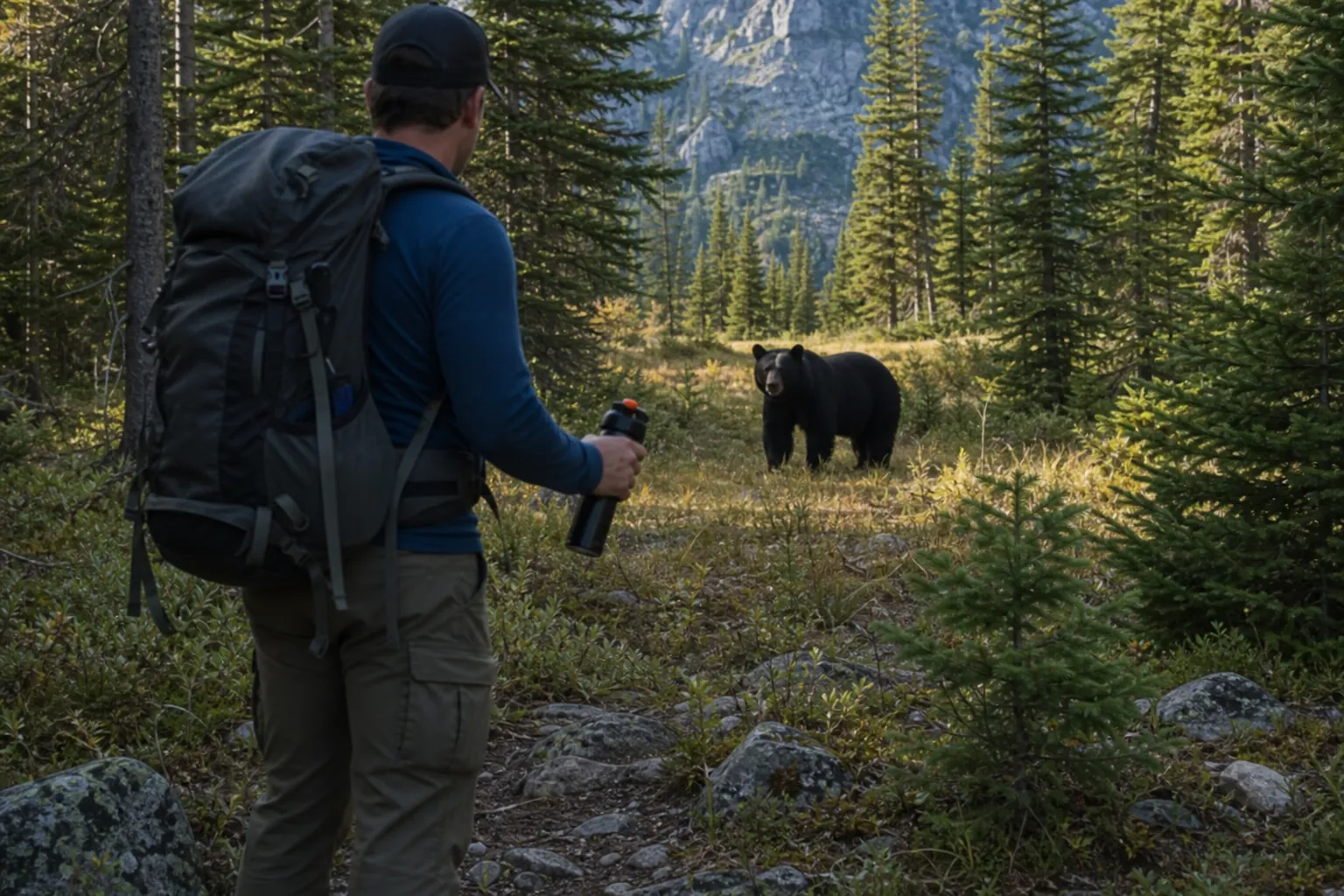
Bear spray can work, and the best evidence supports a careful yes. National Park Service guidance and field research describe bear spray as an effective last line of defense when it is made for bears, carried where you can reach it fast, and sprayed as a cloud between you and a bear. It is not a magic shield, and no deterrent is 100 percent effective.
How does bear spray work?
Bear spray is a non lethal aerosol deterrent made specifically to deter bears. Denali National Park says the active ingredient is capsaicin.
Unlike personal pepper spray, Denali National Park explains that bear spray comes out as a cloud rather than a stream. That cloud is meant to reach the bear’s face and breathing zone. Denali says capsaicin can cause temporary irritation and pain in a bear’s nose, eyes, and lungs.
The Interagency Grizzly Bear Committee describes bear spray as something sprayed as a cloud at an aggressive animal. That is an important distinction. It is not a surface treatment for camp gear. IGBC says bear spray should not be applied to people, tents, packs, equipment, or surrounding areas as a repellent.
That means the basic idea is simple: carry the can where you can reach it, create a cloud between you and the bear when needed, and leave when the bear retreats. The product is for an encounter, not for pre treating objects.
What to look for when buying bear spray
Choose a product labeled as bear spray or bear deterrent, not a general personal defense spray. Denali National Park notes that bear spray differs in delivery because it creates a cloud instead of a stream, and IGBC recommends bear spray or bear deterrent canisters that meet specific bear use criteria.
For products in the United States, IGBC advises buying only bear spray registered by the U.S. Environmental Protection Agency. IGBC says the EPA registration number is displayed on the front label. EPA’s archived 1998 registration release says companies registering bear repellents with EPA must demonstrate effectiveness and meet health and environmental standards.
A practical label checklist looks like this:
| What to check | Agency guidance |
|---|---|
| Minimum spray distance | BLM gives 25 feet as the recommended minimum spray distance. |
| Spray duration | BLM gives 6 seconds as the spray duration benchmark. |
| Can size | IGBC recommends at least 7.9 ounces, or 225 grams, of product. |
| EPA registration | IGBC says to buy EPA registered bear spray and look for the registration number on the front label. |
| Expiration date | Yellowstone National Park advises checking the expiration date before purchasing. |
Do not skip the expiration date. Yellowstone specifically tells users to check it before buying, and older cans are addressed again in the storage section below.
Does bear spray work in field studies?
An often cited field study found that bear spray appeared to stop undesirable or aggressive bear behavior in a high share of recorded encounters. This kind of study is useful because it examined real incidents, not only controlled tests. It also has limits, because bear encounters vary and field reports are not identical from case to case.
Herrero and Higgins, writing in Ursus in 1998, analyzed 66 field uses of capsicum sprays between 1984 and 1994. They found that in 94 percent of close range encounters with aggressive brown or grizzly bears, spray appeared to stop the behavior that was happening immediately before spraying. The authors also cautioned that bear responses vary and that their diverse field record database should be interpreted cautiously.
The balanced takeaway is this: bear spray has field support as a last line deterrent, but it still depends on having the right product, carrying it accessibly, using it at the right distance, and understanding that bears and conditions vary.
How to carry bear spray
Yellowstone National Park calls bear spray a last line of defense and says it should be carried where it is reachable quickly. Yellowstone tells each person in a group to carry one can in a quickly reachable place, such as a waist holster or chest holster.
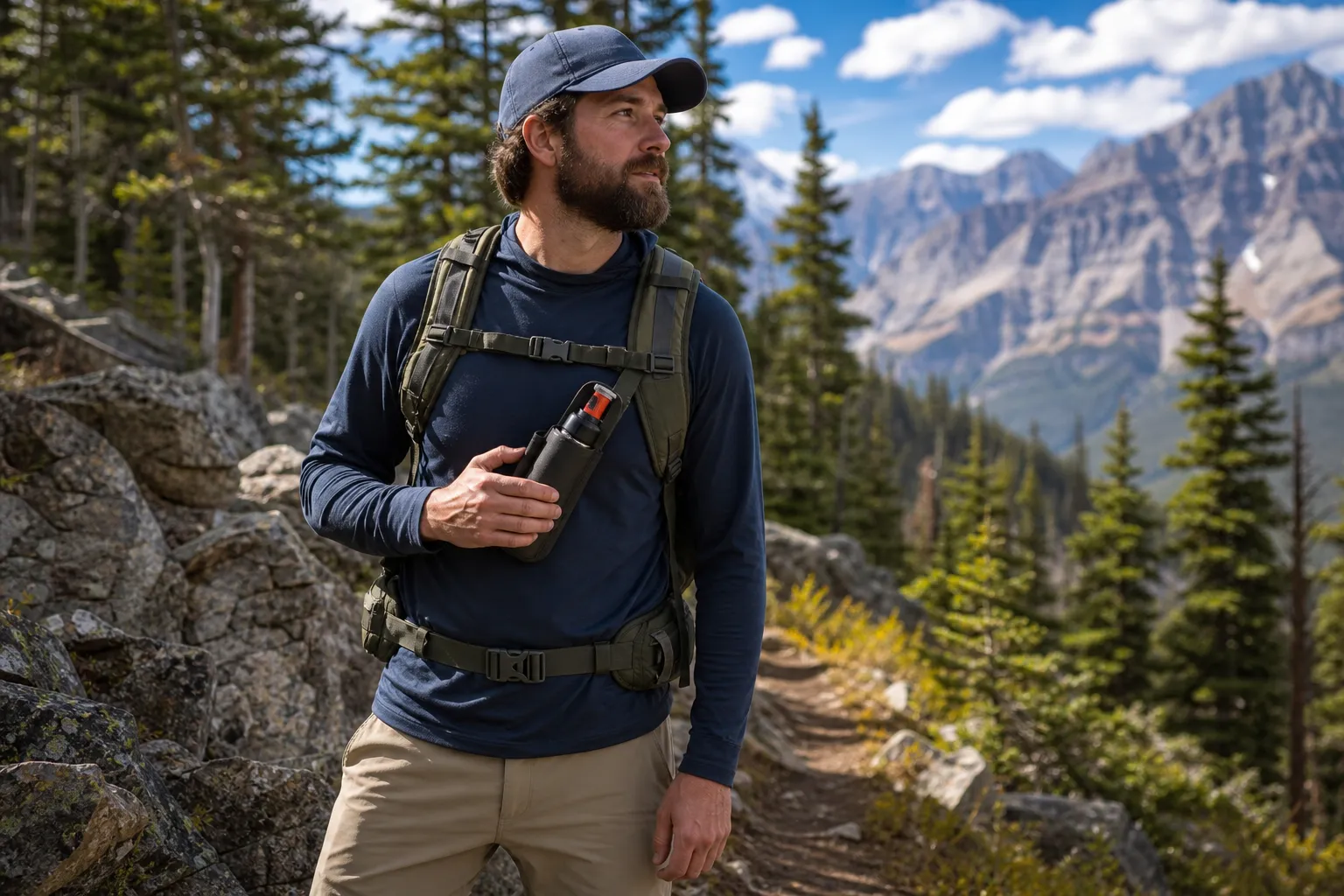
Yellowstone also says not to carry bear spray inside a pack or another hard to reach place. That matters because a canister in a backpack may not be available during a sudden close encounter.
Denali National Park adds that in thick vegetation or poor visibility, you should carry spray in your hand. This is the kind of situation where a person may have less time to react because the bear may be close before it is seen.
Before relying on any canister, know how its safety clip and nozzle are arranged. Yellowstone’s use instructions include removing the safety clip before spraying.
How to deploy bear spray in an encounter
Yellowstone National Park says to spray when a charging bear is 30 to 60 feet away, creating a wall between you and the bear. The park’s instructions are to remove the safety clip, point the nozzle slightly down, adjust for crosswind, and keep spraying until the bear changes direction.
BLM’s bear safety guide gives 25 feet as the recommended minimum spray distance and 6 seconds as the spray duration benchmark. Those numbers are useful when reading labels, because they help separate true bear spray from products that may not have the same reach or discharge time.
After the bear leaves, Yellowstone says to leave the area quickly, but not to run. The goal is not to remain close to the bear or to approach it. Once the bear has retreated, increase distance in the way the agency describes.
Storage, cold weather, wind, and expiry
Bear spray is a pressurized canister, so storage matters. Yellowstone National Park warns that bear spray can explode if it reaches 120 degrees Fahrenheit, or 49 degrees Celsius. Do not leave a can where it can reach that temperature, such as a hot vehicle.
Wind can also affect the cloud. Yellowstone’s use instructions say to adjust for crosswind.
Expiration matters too. Yellowstone advises checking the expiration date before purchasing bear spray. Before a trip, check the label, expiration date, can condition, and current agency guidance for the place you plan to visit.
Bottom line
Bear spray is recommended by major land management agencies as a last line of defense, and field research reports a high rate of stopped bear behavior in recorded encounters. It works best when it is an EPA registered bear product, has suitable range and duration, is carried where you can reach it immediately, and is used as an airborne cloud at the distances described by agencies and the product label.
Before heading into bear country, confirm current guidance with the land agency for your destination and read the exact label on the canister you carry. Check the EPA registration, expiration date, minimum range, spray duration, storage warnings, and can size before you rely on it.
Frequently asked questions
Does bear spray actually work?
Yes, it can work as a last line deterrent. National Park Service guidance describes bear spray as effective when it is made for bears, carried accessibly, and sprayed as a cloud between the user and the bear. A field study by Herrero and Higgins found that spray appeared to stop the behavior occurring immediately before spraying in 94 percent of close range encounters with aggressive brown or grizzly bears, while also cautioning that responses vary.
How does bear spray work?
Denali National Park says the active ingredient is capsaicin, which can temporarily irritate a bear’s nose, eyes, and lungs. Bear spray comes out as a cloud, not a stream, so it can create an airborne barrier between the user and the bear.
Can I spray bear spray on my tent or pack?
No. The Interagency Grizzly Bear Committee says bear spray should not be applied to people, tents, packs, equipment, or surrounding areas as a repellent. It is meant to be sprayed as a cloud at an aggressive animal.
What range should bear spray have?
The Bureau of Land Management lists 25 feet as the recommended minimum spray distance. Yellowstone National Park says to spray when a charging bear is 30 to 60 feet away to create a wall between you and the bear.
Does bear spray expire?
Yes, canisters carry expiration dates. Yellowstone National Park advises checking the expiration date before purchasing.
Sources
- Bear Spray, Denali National Park & Preserve, National Park ServiceOfficial source. Accessed October 23, 2026.
- Safety, Yellowstone National Park, National Park ServiceOfficial source. Accessed October 23, 2026.
- Bear Spray, Interagency Grizzly Bear CommitteeOfficial source. Accessed October 23, 2026.
- Hiking in Black Bear Country, Bureau of Land ManagementOfficial source. Accessed October 23, 2026.
- EPA Registers New Bear Repellent Product, U.S. Environmental Protection AgencyOfficial source. Accessed October 23, 2026.
- Efficacy of Bear Deterrent Spray in Alaska, The Journal of Wildlife Management. Accessed October 23, 2026.
- Field Use of Capsicum Spray as a Bear Deterrent, International Association for Bear Research and Management, Ursus. Accessed October 23, 2026.
- An Investigation of Factors Influencing Bear Spray Performance, The Journal of Wildlife Management. Accessed October 23, 2026.