Bear Scat Identification: What Bear Poop Looks Like
Bear scat is highly variable, but it is often large, contains visible food remains, and changes with season and diet. In the field, it is safest to identify uncertain piles as bear scat unless tracks, range, photos, or other sign confirm black bear or grizzly bear.
By RaiS. Reviewed by RaiS. Published . 8 min read.
Research and drafting were assisted by AI. RaiS checked the facts against the sources below and approved this page.
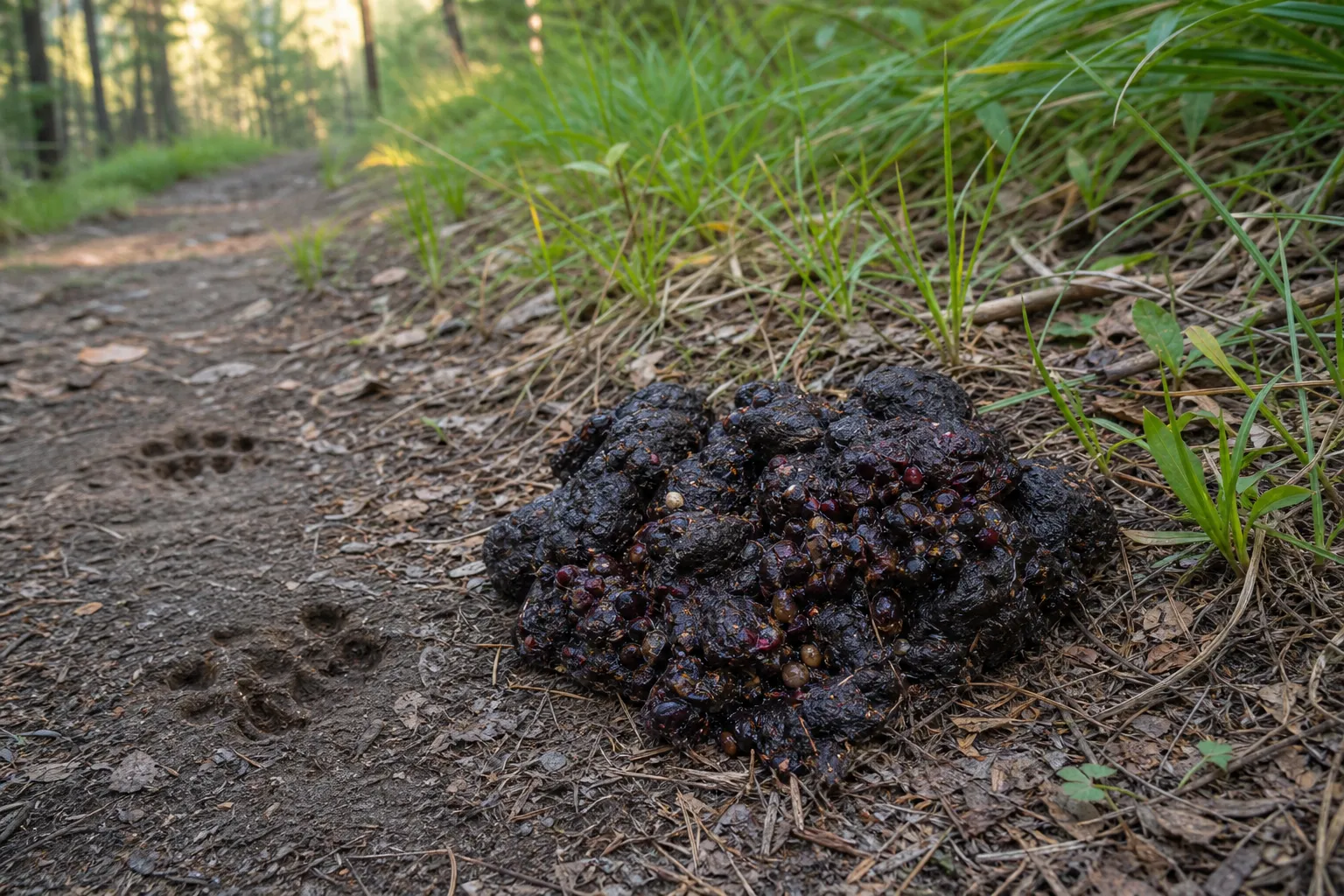
Bear scat is usually best identified as “bear scat” first, not as black bear or grizzly bear scat from the pile alone. National Park Service materials stress that bear scat changes with diet, and other guidance cautions against relying on scat size alone to separate black bear from grizzly bear. Look for a large, variable pile with visible food remains, then use tracks, range, rubs, digging, and current bear activity information for context.
What bear scat usually looks like
Bear scat can look very different from one bear to another, and even from the same bear on different days. Yosemite National Park explains that black bear scat varies because the bear’s diet changes, and the National Park Service at Glacier Bay notes that scat contents can show recent foods such as grass, berries, seeds, fish bones, or hair.
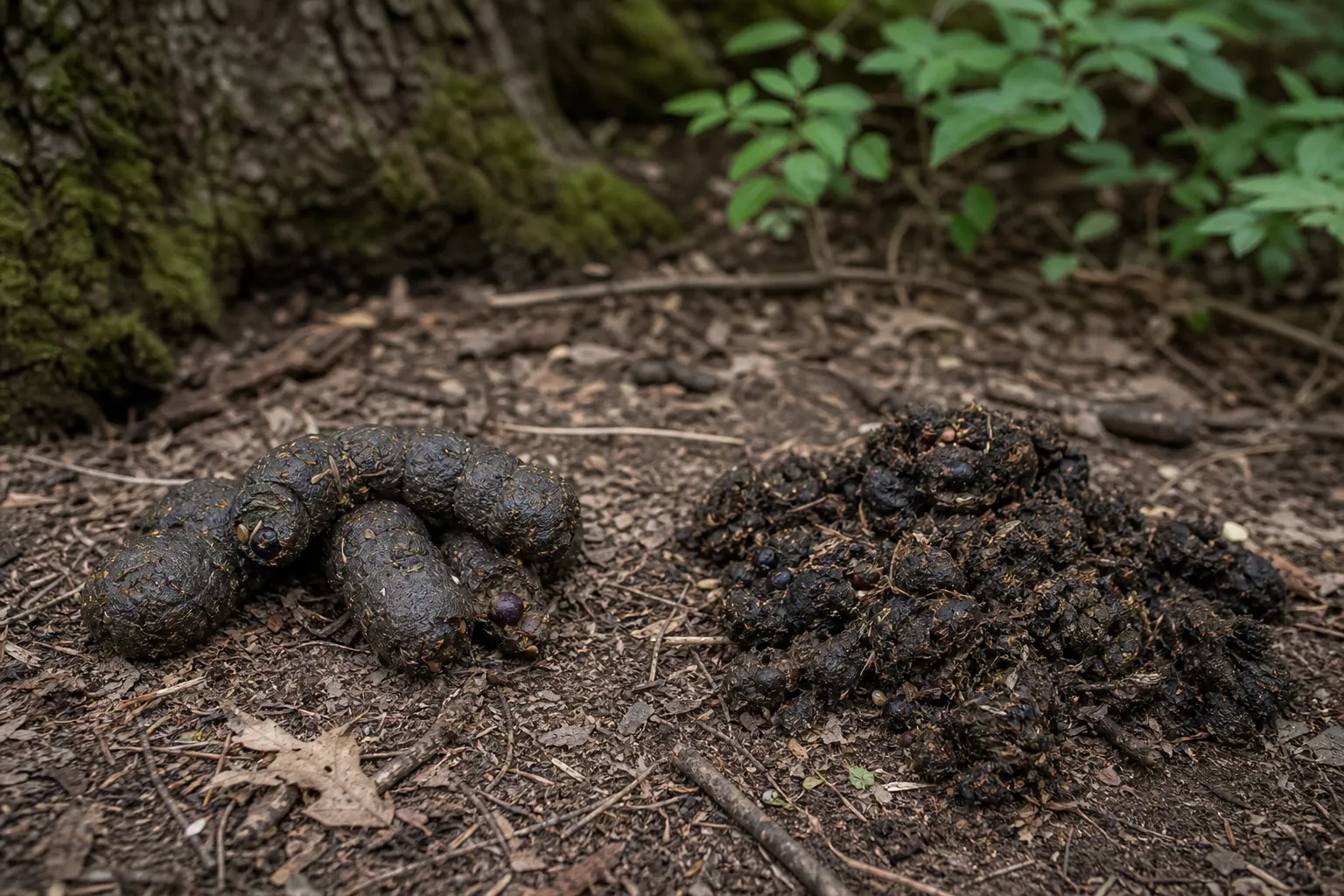
Common bear scat forms include:
- Tubular piles, especially when the bear has eaten grasses or other fibrous plants.
- Loose plops, often seen when soft foods such as berries or fruit make up much of the diet.
- Watery piles, which the North American Bear Center notes can occur with meat based scat.
- Fibrous masses with plant material, seeds, insect parts, hair, bone, or fish remains.
Yosemite National Park notes that black bear scat often contains visible food remains because seeds, fur, and bones may not digest completely. Alaska Department of Fish and Game makes the same field point in practical terms: bear scat often shows unprocessed bits, such as grass, birdseed, or berries.
That visible food is one of the best clues. A large pile full of berry skins and seeds, coarse grass, insect pieces, hair, bone, or fish remains is much more suggestive of bear than a smooth, uniform deposit.
Season and diet clues
Bear scat follows what bears are eating. Denali National Park describes grizzlies as omnivores that eat grasses, berries, roots, fish, and small mammals. Yellowstone National Park says grizzlies in that ecosystem continue eating grasses and sedges in summer and add berries around midsummer. Ontario says black bears feed heavily on summer berry crops and shift to nuts and other mast in fall.
Spring: green, grassy, and fibrous
In spring, Yosemite National Park says black bear scat is often green and tubular where bears are eating fresh vegetation and insects. A spring pile may show grass or plant fibers and may hold together in a tube or fibrous mass.
British Columbia’s grizzly field guide describes bear scat as ranging from round and firm to soft and pie like when bears feed on fresh greens. That is a useful caution: green or plant heavy bear scat is not always a neat tube.
Summer and late summer: berries and soft piles
In late summer and fall, Yosemite National Park says black bear scat may be loose and deposited in large plops, with berries or fruit visible. Denali National Park says berries become a major grizzly food starting in late July during hyperphagia, so berry heavy scat is expected in late summer where berries are available.
In the field, look for berry skins, seeds, and a looser texture. The pile may be dark, purple, red, or mixed in appearance depending on the foods eaten, but the key clue from agency descriptions is visible berry or fruit material.
Fall: mast, nuts, and regional foods
Ontario says black bears shift to nuts and other mast in fall. In regions where acorns, beechnuts, or other mast are available, fall bear scat may show broken nut material along with berries or other plant remains.
Because fall foods vary by region, the contents of a pile may be more useful than its exact shape. A large, varied pile with seeds, nut fragments, fruit remains, or other visible foods fits the general bear pattern described by wildlife agencies.
Meat, fish, or carcass feeding: dark, watery, hair, or bone
The North American Bear Center says meat based scat may be watery. Glacier Bay National Park says bear scat can include fish bones or hair. Yosemite National Park also notes fur and bones in black bear scat.
If scat is dark or watery and contains hair, bone, or fish remains, treat the area with extra caution. Denali National Park tells visitors to pay attention to tracks, scat, dug up areas, carcasses, and trailhead signs about recent bear activity.
Size: useful, but not enough for species ID
Size can help you decide whether a pile is likely from a bear, but it is not enough to separate black bear from grizzly bear where their ranges overlap.
| Reference | Size note | Important caution |
|---|---|---|
| Maryland Department of Natural Resources black bear curriculum | Black bear scat usually tubular and averages about 1.5 to 2.25 inches in diameter | This is a black bear teaching reference, not a stand alone species test. |
| Interagency Grizzly Bear Committee | Grizzly scat roughly 2 inches in diameter | The committee cautions that scat size cannot reliably distinguish black bear from grizzly bear. |
| North American Bear Center | Black bear scat commonly weighs about a half pound to a pound or more | Shape may be tubular, loose, or watery. |
The safest field label is often simply “bear scat.” Use species names only when the location, tracks, photos, or other sign support the ID.
The National Park Service says brown bear and grizzly bear are common names for the same species, Ursus arctos. In North America, a grizzly scat discussion is a brown bear scat discussion.
Black bear versus grizzly bear: use more than scat
Scat size alone is not reliable in overlap areas. The Interagency Grizzly Bear Committee says it is not always possible to distinguish black bear and grizzly bear by scat.
Use nearby sign instead. The National Park Service says bear color is not enough to identify species because black bears may be black, gray, cinnamon, or white depending on location and individual.
For grizzly or brown bear field ID, the National Park Service points to body and track features such as a distinctive shoulder hump, dished face, close toes, and often visible claw marks. Alberta also says grizzly tracks can show a straighter toe line and clearer claw imprints.
For American black bear field ID, the National Park Service points to lack of shoulder hump, a higher rump, a straighter face profile, arced toes, and shorter front claws. Alberta says black bear tracks can show a curved toe line made by the front toes.
How to tell bear scat from other large mammal scat
Several animals can leave scat that looks confusing at first glance. The best comparison is shape, size, texture, contents, and location.
Moose
Alaska Department of Fish and Game says moose scat can sometimes look like a wet patty rather than pellets, so moose is a key confusion species. The same agency says moose feces is usually more uniform because moose are ruminants.
Bear scat is more likely to show unprocessed food bits such as grass, berries, or other visible remains. Moose scat, even when loose, is usually more uniform and processed.
Coyote
Yosemite National Park says coyote scat may also be tubular, but it often looks like a pile of twisted rope. Coyote scat is generally a smaller, rope like comparison point rather than a large, variable bear pile.
Raccoon
Yosemite National Park notes that raccoons often defecate repeatedly in the same place, creating latrine piles. A repeated latrine location can point away from a single bear scat deposit.
Bobcat and mountain lion
Yosemite National Park says bobcat and mountain lion scat can be confused with bear scat, but feline scat is segmented and smaller than bear scat. A dense, segmented scat pile is a better fit for a cat than for a large bear pile with obvious food remains.
Other bear sign near scat
Scat is stronger evidence when it appears with other bear sign. Glacier Bay National Park lists tracks, scat, grazed plants, trails, rubbed trees, digs, and day beds as common bear sign.
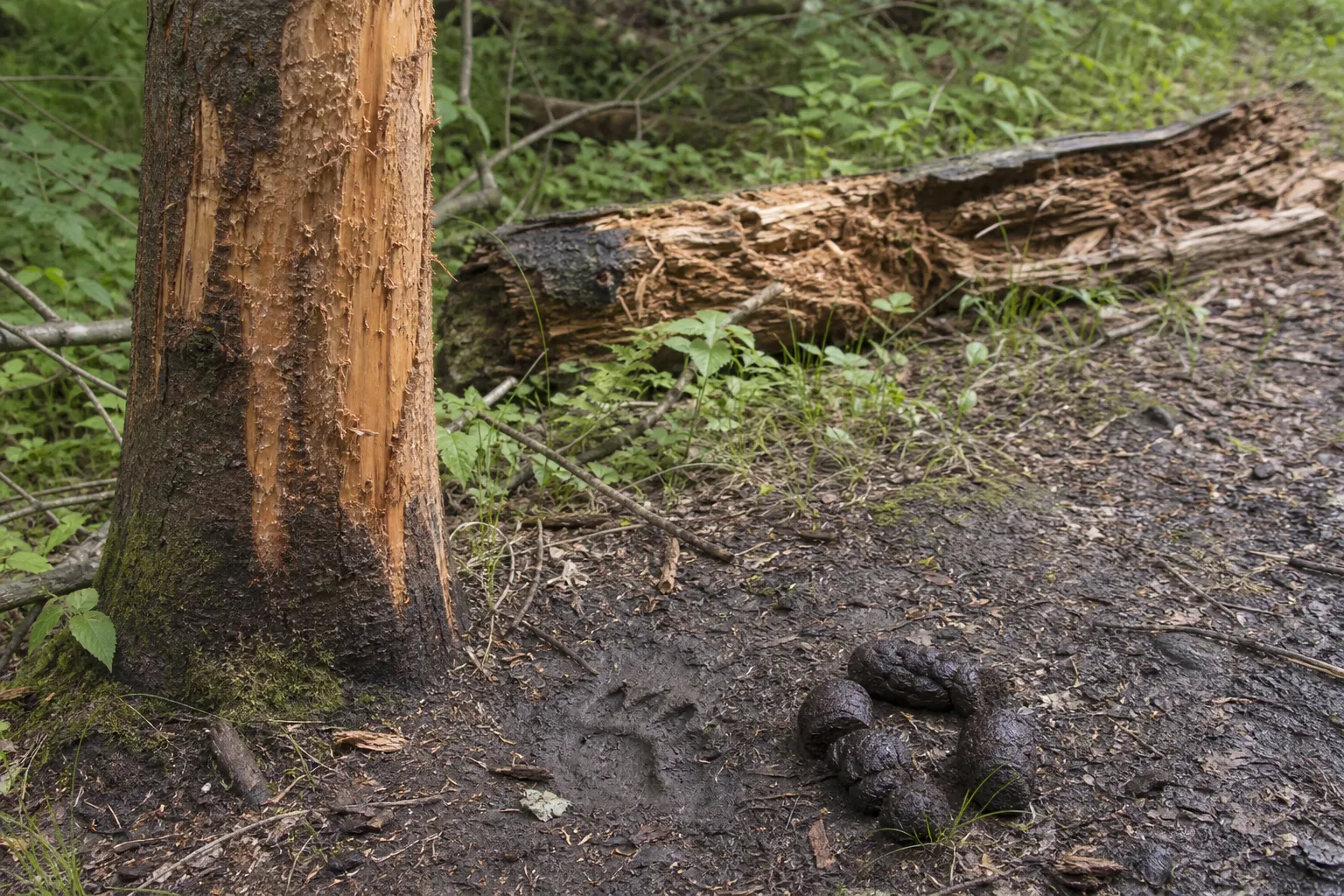
Bear sign to look for includes:
- Tracks with five toes.
- Claw marks near tracks or on trees.
- Rubbed trees with hair.
- Torn logs, rolled rocks, or torn stumps.
- Digging or dug up vegetation.
- Day beds.
- Bear trails.
- Carcasses or buried carcasses.
Alberta BearSmart lists bear signs including trails, scat, digging, rolled logs and rocks, torn stumps, rubbed trees, and buried carcasses. Bering Land Bridge National Preserve lists large piles of scat with berries or plant matter, tracks, claw marks, fur tufts, and dug up vegetation as signs of bear presence.
Glacier Bay National Park says bear trails can appear as a single solid trail or as a series of individual sunken looking footprints. If you find scat on or near that kind of trail, the bear ID becomes stronger.
What fresh bear scat means for safety
Fresh scat, tracks, digging, rubs, carcasses, or heavy feeding sign mean you should act as if a bear may be nearby. Denali National Park tells visitors to pay attention to tracks, scat, dug up areas, carcasses, and trailhead signs about recent bear activity.
The National Park Service’s bear aware reminder lists core precautions: stay alert, hike in groups, make noise, store attractants, carry bear spray where recommended, and never run from a bear. Grand Teton National Park says bears usually avoid people if they hear them coming, so hikers should call out and clap, especially in dense vegetation or around blind corners.
If you find fresh scat:
- Stay alert and look for tracks, digging, rubs, carcasses, or feeding sign.
- Keep your group together.
- Make noise, especially where visibility is poor.
- Leave areas with carcasses or heavy feeding sign.
- Store food and scented items as official bear aware guidance recommends.
- Do not approach bears.
- Carry bear spray where recommended and allowed.
The Interagency Grizzly Bear Committee says bear spray should be accessible, but it is not a substitute for standard bear avoidance practices. The committee also says bear spray works on all North American bear species. For more on that topic, see our Does Bear Spray Work guide.
Field takeaway
A practical field ID does not need to be perfect. If the scat is large, variable, and full of visible food remains, group it as bear scat unless tracks, photos, range, or other sign support a black bear or grizzly bear ID.
Before a hike, hunt, or camping trip in bear country, check the current guidance from the land management agency, park, state or provincial wildlife department, or trailhead notice for recent bear activity, food storage requirements, and bear spray recommendations for that exact area.
Frequently asked questions
Can you tell black bear scat from grizzly scat by size?
Not reliably. The Interagency Grizzly Bear Committee cautions that scat size cannot reliably distinguish black bear from grizzly bear.
What does bear scat look like after bears eat berries?
Yosemite National Park says late summer and fall black bear scat may be loose and deposited in large plops, with berries or fruit visible. Denali National Park says berries become a major grizzly food starting in late July where berries are available.
What does spring bear scat look like?
Yosemite National Park says spring black bear scat is often green and tubular where bears are eating fresh vegetation and insects. British Columbia’s grizzly field guide also notes that bear scat can be soft and pie like when bears feed on fresh greens.
What other sign should I look for near suspected bear scat?
Glacier Bay National Park lists tracks, scat, grazed plants, trails, rubbed trees, digs, and day beds as common bear sign. Alberta BearSmart also lists rolled logs and rocks, torn stumps, and buried carcasses.
What should I do if I find fresh bear scat?
Treat it as a sign that a bear may be nearby. National Park Service bear aware guidance says to stay alert, hike in groups, make noise, store attractants, carry bear spray where recommended, and never run from a bear.
Sources
- The Scoop on Bear Poop, National Park Service, Yosemite National ParkOfficial source. Accessed October 23, 2026.
- Bear Sign, National Park Service, Glacier Bay National Park and PreserveOfficial source. Accessed October 23, 2026.
- Bear Identification, National Park ServiceOfficial source. Accessed October 23, 2026.
- Grizzly Bear, National Park Service, Denali National Park and PreserveOfficial source. Accessed October 23, 2026.
- Food Habits of Bears in the Yellowstone Ecosystem, National Park ServiceOfficial source. Accessed October 23, 2026.
- Bear Identification and Signs, Interagency Grizzly Bear CommitteeOfficial source. Accessed October 23, 2026.
- Wildlife Viewing Guide, Tracks and Scat Pocket Guide, Idaho Fish and GameOfficial source. Accessed October 23, 2026.
- Black Bear Curriculum Guide, Maryland Department of Natural ResourcesOfficial source. Accessed October 23, 2026.
- Scat / Droppings, North American Bear Center. Accessed October 23, 2026.
- Was that a Bear or a Moose?, Alaska Department of Fish and GameOfficial source. Accessed October 23, 2026.
- Alberta BearSmart Program Manual, Government of AlbertaOfficial source. Accessed October 23, 2026.
- Know Your Bears, Government of AlbertaOfficial source. Accessed October 23, 2026.
- Field Guide to Species at Risk in the Coast Forest Region of British Columbia, Grizzly Bear Entry, Province of British ColumbiaOfficial source. Accessed October 23, 2026.
- Be Bear Wise and Prevent Bear Encounters, Government of OntarioOfficial source. Accessed October 23, 2026.
- National Park Service Reminds Visitors to be Bear Aware as Spring and Summer Bear Activity Increases, National Park ServiceOfficial source. Accessed October 23, 2026.
- Bear Safety, National Park Service, Denali National Park and PreserveOfficial source. Accessed October 23, 2026.
- Bear Safety, National Park Service, Bering Land Bridge National PreserveOfficial source. Accessed October 23, 2026.
- Safety in Bear Country, National Park Service, Grand Teton National ParkOfficial source. Accessed October 23, 2026.
- Bear Spray, Interagency Grizzly Bear CommitteeOfficial source. Accessed October 23, 2026.