Javelina (Collared Peccary): Identification, Behavior and Safety
A javelina is the collared peccary, a pig like native mammal of the Americas, not a true pig. This guide covers identification, herd behavior, diet, range in Arizona, New Mexico and Texas, and practical safety near homes and trails.
By RaiS. Reviewed by RaiS. Published . 6 min read.
Research and drafting were assisted by AI. RaiS checked the facts against the sources below and approved this page.
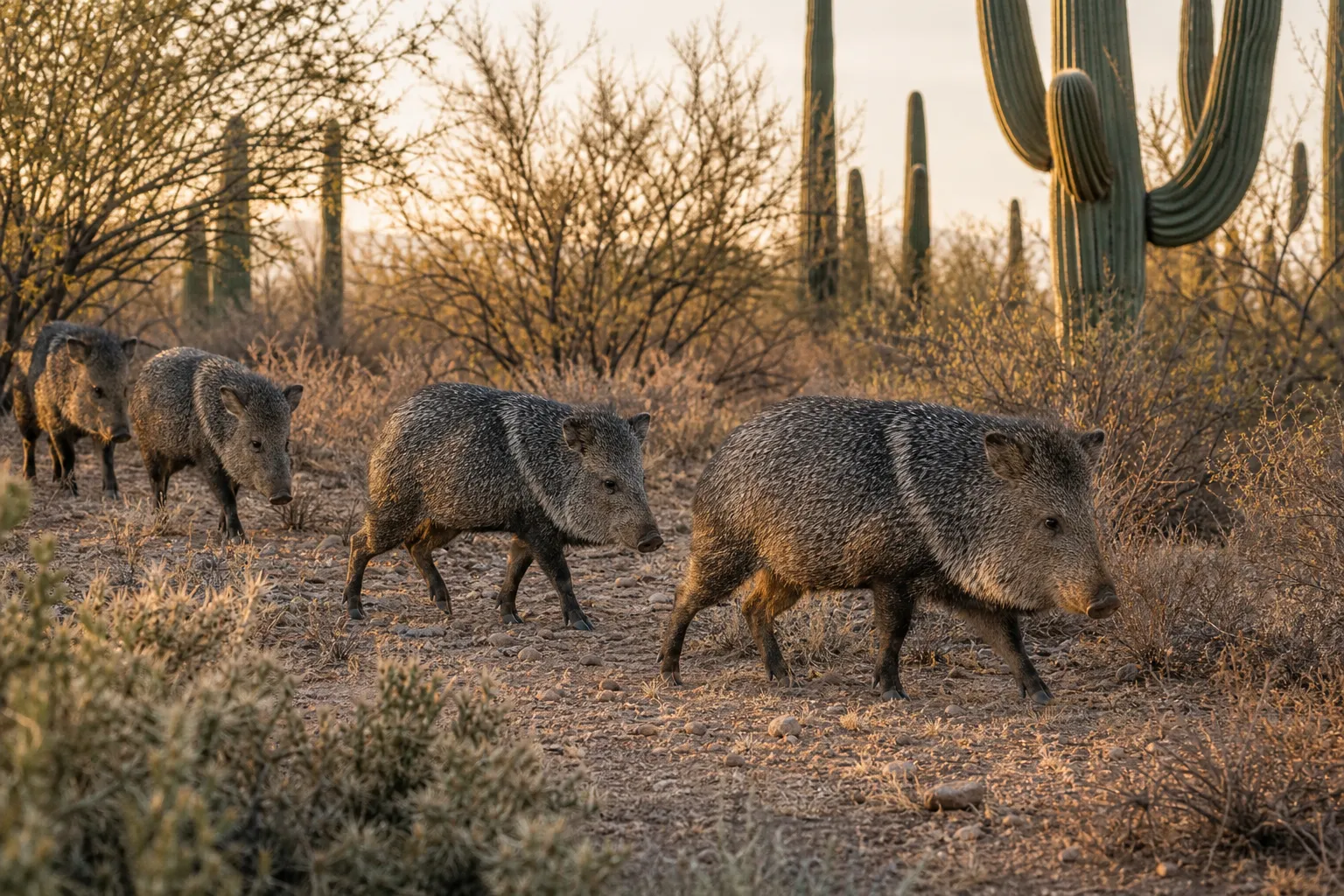
A javelina is the collared peccary. It looks pig-like, but the National Park Service, Texas Parks and Wildlife and Smithsonian all describe peccaries as separate from true pigs. For hunters, hikers and residents in the Southwest, the key points are simple: identify the pale collar, expect herd behavior, do not feed them, be cautious around dogs, and give any javelina room to leave.
What a javelina is
The National Park Service identifies the javelina as the collared peccary. Texas Parks and Wildlife notes that feral hogs are true pigs while javelina belong to a separate mammal family.
Smithsonian explains the broader split this way: peccaries are pig-like mammals in the family Tayassuidae and are found only in the Americas, while pigs and boars are in the family Suidae and are found in Eurasia and Africa.
That matters in the field because javelina are not just small pigs with a different name. They have their own body shape, social behavior, scent system and range.
Javelina vs pig: the practical differences
Texas Parks and Wildlife lists several field marks that help separate javelina from feral hogs. Javelina are smaller, have an unnoticeable tail, have only one dew claw on the hind foot, have a scent gland near the base of the tail, and have a grizzled grayish coat with a white band of hair around the shoulder or collar.
Big Bend National Park also lists traits that differ from pigs, including three toes on the hind foot, scent glands, a complex stomach, no gall bladder, a short tail and no sweat glands.
| Feature | Javelina clue |
|---|---|
| Family | Peccary family, not true pig family, according to Texas Parks and Wildlife |
| Tail | Short or unnoticeable tail, according to Texas Parks and Wildlife and Big Bend National Park |
| Hind foot | Three toes on the hind foot, according to Big Bend National Park |
| Dew claw | One dew claw on the hind foot, according to Texas Parks and Wildlife |
| Scent gland | Scent gland near the base of the tail, according to Texas Parks and Wildlife |
| Digestion | Complex stomach and no gall bladder, according to Big Bend National Park |
| Social unit | Herd or band behavior, described by Saguaro National Park and Big Bend National Park |
How to identify a javelina
Saguaro National Park describes javelina as about 18 inches tall, 32 to 36 inches long and 40 to 60 pounds.
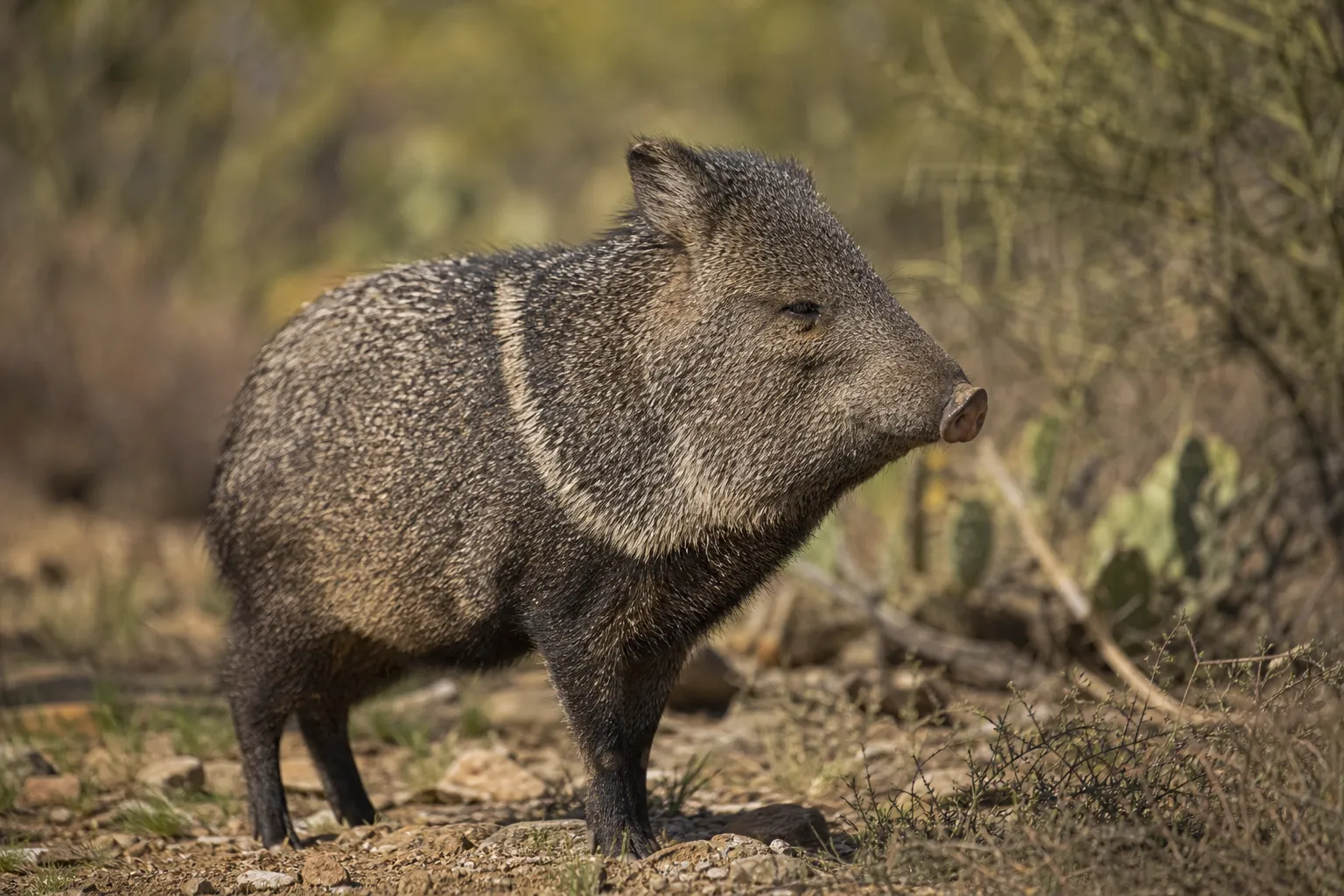
The classic field mark is the collar. Saguaro National Park describes the coat as coarse salt-and-pepper fur with a band of white around the neck that gives the appearance of a collar. Texas Parks and Wildlife describes a grizzled grayish coat with a white band of hair around the shoulder or collar.
Javelina also have a short tail, and it may be hard to notice. Saguaro National Park says they have an excellent sense of smell, average hearing and poor eyesight. That combination helps explain why a javelina may notice scent before it clearly sees what is nearby.
Herd behavior and scent
Javelina are social animals. Saguaro National Park says the herd is the basic social unit and reports an average of 12 individuals there. Big Bend National Park reports band sizes from five to 27 animals, with an average of 14 in the park.
Scent is central to javelina life. Saguaro National Park says a scent gland just above the short tail gives off a strong, musky odor. Members of a herd often stand head-to-rump and rub their necks on another herd member’s scent gland. Saguaro National Park says this lets herd members quickly identify one another or notice an odd-smelling stranger.
Javelina also mark territory. Saguaro National Park says herd members rub their scent glands on rocks, shrubs and trees.
For people, this means a strong musky smell can be a clue that javelina have been nearby. It also means a single javelina may not be alone. If you see one animal, look carefully from a distance before stepping closer.
Diet and daily activity
Saguaro National Park describes javelina as chiefly vegetarian. Their foods include desert plants, cactus stems, pads and fruits, agave hearts, mesquite beans, jojoba nuts, roots and flowers. The park also says an occasional insect or bird egg may be added to the menu.
Texas Parks and Wildlife says prickly pear cactus is more than half of the diet on most ranges. Texas Parks and Wildlife also lists mesquite beans, juniper berries, wild grapes, ground cherries, desert gourds, green plants, vines and grasses as supplemental foods.
Activity often follows temperature. Saguaro National Park says javelina are active during the cooler parts of the day, and in summer that means early morning and early evening. For hikers and residents, dawn and dusk are times to pay extra attention near washes, cactus patches and natural desert edges.
Range in Arizona, New Mexico and Texas
The National Park Service gives the broad range of the collared peccary as south to Argentina and north to Texas, New Mexico and Arizona. In the United States, Arizona, New Mexico and Texas are the main states covered in this guide.
Arizona
The National Park Service includes Arizona in the northern part of the collared peccary range.
New Mexico
The National Park Service includes New Mexico in the northern part of the collared peccary range.
Texas
Texas Parks and Wildlife places javelina in the western part of Texas and the brush country of South Texas. Big Bend National Park is an official National Park Service example of javelina habitat in western Texas.
Texas Parks and Wildlife also says javelina are fairly common in the southwestern counties of Northcentral Texas where prickly pear cactus and mesquite trees dominate the landscape.
Safety near homes
Saguaro National Park warns against hand feeding wildlife, saying it can cause animals to lose fear of humans and may encourage them to aggressively seek people and food.
If javelina are in a yard, avoid trapping them in a tight space. Texas Parks and Wildlife says javelina normally retreat unless cornered or startled. Giving them an open way out is safer than forcing a close encounter.
Safety on trails and around dogs
Texas Parks and Wildlife says javelina are normally not aggressive toward humans and usually retreat unless cornered or startled. Saguaro National Park adds that a javelina can act aggressively if it feels cornered or is protecting young, especially around people or pets.
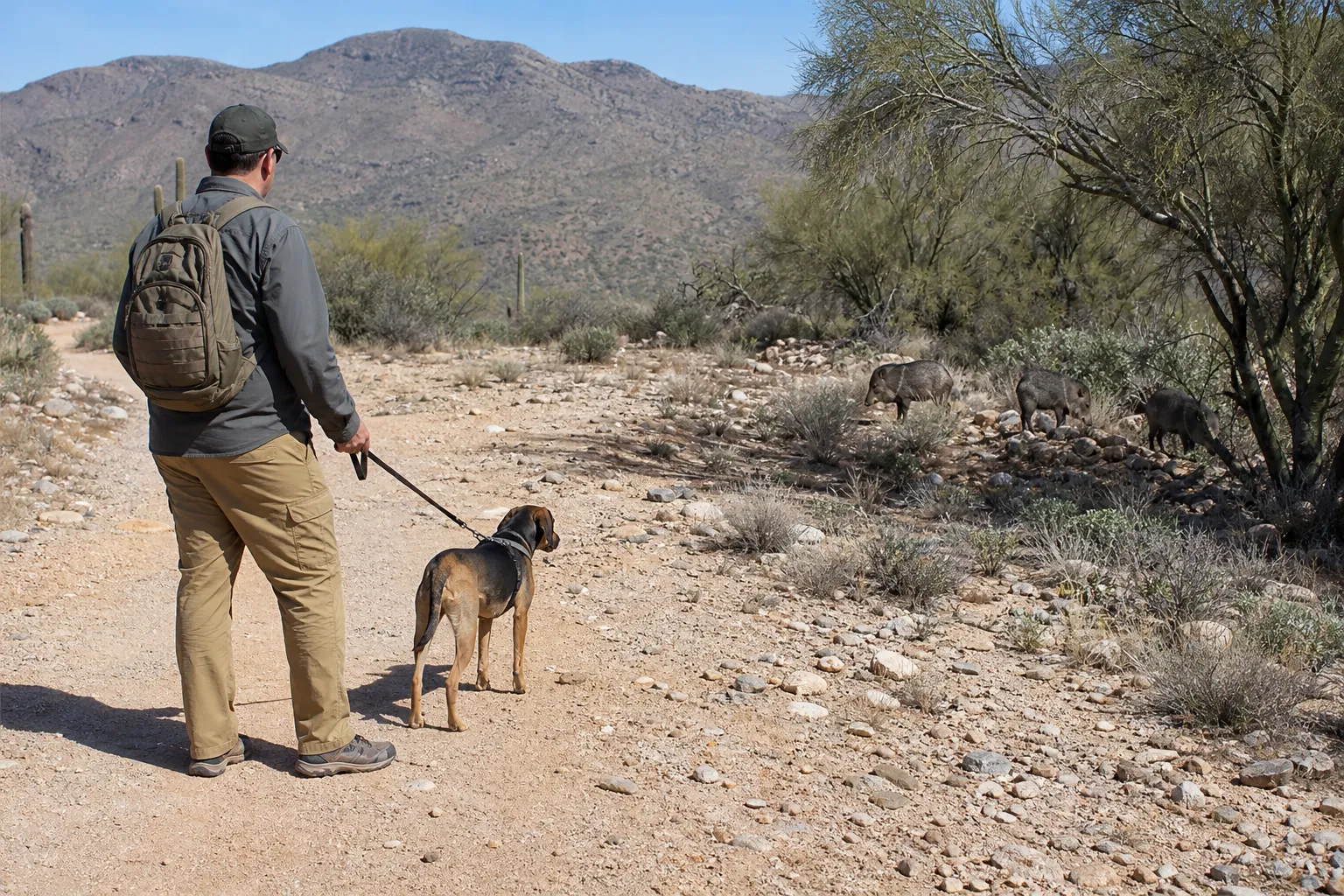
Dogs deserve special caution. A close encounter around a pet can raise the risk of aggressive behavior, so keep distance and move away early.
Do not approach young javelina. Saguaro National Park tells visitors to leave baby javelina alone because the mother was likely frightened away by a human approach and will return after people leave.
The best viewing plan is distance. Saguaro National Park recommends watching javelina from a distance with binoculars or using a telephoto lens for photos.
Quick field checklist
Use this checklist when you see a pig-like animal in javelina country:
- Look for the pale collar on the neck or shoulders.
- Notice the short or unnoticeable tail.
- Expect more animals nearby, since javelina travel in herds or bands.
- Keep dogs close and give javelina space.
- Do not feed the animal.
- Give it a clear escape route if it is near a wall, fence, yard corner or narrow trail.
- Watch from a distance, especially if young animals are present.
For local situations, check current guidance from the appropriate wildlife agency or park office, such as Arizona Game and Fish, New Mexico Department of Game and Fish, Texas Parks and Wildlife, or National Park Service staff for the specific park you are visiting.
Frequently asked questions
Is a javelina a pig?
No. The National Park Service says javelina are often mistaken for pigs but are in a different family. Texas Parks and Wildlife also describes javelina as separate from true pigs.
How can I identify a javelina?
Look for a low, stocky animal with coarse salt-and-pepper fur, a pale collar around the neck or shoulders, and a short or unnoticeable tail. Saguaro National Park lists adults at about 18 inches tall, 32 to 36 inches long and 40 to 60 pounds.
Why do javelina smell musky?
Saguaro National Park says a scent gland just above the short tail gives off a strong, musky odor. Javelina use scent rubbing to recognize herd members and mark territory.
Where do javelina live in the United States?
The National Park Service gives the northern part of the range as Texas, New Mexico and Arizona. Texas Parks and Wildlife places them in western Texas and the brush country of South Texas.
Are javelina dangerous to people?
Texas Parks and Wildlife says javelina are normally not aggressive toward humans and usually retreat unless cornered or startled. Saguaro National Park says they can act aggressively if cornered or protecting young, especially around people or pets.
What should I do if I see javelina while walking my dog?
Keep distance, keep your dog close and move away early. Do not let the dog approach.
Sources
- Living with Javelina, Arizona Game and Fish DepartmentOfficial source. Accessed October 23, 2026.
- Javelina, Arizona Game and Fish DepartmentOfficial source. Accessed October 23, 2026.
- Feral Hogs vs. Javelina, Texas Parks and Wildlife DepartmentOfficial source. Accessed October 23, 2026.
- Javelinas, Introducing Mammals to Young Naturalists, Texas Parks and Wildlife DepartmentOfficial source. Accessed October 23, 2026.
- Cross Timbers Habitat, Big Game, Texas Parks and Wildlife DepartmentOfficial source. Accessed October 23, 2026.
- Javelinas, National Park Service, Big Bend National ParkOfficial source. Accessed October 23, 2026.
- Javelina, National Park Service, Saguaro National ParkOfficial source. Accessed October 23, 2026.
- 8 Reasons Why Zoo Staff Think the Chacoan Peccary Might Be Your New Favorite Animal, Smithsonian's National Zoo and Conservation Biology InstituteOfficial source. Accessed October 23, 2026.
- Unprotected Species, New Mexico Department of Game and Fish / New Mexico Department of Wildlife websiteOfficial source. Accessed October 23, 2026.
- New Mexico Wildlife, Volume 62 Number 2, Winter 2020, New Mexico Department of Game and FishOfficial source. Accessed October 23, 2026.
- New Mexico Wildlife Corridors Action Plan, June 2022, New Mexico Department of Transportation, with wildlife agency citationsOfficial source. Accessed October 23, 2026.