Exit Pupil Explained: Why the Bright Circle in a Scope or Binocular Matters
Exit pupil is the bright circle of light leaving a scope or binocular eyepiece. It helps explain brightness, low light use and forgiving eye position, but it is only one part of optical performance.
By RaiS. Reviewed by RaiS. Published . 8 min read.
Research and drafting were assisted by AI. RaiS checked the facts against the sources below and approved this page.

Exit pupil is the small bright circle of light you see in a scope or binocular eyepiece when the optic is pointed at a bright surface. In practical terms, it is the beam of light leaving the ocular lens and entering your eye. You calculate it by dividing the effective objective diameter in millimeters by magnification, so an 8x42 binocular has about a 5.3 mm exit pupil. Bigger can help in low light and can make eye position more forgiving, but your own pupil, glass quality, coatings and optical design all limit what the number can tell you.
What exit pupil means
Nikon defines exit pupil as the bright circle visible in the center of each binocular eyepiece when the binocular is held about 30 cm from the eyes and pointed toward a bright light.
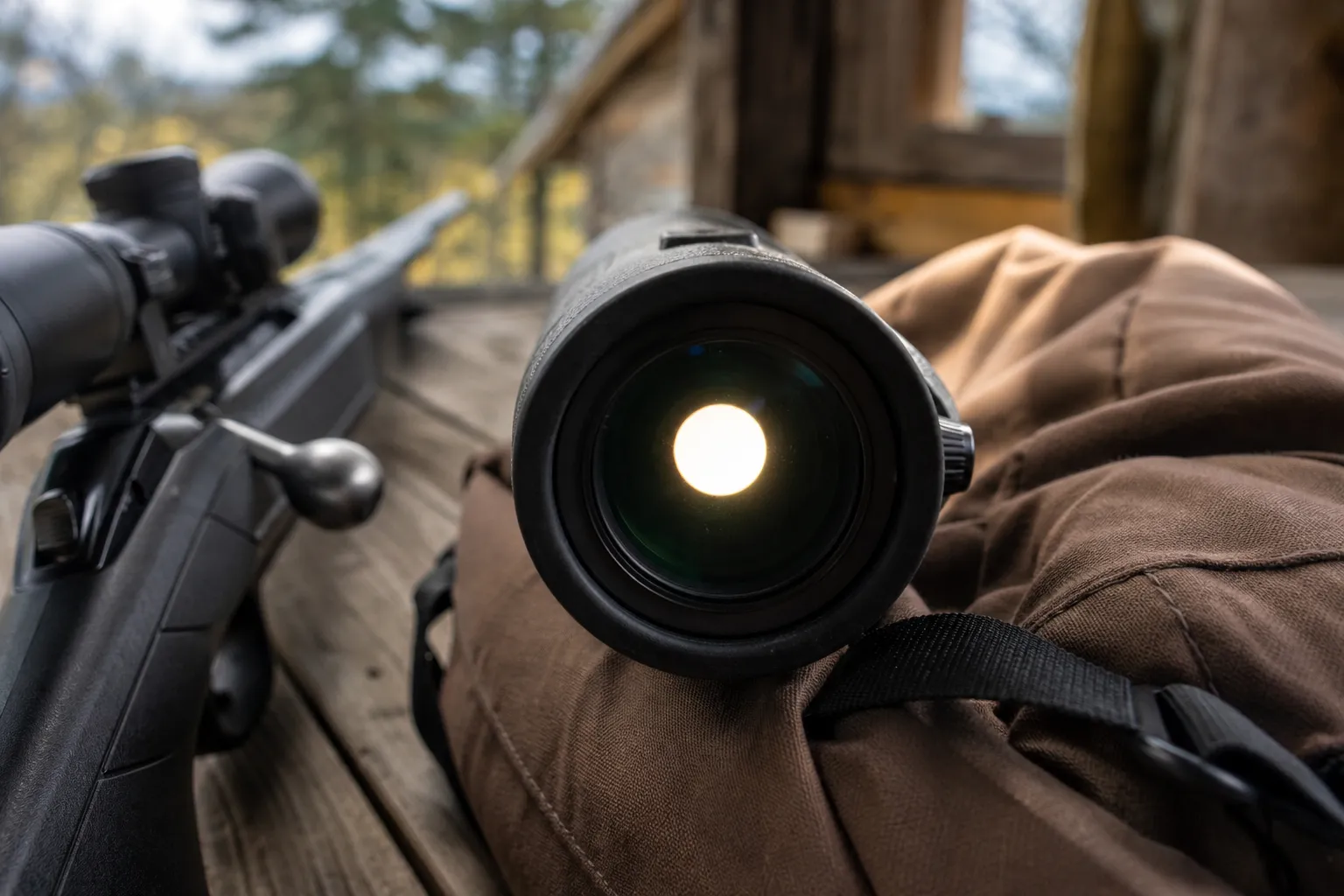
Leupold defines exit pupil diameter as the width of the beam of light between the ocular lens and the user’s eye. ZEISS describes it as the diameter of the luminous flux exiting binoculars.
For a beginner, the easiest way to picture it is this: the objective end gathers light, the optic forms an image, and the eyepiece sends a small round beam toward your eye. That round beam is the exit pupil.
It is also tied to where your eye must be. University of Arizona optics lecture notes state that the eye should be placed at the telescope exit pupil to couple the eye and instrument properly. When the eye is in the exit pupil, the entire field of view is seen. If the eye is not at that position, vignetting can result.
How to calculate exit pupil
Nikon gives the basic formula this way: exit pupil equals effective objective diameter divided by magnification.
Formula:
exit pupil in millimeters = effective objective diameter in millimeters ÷ magnification
Common examples:
| Optic example | Calculation | Exit pupil |
|---|---|---|
| 8x42 binocular | 42 ÷ 8 | 5.3 mm |
| 7x50 binocular | 50 ÷ 7 | about 7.1 mm |
| 10x42 binocular | 42 ÷ 10 | 4.2 mm |
| 10x30 binocular | 30 ÷ 10 | 3 mm |
| 50 mm riflescope at 10x | 50 ÷ 10 | 5 mm |
Nikon’s 8x42 example gives 42 ÷ 8 = 5.3 mm. Nikon’s 7x50 low light example gives 50 ÷ 7 = 7.1 mm. ZEISS gives the same kind of comparison when it says an 8x56 binocular has a 7 mm exit pupil, while a 10x30 binocular has a 3 mm exit pupil. Vortex gives a riflescope example: a 50 mm objective at 10x has a 5 mm exit pupil.
For variable power riflescopes, exit pupil changes as magnification changes. Vortex also notes that lowering magnification helps in low light situations because exit pupil increases.
That is why a variable scope can look easier and brighter at a lower setting than it does at the top of its zoom range, assuming the same lighting and the same optic.
Exit pupil, brightness and the human eye
Exit pupil matters because only the light beam that enters your eye can contribute to the image you perceive. ZEISS states that only the part of the luminous flux that enters the eye contributes to perceived brightness.
Your eye pupil changes size with light. Cleveland Clinic says pupils constrict in bright light and dilate in darkness to let in more light. Cleveland Clinic gives normal pupil size as 2 to 4 mm in bright light and 4 to 8 mm in dim light. Nikon’s binocular examples use about 2 to 3 mm for the human pupil in bright conditions and 7 mm in a low light example.
This leads to a simple rule: the optic’s exit pupil can only help if your eye can use it. ZEISS states that the eye pupil must be at least as large as the binocular exit pupil to take full advantage of the emerging light intensity. The University of Arizona optics lab similarly states that the exit pupil should ideally match, or be slightly larger than, the user’s eye pupil.
In bright daylight, a very large exit pupil may not make the view look brighter. ZEISS gives the example that if the user’s pupil is only 2 to 3 mm during the day, the 7 mm exit pupil of an 8x56 binocular cannot be fully used. The University of Arizona optics lab explains that if the eye pupil is smaller than the instrument exit pupil, the eye becomes the aperture stop and some objective diameter is wasted.
In dim light, the opposite problem can appear. Nikon’s low light example says an 8x20 binocular has a 2.5 mm exit pupil and will be perceived as dark when the human pupil is 7 mm. Nikon compares that with a 7x50 binocular, which has a 7.1 mm exit pupil, about the same size as a 7 mm human pupil.
For hunters, this is why exit pupil often comes up in dawn and dusk discussions. ZEISS says that for dawn use, the binocular exit pupil should be as large as possible but not less than 4 mm.
Bigger is not always brighter
A larger exit pupil can be useful, but it does not automatically mean that one optic will look better than another. Nikon states that the larger the exit pupil diameter is, the brighter the viewfield is, especially in dark situations and astronomy. Nikon also warns through its relative brightness explanation that brightness values do not exactly match brightness over the naked eye because the eye pupil limits how much light is effective.
Other parts of the optic matter too. Celestron states that binocular image brightness depends on objective lens diameter, optical transmission through lenses and prisms, coatings and magnification. Vortex states that optical design, lens quality and coatings are most important for low light performance and can matter more than a larger objective bell. Leupold warns that twilight factor does not account for glass or coating quality, so it should not be treated as a complete low light performance indicator.
That means exit pupil is a helpful comparison number, not a complete optical test. Two optics with the same calculated exit pupil may not look the same if their transmission, coatings, prisms, glass quality or optical design differ.
Objective size also has tradeoffs. Nikon’s glossary defines objective diameter as the effective aperture of the front lens frame and says larger objectives increase resolving power and image brightness, but larger objective lenses make binoculars heavier.
For a hunter comparing specifications, exit pupil should sit beside the rest of the optic’s information, not replace it. If you are still learning what numbers like 8x42 mean, see our guide to binocular numbers.
Eye position and a forgiving view
Exit pupil also affects how easy it is to stay behind the optic. ZEISS says that if the exit pupil is larger than the pupil of the eye, the theoretical brightness is not fully used, but the eye still has a certain amount of flexibility.

That flexibility matters when your hands move, your head position changes, or you are trying to settle quickly behind a scope or binocular. A larger exit pupil can make it easier to keep the full image because your eye has more room to stay within the light beam.
University of Arizona lecture notes state that close matching of the instrument exit pupil and eye pupil requires precise alignment, and small displacements change the image light level. In plain English, if the exit pupil is very close to your eye pupil size, small head or hand movements can make the image dimmer or partially blocked.
This is related to, but not the same as, eye relief. Nikon defines eye relief as the distance between the eyepiece and the eyepoint, where correct eye placement lets the viewer see the whole field of view without vignetting. Exit pupil is the beam size. Eye relief is the distance where your eye needs to be to see the full field. For a deeper look at that distance, see eye relief explained.
If your eye is too far off the correct position, you may see black rings, dim edges or a cut off image. Nikon uses the term vignetting for the loss of the whole field when the eye is not placed correctly at the eyepoint, and University of Arizona lecture notes state that vignetting can result when the eye is not at the exit pupil.
How to use exit pupil when comparing optics
Start with the formula, then think about the conditions where you will actually use the optic.
For bright daylight, Nikon and ZEISS both describe human pupil sizes around 2 to 3 mm in bright conditions. In that situation, a large exit pupil may give more positioning flexibility, but your eye may not use the full light beam for brightness.
For dim light, Cleveland Clinic’s normal dim light pupil range of 4 to 8 mm helps explain why small exit pupils can look dark. ZEISS recommends that dawn binocular use have an exit pupil as large as possible but not less than 4 mm.
For variable riflescopes, remember that turning magnification up makes exit pupil smaller when objective diameter stays the same. Vortex states that lowering magnification helps in low light situations because exit pupil increases. That is a practical reason to compare not only the maximum magnification, but also how the scope behaves at the power settings you expect to use.
Exit pupil is most useful as a quick filter. It tells you whether an optic is likely to deliver a wide or narrow light beam to your eye. It also helps explain why some optics feel easier to look through than others. But it cannot rank products by itself, and it cannot account for glass quality, coatings, prisms, transmission or the full optical design.
Bottom line
Exit pupil is the diameter of the light beam leaving the eyepiece. Calculate it by dividing effective objective diameter by magnification. A larger exit pupil can help in dim light if your eye pupil is large enough to use it, and it can make eye placement more forgiving.
Do not treat exit pupil as a single score for low light performance. When comparing scopes and binoculars, also check objective size, magnification, optical transmission, coatings, prism design where relevant, glass quality, eye relief and how the optic fits your use at dawn, dusk and daylight.
Frequently asked questions
What is exit pupil in a scope or binocular?
Exit pupil is the small bright circle or beam of light leaving the eyepiece and entering your eye. Nikon describes it as the bright circle visible in each binocular eyepiece when the binocular is pointed toward a bright light, and Leupold defines it as the width of the beam of light between the ocular lens and the user’s eye.
How do you calculate exit pupil?
Divide the effective objective diameter in millimeters by magnification. Nikon gives this formula, and its 8x42 example is 42 ÷ 8 = 5.3 mm. Vortex gives a riflescope example: a 50 mm objective at 10x has a 5 mm exit pupil.
Does a bigger exit pupil always mean a brighter image?
No. A bigger exit pupil can help in low light, but only the part of the light beam that enters your eye contributes to perceived brightness. ZEISS states that the eye pupil must be at least as large as the optic’s exit pupil to use the emerging light intensity fully.
Why can a high magnification scope look darker?
Because exit pupil is calculated by dividing objective diameter by magnification, higher magnification gives a smaller exit pupil when objective diameter stays the same. Vortex also states that lowering magnification helps in low light situations because exit pupil increases.
Is exit pupil the same as eye relief?
No. Exit pupil is the beam size leaving the eyepiece. Nikon defines eye relief as the distance between the eyepiece and the eyepoint, where correct eye placement lets the viewer see the whole field without vignetting.
What exit pupil is useful for dawn or dusk hunting?
ZEISS says that for dawn use, binocular exit pupil should be as large as possible but not less than 4 mm.
Sources
- Exit pupil | Basic Information about Binoculars, Nikon Consumer, Sport OpticsOfficial source. Accessed November 3, 2026.
- Glossary of binocular terms, Nikon Consumer, Sport OpticsOfficial source. Accessed November 3, 2026.
- More things to consider when investing in new glass, Part 3: Exit pupil, ZEISS HuntingOfficial source. Accessed November 3, 2026.
- OPTI 202L, Geometrical and Instrumental Optics Lab, Binoculars, University of Arizona College of Optical Sciences. Accessed November 3, 2026.
- OPTI-502 Optical Design and Instrumentation I, Magnifiers and Telescopes, University of Arizona College of Optical Sciences. Accessed November 3, 2026.
- Dilated Pupils (Mydriasis), Cleveland Clinic. Accessed November 3, 2026.
- What Makes Great Low-Light Performance, Vortex OpticsOfficial source. Accessed November 3, 2026.
- What determines the brightness of the image in my binoculars?, CelestronOfficial source. Accessed November 3, 2026.
- Riflescope Owner’s Guide, BushnellOfficial source. Accessed November 3, 2026.
- Glossary, LeupoldOfficial source. Accessed November 3, 2026.
- Binoculars 101, Rocky Mountain Elk Foundation. Accessed November 3, 2026.